

Spontaneous combustion: a UK guide to self-heating fires at work
Spontaneous combustion is when a material heats itself, through slow chemical or microbial reactions, faster than the heat can escape, until it reaches its ignition temperature and catches fire with no spark or flame. In UK workplaces the usual culprits are oily rags, oil-contaminated laundry left to cool in a pile, and large or long-stored piles of wood chip, waste, compost, hay and pellets. Prevent it with metal lidded bins, dryer cool-down cycles, short storage, small separated piles and temperature checks. AI on existing CCTV can add early visual warning out of hours, but never replaces temperature monitoring.

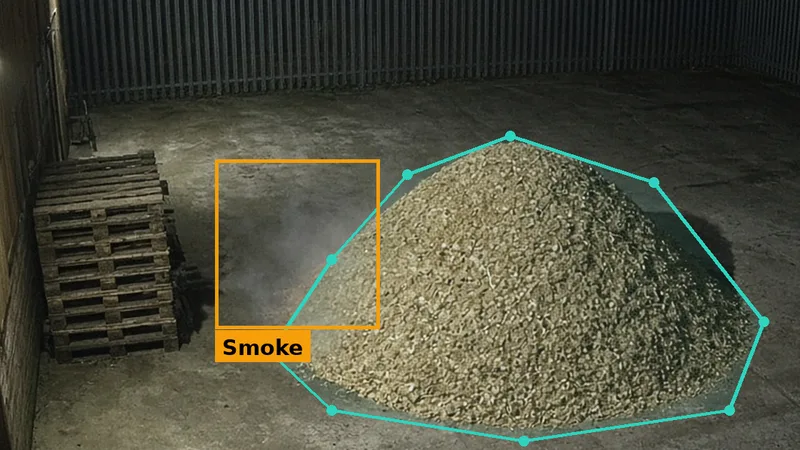
Last updated 3 November 2026. Most fires need something to start them: a spark, a flame, a hot surface, a fault, or a person. Spontaneous combustion is different. A material that can heat itself does so slowly, out of sight, until it is hot enough to smoulder and then burst into flame. There is no spark to find and often no one in the building. The pile of rags in a workshop bin, the stack of hot towels in a laundry room, the heap of wood chip in a yard and the stockpile of baled waste all have one thing in common: the heat is coming from inside them.
This guide explains spontaneous combustion and self-heating fires for UK businesses that store or handle materials that can self-heat. It is written for site and operations managers, facilities managers, health and safety leads, owners of small businesses such as joiners, decorators, salons, gyms, hotels and restaurants, and the people who run waste, recycling, wood and compost sites under an environmental permit. It covers what self-heating is, which materials do it, what the Environment Agency expects on permitted sites, nine real UK fires from 2026, a checklist, and where cameras fit.
We make AI detection for existing CCTV cameras: smoke and flame, and people and vehicles. Near the end we explain where that fits alongside temperature monitoring and fire alarms, and where it does not. To be clear from the start: a camera cannot see heat building up inside a pile or a bag of laundry. It can only see smoke or flame once they appear. Video smoke and flame detection does not replace temperature probes, thermal checks, good storage, a fire alarm or any other precaution in your fire risk assessment or fire prevention plan. What it can add is an early visual warning in the hours when nobody is there to see the first smoke, with a clip so a person can check for themselves.
If you want to go deeper, we have separate guides on waste site fire risk assessment, fire prevention plans, flammable storage, commercial kitchen fire safety and outdoor fire detection. This page is about self-heating itself: why it happens, where it happens and how to stop it turning into a fire.
What is spontaneous combustion?
The Environment Agency puts it simply in its guidance on fire prevention plans. Many materials can self-combust under certain conditions. Self-combustion happens when a material that can self-heat generates heat faster than it can lose it to its surroundings. The temperature keeps rising until it reaches the material's auto-ignition temperature, and then the material ignites. The Agency adds that you can prevent it by carefully managing storage times, pile sizes and heights, and the temperature of the material.
That one idea, heat made against heat lost, explains almost every self-heating fire. A single oily cloth hung on a line will warm a little as its oil reacts with the air, but the heat escapes as fast as it is made and nothing happens. Screw a dozen of the same cloths into a ball and put them in a bin, and the cloths in the middle are insulated by the cloths around them. The heat stays in. As the temperature rises, the reaction speeds up, which makes more heat, which raises the temperature further. Eventually the middle of the ball is hot enough to smoulder.
One thing that surprises people is how low the temperatures involved can be. East Sussex Fire and Rescue Service notes that rags soaked in linseed oil can reach their ignition point at only about 120 degrees. That is not far above the temperature of a hot tumble dryer drum, and it is reached without any outside source of heat at all. In one Environment Agency case study, laboratory tests on a sample of pre-crushed waste wood found a critical ignition temperature of 107°C. Self-heating does not need a furnace. It needs time and insulation.
Three ways materials heat themselves
The materials that self-heat in UK workplaces fall into three rough groups, each heating up in a slightly different way. Knowing which group your material is in helps you understand what makes it worse and what makes it safer.
Drying oils. Linseed oil and similar oils do not dry the way paint does, by a solvent or water evaporating. East Sussex Fire and Rescue Service explains that they dry by oxidation, the same kind of chemical reaction as burning, only much slower, and that reaction gives off heat. On a table top the heat is lost to the air straight away and the surface never even feels warm. On a pile of rags, the cloth acts as an insulator. The British Coatings Federation names linseed oil-based products, alkyds (both solvent-borne and water-borne) and coatings containing drying oils as the most common materials involved. Cooking oils, massage oils and other oils that soak into cotton can do something similar when the textiles are heated in a dryer and then left in a heap.
Microbes in damp organic matter. Freshly cut grass, damp hay and straw, green waste and compost are alive with bacteria and fungi. As they feed, they give off heat, which is why a compost heap is warm in the middle. In most cases the heat levels off and falls away. But if the material is damp enough, packed tightly enough and big enough, the temperature can climb past the point the microbes can survive, and chemical reactions take over. Avon Fire and Rescue Service explains that wet hay is more of a fire risk than dry hay, and that internal temperatures above 55°C trigger a chemical process that produces combustible gases.
Slow oxidation of fines, wood and other materials. Some materials react slowly with oxygen in the air even when they are dry. Fine particles have far more surface area for air to reach than large pieces, so they react faster. The Environment Agency tells permitted sites to reduce the proportion of fines in stored waste and the amount of exposed metal, because exposed metals can oxidise and generate heat, and fine particles are more prone to self-combustion. The Health and Safety Executive notes that stored bulk piles of wood pellets can self-heat in parts with high moisture contents, and that this can lead to spontaneous combustion after a long period of time.
Why it happens hours, days or months later
The other thing that makes self-heating dangerous is the delay. The material is put away safely, the site is locked up, and the fire starts later, often much later, when nobody is there to see it.
For oily rags and laundry, the delay is usually hours. The British Coatings Federation warns that cleaning rags, paper wipes and protective clothing contaminated with products containing more than 10% air drying oils, or high oil content binders, may self-ignite some hours later. Laundry that comes out of a tumble dryer hot and is folded straight into a pile can start to smoulder during the evening or overnight, as several of the 2026 fires later in this guide show.
For damp hay, Avon Fire and Rescue Service says heating is likely within three to seven days in hay above 15% moisture, and Devon and Somerset Fire and Rescue Service says most hay fires happen within six weeks of baling. For big stockpiles of waste, wood or compost, the Environment Agency treats three months as the point at which extra measures are needed at maximum pile sizes, and six months as the normal storage limit for combustible waste. In its case study, the wood sample took an estimated 200 days to reach ignition in the laboratory, which is why the operator's plan to store it for no more than 120 days was accepted.
Which materials can self-heat?
Almost any organic material can self-heat in the wrong conditions, but in UK workplaces a short list of materials causes most of the trouble. The table below groups them by where you are likely to meet them. If your business stores any of these, warm, oily, damp or in bulk, self-heating should be in your fire risk assessment.
The Environment Agency's guidance lists the combustible wastes it expects permitted sites to manage, and gives separate pile size limits for wood, compost and green waste, refuse-derived and solid recovered fuel, plastics, paper and cardboard, textiles and rubber. Not all of these self-heat in the same way or to the same degree, and some, such as plastics and rubber, are on the list mainly because of how fiercely they burn once alight. But wood, compost and green waste, fuels made from waste, paper and textiles can all heat up in large, long-stored piles.
Away from waste sites, the most common culprits are smaller and much closer to home. Rags and cloths used to apply oil-based products are the classic example, and fire services issue warnings about them every year. Laundry that has been in contact with oil is the other, and in 2026 it has been behind fires in a London fitness club basement, a London flat and several laundrettes. Hay and straw are a well-known risk on farms and at equestrian yards, and wood pellets are a risk wherever they are stored in bulk for biomass boilers.
Oily rags and linseed oil
Oil-soaked rags are the textbook case of spontaneous combustion, and the one fire services warn about most. The British Coatings Federation, the UK coatings trade body, published an updated safety note on spontaneous combustion in September 2026. It describes spontaneous combustion as the ability of certain materials to ignite without any ignition source such as a flame, spark or heat. When materials soaked with these products are left exposed to the air and the heat they generate cannot get away, the oxidation of the product can make enough heat to pass the ignition temperature of the rags, filters or other combustible materials.
The Federation lists the materials most often involved as linseed oil-based products, alkyds and coatings containing drying oils, and the usual places for it to happen as rags, paint filters, masking tape, paint scrapings and other materials soaked with the product or carrying a build-up of it. Its key warning is that cleaning rags, paper wipes and protective clothing contaminated with products containing more than 10% air drying oils, or high oil content binders, may spontaneously self-ignite some hours later.
East Sussex Fire and Rescue Service gives one of the clearest explanations. You would never see a piece of furniture spontaneously combust, it says, because the oil oxidises in open air and the surface never even gets warm to the touch. But a pile of oil-soaked rags can. As the oil oxidises, the rags act as an insulator, letting the oxidising oil become hot enough to make the cloth smoke and eventually ignite. The bigger the pile, the greater the possible heat and the greater the risk. Temperature is also a factor: the warmer it is, the quicker the rags reach ignition temperature. The service says that ignition point can be only about 120 degrees.
Northamptonshire Fire and Rescue Service described a typical case in 2020. A pile of linseed oil-soaked cloths had been used earlier in the day, folded up and put away. Later, a chemical reaction made them smoke. Crews were called to a bad smell of smoke and found a box of smouldering cloths with the remnants of linseed oil on them. The service explained that the heat has to be able to escape faster than the reaction makes it, otherwise the temperature eventually becomes high enough for the cloths to combust. In April 2026, the York Press reported that fire crews had been called to a fire which arose from linseed oil rags in a home in York. These are homes, not workplaces, but the chemistry is exactly the same in a workshop bin.
At work, the risk is highest wherever oils, stains and oil-based finishes are used regularly. Joinery and furniture workshops oil and stain timber every day. Decorators, floor finishers, spray shops and maintenance workshops all build up oily rags, filters or wipes. In each case the danger is the same: rags gathered together, out of sight, after the people who used them have gone home.
How to deal with oily rags safely
The British Coatings Federation says that, to avoid the risk of fires, all contaminated materials should be removed from indoor areas after use and stored outdoors in one of four ways. In metal containers with tight-fitting, self-closing lids. Laid out flat in a well-ventilated area, in a single layer, to dry. Placed in a metal container with a tight-fitting lid and soaked in water. Or washed out well with warm soapy water, at 40°C or more, before disposal. It also recommends that heavily soiled rags and clothing are submerged in water inside metal containers with tight-fitting lids.
Just as importantly, the Federation says contaminated rags should not go in regular waste containers, and that linseed oil and rags contaminated with it should not be put in general household waste because of the environmental and fire hazards. It suggests checking with your local household waste recycling centre, because policies on accepting specific hazardous materials vary. For a business, that usually means agreeing with your waste contractor how oily rags will be collected, and keeping them in a proper container until then. East Sussex Fire and Rescue Service adds that oily rags should never be thrown into a closed container or a pile where they cannot dry out.
Oily laundry and tumble dryers
If oily rags are the textbook case, oily laundry is the one catching businesses out in 2026. The story is nearly always the same. Towels, tea towels, tablecloths or uniforms that have been in contact with oil are washed and then tumble dried on a hot cycle. They come out hot, are folded and stacked on a shelf or in a basket, and the staff go home. Hours later, the pile is smouldering.
On 25 October 2026, four fire engines and around 25 firefighters from the London Fire Brigade were called to a fire at a fitness club with homes above it, on Queensway in Bayswater. A small part of the basement was damaged. There were no reports of injuries. The Brigade said the fire was believed to have been accidental and was caused by self-heating of textiles in a tumble dryer. Crews were mobilised from four stations after the first of three calls at 13:27, and the fire was out by 14:31.
The Brigade's spokesperson explained what usually lies behind fires like this. They often involve textiles that have become contaminated with oil, most commonly linseed, massage and cooking oil on tea towels, tablecloths and chef whites. When materials are cleaned and put in tumble dryers, the heat from the drying sometimes cannot escape, and this can lead to a temperature high enough to build up to a point where the laundry smoulders and eventually ignites. The Brigade's advice is to check the manufacturer's cleaning recommendations for your textiles, to always use the cooling cycle when drying on a hot cycle, and to let the heat dissipate properly before stacking laundered items together.
The same Brigade gave the same warning in January 2026, after a fire in a first-floor flat on Crescent Lane in Clapham. Four engines and around 25 firefighters attended, and two women were treated for smoke inhalation. That fire, too, was caused by self-heating of textiles in a tumble dryer. The danger is not limited to business premises, but it is far greater where oily textiles are washed in bulk, every day.
Laundrettes have seen several of these fires this year. At 2.23am on 10 February 2026, Essex County Fire and Rescue Service was called to Lower Queen's Road in Buckhurst Hill after a resident in a first-floor flat smelled burning and called 999. Crews saw a small amount of smoke coming from a vent and found a fire in a room at the back of a laundrette. The watch manager said the only explanation was that a pile of clothes had been tightly packed together after drying, and that the heat, combined with contaminants such as oils and a lack of air flow, had caused it to ignite. He praised the resident who raised the alarm, adding that it is always worth calling 999 if you see smoke or smell burning.
Five months later, on 15 July 2026, the same service was called just after 11pm to a laundrette on Gold Street in Saffron Walden, after passers-by saw flames and heard smoke alarms sounding. Crews had the fire out within half an hour. The station manager said they believed the fire had started in a pile of towels, tightly packed together after drying, and that once again heat, oil contaminants and a lack of air flow had caused them to ignite. He thanked the passers-by who raised the alarm.
In June 2026, the Chester Standard reported a fire in a bag of laundry at a commercial laundry on Charles Street in Chester. Two firefighters wearing breathing apparatus put it out with hose reel jets. The owner told the paper that someone had brought in greasy tea towels from a restaurant for a wash and dry, and that they thought the towels had spontaneously combusted after the heat of the dryer. Their lesson, they said, was that anything greasy or oily needs real care, including items with massage oils.
Which businesses are most at risk
Essex County Fire and Rescue Service makes an important point in its tumble dryer advice: items like towels and tea towels can contain higher volumes of oils and fat even after washing, which increases the risk of combustion if they are not cooled down. That is why the advice focuses on cooling as much as on washing.
Timing is the other thread. The two London fires broke out in the middle of the day, when people were around. The two Essex laundrette fires did not: the first calls came at 2.23am in Buckhurst Hill and just after 11pm in Saffron Walden. Both were spotted by people outside the business, by smell or by the sight of flames and the sound of smoke alarms, not by anyone on the premises. The laundry had been dried, stacked and left, and the heat built up after the last person had gone. Our guide to commercial kitchen fire safety covers the wider fire risks in food businesses, including extraction and cooking fires.
Laundry controls that make a difference
The fire service advice for oily laundry is consistent and simple, and most of it costs nothing. The most important single step is to let the tumble dryer finish its cool-down cycle at the end of the programme. If your dryer does not have one, Essex County Fire and Rescue Service says to take the items out as soon as the cycle ends. Hot clothes, especially tea towels and cottons, can ignite if they are packed together while still hot, so spread them out and let them cool before folding and stacking.
Beyond that, it is worth separating heavily oily items from the rest, washing them on a hot wash with a detergent suited to removing oil and fat, and following the textile maker's cleaning advice, as the London Fire Brigade suggests. Many businesses make a rule that the dryer is never left running after the last member of staff has gone, and that nothing goes from the dryer straight onto a shelf. Keeping lint filters and ducts clean removes a separate but common source of dryer fires.
Waste, wood chip and compost stockpiles
At the other end of the scale from a bin of rags is the stockpile: hundreds of cubic metres of wood chip, shredded waste, baled fuel or green waste, stored in the open or in a building for weeks or months. Big piles insulate themselves, and their cores can heat up for a long time before anything shows on the outside. When a stockpile fire does take hold, it can burn deep inside the pile for days.
Dorset and Wiltshire Fire and Rescue Service describes the problem plainly in its guidance for waste and recycling sites. These sites carry a high risk of fire because they hold vast amounts of material, which is often compacted. Those conditions can let heat build up naturally within a stack of waste and, in certain circumstances, it will spontaneously combust. The service explains that it can take many thousands of gallons of water to put out a fire that is deep-seated in a waste stack, that the water becomes contaminated, and that such fires are very often left to burn out under control, with smouldering areas turned over daily.
In England, sites with an environmental permit that store combustible waste usually need a fire prevention plan approved by the Environment Agency. The Agency's guidance, last updated in January 2021, sets three objectives: to minimise the likelihood of a fire happening, to aim for a fire to be put out within four hours, and to minimise the spread of fire within the site and to neighbouring sites. It says minimising the likelihood of a fire is the highest priority. Because self-heating is one of the main ways fires start on these sites, a large part of the guidance is about preventing it. Our fire prevention plan checklist walks through the whole plan; here we focus on the self-heating parts. Wales, Scotland and Northern Ireland have their own regulators and guidance, but the principles below are widely used.
Storage time
The first control is time. The Environment Agency says a fire prevention plan must define the maximum storage time of all materials on site and how it will be controlled and monitored, using good stock rotation and a clear method to record and manage the storage of all waste. Combustible wastes must be stored for less than six months, unless the material is compost and the Agency has agreed a longer period. Storing combustible waste for longer could increase both the likelihood and the duration of a fire.
Three months is the other key number. The Agency says that if you store combustible waste in the maximum pile sizes for longer than three months, you must show what extra measures you will use to prevent self-combustion, such as monitoring temperatures in the waste, because at those maximum dimensions the possibility of self-combustion increases after three months. Sites must also show how they will manage seasonal changes in supply and demand so that waste is still stored for no longer than six months, plan for the reasonable worst case of storing waste longer over the summer months, and plan for planned and unplanned shutdowns. In practice, this is where many sites run into trouble: an outlet closes, material backs up, and piles get bigger and older than intended.
For baled waste stored for more than three months, such as refuse-derived fuel, cardboard and paper, the plan must set out a sampling and testing protocol that assesses a representative number of bales, at least 10%, and must get representative temperature readings from the centre of the bales and from bales in the centre of a pile. The Agency also asks for bales to be turned, and for bays to work on a first in, first out basis.
Pile size, height and separation
The second control is size. The Agency says small piles with appropriate separation are safer than one big one, and that sites must store waste in its largest form for as long as practicable, because treating waste to reduce its particle size can increase the risk of self-combustion. Shredding, chipping and crushing all create fines, and fines heat up more readily.
The guidance then sets maximum pile volumes for each type of waste, in three bands of particle size: loose pieces over 150mm, pieces of 30 to 150mm or baled, and pieces under 30mm. For wood, the limits are 750, 450 and 300 cubic metres. For compost and green waste, outside the active composting process, they are 750, 450 and 450. Refuse-derived and solid recovered fuel is limited to 450 cubic metres at every size. Paper and cardboard are 750, 750 and 450, and textiles 750, 750 and 400. Whatever the material, no pile can be more than 4 metres high or more than 20 metres long or wide.
Separation matters as much as size. The Agency says combustible waste piles must be at least 6 metres apart, with at least 6 metres between waste and the site perimeter, any buildings and other combustible or flammable materials. Higher calorific materials may need more space or fire walls, and fire walls and bays can be used to reduce the distances. If a pile does self-heat and catch fire, that gap gives crews room to work, stops the fire spreading to the next pile and gives loaders space to pull burning material apart. The guidance also requires a quarantine area, big enough to hold at least half the volume of the largest pile with 6 metres around it, so that burning or threatened waste can be moved there as soon as possible and at most within one hour of a fire starting.
Managing heat in the pile
The third control is temperature. For waste stored for more than three months, the Agency says the plan must show how heat will be controlled to prevent self-combustion. That means reducing exposed metal and fines in the waste, letting heat generated by shredding, chipping or producing crumb escape so that waste is cool before it goes into a pile, and monitoring the temperature of the pile with a probe or other suitable device.
Sites must explain the triggers they will use, which may include temperature, the rate of temperature change over time, or visual signs of heating, and the actions they will take in response, including training staff to find and manage hotspots. Piles must be turned routinely so the waste stays cold and any local warming is dissipated quickly. The Agency is frank about the limits of surface checks: surface temperature monitoring is unlikely to give an accurate temperature at the core of a pile, though it can help identify local self-heating and show unusual temperature rises over time.
Weather plays a part too. The guidance asks sites to explain how they will check for outside heating of waste during hot and dry weather, with examples such as shading waste from direct sunlight where practicable, letting heat escape from the waste, monitoring temperatures more often, keeping storage times short, rearranging the site layout and moving or covering reflective surfaces so sunlight does not reflect onto the waste. The summer of 2026 brought several outdoor fires that local fire services linked to hot weather, as the next part of this guide shows.
The Agency's published case studies show how this works in practice. In one, an operator wanted to store pre-crushed waste wood in piles bigger than the standard maximum for 120 days. Because more than 10% of a sample was smaller than 100mm, and smaller pieces can promote self-heating, the operator had the wood tested in a laboratory. The tests gave a critical ignition temperature of 107°C and a time to ignition of 200 days. As the wood would be stored for no more than 120 days, the Agency accepted that mass self-heating would not happen in that time. But visual screening of incoming wood had shown that batteries and oily rags still ended up in the wood stacks, so the operator still had to deal with hotspots. It proposed a thermal imaging system with a trigger of 75°C; the Agency considered a maximum trigger of 50°C appropriate.
In another case, an operator storing processed wood proposed using a temperature probe and a hand-held thermal imaging camera, with a trigger of 50°C, at the end of each working shift. If a reading reached 50°C, the pile would be dismantled and moved to the quarantine area to cool. Outside working hours, a security guard patrolled the site and used a hand-held thermal camera to watch the piles for any rise in temperature. That last detail is a reminder that the Agency expects someone, or something, to be watching when the site is closed.
Detecting a fire when the site is closed
Section 13 of the guidance covers detection. Sites must have procedures to detect a fire in its early stages, and must show in their plan how the detection system will raise the alarm if a fire is detected both during working hours and when the site is closed. The system must be proportionate to the activities and risks, and can be automated or manual. The Agency lists examples of suitable automated systems: smoke and heat detectors including temperature probes; CCTV visual flame detection systems; and spark, infrared and ultraviolet detection. Design, installation and maintenance must be covered by an appropriate third-party certification scheme such as UKAS, or meet a recognised standard such as a British Standard, or the operator must show it can still meet the three objectives.
The guidance also requires security measures against arson, such as security fencing, intruder alarms and CCTV, with arrangements for outside working hours, and asks operators to describe where the CCTV and alarms are. Many permitted sites therefore already have cameras looking over their stockpiles. Whether those cameras can count towards detection depends on the system, its certification and what your regulator and insurer accept. Our waste site fire risk assessment guide and our page on fire detection for waste and recycling sites go into this in more depth.
Wood pellets and biomass fuel
Biomass boilers have brought bulk wood pellet and wood chip stores to schools, farms, hotels, leisure centres and industrial sites. The Health and Safety Executive explains that wood pellets are made from sawdust and wood shavings that are dried, milled and compressed. Stored bulk piles of pellets can self-heat in parts with high moisture contents, and this can lead to spontaneous combustion after a long period of time. The HSE also warns that pellets oxidise to produce carbon monoxide and carbon dioxide, which can build up to dangerous levels in an enclosed store, so nobody should go into a pellet store or hopper without proper training and confined space precautions.
For anyone running a fuel store, the self-heating advice is the same as for any stockpile: keep the fuel dry, rotate stock, avoid long storage of large volumes, watch for warmth, smells and smoke, and make sure a fire in the store would be noticed out of hours. Our page on biomass fuel store fire detection covers stores and boiler houses in more detail.
Hay, straw and green waste
Hay is the oldest known case of spontaneous combustion, and it still causes barn fires every summer. Avon Fire and Rescue Service makes the point that, understandably, most people think dry hay is the bigger fire risk. In fact it is wet hay that can spontaneously combust, if its moisture content is more than 22%. Internal temperatures above 55°C trigger a chemical process that generates combustible gases, and if the stack stays at that heat or keeps warming, those gases can catch fire. Heating is likely within three to seven days in hay above 15% moisture, but usually does not reach dangerous levels and should settle over the following weeks.
Avon recommends keeping moisture between 18% and 22% for small rectangular bales and between 16% and 18% for larger round or rectangular bales. It notes that heating hay has a distinctive smell, which may be like caramel or quite musty, and that if you notice it, it is time to start checking the temperature with a probe. Devon and Somerset Fire and Rescue Service adds that most hay fires happen within six weeks of baling, and advises keeping stacks apart so a fire in one does not spread to the next.
Avon's temperature guide is a useful model for any business that stores organic material, even though it was written for hay. At 65°C, check the temperature daily. At 70°C, check it every four hours. At 80 to 85°C, wet the hay and remove it from the barn, or move it away from other dry hay and buildings. At 100°C, it is likely the hay will ignite if it has not already: evacuate safely and call 999 immediately. The service also warns never to walk on top of a stack you think is heating, because pockets inside can burn away and leave a crust of hay that can collapse into the fire beneath. Our farm fire safety guide covers hay, straw and other farm fire risks in more detail.
Green waste and garden waste behave in a similar way, and hot weather can make things worse. On the afternoon of 27 June 2026, firefighters from Cheshire Fire and Rescue Service were called to a fire in the open near Moston Road, Chester, involving around 10 square metres of garden waste and two gas cylinders. The service said it was thought the materials had spontaneously combusted in the hot weather, and crews were on scene for around three hours. A heap of green waste is a small version of the compost windrows found on composting sites, where the Environment Agency's storage rules apply.
Warning signs that something is heating up
Self-heating usually gives some warning before it becomes a fire, if someone is there to notice. The trouble is that the warning signs are easy to miss, easy to mistake for something harmless, and often appear when nobody is around.
Smell. A burning smell is often the first sign. In the Buckhurst Hill laundrette fire in this guide, the alarm was raised because a neighbour smelled burning, and in a 2020 Northamptonshire case crews were called to a bad smell of smoke from a box of linseed oil cloths. Heating hay can smell sweet like caramel, or musty. Heating compost and green waste can smell sour. Treat any unexpected burning smell as a reason to check, and as the Essex watch manager said, it is always worth calling 999 if you see smoke or smell burning.
Steam, haze and smoke. A pile that is warmer than the air around it will often give off vapour, especially on a cold morning. On a compost site this is normal. On a pile of wood chip, baled waste or stored fuel, it may be the first visible sign of heat, and a pale haze can turn to grey smoke as the material starts to smoulder. In a laundry room, a faint haze or a smell of hot fabric from a stack of towels is a clear warning.
Warmth. A bag of laundry, a bin of rags or a bale that feels warm to the touch some time after it was put away is heating. On a stockpile, a probe reading that keeps rising, or a rise faster than usual, is the trigger the Environment Agency expects sites to act on, along with any visual signs of heating.

Change. A pile that slumps, sinks in one area or shows dark, charred patches when it is turned has been burning inside. When a loader pulls a heating pile apart, the inside is often blackened or glowing, and exposing it to air can make it flare up, which is why the Environment Agency expects a planned response and a quarantine area. Never try to dig into a large heating pile on your own. Get help, and if there is any sign of fire, call 999 first.
Nine UK self-heating fires in 2026
To show how common these fires are, and where they happen, we gathered reports of fires in 2026 where the fire service or local reports said self-heating or spontaneous combustion was the believed cause, plus two large wood and chip fires where no cause had been given. We have not named any businesses. The causes below are as stated in the reports at the time, and fire investigations can change.
Clapham, London, 8 January. Four fire engines and around 25 firefighters were called to a fire in a first-floor flat on Crescent Lane. Two women were treated for smoke inhalation. The London Fire Brigade said the fire was caused by self-heating of textiles in a tumble dryer.
Buckhurst Hill, Essex, 10 February. A resident in a flat above a laundrette smelled burning at 2.23am and called 999. Crews found a fire in a back room. They believed a pile of clothes tightly packed after drying had ignited because of heat, oil contaminants and a lack of air flow.
York, 8 April. The York Press reported that fire crews were called to a fire which arose from linseed oil rags in a home in York.
Chester, June. Firefighters in breathing apparatus put out a fire involving a bag of laundry at a commercial laundry on Charles Street. The owner said greasy tea towels from a restaurant had been washed and dried and were thought to have spontaneously combusted after the heat of the dryer.
Near Chester, 27 June. Around 10 square metres of garden waste and two gas cylinders caught fire in the open near Moston Road. Cheshire Fire and Rescue Service said it was thought the materials spontaneously combusted in the hot weather.
Saffron Walden, Essex, 15 July. Passers-by saw flames and heard smoke alarms at a laundrette on Gold Street just after 11pm. Crews believed the fire started in a pile of towels tightly packed after drying.
Henlade, near Taunton, 16 July. The BBC reported that Devon and Somerset Fire and Rescue Service crews from five stations were called at about 00:24 to a large blaze involving 200 tonnes of wood and wood chip at a manufacturing business on Ilminster Road. Residents and businesses nearby were told to keep windows and doors closed. The report did not give a cause. We include it to show the scale of a wood and chip fire, not as a confirmed case of self-heating.
Near Great Heck, North Yorkshire, 29 September. North Yorkshire Fire and Rescue Service was called at 23:41 to a fire at a wood recycling plant, where one of the unprocessed wood piles was alight. The BBC reported that the fire had grown to 50 metres by 30 metres and could burn for a number of days, with smoke visible from the M62. No one was hurt. Again, the report did not establish a cause.
Bayswater, London, 25 October. Four fire engines and around 25 firefighters were called at 13:27 to a fire in the basement of a fitness club with homes above, on Queensway. There were no reported injuries. The London Fire Brigade said the fire was believed to have been accidental and caused by self-heating of textiles in a tumble dryer.
What the 2026 fires have in common
Three lessons stand out. First, most of these fires involved ordinary materials handled in ordinary ways: towels dried and stacked, rags put away, garden waste left in a heap on a hot day. Nobody did anything that felt dangerous at the time. The precautions that would have prevented them, a cool-down cycle, a metal bin, a smaller heap in the shade, are simple and cheap.
Second, timing. Of the fires above where a time was given, four were called in between 11pm and half past two in the morning: the two Essex laundrettes, and the two big wood fires at Henlade and Great Heck. Self-heating takes time, so it often reaches the point of smoke and flame hours after the last person has left. In the two laundrette fires, the alarm was raised by a neighbour who smelled burning and by passers-by who saw flames. Had the businesses been on an industrial estate with no flats above and nobody walking past, the fires could have burned much longer.
How to prevent self-heating fires
The good news is that almost every self-heating fire is preventable with simple, well-understood controls. The bad news is that those controls only work if they are followed every day, including the busy day, the short-staffed day and the day before a bank holiday. The checklist below pulls together the advice from the sources in this guide, by material.
Oily rags, wipes and filters. Follow the British Coatings Federation advice. Take them out of the building after use. Store them outdoors in a metal container with a tight-fitting, self-closing lid, or lay them flat in a single layer in a well-ventilated place to dry, or soak them in water in a lidded metal container, or wash them in warm soapy water at 40°C or more. Never put them in a general waste bin, a bag, a cardboard box or a heap. Agree with your waste contractor how they will be collected.
Oily laundry. Follow the London Fire Brigade and Essex County Fire and Rescue Service advice. Check the textile maker's cleaning recommendations. Let the dryer finish its cool-down cycle, or take items out as soon as the cycle ends if there is no cool-down. Spread hot items out and let the heat dissipate before folding and stacking. Never leave a dryer running, or a stack of freshly dried laundry, when nobody is on the premises. Keep lint filters clean.
Stockpiles of waste, wood, compost and fuel. Follow the Environment Agency guidance even if you are not a permitted site, because the principles are sound for anyone. Keep storage times short and rotate stock on a first in, first out basis. Keep piles small, low and well separated, at least 6 metres apart and from buildings and boundaries. Store material in its largest form for as long as you can. Let shredded or chipped material cool before piling. Monitor temperatures with probes, set triggers and act on them. Turn piles. Take extra care in hot, dry weather.
Bales. Rotate them, and if you store them for more than three months, sample at least 10% and take readings from the centre of bales and from bales in the centre of the stack. For hay, follow Avon's moisture and temperature guidance, and never stack hay that is too damp.
Pellets and chip. Keep fuel dry, rotate stock, avoid long storage of large volumes, and follow the HSE's advice on carbon monoxide and confined spaces before anyone enters a store.
Put it in your fire risk assessment
In England and Wales, the Regulatory Reform (Fire Safety) Order 2005 requires the responsible person for most non-domestic premises to carry out a suitable and sufficient fire risk assessment, and Scotland and Northern Ireland have similar duties. Self-heating materials are a fire hazard like any other, so if you store or handle them, your assessment should say so. List the materials that could self-heat, where they are kept and who handles them. Describe the controls, such as the metal bin, the cool-down rule or the storage limits. Say how a fire would be found and how the alarm would be raised, during the day and when the premises are empty. Review it whenever something changes, such as a new product, a new process, a new supplier or a near miss.
The most useful thing many small businesses can do is turn the controls into a closing-up routine that someone owns. At the end of every day, before the last person locks up, they check four things. Every oily rag is in the metal bin with the lid shut. Every dryer has finished and cooled, and nothing freshly dried is stacked up. Every pile in the yard has been looked at, its probe read and the reading logged. And the alarm is set, with any cameras armed for the night. It takes five minutes and prevents most of the fires in this guide.
What to do if you think something is self-heating
If you notice a burning smell, haze or smoke, or a pile, bale or bag that is unusually warm, take it seriously. The advice from fire services is consistent. Your safety comes first: do not climb onto a heating stack or pile, and do not dig into one on your own, because the inside may be burning and exposing it to air can make it flare up. If there is any sign of fire, such as smoke, flames or a strong burning smell, call 999 straight away. Warn anyone nearby and keep people away.
Only if you are trained, it is safe to do so and it is part of your plan, take action to isolate the material. For a bin of rags, that may mean moving it outside and soaking it. For laundry, it may mean spreading the items out to cool. For a stockpile, the Environment Agency expects a planned response, with trained staff, suitable machinery and a quarantine area where hot material can be moved and cooled. For hay, Avon's table says to wet the hay and move it away from other hay and buildings at 80 to 85°C, and to evacuate and call 999 at 100°C.
The out-of-hours gap
Every part of this guide comes back to the same problem. Self-heating takes time. The rags are put away in the afternoon. The towels come out of the dryer at closing. The pile is built on Monday and starts to heat the following month. By the time heat turns into smoke and flame, the people who could have seen it have usually gone home.
Inside buildings, a fire alarm system with automatic detection, linked to someone who will respond when the building is empty, deals with much of this gap. A smoke detector in a laundry room or workshop will often pick up smoke from a smouldering pile of towels or rags. But a fire alarm is only as good as the response to it. A sounder in an empty unit on an industrial estate at 2am may not be heard by anyone. Our guide to outdoor fire detection looks at the options in more detail.
Outside buildings, the gap is wider. Ordinary smoke and heat detectors are not designed for open yards, where smoke disperses and wind carries it away, so stockpiles, bin stores, skips and bale stacks in the open are often not covered by any automatic detection at all. Temperature probes give valuable readings, but on many sites they are read by hand at set times, and they only measure the spot where they sit. Hand-held thermal checks are done at the end of a shift or on a patrol, not continuously. Security guards and patrols help, but they cannot watch every pile all night.
Where AI on existing CCTV fits
Many of the places where self-heating fires start already have a camera pointing at them: the yard and its stockpiles, the bales waiting for collection, the bin store behind the workshop, the fuel store, the back door of the laundry. At 3am nobody is watching them. AI video detection watches for visible smoke and flame inside areas you choose, at the times you choose, and sends an alert with a snapshot and a short clip so a person can decide what to do.
We want to be precise about what this is and is not. A camera cannot see heat building up inside a pile, a bale, a bin or a bag of laundry. It can only see smoke or flame once they reach the surface and come into view. That means it will never give the earliest warning of self-heating: temperature probes, thermal checks, a nose and a hand on the bale will always find heat sooner, if they are used at the right time. Video smoke and flame detection does not replace temperature monitoring, storage limits, a fire alarm, a fire prevention plan or any other precaution your fire risk assessment, regulator or insurer requires. It does not sound your fire alarm or call the fire service. It is an extra layer of early visual warning.
What it adds is coverage of the hours between checks. A probe read at 17:30 and again at 07:30 leaves fourteen hours in which a pile can start to smoke. In the yard, where ordinary smoke detectors do not work well, a camera that already looks over the piles can watch them all night and alert someone with a clip as soon as visible smoke appears, so the fire is found while it is still small. The Environment Agency lists CCTV visual flame detection among the automated detection options for permitted waste sites, alongside smoke and heat detectors and temperature probes, provided the system meets the certification or standard requirements in its guidance.
If you are considering it, talk to your fire risk assessor, your insurer and, for permitted sites, the Environment Agency or your regulator first. Ask whether it would help with the risks in your assessment or plan, and make sure your arrangements do not come to rely on it in place of temperature monitoring or a fire alarm. Our guides to video smoke detection on existing CCTV and outdoor fire detection explain how it works in more detail.
Where it can help
The places where camera detection adds most are outdoor or out-of-the-way spots where self-heating materials are stored and nobody is around at night. Choose an area below to see how a zone might be set up. Each image is a camera view with a zone drawn over the area to watch.
Which area?
Bales of refuse-derived fuel, paper, cardboard or plastics are often stored for weeks or months before shipment, and the Environment Agency expects temperature sampling of bales stored for over three months. A camera that already looks over the bales can watch a zone drawn over the stack and send an alert with a clip if visible smoke or flame appears at night, between temperature checks.
Smoke and flame, out of hours
Compost windrows and green waste piles steam as part of the normal process, especially on cold mornings, so camera detection here needs careful set-up and review to tell normal vapour from smoke. It is most useful for watching stored green waste and finished material out of hours, as an addition to the temperature checks the site already does.
Smoke and flame, with care
For a joinery, decorator, floor finisher or spray shop, the outdoor metal bin store for oily rags is the place a self-heating fire is most likely to start, usually in the evening. A camera covering the bin store can watch a small zone after the workshop closes. It adds a warning; it does not replace the metal bins and the closing-up routine.
Smoke and flame, after closing
Each area needs its own zone and schedule.
Other places worth considering include open stockpiles of wood chip and shredded waste (as in the picture at the top of this page), quarantine areas, skips, biomass fuel stores and the outside of laundry rooms, where smoke may first be seen at a vent, as it was at Buckhurst Hill.
The limits of camera detection
Every detection method has limits, and camera detection is no exception. A camera can only see what is in its view: heat deep inside a pile, smoke inside a closed room, or smoke behind a stack will not be seen until it comes into view. A deep-seated fire in a large pile can smoulder for a long time before smoke shows. Cameras need enough light, or infrared, to see at night, and very thin smoke in the dark is harder to see.
What about false alerts?
Self-heating sites have a particular challenge: steam. Compost, green waste and warm stockpiles often give off vapour, especially on cold mornings, and vapour can look like smoke. Dust, headlights, low sun and mist can too. Good set-up keeps them down. Tight polygon zones cover the piles, not the whole view. Schedules arm zones only when the yard should be quiet. Clean lenses and steady lighting help, and a self-learning system gets better over time at knowing what is normal for each camera, including the usual morning steam. Reviewing alerts after the first week or two, and adjusting zones, makes a big difference.
A worked example
Here is how this might look for the fictional joinery and wood recycling firm in the picture at the top of this page. It is an example, not a real business. It chips offcuts and old pallets in the yard and sells the chip as fuel. The chip pile is kept within the size and separation limits the firm follows, and a temperature probe in the pile is read at the start and end of each day. Oily rags from the finishing shop go into lidded metal bins in a store behind the workshop.
After a conversation with its fire risk assessor and insurer, the firm adds smoke and flame detection to two existing cameras. One zone is drawn over the chip pile, armed from 17:30 to 07:00. Another covers the rag bin store, armed from 17:30.
One night in late summer, after a long spell of hot weather, the probe reading at 17:30 is a little higher than the day before, but below the firm's trigger, and the pile is noted for turning in the morning. At 03:14, a thin wisp of grey smoke starts to rise from one flank of the pile. The camera zone sees the smoke, and within a minute the alert reaches the yard manager on call, with the clip. He can see smoke coming from the pile, calls 999 and tells the fire service exactly where it is.
Crews arrive and, with the firm's loader driver, pull the pile apart and damp down the hot core. The next week, the firm reviews what happened with its assessor and insurer. It lowers its temperature trigger, makes the chip piles smaller in summer, and moves more chip off site sooner. The camera did not stop the pile heating. It meant the fire was found at 03:14 by the firm, not at dawn by a passer-by.
How Woodcock AI fits
Woodcock AI connects to existing IP cameras and runs on an edge server on site or on a cloud server. It adds smoke and flame detection, and people and vehicle detection, to the cameras you already have. You draw polygon detection areas over the places that matter, choose when they are armed and who gets the alerts. Each alert has a snapshot, a short clip and an AI description of what the camera saw. Our smoke and fire detection page and how it works page show more, and our waste and recycling, wood recycling and biomass fuel store pages show how it is used in those settings.
Woodcock AI is self-learning, so it gets better over time at knowing what is normal on each camera, including the steam and dust of a working yard. It is the result of years of development and is now in use on real sites in the UK. It works alongside your temperature checks, fire alarm, fire risk assessment, fire prevention plan and people rather than replacing them. Ask your cameras (Coming soon, early 2027) will let you ask questions about what your cameras have seen in plain words.
Ways to start
Book a site assessment. We look at what your cameras see by day and after dark, and show where zones would help, such as stockpiles, bale bays, windrows, fuel stores and bin stores. Or ask for a live test on your cameras: we connect two or three of your existing cameras for about a fortnight, so you can see the alerts for yourself. We are also happy to arrange an on-site demo.
Sources
- Environment Agency, Fire prevention plans: environmental permits, updated 11 January 2021 (sections 1, 7, 8, 9, 11, 12 and 13); Fire prevention plans: case study examples of alternative measures, updated 11 January 2021.
- British Coatings Federation, Guidance on spontaneous combustion for the general public, HS 019, September 2026, version 2A (technical publications).
- East Sussex Fire and Rescue Service, The fire hazards of linseed oil; Northamptonshire Fire and Rescue Service, Warning to home improvers about oil cloth combustion risks, 23 June 2020.
- Health and Safety Executive, Wood pellet fuels; Dorset and Wiltshire Fire and Rescue Service, Waste and recycling sites.
- Avon Fire and Rescue Service, Farm fires; Devon and Somerset Fire and Rescue Service, Storing hay safely.
- Regulatory Reform (Fire Safety) Order 2005 (legislation.gov.uk).
- Reports of 2026 fires: London Fire Brigade, Clapham and Bayswater; Essex County Fire and Rescue Service, Buckhurst Hill and Saffron Walden; York Press, York; Chester Standard, Chester and near Chester; BBC News, Henlade and Great Heck.
We have summarised these sources in our own words and checked them on 3 November 2026. This guide is general information, not fire safety advice for your premises. Causes of the 2026 fires are as stated in the reports at the time. The Environment Agency guidance applies to permitted sites in England; Natural Resources Wales, SEPA and the Northern Ireland Environment Agency have their own rules. Your fire risk assessor, insurer, regulator and local fire and rescue service can tell you what applies to your site.
Is anything watching your piles, bins and bales at 3am?
Book a site assessment and we will look at what your cameras see by day and after dark, and show where smoke and flame zones would help over stockpiles, bale bays, windrows, fuel stores and bin stores, or ask for a live test on your cameras.
Related pages
- Waste site fire risk assessment
- Fire prevention plan checklist
- Farm fire safety
- Commercial kitchen fire safety
- Flammable storage fire safety
- Factory fire safety
- Outdoor fire detection
- Video smoke detection on existing CCTV
- Waste and recycling fire detection
- Biomass fuel store fire detection
- Smoke and fire detection cameras
- Book a site assessment
Frequently asked questions
What causes spontaneous combustion?
A material that can heat itself, through slow oxidation or the activity of microbes, makes heat faster than it can lose it. The temperature keeps rising until it reaches the material’s ignition temperature and it catches fire, with no spark or flame. The Environment Agency says it can be prevented by managing storage times, pile sizes and heights, and temperature.
Can oily rags really catch fire on their own?
Yes. Linseed oil, many stains and oil-based finishes dry by reacting with oxygen, which gives off heat. On a pile of rags the heat is trapped. The British Coatings Federation warns that rags and wipes with products containing more than 10% air drying oils may self-ignite some hours later. Store them outdoors in a lidded metal bin, lay them flat to dry, soak them in water or wash them at 40°C or more.
Why do towels catch fire after tumble drying?
Towels, tea towels and uniforms can hold oil, such as cooking, massage or linseed oil, even after washing. A hot dryer warms the oil and speeds up its reaction, and if the items are stacked while hot, the heat cannot escape. The London Fire Brigade advises always using the cool-down cycle and letting heat dissipate before stacking laundry.
How long can waste be stored before it self-heats?
It depends on the material, its size and the weather. For permitted sites, the Environment Agency says combustible waste must be stored for less than six months, and that extra measures such as temperature monitoring are needed after three months at maximum pile sizes. Piles must be no more than 4 metres high and at least 6 metres apart.
What are the warning signs of self-heating?
An unusual smell, such as burning, caramel or musty, steam or haze from a pile or bag, warmth to the touch or a rising probe reading, and slumping or charred patches. Do not climb on or dig into a heating pile. If there is any sign of fire, call 999. As one fire service said in 2026, it is always worth calling 999 if you see smoke or smell burning.
Can AI on CCTV detect spontaneous combustion?
Not the heating itself. A camera cannot see heat inside a pile, bale or bag. AI on existing CCTV can watch for visible smoke and flame once they appear, out of hours, and send an alert with a clip. It adds early visual warning between temperature checks and never replaces them. Woodcock AI runs on an edge server on site or on a cloud server.
Last reviewed 3 November 2026