

Commercial kitchen fire safety: a UK guide for restaurants, takeaways, pubs, hotels and canteen kitchens
Commercial kitchen fire safety means preventing, detecting and controlling fires in kitchens that cook for the public or staff. The essentials are safe frying, extract canopies, filters and ducts cleaned to TR19 Grease, maintained gas and electrics, a suppression system and Class F extinguishers, a tested fire alarm, trained staff, safe bin and battery storage, and a close-down routine every night, all set by the fire risk assessment. AI on existing CCTV can add early sight after close, but never replaces any of these.

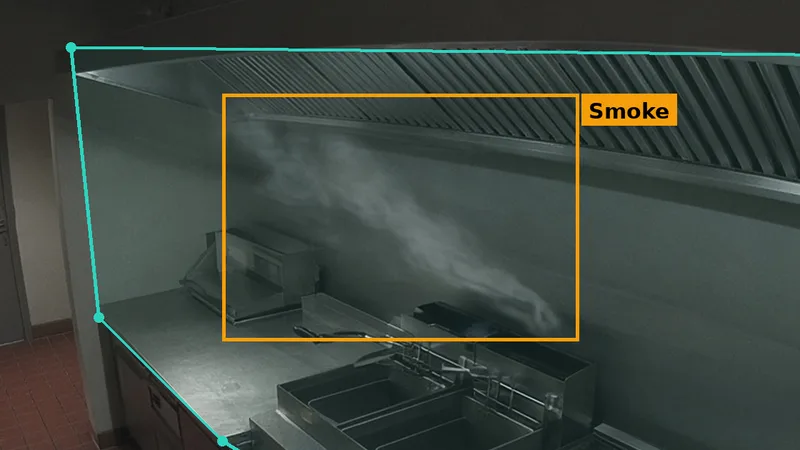
Last updated 3 November 2026. A commercial kitchen is one of the hardest-working rooms in any building. Fryers hold litres of oil at frying temperature for hours at a time. Grills, ranges and woks throw heat and fat into an extract canopy that runs up through the building to the roof. Gas and electricity feed the whole line. And at the end of the night, when the last plate goes out, the room is left to cool down, often with flats or hotel bedrooms above it, cardboard and bins at the back door and, at many takeaways, delivery e-bikes charging in a corner.
This guide explains commercial kitchen fire safety in the UK for the people who run those kitchens: owners and managers of restaurants, cafes and takeaways, licensees and managers of pubs, hotel operators and head chefs, and the facilities teams that look after staff canteens. It covers why kitchens catch fire, the role of the extract system and grease, the risks that remain once the kitchen has closed, the protection a kitchen needs, the law and guidance, a close-down checklist you can print, and where cameras fit. It is written for ordinary kitchens, from a two-fryer takeaway on a high street to a busy hotel kitchen.
We make AI detection for existing CCTV cameras: smoke and flame, and people and vehicles. Near the end we explain where that fits in a kitchen and where it does not, including the honest limit that cooking smoke and steam during service mean smoke zones are best armed after close. Be clear from the start: AI on cameras is an addition to your fire alarm, your suppression system, your extinguishers and your people. It never replaces them. Most of this page applies to any kitchen, with or without cameras.
If you want to go deeper on a single topic, we have separate guides on fire risk assessments, bin store fire safety, lithium-ion battery storage, hot works, pub security and hotel security. This page looks at the kitchen itself and shows how those pieces fit together around it.
What does commercial kitchen fire safety cover?
Commercial kitchen fire safety is everything you do to stop a fire starting in a kitchen that cooks for the public or for staff, to stop a fire spreading if one does start, and to make sure that people get out and the fire service is called quickly. In practice that means safe cooking and frying, a clean and well-maintained extract system, sound gas and electrical installations, good housekeeping, the right firefighting equipment, a fire alarm that works, trained staff, clear escape routes, and a close-down routine that leaves the kitchen safe for the night.
The hazards are much the same whatever the kitchen, but the setting changes how much is at stake. A restaurant kitchen may run two long services a day with grills, fryers and ovens all working at once. A takeaway may fry almost everything it sells and stay open late, often in a terraced unit with a flat above reached by a single staircase. A pub kitchen sits inside a building where the licensee may live upstairs, and a hotel kitchen sits below or beside bedrooms full of sleeping guests. A staff canteen may cook in large batches inside a much bigger office, factory or hospital, where a kitchen fire can close the whole building.
London Fire Brigade sums up the main causes of fire in restaurants, cafes and takeaways as cooking appliances, electrical installations, and fuels and chemicals. Behind those headings sit a handful of familiar stories: oil in a fryer that overheats or is left on, a pan left unattended, fat and grease that build up in the canopy and ductwork until something ignites them, hot charcoal or embers dumped in the wrong place, a tired electrical connection behind a fridge or a fryer, and rubbish that someone sets alight at the back door.
The other thing that shapes kitchen fire safety is time. During service, the kitchen is full of people who would see and smell a fire within seconds, and most cooking fires that start then are dealt with quickly by staff with a fire blanket, a wet chemical extinguisher or the suppression system. After close, the picture changes. The fryers are cooling, the extract may still be running, the grease is still in the ducts, and the people who would have noticed have gone home or gone to bed upstairs. Several of the 2026 fires later in this guide started in the small hours.
That does not make service safe. Two of the 2026 fires we describe began in the afternoon, both with hot oil in a fryer. Daytime risks are mainly about how people cook and how equipment is maintained. Night-time risks are about what is left behind, and whether anyone finds out in time. This guide covers both, starting with the figures.
How common are fires in commercial kitchens?
National statistics in England do not publish a simple count of kitchen fires in businesses on their headline pages, so it helps to start with the wider group they belong to. In the fire and rescue incident statistics for the year ending March 2026, fire and rescue services in England attended 13,679 fires in what the statistics call other buildings, meaning buildings that are not homes. That was 3.7 per cent more than the 13,193 the year before. Other buildings include shops, offices, factories, pubs, restaurants, takeaways and hotels, so kitchens are only part of the picture, but cooking is one of the familiar causes within it.
Those fires hurt people. There were 991 non-fatal casualties in other building fires in the year, 14 per cent of all non-fatal fire casualties in England and 7.7 per cent more than the year before. The detailed analysis for the same year found that 30 per cent of other building fires were larger fires, up from 26 per cent, while 22 per cent caused no fire damage at all. In other words, many fires in non-domestic buildings are caught early and put out with little harm, but a growing share are not.
Fire services see the same pattern in kitchens. Every year they attend a steady stream of fires in restaurants and takeaways, and the incident reports read alike: a fire in a ground-floor kitchen, fire in the ducting that runs to the roof, and families evacuated from the flats above. London Fire Brigade lists the main causes as cooking appliances, electrical installations, and fuels and chemicals. Its guidance on catering kitchen extract systems adds the one that turns a small fire into a big one: grease in the canopy, the plenum behind the filters and the ductwork.
Two more causes sit just outside the kitchen door. Waste, including cardboard, food waste and used cooking oil, is stored at the back of most kitchens and is a target for arson. And many takeaways now rely on delivery riders, some of whom charge e-bike batteries on or near the premises. The causes are ordinary. What makes them dangerous is the setting: heat, fat and fuel in one room, often with people asleep above.
Kitchen fires in 2026
Reports from fire services and local news show how these fires play out. We have left out business names; the point is the pattern, not the premises.
In the early hours of 7 February, two pub kitchens caught fire in different parts of England. In Ramsey, Cambridgeshire, crews from five stations were called at 02:45 to a fire in the kitchen area of a pub on the High Street; the fire was later found to be accidental. In Launceston, Cornwall, the 999 call came at 01:24 to a fire in the kitchen of a public house. More crews were called, it was made a four-pump fire, and it spread to the flat above before it was put out. That fire was also accidental. On 13 March, at 01:46, firefighters in Glasgow were called to a takeaway on the ground floor of a four-storey tenement on Hyndland Street, with four appliances and a height vehicle. Nobody was hurt.
In April, London Fire Brigade was called at 03:56 to a restaurant with flats above on Chapel Road in Ilford. Part of the ground floor and the ducting to the roof were damaged, and people were evacuated from the flats before the fire was out at 04:59. The cause was the unsafe disposal of charcoal from a grill. In May, at 00:34, crews went to a restaurant with homes above on Royal Parade in Lee Green. Half of the ground-floor kitchen and part of the ducting were damaged, and the fire was found to be accidental, caused by a build-up of grease in the ducting. Around 25 firefighters were there.
The afternoon fires were no less serious. On 15 June, at 15:23, eight fire engines and about 60 firefighters were called to a takeaway with homes above on Great West Road in Hounslow. Part of the ground floor, half of the roof and the entire ducting were destroyed. The brigade believes cooking oil ignited in a commercial deep fat fryer. On 11 September, at 13:43, six engines and about 40 firefighters went to a fast food restaurant with flats above on Mile End Road in Stepney Green, where half of the ducting from the ground floor to the roof was damaged. A woman and a baby left the flat above before crews arrived. The cause was a fault in a commercial fryer that ignited the oil.
And on 25 October, at 06:40, firefighters were called to a restaurant with homes above on Kilburn High Road. Eleven people were led to safety from two flats. The brigade believes the fire was caused by an electrical fault. That fire began before most kitchens open, at the time when a closed kitchen is at its quietest.
What the 2026 fires tell us
Read together, the reports say four things. First, homes above are the norm, not the exception. Almost every one of these kitchens had flats, a licensee's home or rooms above it, and in several, people had to be led out. Second, the ducting is where small fires become big ones. In Ilford, Lee Green, Hounslow and Stepney Green, the fire travelled into the extract duct, and in Hounslow the whole duct was destroyed. Third, many of these fires began in the small hours, when the kitchen was closed or closing and nobody was cooking. Fourth, the causes were ordinary: oil in a fryer, grease in a duct, charcoal from a grill and an electrical fault.
None of this is new to fire services. Greater Manchester Fire and Rescue Service warns that uncleaned extraction ducts can cause a fire to spread rapidly, that insurers may refuse to pay out where cleaning has not been done, and that it often finds people sleeping above takeaways and cafes, with a single unprotected staircase leading down past the kitchen as the only way out. Where people sleep above a kitchen, the fire risk assessment needs to consider how they are warned and how they get out, and the separation between the kitchen and their home.
The lesson for anyone running a kitchen is that the night-time risk deserves as much attention as the lunchtime rush. The rest of this guide looks first at how kitchen fires start, then at the hours after close.
How do commercial kitchen fires start?
Every fire needs fuel, heat and air. A commercial kitchen supplies all three in quantity, all day. The fuel is cooking oil and fat, grease on surfaces and in the extract, food, packaging, cloths, paper and gas. The heat comes from burners, hobs, grills, ovens, fryers and charcoal, and from electrical faults. And the extract system moves a great deal of air through the room on purpose. Most kitchen fires begin when one of those sources of heat meets a fuel that nobody was watching closely enough.
Fryers and hot oil
Deep fat fryers are at the centre of most takeaway kitchens and many restaurant and pub kitchens. Oil heated past its normal frying temperature begins to smoke, and if it keeps heating it can reach the point where it ignites on its own. That can happen if a thermostat fails, if oil levels drop too low, if old oil is left in use too long, or if a fryer is left on with nobody watching it. In Hounslow and Stepney Green in 2026, the fire brigade believes the fires began with oil igniting in a commercial fryer, in one case because of a fault in the fryer.
London Fire Brigade's advice after the Hounslow fire was practical: take care when cooking with hot oil, never fill a pan more than one third full of oil, dry food before putting it into hot oil so that it does not splash, use an electronic deep fat fryer with thermostatic controls where you can, keep the electrics tested, clean the ducting regularly, and make sure the fire risk assessment and emergency plan are complete. Government guidance adds the simplest rule of all: never leave cooking unattended.
Fryers also need regular servicing by someone competent, following the maker's instructions, with the thermostats and high-limit cut-outs checked. Staff should know the signs that oil is past its best, such as dark colour, foaming and smoking at normal temperatures, and change it before it becomes dangerous. Used oil should be cooled and stored in sealed containers away from heat, and bulk cooking oil is best stored outside the building where possible, as government guidance suggests.
If oil catches fire, staff must know what to do without thinking. Never throw water on it, because water turns to steam instantly under hot oil and throws burning oil across the kitchen. Never try to carry a burning pan or fryer basket outside. Turn off the heat if it is safe to reach the control, then smother the fire with a fire blanket on a small pan, use a wet chemical extinguisher on a fryer, or operate the suppression system. If the fire is not out in seconds, leave, close the door and call 999.
The extract canopy and grease ducts
The extract system is what turns a contained cooking fire into a building fire. A typical system has a canopy over the cooking line, grease filters in the canopy, a plenum chamber behind the filters, ductwork that runs through the building to the outside, and a fan that draws the air out. London Fire Brigade's Guidance Note 86 explains how each part collects grease. No filter is 100 per cent effective, so some grease always gets past the filters and settles in the plenum and the ductwork, often in parts of the building that nobody sees from one year to the next.
That grease is fuel. It can be ignited by flames from the cooking line drawn up into the canopy, by heat, or by sparks and embers from grills and solid-fuel ovens. Once it is burning, the duct behaves like a chimney: fire runs along it quickly and can break out into roof spaces, floor voids and the rooms that the duct passes, including homes above. The brigade's Fire Investigation Team says that by far the most common problem and cause of ducting fires is the lack of proper cleaning and maintenance. Kitchens that fry or chargrill produce far more grease than those that mainly bake or boil, so they need more frequent cleaning.
Duct fires are also hard to fight, because the burning grease is inside a metal duct that may run through ceilings and walls. That is why the fires in Ilford, Lee Green, Hounslow and Stepney Green all involved the ducting, and why the damage in Hounslow reached half the roof. The one thing every kitchen can do is keep the grease out of the system in the first place.
How often should the extract be cleaned?
The industry standard for cleaning kitchen extract systems in the UK is TR19 Grease, published by the building engineering services association, BESA. It sets out how systems should be cleaned and how the result should be checked. As a starting point, BESA's guidance suggests cleaning the ductwork every three months where cooking runs 12 to 16 hours a day, every six months for 6 to 12 hours a day, and every twelve months for light use of 2 to 6 hours a day. These are minimums, not targets. The TR19 Grease specification also sets measurable limits for how much grease may build up on duct surfaces, so that a cleaner can test whether a system is due, and whether a clean worked.
The canopy, the filters and the plenum are higher risk than the rest of the system, because they sit closest to the flames and catch most of the grease. Guidance Note 86 expects the people who run the kitchen to clean canopies and filters themselves, daily or weekly, and to leave the ductwork to a specialist. Fire services treat annual cleaning of the whole system as the bare minimum unless your fire risk assessment says otherwise, and many kitchens need much more.
A clean is only as good as the parts the cleaner could reach. Ductwork needs access panels at regular intervals, fitted to the industry specification, so that the whole length can be cleaned; holes cut in a duct and covered with tape are not acceptable. After each clean, the cleaner should give you a post-clean verification report that shows which systems were cleaned, grease measurements and photographs before and after, the cleaning products used, any recommendations, a certificate, and a schematic that marks any parts that could not be reached. Keep these reports. Fire safety officers ask to see them, and insurers increasingly do too.
If you share a duct with another business, for example in a food court or a parade of shops with a common extract, make sure you know who is responsible for which part and agree a cleaning regime. Responsible persons who share premises have a legal duty to co-operate and co-ordinate on fire safety, which we come back to in the law section.
Charcoal, wood and solid fuel
Charcoal grills, tandoors, wood-fired pizza ovens and smokers are popular, and they bring a risk that gas and electric kitchens do not have: burning fuel that stays hot for hours after cooking stops. The Ilford fire in April 2026 was caused by the unsafe disposal of charcoal from a grill. London Fire Brigade's guidance for restaurants and takeaways says that hot coals should be put into a non-combustible container outside to cool, that the extraction fan should be kept running until the coals are out and cold, and that solid-fuel ovens need their own canopy and ventilation. Solid fuel also produces carbon monoxide, so carbon monoxide detectors are needed.
In practice that means a lidded metal bin kept for ash and coals only, never a plastic bin or a sack; a safe place outside to leave it, away from the building, bins, cardboard and anything that will burn; and a close-down routine that checks the coals are cold before the last person leaves. Embers drawn up into the extract are an ignition source for duct grease, which is one more reason solid-fuel kitchens need frequent duct cleaning.
Electrics and appliances
Kitchens are hard on electrical equipment. Heat, steam, water and grease all attack cables, plugs and sockets, and refrigeration, dishwashers, fryers, ovens and hot cupboards draw a lot of power. Fires start behind and underneath equipment, where nobody looks: a loose connection behind a fridge, a cable trapped and cut by a heavy appliance, an overloaded extension lead feeding a row of countertop kit. The Kilburn fire in October 2026 was caused by an electrical fault.
The fixes are routine. Have the fixed wiring inspected and tested by a qualified electrician at the intervals they recommend, and test portable appliances regularly. Do not run fixed equipment from extension leads or adaptors. Clean grease and dust from behind and under equipment, especially from fridge and freezer condensers, and keep the area round electrical panels clear. Turn off anything that does not need to stay on overnight. And make sure staff report damaged cables, scorched plugs and trips straight away rather than resetting and carrying on.
What fire risks remain once the kitchen has closed?
When the last cover leaves and the kitchen is cleaned down, it is tempting to think the risk has gone. It has not; it has changed. A deep fat fryer full of oil takes a long time to cool. The extract ductwork may still be warm and is still full of whatever grease has collected since the last clean. Charcoal and wood can smoulder for hours. Hot cupboards, dishwashers, glass washers, tumble dryers, refrigeration and chargers may all be left running. Outside, the bins are full of the day's packaging and food waste, with flattened cardboard stacked beside them. And there may be nobody in the building until morning, or people asleep above.
The 2026 incidents show how often fires begin in those hours. The pub kitchen fires in Ramsey and Launceston, the takeaway fire in Glasgow, the Ilford restaurant fire and the Lee Green fire all began between midnight and four in the morning. A fire that begins in a closed kitchen can grow for a long time before anyone sees it, especially if it starts in a duct, behind equipment, or in a bin store outside the reach of the fire alarm.
Fryers, equipment and heat left on
The most basic close-down check is that everything that can be turned off has been turned off. Fryers, ranges, grills, ovens, griddles, hot plates, bain-maries and hot cupboards should be switched off and, where the design allows, isolated at the gas valve or the electrical isolator. Many kitchens have an emergency gas shut-off and a ventilation interlock, which we come to below; staff should know where the controls are and what normal looks like at the end of the night.
Oil left in a fryer overnight should be at a safe level, with the lid on if the fryer has one, and the fryer switched off at the control and the supply. A fryer that has been playing up during service, for example one that is slow to heat, smokes at normal temperatures or trips the power, should be taken out of use until it has been checked, not left on standby for the morning. The Stepney Green fire was caused by a fault in a fryer.
Whether to leave the extract running after close is a question for the people who designed and maintain your system and for your fire risk assessment. Where solid fuel is used, the fire brigade advises keeping the extraction running until the coals are out and cold. Where gas appliances are interlocked with the ventilation, turning off the extract will shut off the gas, which is part of the point. Whatever you decide, write it into the close-down routine so that the last person out does the same thing every night.
Bins, cardboard and oil at the back door
Almost every kitchen has a back door, and almost every back door has bins beside it. Commercial kitchens produce a lot of waste: cardboard boxes from deliveries, plastic packaging, food waste, and used cooking oil in drums or tubs waiting for collection. Left against the building, that waste is fuel, and it is one of the easiest targets for arson. A fire in a bin store can spread up the wall, through a window or a door, or into the eaves, and the building's fire alarm usually cannot see it until it is already inside.
The government guide to fire safety in small and medium places of assembly asks whether combustible materials, waste and refuse bins are stored safely clear of the premises or in purpose-built compounds or rooms. London Fire Brigade asks kitchens to store waste safely, clear it regularly and secure it against arson. In practice, that means bins in a locked compound or store away from walls, doors and windows, with lids closed; cardboard flattened and collected often rather than stacked against the building; used oil in sealed containers in a safe place until it is collected; and nothing hot, such as ash or embers, ever put in a waste bin. Our bin store fire safety guide goes into detail.
Cloths, tea towels and laundry
Kitchens use and wash a lot of cloths, tea towels, oven gloves, aprons and chef whites, and many restaurants, pubs and hotels run their own tumble dryers. Cloths soaked in cooking oil are a known fire risk, because the oil can heat up as it reacts with the air, and a pile of warm, oily laundry straight out of a dryer can hold that heat until it smoulders. London Fire Brigade asks kitchens to store laundry away from heat, to empty tumble dryer lint filters, and to let items cool before folding them.
The safest routine is simple. Do not run a tumble dryer after the last person has left. Let laundry cool fully, spread out, before it is folded or bagged. Keep the dryer's lint filter clean and the area round it clear. And keep clean and dirty cloths away from the cooking line, the fryers and the extract.
Delivery e-bikes charging
Many takeaways and restaurants now depend on delivery riders, and many riders use e-bikes. Lithium-ion battery fires are a different kind of fire: they start suddenly, burn very hot, give off toxic smoke and are hard to put out. London Fire Brigade says that on average there is a fire from a lithium-ion battery in an e-bike or e-scooter every two days in London. In October 2026, it reported 129 fires caused by e-bikes and e-scooters in London from January to the end of August 2026, 16 fewer than the 145 in the same months of 2025, and credited its ChargeSafe campaign, which included a partnership with a delivery platform that reached thousands of riders.
If riders charge batteries at your premises, or staff charge their own e-bikes there, that is a fire risk you need to assess. Department for Transport guidance on e-cycle and e-scooter batteries says the risk is highest while batteries are charging, that charging is best done in purpose-designed metal lockers, ideally outside, that e-cycles must never be kept in escape routes, and that damaged batteries are a high risk and should not be brought onto the premises. You can restrict charging on site while still letting bikes be stored. Never let a battery charge in the kitchen, beside the back door that is your fire exit, or in the corridor that leads to the flats above. Our lithium-ion battery storage guide explains more.
The back door after hours
The back door is the weak point in many kitchens in more than one way. It is the way the bins go out and the deliveries come in, it is often the fire exit from the kitchen, and it is out of sight of the street. That makes it the place where arsonists set fire to bins, where intruders try to get in, and where early-morning deliveries are left before anyone arrives. The door must always open easily from the inside so that staff can escape, so it cannot be chained or padlocked while people are inside; but it can be fitted with good locks and proper emergency exit hardware, kept closed, lit and watched.

A camera over the back door and the yard is common in takeaways and restaurants. Most of the time, though, it records and nobody watches. We come back to how it can do more than record later in this guide. First, the protection every kitchen needs.
What fire protection does a commercial kitchen need?
Good kitchens rely on layers of protection. Prevention, which is everything in the sections above, keeps fires from starting. A fire alarm warns people when one does. A suppression system over the cooking line puts out a fire at the appliance before it reaches the duct. Wet chemical extinguishers and fire blankets let trained staff deal with small fires. And fire-resisting construction, clear escape routes and practised evacuation make sure that people get out if all else fails. The fire risk assessment decides exactly what your kitchen needs.
The fire alarm
Almost every commercial kitchen needs a way to raise the alarm, and most will be part of a building with a fire detection and alarm system. Kitchens are difficult places for detection, because steam and cooking fumes set off smoke detectors, so the detectors in the kitchen itself are often heat detectors, while smoke detection protects the rooms and escape routes around it. The designer of your system should choose detectors to suit the room. London Fire Brigade asks restaurants and takeaways to make sure their alarm is maintained to the British Standard for fire detection and alarm systems in buildings, BS 5839, and tested weekly.
Where people sleep above or beside the kitchen, as in a takeaway with a flat above, a pub with the licensee upstairs, or a hotel, the fire risk assessment must think carefully about how those people are warned. A detector in the kitchen that sounds only in the kitchen does nothing for a family asleep upstairs when the kitchen is empty.
Kitchen fire suppression systems
Many commercial kitchens have a fixed fire suppression system over the cooking line: a network of pipes and nozzles in the canopy and the duct, with detection above the appliances, that releases a wet chemical agent onto a fire and shuts off the gas or power to the cooking equipment. Your insurer may expect one where there is frying, so check your policy. A suppression system is designed to deal with a fire at the appliance and in the canopy before it can reach the duct and the building.
In the UK, the Loss Prevention Certification Board publishes LPS 1223, a standard for fixed fire extinguishing systems for catering equipment. It expects a system to protect the extract system and all of the appliances it serves, to operate automatically and by a manual release, to detect fire in the appliances and in the hood, to shut down the heat source when it operates, and to have its manual release on the way to the exit. Nozzles must be protected from fat, and the system must carry labels warning that cooking must not take place while it is out of commission.
The European series for commercial kitchen ventilation, BS EN 16282, was updated in 2026. Part 7, which covers the installation and use of fixed fire extinguishing systems, was published in May 2026, and Part 1, covering general requirements, in July 2026. The BAFE SP206 scheme certificates companies that design, install, commission, maintain and recharge kitchen fire protection systems. Choosing a third-party certificated company gives you evidence that the work was done to a recognised standard, which is what your fire risk assessor and your insurer will want to see.
Once a suppression system is installed, it has to be maintained. The Fire Safety Order requires fire safety equipment to be kept in efficient working order. That means regular servicing by a competent person, keeping nozzles clean and caps in place, never blocking the manual release, and recharging the system after it has gone off. If the system is ever out of action, stop cooking under it until it is fixed.
Extinguishers and fire blankets
Fires involving cooking oil and fat are known as Class F fires, and they need their own extinguisher. The government guide for places of assembly says that Class F extinguishers, which use a wet chemical, are particularly suitable for commercial catering with deep-fat fryers, and that water and carbon dioxide extinguishers are not suitable for fires involving fryers. Light-duty fire blankets suit small fires in pans of cooking oil. A carbon dioxide extinguisher is useful for electrical equipment elsewhere in the kitchen, but should never be used on a fryer, because the force of the gas can spread burning oil.
Put the right extinguisher in the right place, usually near the cooking line and on the way out, with a sign showing what it is for. The Fire Safety Order requires non-automatic firefighting equipment to be easily accessible, simple to use and indicated by signs. Make sure staff know which one to use, how to use it, and when not to try: if a fire is in the duct, or growing fast, the right answer is to get out and call 999.
Gas safety
Most commercial kitchens cook with gas, and gas is the other big hazard on the line. The Health and Safety Executive's guide to gas safety in catering and hospitality explains the duties under the Gas Safety (Installation and Use) Regulations 1998: anyone who works on gas equipment must be registered with Gas Safe, and appliances, flues and pipework should be inspected regularly, with an annual inspection as a reasonable minimum. Staff should know where the emergency control valve is, what to do if they smell gas, and what to do if a burner's flame supervision device stops working.
The same guide explains a safety feature that every kitchen with mechanical extract should have: an interlock between the ventilation and the gas supply, as set out in the British Standard for commercial catering gas installations, BS 6173. If the extract fails, the interlock shuts off the gas, so that combustion fumes and unburned gas cannot build up. Manual bypasses are not permitted. Where an older kitchen does not have one, its risk needs to be assessed and the installation brought up to standard. The interlock is also useful at close: turning off the extract shuts off the gas to the cooking line.
Separation, fire stopping and escape
Because kitchens are high risk, the building around them has to hold a fire back long enough for people to escape. Government guidance says that kitchens with extensive catering and deep-fat fryers should be separated from the rest of the premises by fire-resisting construction. Where ducts, pipes and cables pass through walls and floors, the gaps need proper fire stopping, and the duct itself must not provide an easy route for fire into the floors above. Fire doors into the kitchen should close on their own and never be wedged open.
Escape routes must be kept clear at all times, and people should never have to escape through a kitchen alone. Where homes sit above, Greater Manchester Fire and Rescue Service warns of the common case of a single unprotected staircase leading down past the kitchen, and the fire risk assessment must look at whether the people upstairs have a safe way out. Hotels and pubs with letting rooms should also follow the government guide to sleeping accommodation; our hotel security guide and pub security guide cover those buildings more widely.
Training and drills
Kitchens have high staff turnover, many part-time and agency workers, and long, tiring shifts, so training matters. The Fire Safety Order requires employers to give employees adequate safety training when they start and again when they face new or increased risks, such as new equipment. Every member of kitchen staff should know how to deal with an oil fire, where the fire blanket, the wet chemical extinguisher and the suppression system's manual release are, how to shut off gas and power, how to raise the alarm, and how to get out. Practise the evacuation, including what happens to the people upstairs.
If contractors carry out hot work in or near the kitchen, such as welding, cutting or grinding during a refit or a repair to the extract, use a permit and a fire watch afterwards. London Fire Brigade suggests a fire watch for at least an hour after the work ends. Our hot works guide explains how.
What law and guidance apply to commercial kitchens?
In England and Wales, fire safety in commercial kitchens is governed mainly by the Regulatory Reform (Fire Safety) Order 2005, usually called the Fire Safety Order. It places duties on the responsible person, normally the employer, the business owner or whoever controls the premises, to carry out a fire risk assessment and to put in place the precautions it shows are needed. Gas work and gas appliances are covered by the Gas Safety (Installation and Use) Regulations 1998, and general health and safety law covers safe equipment, safe working and training. Scotland and Northern Ireland have their own fire safety law, which follows broadly the same approach.
The Fire Safety Order
Under article 9, the responsible person must make a suitable and sufficient assessment of the fire risks and review it regularly and whenever there is reason to think it is no longer valid, such as a significant change to the premises or the way they are used. Adding fryers, a charcoal grill, a delivery service with e-bikes charging, or a new extract run are all changes that call for a review. As the article now stands, the responsible person must record the assessment and each review, including its findings and the measures taken or planned, whatever the size of the business.
Article 13 requires appropriate firefighting equipment and fire detectors and alarms, with non-automatic equipment easy to reach, simple to use and signed. Article 17 requires that equipment and facilities provided for fire safety are kept in efficient working order and good repair, which covers the fire alarm, the suppression system and the extinguishers. Article 21 requires training. And article 22 requires responsible persons who share premises to co-operate and co-ordinate, which matters wherever a kitchen shares a building, a duct or an escape route with others.
Government guides help you carry out those duties. The guide for small and medium places of assembly covers restaurants, pubs and similar premises, and lists cooking equipment, hot ducting, flues and filters among the ignition sources a risk assessment should consider. It asks plainly: are filters and ductwork subject to regular cleaning? The guide for sleeping accommodation covers hotels, guest houses and pubs with rooms, and the guide to small non-domestic premises covers small takeaways and cafes. The government page on workplace fire safety sums up the responsible person's duties.
The kitchen in your fire risk assessment
London Fire Brigade's Guidance Note 86 says the fire risk assessment should include a detailed assessment of the kitchen extract system. That means knowing where the duct runs, how it is cleaned and how often, whether it has the access panels it needs, who is responsible for each part of it, and whether the cleaning reports show any parts that were not reached. The assessment should also cover the cooking equipment and fuels, the gas installation, the suppression system, the electrics, the bins and waste, laundry, any battery charging, and the people at risk, including anyone sleeping above or nearby.
Many small kitchens write their own fire risk assessment, which is allowed if the person doing it is competent. In a busy kitchen with homes above, a complex duct or a shared building, it is usually better to use a competent fire risk assessor. Our fire risk assessment guide explains how the process works, step by step.
Records and inspections
Fire safety officers carry out audits of premises, and kitchens with homes above are an obvious priority. Guidance Note 86 says auditors will ask to see records of post-clean verification for the extract system. They will also want to see the fire risk assessment and the evidence that its actions have been done: fire alarm test records, suppression and extinguisher service certificates, gas inspection records, electrical test records and staff training records. Where the risk is serious, fire services can issue notices requiring work to be done, and they can prosecute. Insurers look for the same evidence after a fire, and missing duct cleaning records can put a claim at risk.
Shared buildings, landlords and shared ducts
Many kitchens are tenants: a restaurant in a parade, a takeaway in a terrace, a canteen run by a contract caterer inside a client's building, a hotel or pub kitchen run by an operator for an owner. Responsibility for fire safety is then shared. The kitchen operator usually controls the kitchen, the cooking line and the close-down routine. The landlord or building owner usually controls the structure, the common parts and, often, parts of the duct that run through the building. Where an extract is shared between several kitchens, all of them need to agree who cleans what and when. The Fire Safety Order requires all of those people to co-operate, so write the split down and check your lease.
If the homes above are let by the same landlord, or by someone else entirely, the kitchen operator and the people responsible for the homes need to agree how residents are warned of a fire in the kitchen and how they escape. A fire in a closed takeaway at three in the morning is a fire in someone's home.
A nightly close-down checklist for commercial kitchens
The close-down is where most of the out-of-hours risk is won or lost. Use this list as a starting point, adapt it to your kitchen and your fire risk assessment, and make one named person responsible for walking it and signing it off each night. Keep the signed sheets: they are part of your evidence that the kitchen is managed safely.
The cooking line
- All fryers, ranges, grills, griddles and ovens switched off at the control
- Gas isolated at the emergency control or by the interlock, as your routine says
- Fryer oil at a safe level, lids on, any faulty fryer taken out of use
- Hot oil, pans and trays cooled or moved somewhere safe
- Nothing left cooking, holding or proving unattended unless the risk assessment allows it
Canopy and extract
- Canopy and grease filters cleaned or swapped on schedule
- No grease drips or build-up on the canopy edges or filter housings
- Charcoal and embers removed into a metal bin to cool outside
- Extract left on or off as your routine says (on until coals are cold)
- Suppression system nozzles clear, manual release unobstructed
The kitchen and back of house
- Hot cupboards, dishwashers, glass washers and dryers off unless needed
- Oily cloths and laundry cooled, spread out and stored away from heat
- Lint filter emptied; nothing left in a dryer
- Extension leads and chargers unplugged; nothing on charge in the kitchen
- Fire doors shut; escape routes and exits clear and able to open
Outside and the back door
- Bins lidded and in the compound or store, away from walls and windows
- Cardboard flattened and stored safely, not stacked against the building
- Used oil sealed and stored safely for collection
- No e-bike or battery charging by the back door or in escape routes
- Back door closed and secured; yard lit
Before you leave
- Fire alarm clear of faults and set to normal
- Last walk-round done by the named person; sheet signed
- Keyholder and emergency contacts up to date
- People living above know the kitchen is closed and how they would be warned
Alongside the nightly routine, some checks happen weekly or less often. The fire alarm should be tested every week. Canopy filters should be deep cleaned on the schedule your extract contractor recommends. Extinguishers and blankets should be checked to make sure they are in place and undamaged. The ductwork should be cleaned to TR19 Grease at the frequency your use demands, and the gas installation, the suppression system and the fire risk assessment should all be inspected or reviewed at least once a year. If you are closing for a longer period, such as over Christmas, our Christmas shutdown checklist adds the extra steps.
Where does ordinary kitchen CCTV fall short?
Most restaurants, takeaways, pubs and hotels already have CCTV, often with a camera over the till, one in the kitchen, and one at the back door or in the yard. But like most business CCTV, it is usually a record, not a warning. The cameras record all night and nobody looks until something has gone wrong. That helps afterwards, with insurers and the police, but it does not help the people asleep upstairs when a bin catches fire at three in the morning.
A kitchen is empty for many hours each night, and the places where out-of-hours fires start are often the ones the fire alarm cannot see: the bin store outside, the yard, a charging spot under a canopy. Inside, the alarm will respond once there is enough heat or smoke at a detector, but a fire that starts small at the canopy or behind a fryer can take time to get there. Early sight can mean an earlier 999 call.
How can AI on existing CCTV help a commercial kitchen?
AI video detection changes what existing cameras can do. Software watches the camera views and looks for the things you care about: visible smoke and flame in the areas you choose, and people or vehicles where nobody should be after hours. When it sees them in an area that is armed, it sends an alert straight away with a snapshot, a short clip and a description of what the camera saw, so the owner, a manager or a keyholder can check what is happening and call 999 if it is a fire.
With Woodcock AI, you draw polygon detection areas on each camera view around exactly what you want to watch, such as the canopy and the pass, the bin store, the charging spot or the back door, and leave out what you do not, such as the dish pit, the glass washer or the street. You choose when each area is armed and who gets the alerts. In a kitchen that matters more than anywhere: smoke zones over the cooking line are armed after close on a schedule, not during service. Our guides to video smoke detection on existing CCTV and AI smoke and fire detection explain more.
Three areas worth watching
Choose an area below to see what a camera view of it might look like and how a detection zone could be set up.
Which area?
The cooking line is where most kitchen fires start, but during service it is full of cooking smoke, steam and flare-ups from the grill, so a smoke zone there would alert all evening. The answer is a schedule. Arm a smoke and flame zone over the canopy, the fryers and the pass from shortly after close until morning prep, when the line should be cold and still. Smoke there at midnight is not normal.
Smoke and flame, after close
Bins and cardboard at the back door are the easiest target for arson and a common place for a fire to start out of hours. A zone over the bin store can watch for visible smoke and flame and, after close, for people in the yard. Fires outside the building are often beyond the reach of the fire alarm, so early sight from a camera that already looks at the bins can make a real difference.
Smoke, flame and people
If delivery riders or staff charge e-bikes at the premises, the charging spot is worth a camera view of its own. A smoke and flame zone over it can watch for a battery starting to fail, as long as the camera has a clear view. It does not replace a proper charging location, smoke detection or the government guidance on where charging should happen.
Smoke from a battery
Each area needs its own zone and schedule.
Where should cameras watch?
Start from your fire risk assessment. The best places for AI detection are where it says a fire is most likely to start and least likely to be seen out of hours. In most kitchens that means the cooking line, seen from above the pass, with the canopy and the fryers in view; the bin store and the back yard; the spot where e-bikes are charged, if there is one; and the back door and the yard gate for people and vehicles after close. A pub or hotel may add a camera on the cellar hatch or the laundry, and a canteen may add the goods-in door.
Not every camera is suitable. Detection needs a clear, stable view with enough light or good infrared at night, and a lens that is not coated in grease. A camera inside the kitchen needs cleaning as often as the canopy. Our camera placement guide explains how to check whether a view is good enough.
What AI on your cameras cannot do
Be clear about the limits. During service, a kitchen is full of cooking smoke, steam and the odd flare-up from a grill, so smoke zones over the cooking line are best armed after close on a schedule, when smoke there is not normal. Woodcock AI detects visible smoke and flame in the zones you choose; it does not sense heat or gas, so it cannot warn of a gas leak, a fryer overheating before it smokes, or a fire hidden inside a duct, a void or behind equipment. It sees only what the camera sees. And it is an addition to your fire alarm, your suppression system, your extinguishers and your people, never a replacement for any of them.
What about false alerts?
Kitchens are busy with things that look a bit like smoke: steam from dishwashers and pots, vapour from a mop bucket, the haze of a long service. Good set-up keeps false alerts down. Schedules keep smoke zones over the line off during service and while the dishwasher runs at close. Tight polygon areas cover the canopy and the fryers, not the dish pit or the steam oven door. Clean lenses and a steady aim give the software the clearest view. And because Woodcock AI is self-learning, it gets better over time at knowing what is normal on each camera. Our guide to reducing CCTV false alarms goes into more detail.
A worked example
Here is how this might look for a fictional takeaway in a terrace, with a flat above, a back yard with a bin store, and three cameras: one above the pass, one over the back door and one over the yard. It is an example, not a real business. The kitchen closes at 23:15. The last member of staff switches off the fryers, signs the close-down sheet and locks up. At 23:30, the smoke and flame zones over the canopy and the bin store are armed, along with a people zone over the yard. At 02:41, the yard camera sees grey smoke rising from under the lid of one of the bins beside the back wall. Within a minute, the alert reaches the owner, with the clip and a description. Watching the clip, the owner sees the smoke thickening and calls 999, then calls the tenant upstairs, who gets out by the front stair.
The next morning, the owner and the landlord look at what happened. The bins had been left against the back wall after the evening collection was missed, and the yard gate did not lock. The bins are moved to a compound away from the building and a lock is fitted to the gate. The camera did not put the fire out, and the fire service and the building's fire alarm stayed in charge. What it added was early sight of a fire that started outside, where the alarm could not see it.
How Woodcock AI fits
Woodcock AI connects to existing IP cameras and runs on an edge server on site or on a cloud server. It adds smoke and flame detection, and people and vehicle detection, to the cameras you already have. You draw polygon detection areas over the places that matter, choose when they are armed and who gets the alerts. Each alert has a snapshot, a short clip and an AI description of what the camera saw.
Woodcock AI is self-learning, so it gets better over time at knowing what is normal on each camera. It is the result of years of development and is now in use on real sites in the UK. It works alongside your fire alarm, your suppression system, your extinguishers, your staff and your fire risk assessment rather than replacing them. Ask your cameras (Coming soon, early 2027) will let you ask questions about what your cameras have seen in plain words.
Ways to start
Book a site assessment. We look at what your cameras see by day and after dark, and show where zones would help, such as the canopy and the pass after close, the bin store, the charging spot and the back door. Or ask for a live test on your cameras: we connect two or three of your existing cameras for about a fortnight, so you can see the alerts for yourself. We are also happy to arrange an on-site demo.
Sources
- Ministry of Housing, Communities and Local Government, Fire and rescue incident statistics: year ending March 2026 and Detailed analysis of fires and response times, year ending March 2026.
- London Fire Brigade, Fire safety in restaurants, takeaways and cafes; Guidance Note 86: catering kitchen extract systems; E-bikes and e-scooters; and ChargeSafe campaign news, October 2026.
- Building Engineering Services Association, TR19 Grease: kitchen extract system cleaning.
- GOV.UK, Fire safety risk assessment: small and medium places of assembly, Fire safety risk assessment: sleeping accommodation, Making your small non-domestic premises safe from fire and Workplace fire safety: your responsibilities.
- The Regulatory Reform (Fire Safety) Order 2005, article 9, article 13, article 17, article 21 and article 22 (legislation.gov.uk).
- Health and Safety Executive, CAIS23: Gas safety in catering and hospitality.
- Loss Prevention Certification Board, LPS 1223: fixed fire extinguishing systems for catering equipment; BAFE, SP206 kitchen fire protection systems; BSI, BS EN 16282-7:2026, part of the BS EN 16282 series for commercial kitchen ventilation.
- Department for Transport, E-cycle and e-scooter batteries: managing fire risk for premises.
- Greater Manchester Fire and Rescue Service, Non-residential fire risk assessments.
- Reports of 2026 incidents: London Fire Brigade, Ilford, Lee Green, Hounslow, Stepney Green and Kilburn; Glasgow Live, Glasgow; Hunts Post, Ramsey; Cornwall Live, Launceston.
We have summarised these sources in our own words. The Fire Safety Order applies in England and Wales; Scotland and Northern Ireland have their own fire safety law. Check the current law and guidance for your nation, your lease and any conditions in your insurance policy. This page is general guidance, not legal, fire engineering or insurance advice. In an emergency, always call 999.
Who sees your kitchen at 3am?
Book a site assessment and we will look at what your cameras see by day and after dark, and show where zones would help over the canopy and the pass after close, the bin store, the charging spot and the back door, or ask for a live test on your cameras.
Related pages
Frequently asked questions
What are the main causes of fire in commercial kitchens?
London Fire Brigade lists cooking appliances, electrical installations, and fuels and chemicals. In practice, that means oil in fryers overheating or left unattended, grease building up in canopies and extract ducts, hot charcoal disposed of unsafely, electrical faults behind equipment, and waste at the back door that is set alight. Delivery e-bike batteries on charge are a newer risk.
How often should a kitchen extract duct be cleaned?
The industry standard is TR19 Grease. As a starting point, it suggests every three months for heavy use of 12 to 16 hours a day, every six months for 6 to 12 hours, and every twelve months for light use. Canopies and filters need cleaning by the kitchen team daily or weekly. Your fire risk assessment may set shorter intervals.
Which fire extinguisher should a commercial kitchen have?
A wet chemical extinguisher, known as Class F, for fires involving cooking oil and fat, such as deep fat fryers, and light-duty fire blankets for small pan fires. Water and carbon dioxide extinguishers must not be used on fryers. Your fire risk assessment decides the exact equipment, and staff need training in when and how to use it.
Does a commercial kitchen need a fire suppression system?
The law does not name one for every kitchen, but many kitchens with fryers need one because of their fire risk assessment or their insurance. A system should protect the appliances and the extract, release automatically and by hand, and shut off the heat. Look for systems approved to LPS 1223 and companies certificated under BAFE SP206.
What should a nightly kitchen close-down include?
Switch off and isolate fryers, ranges and grills; leave oil at a safe level; clean canopy filters on schedule; remove charcoal and embers to cool outside; turn off dryers and hot cupboards; cool and store oily laundry safely; put bins away from the building; keep exits clear; stop battery charging near the kitchen; and sign the sheet.
Can AI on existing CCTV help with kitchen fire safety?
Yes, as an addition, never a replacement. Woodcock AI runs on an edge server on site or on a cloud server and watches polygon zones you draw over the canopy and pass, the bin store, a charging spot or the back door. Because of cooking smoke and steam, smoke zones are armed after close. It sees visible smoke and flame only, not heat or gas.
Last reviewed 3 November 2026