

Construction site security: theft, trespass, children, arson and out-of-hours detection
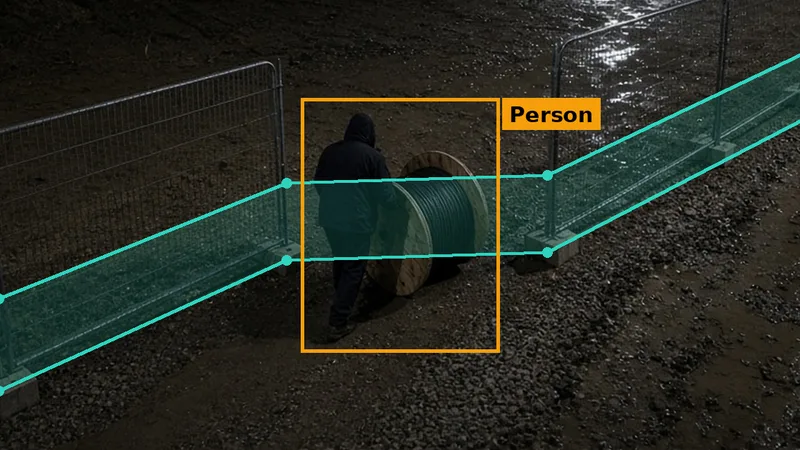
Construction site security means stopping unauthorised access in and outside working hours, as CDM 2015 requires: a continuous, well-maintained perimeter, locked gates, ladders removed, plant immobilised and locked away, materials, tools and fuel stored securely, and regular checks. The highest risks come when the site is closed, at night, at weekends and over holidays, from theft, children and other trespassers, vandalism and arson. AI on site CCTV can add alerts, with a clip, when a person is at the fence, in the compound or on the scaffold at night, or when smoke rises from the plots.

Last updated 2 November 2026. A construction site is one of the hardest places in the country to keep secure. It changes shape every week. Its boundary is often a line of temporary fence panels standing on concrete feet. It holds tools, cable, copper, fuel, plant and materials that are easy to sell, all in the open or in steel containers that can be forced. Its scaffolding and half-built walls look, to a bored teenager, like an adventure playground. And for most of every week, at night, at weekends and over the holidays, nobody is there at all.
The results show up in police appeals and fire service incident logs across the UK. In 2026 alone, homes under construction were set alight at night, an excavator was found burning at 02:50, containers were emptied of tools and diesel over a weekend, and youths climbed scaffolding and pushed over plant.
This guide is for principal contractors, site managers, developers, self-builders and clients in the UK, from a single plot to a large housing development. It covers the latest figures and 2026 cases, the law, children and trespassers, perimeters, scaffolds, theft, plant, arson and lighting, and ends with where AI on site cameras can help.
It is general guidance, not a substitute for your construction phase plan, your own risk assessments, advice from the police, or the requirements of your client, your insurer and your local fire and rescue service. For fire safety on a working site, see our separate guide to construction site fire safety.
What are the main security risks on a construction site?
Every site is different, from a loft conversion on a terraced street to a hospital extension or a 300-home estate. But the HSE, the police and fire services, and the incident reports from 2026 all point to the same four risks, again and again.
Theft. Power tools, generators, surveying equipment, cable, copper pipe, boilers, roof tiles, timber and diesel are all worth money and easy to move. Some thefts are opportunist: an open container, a van-load of tools left in a cabin. Others are planned, with a vehicle, cutting gear and a knowledge of when the site is empty. Plant and attachments are targeted too, and our guide to plant and machinery theft prevention covers them in depth.
Trespass. Children, teenagers, people looking for somewhere to shelter, urban explorers and people looking for things to steal all find their way onto sites. For children in particular, a site is full of dangers they do not see: open excavations, unguarded edges, scaffolding, stacked materials that can topple, and plant that can be started or moved. The HSE has warned that, while rare, children have lost their lives and others have been injured after getting onto unsecured sites, and the law expects sites to keep them out.
Vandalism and damage. Broken windows, smashed fittings, graffiti, cut cables, flooded plots and moved or overturned plant cost time and money, and can leave the site dangerous for the workers who arrive the next morning.
Arson. Timber frames, roof timbers, insulation, packaging, waste and skips all burn, and a part-built house is open to the air. Figures released by UK fire services show that almost half of construction site fires in the last five years were confirmed or suspected to be deliberate.
Behind all four sits one common factor: time. A person at the fence during the working day is seen and challenged by someone on site. The same person at 1am on a Sunday, or on the first night of a two-week Christmas shutdown, may have the site to themselves for hours.
How common are fires and crime on construction sites?
There is no single national count of crime on construction sites. Police forces record thefts, burglaries and criminal damage by offence, not by type of premises, and much site crime is never reported at all, or is reported only to an insurer. What is published is a picture built from fire service data, police appeals and the industry itself.
The clearest recent figures come from fire and rescue services. In April 2026, responses to Freedom of Information requests to UK fire services were published, covering incidents at buildings under construction, renovation or conversion from January 2021 to December 2025. They recorded 1,635 fires at construction sites in those five years. Of those, 45% were confirmed or suspected to have been started deliberately, and 2.6% resulted in an injury or a death. The figures were reported by Builder Master and Scottish Business News.
Not every fire service records incidents in the same way, and not every service replied with figures, so the total is best read as a floor rather than a full count. But the share that was deliberate stands out. Nearly one fire in every two at a construction site in the UK was started on purpose, or was thought to have been.
The figures by fire service show how widely the problem is spread. The Scottish Fire and Rescue Service attended the most fires, 170, of which 77 were deliberate. Greater Manchester followed with 157, of which 76 were deliberate, then Kent with 139, the West Midlands with 93, Shropshire and Merseyside with 91 each, Lancashire with 90, South Wales with 69, Derbyshire with 65 and West Yorkshire with 57. In the West Midlands, 66 of the 93 fires were deliberate, and in West Yorkshire 39 of 57.
Across all buildings other than homes in England, the fire and rescue incident statistics for the year ending June 2026 recorded 13,111 fires, and the average response time to those fires was 9 minutes 14 seconds. That is the time from the call to the first engine arriving. On a closed site, it does not include the time it takes for someone outside to notice the smoke and call.
Theft is harder to count, but the cases in the next section show the pattern that police appeals describe again and again: containers and stores forced overnight or over a weekend, tools, generators and fuel taken, and a vehicle used to carry them away.
What happened on construction sites in 2026?
The figures are national. The cases below were reported by fire services, police forces and the press in 2026. They are named by place, and the published reports are linked.
Sywell Road, Northampton, January. Just after 21:30 on Monday 19 January, firefighters were called to two homes under construction on a large new-build estate on the outskirts of Northampton. As the Northampton Chronicle reported, four crews and an aerial appliance attended. A second fire was found at the base of the stairs in one of the homes, and the fire was believed to have been started deliberately. Nobody was inside.
Halebank Road, Ditton, Widnes, February. At 02:50 on Saturday 14 February, Cheshire Fire and Rescue Service crews from Widnes and Runcorn were called to a construction site, where they found an excavator well alight. They used breathing apparatus and a hose reel jet to put the fire out, then checked the machine with a thermal imaging camera, according to the Runcorn and Widnes World.
Violet Road, Wixams, Bedfordshire, February. At 23:23 on Wednesday 18 February, Bedfordshire Fire and Rescue Service sent eight crews to a detached house and garage under construction. The building was recorded as 100% damaged, and the cause as deliberate.
Dufferin Street, Islington, March. At 20:26 on 2 March, London Fire Brigade took the first of ten calls about a fire in a building under renovation. Four fire engines and around 25 firefighters attended. A void in the building was damaged, one man was taken to hospital, and a gas cylinder was removed and cooled by crews. The fire was under control at 22:17, and its cause was under investigation.
Smithy Fen, Cottenham, April. At 22:54 on Wednesday 29 April, Cambridgeshire Fire and Rescue Service was called to a fire at a house under construction. The fire was believed to have been started deliberately.
Roman Road, Harpole, Northamptonshire, June. Between 17:00 on Saturday 6 June and 07:00 on Monday 8 June, two containers on a building site were broken into. As the Northampton Chronicle reported, theodolites, disc cutters, power drills, water pumps, a generator, a compactor and hand tools were taken, along with diesel. Nobody found out until the site opened on Monday morning.
Old Church Road, Clevedon, June. Between 19:40 on Sunday 14 June and 09:30 the next morning, tools and equipment including drills, generators and jet washers were stolen from a community restoration project. Avon and Somerset Police said a vehicle was likely to have been used to take them away.
Goldcrest Avenue, Bacup, June. On the evening of Tuesday 30 June, youths forced their way onto a housing development and allegedly pushed over plant, the Lancashire Telegraph reported, prompting a warning about the dangers of playing on building sites.
Wenlock Road, Bridgnorth, September. Between 18:00 on Thursday 3 September and 08:00 the next morning, a secure storage container on a construction site was entered and tools were taken. West Mercia Police appealed for information, as Shropshire Live reported.
Polmaily, near Drumnadrochit, over Christmas. Tools, materials and roof tiles were stolen from two lodges under construction at some point between 22 December 2025 and 13 January 2026, while the site was closed for the holidays, BBC News reported. The site had been empty for about three weeks when the theft was found.
Clitheroe Castle, early 2026. Police issued a warning after youths were seen climbing the scaffolding put up for restoration work on the castle keep, according to the Lancashire Telegraph. Police said the site was monitored by a security company and patrolled.
Whitehaven town centre, April. Police warned about youths climbing scaffolding and getting onto rooftops in the town centre, the News and Star reported, and said they had identified those responsible.
When do construction site fires and thefts happen?
Look at when those cases happened and a pattern appears. All five fires were reported in the evening or the small hours: 20:26, around 21:30, 22:54, 23:23 and 02:50. On a typical site, every one of those times falls after the last worker has gone home and before the first one arrives.
The thefts tell the same story. Nobody saw them happen, and each was found when the site opened again: after a weekend at Harpole, overnight at Clevedon and Bridgnorth, and after about three weeks near Drumnadrochit.
That gap is the heart of construction site security. The rest of this guide is about closing it: making it harder to get in, leaving less to steal or set alight, and making sure that someone is told while it is happening, not the next morning.
What does the law say about construction site security?
Site security is not optional on a UK construction site. It is written into the Construction (Design and Management) Regulations 2015, known as CDM 2015, which apply to almost all building work in Great Britain, from domestic extensions to major projects. Northern Ireland has its own equivalent regulations.
Regulation 18, good order and site security. Under regulation 18, where it is necessary in the interests of health and safety, a construction site must, so far as is reasonably practicable and in line with the level of risk, have its perimeter identified by suitable signs so that its extent is clear, or be fenced off, or both.
Regulations 13(4) and 15(10), keeping unauthorised people out. The principal contractor must take the necessary steps to prevent access by unauthorised persons to the site, under regulation 13(4). A contractor must not begin work on a site unless reasonable steps have been taken to prevent unauthorised access, under regulation 15(10). Under regulation 4(6), the client must take reasonable steps to make sure the principal contractor meets its duties. The HSE pointed to all three regulations when it urged construction companies to strengthen site security in its press release of 24 June 2026.
Regulation 17, safe places of work. Regulation 17(3) adds that action must be taken, so far as is reasonably practicable, to make sure that nobody gains access to any part of a site that is not safe.
The Occupiers' Liability Act 1984. Under section 1 of the 1984 Act, an occupier can owe a duty of care to people who are not visitors, including trespassers, where the occupier knows or has reasonable grounds to believe there is a danger, that someone may come near it, and the risk is one they could reasonably be expected to offer some protection against. A construction site full of excavations, scaffolding and plant, near homes and schools, is exactly the kind of place where that duty can arise.
The HSE's guidance on protecting the public and its publication HSG151, Protecting the public: your next move explain what this means in practice. Start with an assessment of the site, its surroundings and whether it will attract children, then match the measures to the risk, write them into the construction phase plan and keep them up to date.
How do you keep children and trespassers off a building site?
Children are the group the HSE worries about most. Its guidance notes that some children are drawn to construction sites as exciting places to play, and that while the numbers of children killed or injured on sites have fallen, these incidents still happen and there is no room for complacency. Its June 2026 press release, timed for the start of the school holidays, said that, while rare, children have lost their lives, and others have been injured, after getting onto unsecured construction sites.
The HSE lists specific steps that are particularly relevant to child safety:
- put up suitable perimeter fencing or hoarding where needed, to reflect the nature of the site and the area around it;
- check and review site security regularly, so the fencing or hoarding is maintained and kept in good order;
- secure the site properly when finishing work for the day;
- barrier off or cover excavations and pits;
- isolate and immobilise vehicles and plant, and lock them in a compound if possible;
- store building materials, such as pipes, manhole rings and cement bags, so they cannot topple or roll;
- remove access ladders from excavations and scaffolds; and
- lock away hazardous substances.
The HSE is clear that signs on their own are not enough. Its safety bulletin on ladder and scaffold security says signage is a low level of control and unlikely in itself to deter children, who may be too young to read or understand the signs. The same bulletin accepts that no measure can guarantee an older or determined person will not get in. The aim is to stop the very young and the curious, and to deter, slow down and detect everyone else.
What makes a good construction site perimeter?
The perimeter is the first and most important layer of site security. The HSE bulletin says the primary way to keep people off scaffolds should be the site perimeter fencing, and that where it is reasonably practicable, the perimeter should prevent unauthorised access to the site.
According to the HSE, the fencing should be continuous and fixed in place. Where it changes from one type to another, or butts up against a wall or another structure, it must be secured so that nobody can squeeze through a gap. Gaps between gates and the ground, and between fixed and moveable fencing, should be kept small enough that small children cannot climb through or under. The fencing itself should not create a climbing point onto the scaffold.
The perimeter also needs to be checked and kept in good order. Temporary fence panels are moved by deliveries, blown over in the wind, unclipped by workers who need a shortcut and lifted by people who want to get in. The HSE says no materials, skips or plant should be stored or parked where they could help someone climb into the site. A walk round the fence line at the end of each day, and before any weekend or holiday, catches most of these problems.
The HSE's guidance on protecting the public says that, in populated areas, this will typically mean a two-metre-high small-mesh fence or hoarding around the site. Where a site sits next to homes, a school or a busy street, solid hoarding is often a better choice than open mesh. It is harder to climb, hides what is inside from people looking for something to steal, and protects passers-by. On a large housing development, the perimeter may need to move as phases are completed and handed over, and every move is a chance for a gap to open up.
For a deeper look at how fences, zones and detection work together on any kind of site, see our guide to perimeter intrusion detection.
How should site gates and access be controlled?
A strong fence is only as good as its gates. During the working day, the gate is where the principal contractor controls who comes onto the site, and out of hours it is the most obvious way in for a vehicle.
- Lock the gates out of hours, with a good-quality chain and padlock or a locking bar, and check them at the end of each day.
- Control who comes in during the day. A site induction, a signing-in system and a visitor log mean everyone on site has been authorised, which is what regulation 13(4) requires.
- Meet deliveries at the gate and make sure the gate is closed again afterwards. An open gate during a delivery is a chance for someone to walk in unseen.
- Keep the keyholder list short and known. Who has keys to the gates, the cabins and the containers, and who will come out if something happens at night?
- Block vehicle access out of hours with the gate itself, and where needed with barriers or plant parked across the entrance inside the fence, so a vehicle cannot simply drive in and load up.
Several of the thefts in this guide involved a vehicle. At Clevedon, police said a vehicle was likely to have been used. Equipment like generators, compactors, pumps and cable drums is heavy, and most thieves need a van or a trailer to take it away. A gate that stops a vehicle, and a camera that sees one arrive after hours, both matter.
How do you secure scaffolding and ladders?
Scaffolding is one of the biggest draws for trespassers, and falls from it are among the most serious outcomes. The HSE bulletin says falls from height from scaffolding or incomplete buildings, after the public get in, frequently involve children and result in major and sometimes fatal injuries. The Clitheroe Castle and Whitehaven cases in 2026 both involved youths climbing scaffolding, and in Whitehaven getting onto rooftops.
The HSE bulletin sets out what is expected:
- Fence the scaffold at ground level where needed, especially across ground-level bracing, and do not leave projecting transoms or ledgers on the first lift that could help someone climb. Sheeting or fans on the lifts can also deter climbing.
- Remove the bottom ladder at the end of each shift, and store it in a locked container or padlock it horizontally to the scaffold. Do not leave it lying on the first lift, where a trespasser can reach it.
- Use ladder guards where removing the ladder is not reasonably practicable. They must be locked or padlocked in place, cover at least six rungs and leave no more than 50mm of rung exposed.
- Close off stair towers with padlocked fence panels, unless they form part of a planned public escape route from an occupied building.
- Fit local fencing as the scaffold goes up, lift by lift, so there is no gap between the scaffold being built and it being secured.
The bulletin also lists further controls for situations where the risk of unauthorised access is high: CCTV, CCTV with active monitoring to detect people, CCTV with active monitoring and loudspeakers so a remote operator can speak to trespassers, and security staff on site or on patrol. The site risk assessment should be kept under review, and any report of damage to fencing or trespass out of hours should be investigated and the security measures reviewed urgently.
How do you stop theft of tools, materials, fuel and cable?
Theft from construction sites is common, often unreported and expensive in ways that go beyond the value of what is taken. The 2026 cases in this guide show what is targeted: surveying equipment, disc cutters, drills, pumps, generators, compactors, jet washers, hand tools, roof tiles and diesel.
- Lock tools away every night in steel containers or a secure store, not in cabins, vans or the plots. Choose containers with protected locks and hinges, and keep them inside the fence, in view of the cameras.
- Mark and list your tools. Keep a register with makes, models and serial numbers, and mark tools clearly. Marked tools are harder to sell, and a list makes it easier for the police and your insurer.
- Order materials just in time. The less that sits on site overnight, the less there is to steal. Plan deliveries so that boilers, kitchens, cable and copper arrive shortly before they are fitted, and fit or lock them away the same day.
- Store materials away from the fence, inside a compound if possible, so they cannot be passed over the fence or reached from outside.
- Protect fuel. Lock fuel bowsers and tanks inside the compound, use lockable fuel caps on plant, and keep as little fuel on site as you can. At Harpole, diesel was taken along with the equipment. Our guide to fuel theft prevention covers this in depth.
- Protect cable and copper. Cable drums, copper pipe and cylinders are a target for metal thieves. Keep them locked away until they are fitted. Our guide to metal theft prevention explains more.
How do you protect plant and machinery on site?
Excavators, dumpers, telehandlers, rollers and generators are valuable, often left on site for weeks at a time, and can be stolen, vandalised, used to cause damage or set alight. The excavator found burning at 02:50 in Ditton in February 2026, and the plant pushed over by youths in Bacup in June, show what can happen when plant is left on a closed site.
- Isolate and immobilise plant at the end of each day, as the HSE advises. Take the keys away, turn off isolators and use any immobilisers fitted.
- Park plant inside a compound where possible, not on the road, at the edge of the site or by the fence.
- Lower buckets and attachments to the ground, and use plant to block vehicle routes into the site where it is safe to do so.
- Mark and register plant and attachments, and fit tracking where it is appropriate.
- Lock fuel tanks and keep bowsers inside the compound.
Our guide to plant and machinery theft prevention goes into detail on plant on construction sites, farms and depots.
How do you secure site cabins and containers?
Welfare cabins, site offices and storage containers hold laptops, drawings, tools and keys, and they are the first place a thief looks. At Harpole in June 2026, two containers were broken into over a weekend. At Bridgnorth in September, a secure storage container was entered overnight.
- Choose secure units, with steel doors, window shutters and protected locks, and close the shutters every night.
- Leave nothing of value on show, and never leave keys to plant, vehicles or other containers in the cabin.
- Fit an intruder alarm to cabins and stores, with a clear response plan for when it goes off.
- Light the cabins and containers, and make sure they are in the view of a camera, including the doors.
- Position them inside the fence, where they cannot be reached by a vehicle from the road.
How do you prevent vandalism on construction sites?
Vandalism often gets less attention than theft or fire, but it can be just as costly. Broken windows, smashed sanitaryware, graffiti on new brickwork, cut cables and flooded plots all have to be put right before work can carry on, and damaged scaffolding, edge protection or plant can leave a site unsafe for the workers who arrive the next morning.
Many of the measures that stop theft also stop vandalism: a continuous perimeter, locked gates, ladders removed, plant immobilised and nothing left lying around to throw or break. Our guide to vandalism prevention covers the wider picture.
Vandalism also has a way of escalating. A group that gets onto a site once and finds nothing stops them will often come back, and the next visit may involve fire.
How do you prevent arson on a construction site?
Arson is the most dangerous risk on a closed construction site. Fire services' figures show that 45% of construction site fires in the five years to December 2025 were confirmed or suspected to be deliberate, and four of the five fires in this guide were in homes or buildings under construction or renovation, at night.
The HSE's guidance on fire safety in construction, HSG168, says arson is a real, substantial problem and risk on all sites, and that trespassers may start a fire deliberately or by accident. It sets out the security measures that help prevent unauthorised access and arson:
- perimeter fencing or hoarding, and securing all access points such as windows and doors on a refurbishment site;
- securing openings on vulnerable buildings with fire-resisting material;
- regular out-of-hours security patrols or a permanent security presence;
- security lighting;
- CCTV monitoring, including the possible use of thermal imaging cameras;
- intruder alarm systems;
- liaison with the local police;
- secure storage, or if necessary removal, of flammable liquids, gas cylinders and other combustible materials while the site is closed; and
- storing materials and waste inside the site perimeter, preferably in secure compounds or away from the fence, bearing in mind that skips are often a target.

For timber frame, the fire safety plan, hot work and fire detection on site, see our guide to construction site fire safety, and for arson more widely, our guide to arson prevention.
What lighting does a construction site need out of hours?
Security lighting appears in the HSE's list of measures against arson and in most police crime prevention advice. It helps in three ways: it makes people on site visible to neighbours, passers-by and patrols; it removes the dark corners where someone can work unseen; and it gives cameras the light they need to see detail at night.
Focus lighting on the gate and the access road, the compound and containers, the cabins, and the edges of the build. Avoid dazzling drivers or neighbours. Where lighting is limited, cameras with infrared illumination can still see in the dark, though in black and white and over a shorter range. A site assessment should check what each camera can actually see at night.
What level of security does a construction site need?
No single measure secures a construction site. The HSE's approach is to match the controls to the risk, and to add layers as the risk rises.
At the lowest level, signs mark the edge of the site. Then come continuous fencing or hoarding, locked gates, ladders removed and regular checks. Where the risk of unauthorised access is high, the HSE bulletin lists CCTV; CCTV with active monitoring to detect the presence of people; CCTV with active monitoring and loudspeakers so a remote operator can speak to trespassers; and security staff, either on site or on a visiting patrol.
The higher layers are added to the lower ones, not used instead of them. What decides the right mix is the site assessment: what the site holds, how long it is empty, how close it is to homes and schools, and what has happened there before.
How do security risks change as a build goes up?
A construction site's security needs are not fixed. They change week by week as the build progresses, and the security plan needs to change with them.
- Groundworks. Open excavations and trenches are a danger to trespassers, especially children. Plant and fuel are on site, often in large amounts.
- Frame and shell. Scaffolding goes up, and with it the risk of climbing and falls. Materials such as blocks, roof tiles and timber arrive in volume.
- First fix. Cable, copper pipe, cylinders and boilers arrive, along with more tools. These are attractive to thieves and easy to sell.
- Finishing. Kitchens, appliances, sanitaryware and glazing are fitted, and part-finished homes are full of new fittings.
- Handover. Finished but empty homes, sometimes for weeks, can attract theft, squatting and damage. Our guide to vacant property security covers this stage.
On a large housing development, all five stages can be happening at once, on different plots. Review the security plan at each stage, not just at the start, and whenever there is an incident on the site or nearby.
Why are nights, weekends and holidays the highest-risk times?
On a typical site, workers are present for only around a third of the week. The rest of the time, the site is closed.
Take an example site working 07:30 to 18:00 on weekdays and 08:00 to 13:00 on Saturdays. That is about 58 hours a week with people on site, and about 110 hours, two-thirds of the week, with nobody there. Every one of the 2026 fires in this guide was reported in hours like these, and every one of the thefts was found only when the site opened again.
Long weekends and holidays stretch the empty hours further. The theft near Drumnadrochit happened at some point during a shutdown of about three weeks over Christmas and New Year. The HSE times its child safety warnings for the school holidays, when children have more free time and sites can be quieter. Our out-of-hours site security checklist sets out what to check before you lock up.
Before any long closure:
- take tools, fuel and valuable materials off site, or lock them away securely;
- walk the whole perimeter, close any gaps and move anything that could help someone climb in;
- remove ladders, fit guards and close off stair towers;
- isolate and immobilise plant, and park it in the compound;
- clear waste and skips away from buildings and the fence;
- agree who the keyholders are, who will check the site and how often, and who will respond to an alert; and
- make sure cameras, alarms and lighting are working, and armed for the whole break.
Why is a construction site hard to protect with ordinary CCTV?
Many sites already have cameras: on the gate, the compound, the cabins and sometimes the plots. But recording-only CCTV is built for looking back. On a closed site, nobody is watching the screens at 1am, and the footage is only checked when the damage is found in the morning.
Ordinary motion alerts struggle too. A construction site is full of movement at night: loose sheeting and banners flapping in the wind, dust blowing across bare ground, rain, foxes, cats and birds, and headlights from the road. A system that alerts on all of it is ignored or switched off within weeks. And motion detection does not recognise smoke at all.
A construction site also changes constantly. A camera that saw the whole compound in March may be looking at a brick wall by June. Fixed camera positions have to be reviewed as the build goes up, and detection settings with them.
Where should cameras watch on a construction site?
Start with the cameras you already have, and what they can see by day and by night. On most sites, four places matter most.
- The gate and the site road. Every vehicle that comes in or out, and anyone who walks in through the main entrance.
- The fence line. Especially the corners, the far side away from the road, any stretch next to a footpath or field, and anywhere fence panels meet a wall or another fence.
- The compound. Containers, cabins, plant, fuel and the stores where the most valuable things are kept.
- The plots. Part-built homes, scaffolding, materials on pallets, waste and skips.
What do site cameras need to work?
Every camera, whether fixed to a cabin, a pole, a building or a mobile tower, depends on four things. A site assessment checks each one.
- A clear view. Of the area that matters, not blocked by stacked materials, scaffold sheeting or the next plot as it goes up.
- Light. Security lighting, or infrared illumination on the camera, so it can see at night.
- Power. A mains or site supply that stays on out of hours. Sites that switch off the temporary supply at night need to plan for this.
- A network connection. So that alerts and clips can reach people off site, whether over a fixed line or a mobile connection.
Mobile camera towers are common on construction sites, because they can be placed where they are needed and moved as the site changes. Like any camera, they only help as much as their cameras can see and their connection allows.
How can AI on site CCTV help on a construction site?
Recording-only CCTV shows what happened after the event. AI detection tells someone while it is happening, in time to act. Woodcock AI connects to the IP cameras and recorders already on site, over RTSP or ONVIF, including Hikvision, and runs on an edge server on site or on a cloud server (an edge server needs only a power socket and a network connection).
- Smoke and flame. Smoke and flame detection on every camera that sees the plots, the compound, the skips and the stored materials, around the clock, indoors and out.
- Polygon zones. Draw an area of any shape on a camera's view, around the compound, the scaffold or the materials on a plot, and detect people only inside it. A zone can follow the edge of the compound exactly and leave out the footpath beyond the fence.
- Lines. Draw a line along the inside of the fence or across the gate, and alert when a person crosses it, in the direction you choose.
- People and vehicles. Detect people and detect vehicles moving in a zone, ignoring foxes, birds, rain and passing headlights.
- Schedules. Arm each people rule for the hours that make sense, such as the fence and the plots from 18:30 and all weekend, and leave smoke on all the time.
- Alerts with the clip. Alerts arrive in the app and by email with a short clip and an AI description, so a site manager or a keyholder can see in seconds whether it is a fox, a security guard on patrol, a person at the fence, or smoke.
The system is self-learning. It learns each camera, what is normal on that view and what is not, and marking an alert as correct or false feeds into retraining for your site. Woodcock AI has been in development for years and is now running on customer sites across the UK.
Woodcock AI does not read number plates or identify people. It tells you that there is a person at the east fence at 01:12, or smoke from plot 14 at 22:47, with the clip; what happens next is up to you.
Coming next: Ask your cameras Coming soon, early 2027, which will let you ask the system questions about what your cameras have seen.
For how this works on construction sites specifically, see our construction sector page.
What does detection look like in different parts of a site?
Each part of a construction site has its own risks and its own camera views. Choose an area to see how detection might be set up there.
Which part of the site are you protecting?
A part-built house is full of timber, packaging and offcuts, with openings that let air in and smoke out. Several of the 2026 fires in this guide were in homes under construction, at night. Smoke detection on the cameras that see the plots runs at every hour, and a people zone between the plots, armed when the site closes, flags someone inside the build.
House shells, window openings, roof timbers and the gaps between plots
Scaffolding draws climbers, especially children and teenagers in the evenings and school holidays. With ladders removed and guards fitted, a camera that sees the lifts can carry a people zone armed from the end of the day, so someone climbing is seen while they are on the first lift, not when they reach the roof.
Scaffold lifts, ladder access points and the roof line
Materials on pallets, cable drums, tools in containers and fuel in plant are what thieves come for. Keep them inside a compound or well away from the fence, then draw a people zone over the compound and the materials area, armed from the end of the day and all weekend, with smoke detection on the same views.
Pallets of tiles and blocks, cable drums, containers, plant and fuel
The plots, the scaffold and the materials each get their own camera views and schedule, with smoke detection on all three.
How does AI detection compare with other site security measures?
No single measure secures a construction site. The table compares the main approaches. Most sites use several together, and the higher layers are added to the basics, not used instead of them.
| Measure | What it does | Strengths | Watch out for |
|---|---|---|---|
| Fencing, hoarding and locked gates | Keeps people out and marks the boundary | Required in some form on almost every site; the basis of everything else | Panels moved, gaps under the fence, gates left open, materials stacked against it |
| Locks, containers and immobilised plant | Makes theft slower and harder | Low cost; protects the things thieves want most | Containers can be forced; nobody knows until the morning |
| Security guard on site | A person on site through the night | Can see, challenge and call for help; a strong deterrent | One person cannot see a large site at once; needs welfare, lighting and a lone worker plan |
| Mobile patrols | A visit at set or random times | Visible presence; checks gates and fences | The site is unwatched between visits |
| Intruder alarm on cabins and stores | Detects entry into a building or container | Can be linked to a monitoring centre and police response | Only covers what it is fitted to; police response depends on the rules for alarms |
| Recording-only CCTV | Records the gate, the compound and the plots | Evidence for the police and the insurer | Nobody sees the person at the fence at 1am until someone reviews the footage |
| Monitored CCTV | Cameras watched or alerting to a monitoring centre | A response while it is happening; the HSE lists it for higher-risk sites | Quality depends on the detection behind it and how alerts are handled |
| AI on site CCTV | Recognises people, vehicles, smoke and flame, in zones you draw, on a schedule | Covers the fence, compound and plots at once; each alert includes the clip | Cameras need a clear view, power, a connection and enough light or infrared at night; it does not replace fencing, locks or a response |
Security guards and AI detection are not alternatives. A guard on a large site can only be in one place at a time, and alerts from cameras covering the whole site can tell the guard where to go. On a smaller site where a full-time guard is not practical, alerts to a keyholder or a monitoring centre can fill the gap between patrols.
How do you keep false alerts down on a building site?
A construction site is one of the most changeable places a camera can look at. Sheeting and banners move in the wind, dust blows off bare ground, puddles reflect lights, and the view itself changes as the build goes up. A system that alerts on all of that will be ignored.
- Choose views carefully. Avoid cameras pointing straight into low sun or headlights where you can, and tie down loose sheeting in view.
- Draw tight zones. Cover the compound, the scaffold or the inside of the fence, not the public footpath or the road beyond it.
- Use schedules. Arm people rules only when nobody should be there, and adjust them for late working, weekend shifts, deliveries and guard patrols.
- Recognise people, not motion. Detecting people and vehicles, rather than any movement, removes foxes, birds, rain and blowing sheeting.
- Review as the site changes. Check each camera's view and zones when the scaffold goes up, a phase is handed over or the compound moves.
- Mark alerts. Mark each alert as correct or false. The system learns each camera's view over time.
Our guide to reducing CCTV false alarms goes into more detail. The aim is a handful of alerts a week that each matter, not dozens a night that nobody reads.
What detection schedule suits a construction site?
Every site keeps different hours, but the pattern is the same: people rules where and when nobody should be there, and smoke and flame detection on everything, all the time.
In this example, the site works from 07:30 to 18:00 on weekdays. The compound is armed for people from 18:00, as soon as the stores are locked. The fence line and the plots, including the scaffold, are armed from 18:30, once the last workers have left, until 07:00. At weekends and over holidays, the people rules stay armed for the whole closure. Smoke and flame detection never switches off, because fires start in working hours as well as out of them.
Start with a cautious schedule, look at the alerts for a fortnight, and adjust. Our out-of-hours site security checklist covers the same thinking for other kinds of site.
What should happen when an alert comes in?
An alert is only useful if someone acts on it. Before the cameras go live, agree who receives alerts for each area, at what hours, and what they do. Write it into the security section of the construction phase plan.
- Alert. The alert arrives in the app and by email, with the clip and an AI description.
- Check. Watch the clip. Is it a fox, a guard on patrol, a worker staying late, a person at the fence, or smoke?
- Act. For a fire, call 999. For a crime in progress, such as someone breaking into a container, call 999. Otherwise, follow the security plan you agreed: a keyholder, a security patrol or a monitoring centre. Never send someone alone to confront intruders.
- Review. Mark the alert, note what happened, and fix what it showed: a fence panel moved, a ladder left up, a gate left open.
Police response to intruder alarms is governed by the National Police Chiefs' Council requirements for security systems, and police response to an alarm system with a unique reference number is withdrawn after three false calls in a rolling 12 months. Alerts that come with a clip, checked by a person before anyone calls, help keep calls for real incidents.
What should you do after a theft, break-in or fire?
After any incident, the first priority is safety. Do not enter a container, cabin or building that may still have someone inside, and leave a fire to the fire service until it hands the site back. Then:
- Report it. Report crime to the police and get a crime reference number. Tell your insurer, the client and the principal contractor promptly.
- Save the clips. Export and keep the footage before the recorder overwrites it, and note the times. The police and insurers will want it.
- Make the site safe. Check the fence, the gates, the scaffold, the excavations and any plant that has been moved or damaged before work starts again.
- List what was taken. Use your tool and plant register to give the police serial numbers and descriptions.
- Review. Update the security plan and the risk assessment. How did they get in, what did the cameras see, and what needs to change?
How can neighbours and the police help?
The people who live and work around a site are often the first to notice something wrong, and the police can offer advice tailored to the area.
- Neighbours. Write to neighbours at the start of the job with a contact name for out-of-hours concerns, and keep them updated.
- Schools. Talking to local schools about the dangers of playing on building sites, especially before the school holidays, when the HSE says the risk to children rises, can help keep them away.
- Police. HSG168 lists liaison with the local police among the measures against arson, and police crime prevention officers can advise on security for your site.
- Reports. Make it easy for anyone to report trouble, with clear signs at the gate showing who to contact. In an emergency, call 999.
What about privacy and data protection?
Cameras on a construction site see workers, visitors and, often, neighbouring homes and the public road. Under UK GDPR, the organisation running the cameras is responsible for the footage. The ICO's guidance on video surveillance sets out what to do.
- Tell people. Explain to workers why the cameras are there, what they detect and how footage is used, and cover it in the site induction.
- Focus. Point cameras at the site, not into neighbouring gardens or windows, and use privacy masking where a view takes in more than it needs to.
- Signs. Put up clear signs at the gate and on the fence saying CCTV is in use and who runs it.
- Retention. Keep footage only as long as you need it, and delete it after that.
- Assessment. Carry out a data protection impact assessment where the cameras are likely to be high risk to privacy.
Woodcock AI does not use facial recognition, identify who anyone is or read number plates. Our guide to AI CCTV and GDPR in the UK covers this in more depth.
How do you get started?
Start with the basics: a site assessment written into the construction phase plan; a continuous, well-maintained perimeter; locked gates; ladders removed at the end of every day; plant immobilised and locked away; tools, fuel and materials stored securely; waste and skips kept away from the buildings and the fence; and a clear plan for nights, weekends and holidays. Then look at what your cameras can already see.
Our site assessment looks at the cameras already covering your gate, fence line, compound and plots, what each one can see by day and night, and where zones and lines would go. To see it working first, we can run a live test on your cameras: we connect two or three of them for about a fortnight. We can also arrange an on-site demo.
What are the limits?
AI on site cameras is useful, and it is not magic. It is worth being clear about what it cannot do.
- It only sees what the cameras see. Someone working behind a stack of materials, inside a part-built house or out of view will not be detected until they come into view.
- It needs light. At night, cameras need lighting or infrared to see well.
- It needs power and a network. If the site supply is switched off or the connection drops, so do the cameras and the alerts.
- It does not replace physical security. Fencing, locks, ladder removal and immobilised plant still come first, and are what the law requires.
- It detects; it does not stop anyone. Someone has to respond. An alert at 1am is only useful if someone sees it and acts.
- The site changes. Views and zones need reviewing as the build goes up.
Sources
- legislation.gov.uk, Construction (Design and Management) Regulations 2015, regulation 18, and regulations 4, 13, 15 and 17.
- legislation.gov.uk, Occupiers' Liability Act 1984, section 1.
- Health and Safety Executive, HSE urges construction companies to strengthen site security (press release, 24 June 2026).
- Health and Safety Executive, Protecting the public, and HSG151, Protecting the public: your next move.
- Health and Safety Executive, safety bulletin on ladder and scaffold security on construction sites.
- Health and Safety Executive, HSG168, Fire safety in construction, paragraphs 141 to 144.
- Freedom of Information responses from UK fire and rescue services, January 2021 to December 2025, as reported by Builder Master and Scottish Business News (April 2026).
- GOV.UK, Fire and rescue incident statistics: England, year ending June 2026.
- Fire incident reports: Bedfordshire Fire and Rescue Service, Wixams (February 2026); London Fire Brigade, Islington (March 2026); Cambridgeshire Fire and Rescue Service, Cottenham (April 2026).
- Press reports: Northampton Chronicle, Sywell Road (January 2026) and Harpole (June 2026); Runcorn and Widnes World, Ditton (February 2026); Lancashire Telegraph, Clitheroe (March 2026) and Bacup (2026); News and Star, Whitehaven (April 2026); Shropshire Live, Bridgnorth (September 2026); BBC News, Drumnadrochit (January 2026).
- Avon and Somerset Police, appeal after tools and equipment stolen in Clevedon (June 2026).
- National Police Chiefs’ Council, Police Operational Advice and Security Industry Requirements for Response to Security Systems (March 2024).
- Information Commissioner’s Office, Guidance on video surveillance, including CCTV.
We have summarised these sources in our own words. Always read the current versions in full. This page is general guidance, not legal, health and safety, insurance or security advice; the HSE, the police, your principal designer, your insurer and your installer can advise on your own site.
Want to know who is on your site tonight?
Book a site assessment and we will look at the cameras covering your gate, fence line, compound and plots, and plan people zones and lines for nights, weekends and holidays, with smoke and flame detection around the clock, or ask for a live test on your cameras.
Related pages
Frequently asked questions
Who is responsible for security on a construction site?
Under CDM 2015, the principal contractor must take the necessary steps to prevent unauthorised people getting onto the site, and a contractor must not start work unless reasonable steps have been taken to do so. The client must take reasonable steps to make sure the principal contractor meets its duties.
Is a construction site legally required to have a fence?
Under regulation 18 of CDM 2015, where it is needed for health and safety, a site must, so far as is reasonably practicable and in line with the risk, have its perimeter marked by suitable signs, be fenced off, or both. The HSE says that in populated areas this will typically mean a two-metre-high small-mesh fence or hoarding around the site.
Can a site be liable if a trespasser is injured?
It can. Under the Occupiers’ Liability Act 1984, an occupier can owe a duty of care to trespassers where it knows of a danger, has reason to believe someone may come near it, and could reasonably be expected to offer some protection. Children are a particular concern. The HSE says signs alone are unlikely to deter them, so fencing, ladder removal and other controls matter.
When are construction sites most at risk?
When they are empty: at night, at weekends and over holidays. On an example site working weekdays and Saturday mornings, nobody is there for about two-thirds of the week. Fire service figures show 45% of construction site fires in the five years to December 2025 were confirmed or suspected to be deliberate, and thefts are often only found when the site reopens.
What security does a high-risk construction site need?
Layers that match the risk, on top of a continuous perimeter, locked gates, ladders removed and plant immobilised. For sites where the risk of unauthorised access is high, the HSE lists CCTV, CCTV with active monitoring to detect people, monitoring with loudspeakers, and security staff on site or on patrol. HSG168 adds security lighting, intruder alarms and secure storage of fuel and gas.
Can existing site cameras detect intruders and smoke?
Often, yes. Woodcock AI connects to existing IP cameras and recorders over RTSP or ONVIF, including Hikvision, and runs on an edge server on site or on a cloud server. It detects people in zones and across lines you draw, on a schedule, and smoke and flame at every hour, with a clip in each alert. It adds to fencing, locks and a response plan; it does not replace them.
Last reviewed 2 November 2026