

Equestrian yard security: tack theft, horsebox theft and stable fires
Equestrian yard security means protecting a livery yard, riding school, equestrian centre or private yard’s horses, tack, horseboxes, trailers, hay and buildings from theft, arson and fire, most of all at night when the yard is quiet. The basics are a solid, locked and unlabelled tack room, postcode-marked tack with a photo record, clamped trailers parked away from the road, gates that cannot be lifted off, hay and straw stored away from the stables, and a fire plan. AI on the cameras already on the yard then flags people at the tack room, vehicles at the trailers and smoke from the barn, with the clip in every alert.

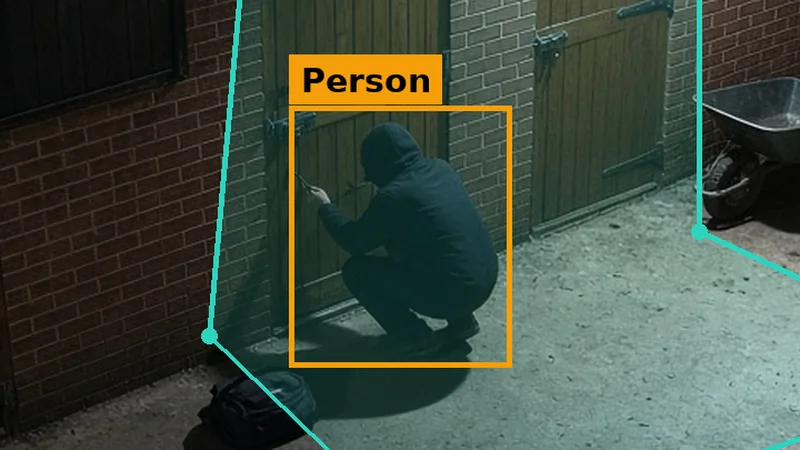
Last updated 1 November 2026. By day an equestrian yard is full of people. Owners arrive before work to muck out and turn out, instructors teach in the arena, the farrier and the vet come and go, and children groom ponies after school. By nine or ten at night the last owner has done the late check, the lights go off and the yard is left to the horses. On many livery yards nobody lives on site at all. On others, the house is at the far end of the drive and its owners are asleep.
Those quiet hours are when tack rooms are broken into, when horseboxes and trailers are hitched up and towed away, and when a hay barn or a stable block can catch fire with nobody there to see the first smoke. This guide covers the main security and fire risks to UK livery yards, riding schools, equestrian centres and private yards, what the figures and recent cases show, what the police, the fire services and equine charities recommend, where cameras should watch, and how AI on the CCTV already on the yard can watch the tack room, the gate, the trailers and the barn. It is written for yard owners and managers, riding school proprietors and owners keeping horses at home, and the installers who look after their cameras.
What are the main security risks to an equestrian yard?
A DIY livery yard behind a farm, a large competition centre with an indoor arena and a riding school on the edge of town look very different. Most face the same four kinds of risk, and all four are at their worst at night.
- Tack and equipment theft. Saddles, bridles, headcollars, rugs, clippers, tools, quad bikes and anything else kept in the tack room, feed room or barn.
- Horsebox and trailer theft. Trailers towed away from the yard, and horseboxes driven off, usually at night.
- Fire. Fires in hay and straw barns, stable blocks, muck heaps and machinery stores, some caused by self-heating hay or faulty electrics and some started deliberately.
- Strangers on the yard. People looking round at night, horses let out or interfered with, and in rare cases horses stolen.
These risks overlap. A thief who walks up the drive to look at the trailers can see into the tack room. A trailer parked against the hay barn is a fire risk as well as a theft risk. The same field gate that riders use to reach the bridleway lets someone onto the yard at 2am. That is why yard security works best when it is planned for the whole site, from the lane to the far paddock, rather than one building at a time.
The cost of an incident is often far bigger than the value of what was taken. A riding school without its saddles cannot teach. A livery owner without a trailer cannot get to a competition or take a horse to the vet in an emergency. Saddles are often fitted to one horse, so a replacement is not just a purchase but weeks of fitting. A barn fire can kill horses, destroy a winter’s hay and leave owners with nowhere to keep their animals.
How many horses and riders are there in Britain?
Horses are part of everyday life for millions of people. The BETA National Equestrian Survey 2023, as summarised in the British Horse Society’s equestrian access strategy and by Equestrian Trade News, found that there are 726,000 horses in Great Britain and 331,000 horse-owning households. An estimated 3.2 million people had ridden in the previous year, and 1.82 million rode at least once a month.
Those horses live in many different places: big commercial livery yards with dozens of stables, riding schools, competition and training centres, farms with a few liveries on the side, and private yards behind a house. Each one holds tack and equipment worth far more than most people realise, often a horsebox or trailer, and a barn of hay and straw. Many are in the countryside, down a lane, out of sight of any road and empty at night.
Rural crime is a constant concern for the equestrian world. There is no single official national figure for equine crime, so this guide draws on police figures where a force publishes them, insurer reports and police, fire service and local news reports of real incidents.
How common is tack, trailer and horse theft?
One of the clearest local pictures comes from West Yorkshire. Figures from West Yorkshire Police’s Horse Watch scheme, reported by the Telegraph and Argus in June 2026, showed that between 1 January and 18 June 2026 there were five horses stolen, six horse trailer thefts and five tack thefts reported in the county. In the same period of 2025 there were seven horses, nine trailers and 14 tack thefts, and in 2024 four horses, ten trailers and 19 tack thefts.
Those are small numbers for one force, and they are falling there, but each one is a yard that lost its saddles, a family without a trailer or an owner without a horse. The West Yorkshire Horse Watch scheme itself says equine crime is relatively low in the county, and asks members to note suspicious incidents and the registrations of unfamiliar vehicles, and to warn the police and others about people acting suspiciously near stables. The scheme forms part of Operation Gallop, a wider initiative to improve collaboration between police forces, rural crime teams and national databases to reduce horse, trailer and horsebox theft.
Nationally, the rural insurer NFU Mutual’s Rural Crime Report 2025 said trailer theft had made a worrying resurgence, up 15% in its 2024 claims. That covers all trailers, from livestock and plant trailers to horse trailers, but horse trailers are among the most valuable and the easiest to sell on. Crimestoppers says horses and related equipment, such as saddles, horseboxes and trailers, are stolen in the UK every year, and that equine crime causes immense emotional distress as well as financial damage to owners.
Why are tack rooms broken into, and how do you protect them?
Tack is valuable, portable and hard to trace unless it has been marked. A good saddle, a bridle and a rug fit in a car boot, and a tack room on a livery yard may hold dozens of saddles. Many tack rooms are a converted stable with a wooden door and a single padlock, or a steel container with a sign on the door. Recent reported cases show the pattern.
- Egdon, Worcestershire (August 2026). Just before 2am on a Saturday, a man in a balaclava was seen on camera going into stables and leaving with a bridle, a saddle, a headcollar and a fleece rug. Police released the CCTV images in an appeal (Worcester News).
- Near Yeovil, Somerset (November 2025). Seven saddles were stolen from a riding school in an overnight raid. The owner said locks were bashed open, that the saddles were very important to the school’s sessions, and warned other riding schools to keep their eyes open (Somerset Live).
- Stow-on-the-Wold, Gloucestershire (October 2025). Offenders forced entry to a property overnight and stole saddles, bridles and other equestrian equipment, and are thought to have used a wheelbarrow to carry the items away. Police asked for CCTV and dashcam footage from the main road nearby (Punchline Gloucester).
- East Stour, Dorset (June 2025). Police were called at 2.47am on a Sunday after an equine premises was burgled. Electricals, tools, horse riding equipment and a four-wheel horse carriage were taken (Somerset Live).
Three things stand out. The thefts were at night, between the late check and the morning. Two of them were found only in the morning, with the police left asking for footage from cameras along the road. And in two cases, the thieves used what was on the yard, a wheelbarrow and the doors themselves, to get in and out. In the Egdon case, the camera recorded the thief clearly, but nobody saw it until after he had gone.
The police advice is consistent. The PSNI’s Operation Gallop advice recommends good locks and solid doors and frames for tack rooms, bars or grilles on windows and roof-lights, an intruder alarm, marking tack with your postcode using a UV pen or a stamp, forensic marking, a saddle rack locked with a good padlock, an inventory with photographs and serial numbers, and considering CCTV and sensory lighting. Crimestoppers suggests storing tack in a strong brick or concrete building secured with a five-lever mortice lock, with metal bars across any windows.
- Lock it. A solid door and frame, good locks, and bars or grilles on the windows. West Yorkshire Police advise locks and bolts to BS 3621 and doorsets to PAS 24 or LPS 1175.
- Mark it. The CLA’s equine crime advice says saddles should be marked with your postcode on the reverse of the saddle flap, the stirrup bar and underneath the saddle flap, and bridles on the browband and cheekpiece. Do not punch or engrave thin leather that it would weaken.
- Record it. Photograph every item in good light from several angles, and keep a written list with sizes, makers, serial numbers and any marks or damage that make it unique.
- Hide it. The Operation Gallop yard and field advice says not to put Tack Room signs on doors, and to lock away wheelbarrows, forks and shovels that thieves could use.
Then make sure someone knows when a person is at the tack room door at 2am, while they are still there, rather than when the first owner arrives at 6am to find the saddle racks empty.
How do you stop horseboxes and trailers being stolen?
A horse trailer can be hitched to a four-by-four and gone in a couple of minutes, and a horsebox can be driven away like any other vehicle. Both are often parked in the same place every night, in sight of the lane, and both are easy to sell on with a new coat of paint. Recent police appeals show how often it happens at night.
- Turriff, Aberdeenshire (January 2026). A horsebox and a trailer were stolen from a premises at around 8.30pm on a Saturday. Police Scotland asked anyone with private CCTV or dashcam footage to check it (Police Scotland).
- Earls Croome, Worcestershire (April 2026). A horse box trailer was taken between 7pm on a Friday and 5pm the next day (Worcester News).
- Mowsley, Leicestershire (May 2026). A horsebox was stolen overnight, between 8.30pm and 4.45am (Harborough FM).
- Near Weymouth, Dorset (July 2026). A horse trailer was stolen overnight, between 7pm and 7am. Dorset Police’s rural crime team asked anyone who saw suspicious activity to come forward (Dorset Echo).
In three of the four cases, the police could give only a window of eight hours or more for when it happened. Nobody knew the trailer had gone until morning, by which time it could be the other end of the country.
- Park them in one set place. The Operation Gallop advice is a designated, secure area away from roads and footpaths, ideally covered by beam alarms and CCTV, with unused gateways blocked.
- Immobilise them. The CLA advises a wheel clamp or a tow hitch lock whenever a trailer or lorry is not in use.
- Mark them. A postcode painted on the trailer roof deters thieves and helps the police spot a stolen trailer. Keep photographs, chassis numbers and any distinctive dents or repairs on file.
- Keep them away from buildings. The British Horse Society’s stable fire advice says horseboxes and trailers should be stored securely away from buildings, so that a vehicle fire cannot spread to the stables.
Cameras add the one thing the rest cannot: knowing at 2.16am that a vehicle has pulled up at the trailers, rather than finding out at 7am.
How do stable and hay barn fires start?
Fire is the risk yard owners fear most, because it puts horses’ lives at stake. Stables and barns are full of fuel: hay, straw, shavings, wooden partitions, rugs and feed, often with machinery, vehicles and electrics in the same building. Once hay is alight, a fire can spread faster than people can move horses.

Recent reported fires show how quickly it happens and how much is lost.
- Sedgley, Dudley (October 2024). Two horses died in an arson attack on a stables building. The fire started shortly before 1.30am and was put out about five and a half hours later; a third horse was rescued (BBC News).
- Iverley, near Stourbridge (September 2025). Police investigated two arson attacks on neighbouring rural stables in the same week, in which buildings were destroyed and two horses died. Police asked for CCTV, dashcam or doorbell footage, and a neighbour said local horse owners were terrified they might be next (BBC News).
- Near Finstown, Orkney (February 2026). A barn caught fire at a property where horses were kept in a stable joined to the barn and to the house. The owner herded the horses out through thick smoke; four fire engines were sent (BBC News).
- Near Scunthorpe, North Lincolnshire (August 2026). A hay barn at a riding school was destroyed by fire shortly after 6pm. Around 20 horses were moved from the barn next to it. The co-owner said it went from something that could be tackled with a fire extinguisher to completely alight, and that everything was gone within 10 minutes. The livery barn next door lost everything in it, and the cause was not known (Grimsby Live).
- Chesham, Buckinghamshire (October 2026). A large outbuilding, about 10 metres by 40 metres, used for stabling horses and storing machinery and equipment, caught fire on a Tuesday afternoon. Firefighters evacuated all the horses, which escaped injury (Bucks Free Press).
The British Horse Society lists the common causes as spontaneous combustion of damp hay, machinery and vehicles such as quad bikes, faulty electrics and arson, and says nearly half of all rural fires are set deliberately. Cheshire Fire and Rescue Service says about 1,600 farm buildings are destroyed by fire every year in the UK and that around 40% of farm fires are started deliberately.
The Sedgley fire started in the small hours, when nobody was on the yard, and two horses died. The Scunthorpe and Chesham fires started in the afternoon or early evening, and the horses were saved because people were there to see the fire and move them. That is the difference early warning makes.
Why does hay catch fire on its own?
Hay that is baled too wet can heat up as it ferments, sometimes until it bursts into flame weeks after it was stacked. Cheshire Fire and Rescue Service explains that hay with a moisture content above 18% can ferment and heat up, and that at around 55°C there is a high risk of it igniting. It advises checking stored hay regularly, especially in the first six weeks after cutting, and says temperature probes help.
- Buy and stack dry hay. Ask about moisture, and check new hay before it goes into the barn.
- Check it for six weeks. A probe or a long thermometer pushed into the stack shows whether it is heating.
- Split the stacks. The BHS arson checklist says hay and straw stacks should be of a reasonable size and spaced at least 10 metres apart, so one fire does not take the whole winter’s supply.
- Keep hay away from horses. The BHS says animals should never be stabled in barns alongside hay, straw and vehicles.
- Move the muck heap. Muck heaps also heat up. The BHS says they should be downwind and at least 15 metres from the stables.
Self-heating starts deep inside the stack, so no camera sees it until smoke appears at the surface. A temperature probe watches the inside of the stack; a camera watching the stack for smoke covers the moment it breaks out, whatever the time of day.
What about electrics, heaters and machinery?
Stables are hard on electrics: dust, damp, cobwebs, rodents chewing cables and horses chewing anything in reach. The BHS advises regular maintenance of electrics and equipment, having the electrics tested by a qualified electrician at least once a year, and switching off tack room and communal area heaters when not in use, never leaving them on overnight unless they are designed for it. It singles out circuits that have been added to over the years. Kettles, fridges, clippers on charge and battery chargers in the tack room all add to the risk.
Tractors, quad bikes and vehicles parked in the hay barn bring fuel, hot engines and batteries into a building full of dry fodder. The Cheshire guidance is to service machinery regularly, electrically and mechanically, to cut the risk of overheating, and to park all vehicles well away from buildings. Our lithium-ion battery storage guide covers charging tools and e-bikes safely.
What does fire safety law say about stables?
Livery yards, riding schools and equestrian centres are workplaces and businesses, and fire safety law applies to them. The BHS says the Regulatory Reform (Fire Safety) Order 2005 applies to all animal premises, including livery stables and equestrian centres. GOV.UK publishes a guide, Fire safety risk assessment: animal premises and stables, for employers, managers, occupiers and owners, and Kent Fire and Rescue Service says its advice applies to all equine establishments, including stables and livery yards.
In practice that means a responsible person, a written fire risk assessment where the law requires one, and a plan. The BHS advises fire detection in stables, such as hard-wired optical or heat detectors, with remote sounders where an alarm would distress the horses. The BHS also advises keeping maintained firefighting equipment on the yard, with a hose that reaches the full length of the yard, used only if it is safe. The hay barn and the muck heap should be part of the assessment, not just the buildings people work in.
What should a yard fire plan include?
Horses in a fire are frightened, and frightened horses do not always do what people expect. A plan agreed in advance, and practised, saves lives.
- Call 999 first. Give the full address and postcode, the entrance to use and what is on fire. Have someone meet the fire crew at the gate.
- People before horses. Only move horses if it is safe to. Never go into a burning building.
- Close the stable door. The BHS warns that a loose horse may run back into its stable, so close the door after leading a horse out.
- Number the stables and the paddocks. The BHS advises numbering the stables, keeping headcollars outside each one, numbering or signposting the evacuation paddock gates, placing evacuation paddocks upwind of the stables where possible, and starting with the horses closest to the fire.
- Keep the way clear. Keep the yard gate, the access for fire engines and the route to the paddock clear of trailers, muck and machinery.
The Scunthorpe and Chesham fires show what happens when someone sees the fire early: the horses were got out. At night, with nobody on the yard, seeing it early depends on a detector or a camera telling someone straight away. Our arson prevention guide and outdoor fire detection guide cover the wider picture.
Why is an equestrian yard hard to protect?
Most security advice is written for a building with lockable doors and a fixed opening time. A yard is a group of buildings, vehicles and fields used by many people at all hours.
- Many people with access. A livery yard may have dozens of owners, each with a key or a code, plus instructors, grooms, farriers, vets, feed deliveries and visitors.
- Odd hours. Owners come early before work and late after it, and sometimes in the middle of the night for a sick horse. There is rarely a clear closing time.
- Remote sites. Many yards are down lanes, out of sight of the road and of neighbours, with the house, if there is one, away from the stables.
- Open edges. Fields, hedges, post and rail fencing and bridleways run right up to the yard, and field gates are easy to climb.
- Valuable, portable kit. Saddles, bridles, rugs and clippers are easy to carry and easy to sell unless they are marked.
- Animals and weather. Horses move in their stables all night, foxes, cats, deer and birds cross the yard, and rugs, haynets and tarpaulins flap in the wind.
- Weak power and signal. Outbuildings may have little power and poor mobile signal, which matters for cameras and alarms.
That is why yard security starts with the places that matter most at night, the tack and feed rooms, the gate, the trailer park and the hay barn, rather than trying to watch every stable and field.
Look at the plan of your own yard in the same way. Which buildings can someone reach from the bridleway or a field without passing the house? Where do the trailers park? Where is the hay, and how close is it to the stables? Those are the places to lock, light and watch.
Where should cameras watch on an equestrian yard?
Start with the tack room and the ways in, then the trailers, then the hay barn and the muck heap. Many yards already have a camera or two, often pointing at the yard from the house or watching a particular horse in its stable; the gaps are usually the tack room door, the trailer park and the barn at night.
- The tack and feed rooms. The doors, and the route to them from the gate and the fields. This is often the most important camera on the yard at night.
- The gate and the drive. The main yard gate, the drive and the car park, where any vehicle has to come in.
- The trailer park. Horseboxes, trailers, the quad and the yard vehicles.
- The hay barn and the muck heap. Hay and straw stacks, machinery in the barn, and the muck heap, for smoke and flame.
Each camera needs power, a connection and enough light or infrared at night. ProtectUK’s site security guidance says CCTV is central to most modern security systems, and that its primary purpose is to detect suspicious activity and act as a verification system for other security measures. The West Yorkshire Police Horse Watch advice lists CCTV and a monitored intruder alarm alongside locks, lighting and fencing. Check what each camera sees in rain, in winter darkness at 5pm, and when the hay barn is full or empty, because a full barn changes the view.
How does AI on existing CCTV protect an equestrian yard?
Recording-only CCTV shows what happened after the first owner arrives and finds the tack room open. AI detection tells someone while it is happening, while the trailer is still on the yard. Woodcock AI connects to the IP cameras and recorders already on site, over RTSP or ONVIF, including Hikvision, and runs on an edge server on site or on a cloud server (an edge server needs only a power socket and a network connection).
- Polygon zones. Draw a zone of any shape over the tack and feed room doors, the barn aisle floor, the trailer park or the hay stacks, and leave out the stables, the paddocks, the lane and the bridleway.
- Direction-aware lines. Draw a line across the yard gate or the drive and choose which direction counts, so someone climbing in or a vehicle driving in after the late check raises an alert while riders, walkers and traffic outside are ignored.
- People and vehicles. Detection counts people and vehicles, not every movement, so most of the movement from horses, foxes, cats and birds is ignored.
- Smoke and flame. The same cameras watch for smoke and flame around the clock, by the hay and straw, the muck heap, the stable block and the machinery.
- Schedules. Each zone and line has its own hours, so the tack room can be armed from the late check until the morning feeds, the trailer park overnight, and smoke detection all the time.
- Alerts with the clip. Each alert arrives in the app and by email with a short clip and an AI description of what happened, so the yard owner, manager or monitoring centre receiving it can decide quickly what to do.
The system is self-learning. It learns each camera, so swinging haynets, yard lights coming on and the regular early starts become part of the normal view, and marking an alert as correct or false feeds into retraining for your site. Woodcock AI has been in development for years and is now running on customer sites across the UK.
Woodcock AI does not watch over horses’ health or behaviour, read number plates or identify people. It flags that a person or vehicle is somewhere it should not be at a time nobody should be there, and watches for smoke and flame, and the clip shows what happened.
Coming next: Ask your cameras Coming soon, early 2027, which will let you ask the system questions about what your cameras have seen.
What does AI detection look like around a yard?
The rules depend on the part of the yard. Choose an area to see an example of how a camera there is set up and what an alert looks like. A tack room alert is shown at the top of this page, and a smoke alert in the fire section.
Which part of the yard are you protecting?
The tack room is the first target on most yards, and on many it is simply a stable or a container at the end of the block. A zone over the tack and feed room doors and the barn aisle floor, armed from the late check until the morning feeds, flags a person there at night. Draw the zone over the doors and the floor, not over the stables themselves, so horses moving about in their boxes and looking over their doors are not what the camera is watching. If owners sometimes come in after the late check, for a colicking horse or a foaling mare, agree how they let the yard owner know, and the clip will show who it is.
Tack room, feed room, barn aisle, stable block
A horsebox or a trailer leaves the yard on its own wheels or behind a vehicle, so it needs a camera that sees the trailer park and the way out. A zone over the trailer park, armed overnight, flags a person or a vehicle among the trailers; a line across the yard entrance, set to count vehicles coming in, flags a vehicle arriving after the late check while traffic on the lane is ignored. Operation Gallop advice is to park horseboxes and trailers in a set, secure area away from roads and footpaths, ideally covered by beam alarms and CCTV. Fit wheel clamps or hitch locks too: the camera tells you, the clamp slows them down.
Trailer park, horseboxes, the quad, the lorry park
Most yards have one gate a vehicle can use and several that people can climb. A direction-aware line across the main gate, set to count people and vehicles coming in only and armed overnight, flags someone climbing in or a vehicle arriving, while riders and walkers on the lane and the bridleway outside are ignored. Do not try to watch the paddocks: horses, deer and foxes move all night, and the fields are better protected by sound fencing, locked gates hung so they cannot be lifted off their hinges, and regular checks. Our perimeter intrusion detection guide covers lines and fences in more detail.
Yard gate, field gates, drive, bridleway edge
Each door, gate, barn and trailer park gets its own zones and lines, with its own schedule.
How does AI detection compare with other yard security measures?
No single measure protects a yard on its own. Locks, doors and gates keep people out; marking and records make stolen tack and trailers harder to sell and easier to return; clamps slow thieves down; lighting helps people and cameras see; alarms detect and respond; and cameras see what is happening. The table compares the usual options.
| Measure | What it does | Strengths | Watch out for |
|---|---|---|---|
| Locks, doors and gates | Keeps people out of the tack room and vehicles off the yard | Works around the clock; the basis of everything else | Tack rooms in wooden stables or containers; gates that lift off their hinges or are left open for a late owner |
| Marking and records | Postcodes on tack and trailer roofs; photos and lists of every item | Deters thieves and helps the police return stolen kit | Only works if it is done for every item and kept up to date |
| Clamps and hitch locks | Stops a horsebox or trailer being driven or towed away easily | Simple, visible and cheap to run | Has to be fitted every time; owners in a hurry forget |
| Lighting | Lights the yard, the tack room door and the trailer park | Deters and helps cameras see | Can disturb horses and neighbours; dark corners behind barns remain |
| Intruder alarm | Detects entry to the tack room or office and raises an alarm | Can be monitored; often what an insurer expects | Usually covers a building, not the trailers or the open yard |
| Living on site | Someone in the house who may hear or see trouble | Fast to respond to a fire or a loose horse | Nobody hears a quiet theft at 2am from a house at the far end of the drive |
| Recording-only CCTV | Records what happened | Evidence after the event | Nobody sees it until the empty saddle racks are found in the morning |
| AI on existing CCTV | Recognises people, vehicles, smoke and flame, in zones and on lines you draw, on a schedule | Watches the tack room, the gate, the trailers and the hay barn at once; the alert includes the clip | Cameras need a clear view, power, a connection and enough light or infrared at night; horses can still cause some alerts |
Living on site helps, especially with fire, but it does not mean someone is watching. A quiet theft from a tack room at the far end of the yard, or a trailer towed away down the drive, can happen while everyone in the house is asleep. AI detection on the cameras you already have watches the tack room, the gate, the trailers and the hay barn at once and wakes a person only when something happens.
Will horses trigger false alerts?
This is the question every yard owner asks, and the honest answer is that it depends on where the cameras look and when they are armed. A yard at night is full of things that move: horses shifting in their stables and looking over their doors, horses in the paddocks, foxes, cats, deer, badgers and birds, rugs, haynets and tarpaulins in the wind, and headlights on the lane. We do not promise that animals will never cause an alert.
What keeps alerts useful on a yard is the set-up:
- Point cameras at buildings, stores and gates, not fields and stables. Watch the tack room door, the gate and the trailers, not the paddock or the horses.
- Count only people and vehicles, so most animals, weather and lights are ignored.
- Draw tight zones over doors, floors and parking areas, leaving out stable fronts, hedges and the lane.
- Use direction on lines, so only people and vehicles coming in through the gate count.
- Set schedules round the yard’s day, so each zone is armed only when nobody is expected.
- Use the feedback button to mark false alerts, so the system learns your yard.
Our guide to reducing CCTV false alarms covers this in more detail, and our farm CCTV page covers working yards with livestock.
How should detection schedules fit round the yard’s day?
A yard has a rhythm that a schedule can follow. Owners arrive from about six to feed and turn out; lessons run through the day and into the evening; owners come back after work; the last one does a late check; and the yard is quiet until the morning. Weekends start later and competitions mean early starts with trailers. The cameras should be armed where and when nobody is expected, and quiet when owners have every right to be there.
- Tack and feed rooms and the barn: armed from the late check until the morning feeds.
- Yard gate: an inbound line armed overnight, off when owners arrive in the morning.
- Trailer park: armed overnight, with the start moved earlier on competition days.
- Smoke and flame: on around the clock, every day.
Agree a simple rule for owners who need to come in at night, such as a message to the yard owner first, so a late visit to a sick horse is expected and the alert is no surprise. Review the schedules when the clocks change, at the start of the show season and whenever the yard’s routine changes. An owner hitching up at 06:45 for a show is expected; a vehicle at the trailer park at 02:16 is not.
Who responds when an alert fires at night?
An alert is only useful if someone acts on it. Before the cameras go live, agree who receives which alerts and at what hours, what they should do and who they call. For most yards that is the yard owner or manager and one or two trusted liveries, a monitoring centre, or both.
- Check the clip first. The clip and the AI description usually show whether it is a person at the tack room, a vehicle at the trailers, smoke from the barn, or an owner checking a horse.
- Call 999 for a crime in progress or a fire. Give the address and postcode, the entrance to use, the part of the yard and what you can see on the clip.
- Never go alone. Nobody should go out to confront people on a dark yard at night. Wait for the police.
- Review every alert. Mark it correct or false, and fix what it revealed: a gate left open, a light that has failed, a schedule that does not match the season.
The National Police Chiefs’ Council requirements for security systems say police response to an intruder alarm with a unique reference number (URN) is withdrawn after three false calls in a rolling 12 months, another reason to keep false alerts down and to have alerts checked by a person before the police are called. Our out-of-hours site security checklist covers response planning for any site.
What should you do after a theft from the yard?
The first hours after a theft matter. Stolen tack and trailers are often moved and sold on quickly, and thieves who find one easy yard may try the next one along.
- Report it straight away. Call 999 if it is still happening; otherwise report it to the police as soon as it is found, and keep the incident reference.
- Keep the evidence. Save the camera clips before they are overwritten, photograph the damage and do not tidy up until the police say so.
- List what was taken. Use your photographs and records: makes, sizes, serial and chassis numbers, postcode marks and anything distinctive.
- Tell the right people. Your insurer, your liveries, nearby yards, and your local Horse Watch or rural watch scheme, so others can look out for the kit and the vehicle.
- Make it safe. Repair doors and locks, check the cameras still work and walk the boundary before the next night.
- Fix the gap. Work out how they got in, how they got the kit out, and why nobody knew until morning.
How do you work with liveries, neighbours and the police?
Yard security depends on people more than on equipment.
- Yard rules. Agree who locks the tack room and the gate at night, where trailers park and when they are clamped, and who does the late check. Put it in the livery agreement.
- Keys and codes. Keep a list of who has keys and codes, and change them when liveries leave or keys go missing.
- Visitors. The Operation Gallop advice is to challenge unknown visitors politely. Ask liveries to note vehicles that do not belong and anyone asking unusual questions about the yard.
- Neighbours. Neighbouring farms, houses and yards are your best watchers at night. Blue Cross suggests getting to know your neighbours and checking horses at least twice a day.
- Horse Watch. Join your local Horse Watch or rural watch scheme, display its signs, and report every incident, however small.
Cameras support all of this. A clip of a vehicle at the gate at 02:10 and a figure at the tack room at 01:52 gives the police something to work with, and an alert with that clip gives the yard owner a reason to call 999 rather than wait until morning.
How does data protection apply to yard CCTV?
Yard cameras see liveries, children, staff, instructors, farriers, vets and visitors, and sometimes riders on a bridleway or a neighbour’s house. Many yard owners also live on site. The Information Commissioner’s Office guidance on video surveillance sets out what is expected:
- Focus. Cameras should be focussed on a relevant space, and where wider surveillance is possible but unnecessary, it should be restricted.
- Signs. Place signs prominently before people enter the area a camera sees. The ICO says signs should be more prominent and frequent where people are less likely to expect to be monitored.
- Retention. There is no fixed period; the purpose should decide how long footage is kept, and the shortest period for that purpose is the right one.
- Impact assessment. A data protection impact assessment for processing that is likely to result in a high risk to individuals.
- Audio. Audio recording should be switched off by default.
- People on the yard. Tell liveries, staff and instructors what the cameras cover and why, for example in the livery agreement and the yard rules.
Polygon zones help: a zone over the tack room door watches the door, not the wash bay where owners spend their evenings, and the bridleway and a neighbour’s garden can be left out entirely. Woodcock AI does not use facial recognition, identify who anyone is or read number plates. Our AI CCTV and GDPR guide has more.
How do you get started?
Start with the basics: a solid, locked tack room with no sign on the door, marked and photographed tack, clamped trailers parked in one place away from the road, gates hung so they cannot be lifted off and chained at night, lighting on the yard, hay and straw in spaced stacks away from the stables, the muck heap downwind, tested electrics, and a fire plan everyone knows. Then map the cameras you already have: what each covers, what it sees at night, and where trouble has happened before.
Our site assessment looks at the cameras already on your yard and the zones, lines and schedules that would cover the tack room, the gate, the trailers and the hay barn, and tells you honestly where a camera cannot do the job. To see it working first, we can run a live test on your cameras: we connect two or three of them for about a fortnight. We can also arrange an on-site demo. If your cameras are looked after by an installer, our guide for installers explains how they can add AI detection to the system. Yards on working farms may also find our guide to farm CCTV grants useful.
What are the limits of cameras on a yard?
- A camera needs a view. Barns, hedges, trailers and full hay stacks block views, and the view changes with the seasons.
- It needs light or infrared at night. Check what each camera actually sees in the dark, including the far end of the trailer park.
- It needs power and a connection. If either is cut, cameras and alerts stop. Outbuildings on long cable runs are the weak point.
- It detects; it does not stop anyone. Locks, gates and clamps still have to do that.
- It does not replace fire or intruder alarms. Smoke detection on cameras is an early warning, on top of the fire risk assessment, the detectors in the stables and the alarms your insurer expects. It cannot see hay heating up inside a stack.
- It is not for watching the fields. Paddocks are better protected by sound fencing, locked gates and regular checks.
- Animals can still cause some alerts. Good set-up keeps them down, but we do not promise none.
- Someone has to respond. An alert is only useful if someone acts on it.
Sources
- British Horse Society, Equestrian access strategy 2025, and Equestrian Trade News, rider numbers and horse ownership (BETA National Equestrian Survey).
- Telegraph and Argus, horses, trailers and tack stolen in West Yorkshire (June 2026), and West Yorkshire Police, Horse Watch.
- NFU Mutual, Rural Crime Report 2025.
- Crimestoppers, Rural crime: theft.
- Police Service of Northern Ireland, Operation Gallop, and Operation Gallop, Yard and field security advice.
- CLA, Top tips to avoid being a victim of equine crime.
- Blue Cross, Horse theft advice.
- Worcester News, horse riding equipment stolen at Egdon (August 2026) and horse box trailer stolen at Earls Croome (April 2026).
- Somerset Live, theft of saddles near Yeovil (November 2025) and tack stolen at East Stour (June 2025).
- Punchline Gloucester, equestrian equipment stolen in a Cotswolds burglary (October 2025).
- Police Scotland, appeal after vehicles stolen in Aberdeenshire (January 2026).
- Harborough FM, appeal after a horsebox stolen from Mowsley (May 2026).
- Dorset Echo, horse trailer stolen in the Weymouth area (July 2026).
- BBC News, stables arson in Sedgley (October 2024), stables arson attacks near Stourbridge (September 2025) and barn fire in Orkney (February 2026).
- Grimsby Live, horses evacuated after a riding school barn fire (August 2026).
- Bucks Free Press, horses moved to safety in a building fire near Chesham (October 2026).
- British Horse Society, Stable fires.
- GOV.UK, Fire safety risk assessment: animal premises and stables.
- Kent Fire and Rescue Service, Animal premises and stables, and Cheshire Fire and Rescue Service, Farm and stable safety.
- ProtectUK, Site security.
- National Police Chiefs’ Council, Police Operational Advice and Security Industry Requirements for Response to Security Systems (March 2024).
- Information Commissioner’s Office, Guidance on video surveillance, including CCTV.
We have summarised these sources in our own words. Always read the current versions in full. This page is general guidance, not legal, fire safety, equine welfare, insurance or security advice; the police, your fire and rescue service, your fire risk assessor, your insurer, your monitoring centre and your installer can advise on your own yard.
Want to know when someone is at your tack room tonight?
Book a site assessment and we will look at the cameras on your yard and plan zones, lines and schedules for the tack and feed rooms, the gate, the trailer park and the hay barn, or ask for a live test on your cameras.
Related pages
Frequently asked questions
How do you stop tack being stolen from a yard?
Keep tack in a solid building with a strong door, good locks and bars or grilles on any windows, and no sign on the door. Mark saddles with your postcode, photograph everything and record serial numbers, and lock away tools that could be used to break in. A camera on the tack room door, with a zone armed from the late check until the morning feeds, flags anyone at the door at night.
How do you stop a horse trailer or horsebox being stolen?
Park trailers in one designated place, away from the road and footpaths and in view of the house or a camera, use a wheel clamp or a hitch lock whenever it is not in use, and keep photographs and the chassis number on file. Block unused gateways. A camera zone over the trailer park, armed overnight, flags a vehicle or person there at night.
How do stable fires start?
The British Horse Society lists spontaneous combustion of damp hay, machinery and vehicles such as quad bikes, faulty electrics and arson as common causes, and says nearly half of all rural fires are set deliberately. Hay baled too wet can heat up as it ferments and catch fire weeks after it is stacked.
Will horses set off AI camera alerts?
We do not promise that animals will never cause an alert. Pointing cameras at buildings, stores and gates rather than fields and stables, counting only people and vehicles, drawing tight zones over doors and floors, using direction on lines and arming each zone only when nobody is expected keeps alerts from horses and wildlife down.
Does fire safety law apply to livery yards?
The British Horse Society says the Regulatory Reform (Fire Safety) Order 2005 applies to all animal premises, including livery stables and equestrian centres, and GOV.UK publishes a fire safety risk assessment guide for animal premises and stables. Your fire and rescue service or a fire risk assessor can advise on your yard.
Does Woodcock AI need new cameras on a yard?
Usually not. It connects to existing IP cameras and recorders over RTSP or ONVIF, including Hikvision, and runs on an edge server on site or on a cloud server. A site assessment shows which cameras already cover the tack room, the gate, the trailer park and the hay barn, and where a camera cannot do the job.
Last reviewed 1 November 2026