

Rural crime prevention: protecting farms, yards, machinery and rural businesses
To prevent rural crime, make your farm or rural business harder to reach, slower to steal from and quicker to notice trouble. Keep one main way in, with gates that cannot be lifted off; lock quads, tools and GPS units inside, with keys out; mark, record and register machinery; keep fuel in a locked tank in view; stack hay and straw away from buildings; count stock often; and join your local rural watch. Then make sure someone finds out in minutes, not the next morning: AI detection on the cameras you already have can alert you when a person walks into the yard, a vehicle comes up the track or someone crosses the farm gate at night, and can watch barns and bale stacks for smoke around the clock.

Last updated 2 November 2026. On a farm, the things that keep the business running are spread across buildings and fields that nobody can watch all the time. A quad bike sits in an open-fronted shed a long walk from the house. A tractor with an expensive GPS screen is parked in a field gateway at the end of the day. The diesel tank stands by the yard, the hay barn is full after a good summer, and sheep graze a field next to a quiet lane. The family is asleep, the nearest neighbour is half a mile away, and the nearest police patrol may be twenty miles away.
Rural crime is not new, and most of the advice is familiar: lock it up, take the keys out, mark it, join the local watch. What has changed is how organised some of the thieves have become, how quickly stolen kit can be moved out of the area or out of the country, and how the targets shift from one year to the next as farmers protect the last thing that was taken. A run of GPS thefts is followed by a run of quad thefts, then livestock, then fuel.
This guide is for owners and managers of UK farms and rural businesses: arable and livestock farms, estates, contractors, equestrian yards, rural workshops and depots, and the many small businesses that work from converted farm buildings. It covers how big the problem is and what has changed, what police now treat as rural crime, what happened in a run of reported crimes in 2026 and when they happened, how to protect machinery, quad bikes, GPS kit, fuel and livestock, the boundary and the way in, hay and straw stores and the risk of arson, marking and registering equipment, working with neighbours and the police, CCTV where there is no mains power, AI detection, what to do after a crime, insurance, and what the law says now and what is coming.
Some rural crime has its own guide on this site, and we link to it rather than repeat it: plant and machinery theft, fuel theft, fly-tipping and equestrian yard security. Where we use figures, they come from NFU Mutual, the National Police Chiefs’ Council, Parliament, legislation and police appeals, with links at the end. Where we give advice, it is general guidance, not a security survey of your farm.
How big is rural crime in the UK?
There is no single official count of rural crime. Police record crimes by type, such as theft, burglary or criminal damage, not by whether they happened on a farm, so a quad taken from a shed is counted alongside thefts in towns. The most widely used picture comes from NFU Mutual, which insures a large share of UK farms and publishes a rural crime report each year based on its claims.
Its Rural Crime Report 2026, covering claims in 2025, found that the estimated cost of rural theft in the UK fell by 6% on the year before. That was the second fall in a row, and over two years the cost has come down by 21%. Farmers investing in security, and police rural crime teams working more closely across force boundaries, are widely seen as part of the reason.
The headline hides a less comfortable picture underneath. Claims for theft of agricultural vehicles rose by 18% in 2025. Quad bike and all-terrain vehicle (ATV) theft rose by 31%. Livestock theft rose by nearly 30%. These are the very things that are hardest to protect on a working farm, because they are used every day, kept close to where the work is, and often left in buildings with no doors.
Inside the vehicle figures, tractor theft rose by 8% and telehandler theft by 38%. GPS theft is the clearest example of thieves moving on: after two years of heavy losses, farmers took screens and receivers out of cabs and locked them away, and claims for GPS theft fell by 80% in 2025. But NFU Mutual reports that police intelligence points to a new spike in GPS thefts in 2026, which matches the run of thefts reported in Cambridgeshire and elsewhere this year.
Dog attacks on livestock, known as livestock worrying, rose by 10%. They are not theft, but they cause great harm to animals and real losses to farmers, and they are now a police priority in their own right, with new law that came into force in 2026.
The figures are also uneven across the country. NFU Mutual found the cost of rural theft fell by 21% in both the Midlands and Wales in 2025, while it rose by 24% in Northern Ireland, 14% in Scotland and 7% in the North East of England. One reading is that organised thieves go where they meet the least resistance, so a fall in one area can mean a rise in the next.
It is worth knowing what these figures leave out. NFU Mutual counts insurance claims for theft. It does not count arson, hare coursing, fly-tipping or burglary of farmhouses, and it does not count the many small thefts that are never claimed because the excess is too high or the farmer does not want a claim on the policy. The real total is higher than any one report shows.
The cost a claim does not show
Rural crime is often described in money, but people who have been through it tend to talk about something else. A quad taken in spring means stock is checked on foot. A tractor stripped of its GPS at drilling time means a field is sown late. Sheep stolen from a field cannot simply be bought back, because the breeding line and the years of work behind it have gone. And the feeling of being watched, on an isolated farm, does not go away when the insurer pays out.
In NFU Mutual’s survey of its agents, 29% said they had seen farmers change how they work, or leave farming altogether, because of crime, and 90% said rural crime teams need more funding. Rural crime is often repeat crime too: thieves who have taken kit once know the layout, the routine and the gaps, and some return weeks later for whatever has replaced it.
What counts as rural crime now?
Rural crime is not a legal term. It is the name police and farmers use for crime that affects farms, rural businesses and the countryside, from theft of machinery and livestock to fly-tipping, arson, poaching and attacks on livestock by dogs. Wildlife crime, such as the killing of birds of prey or badger persecution, sits alongside it, and the two are now policed together nationally.
The National Police Chiefs’ Council published its Rural and Wildlife Crime Strategy for 2025 to 2028 last year. It sets four national rural crime priorities: organised acquisitive crime, which means gangs stealing for profit; machinery theft, including GPS units, quad bikes and ATVs; livestock theft; and livestock worrying. Hare coursing, poaching and illegal hunting cut across both the rural and the wildlife strands.
Behind the strategy sits the National Rural Crime Unit, formed in January 2023 and funded by the Home Office alongside the National Wildlife Crime Unit. It brings in intelligence from forces across the country, works with the National Construction and Agricultural Theft Team, and supports operations against the gangs that move stolen machinery between regions and overseas. Operation Recall focuses on livestock worrying, and Operation Foldyard on livestock theft, with a national livestock theft co-ordinator now in post.
The strategy uses the familiar police approach of prevent, prepare, protect and pursue. For a farm, the first three come down to the same things this guide covers: making theft harder, noticing it sooner, and giving police the information they need to act. Rural crime teams in most forces now hold regular farm watch meetings, run property marking events, and share alerts about vehicles seen in their area, and they depend on farmers reporting what happens.
What happened in 2026: nine dated cases
Police forces publish appeals when farms are targeted, and those appeals say a lot about how rural crime works. We looked at nine that were reported between May and September 2026, chosen because each gives a place and a date, and most give a time. They are a snapshot, not a survey, but the pattern is clear.
In May, Cambridgeshire Constabulary appealed after GPS equipment was stolen from farm machinery between Thorney and Guyhirn. In June, about 22 GPS display screens were taken from a farm near Soham between 7pm on 16 June and 6am the next morning, and machinery was damaged in the process; police said they were reviewing CCTV and working with national partners.
Quad bikes run right through the summer. On 27 June, North Yorkshire Police appealed after a quad was stolen from a farm at Lebberston near Scarborough. On 6 August, Police Scotland appealed after a quad bike was stolen from a farm between Collace and Pitcur near Coupar Angus at about 5.50pm, in daylight; CCTV showed two men taking it and leaving in a car. On 24 August, Hertfordshire Constabulary appealed after two people damaged fencing and took a quad from farmland near Maple Cross at about 10.50pm. And in late September, Dyfed-Powys Police appealed after a quad was taken from a farm near Llanwrtyd Wells overnight, between 10pm and 7am.
Fires make up the rest. On the evening of 31 July, a fire was started deliberately in hay bales off Milford Road at South Milford in North Yorkshire; it spread across about 15 acres before firefighters and landowners put it out, and police asked for CCTV, dash-cam and phone footage. On 15 August, a barn fire at East Lulworth in Dorset began just after 3am. And on 18 August, a hay stack fire near St Margaret’s at Cliffe in Kent was reported at 7.25pm.
A few things stand out. Quads and GPS kit, the two items NFU Mutual flagged, account for six of the nine. In almost every case the thieves needed a vehicle, which means they came along a track or a lane and through a gate. Several appeals mention damaged fences or machinery, a sign that the thieves came prepared. And in at least two cases the police were working from CCTV, which helped them describe the people and the vehicle involved.
When rural crime happens
Six of the nine appeals give a time or a window. The quad at Coupar Angus was taken at 5.50pm, in daylight. The hay fire at St Margaret’s at Cliffe was reported at 7.25pm, and the South Milford fire on a summer evening. The Maple Cross quad went at 10.50pm. The Soham GPS thefts happened somewhere between 7pm and 6am, and the Llanwrtyd Wells quad between 10pm and 7am. The East Lulworth barn fire began just after 3am.
The lesson is that rural crime is not only a problem of the small hours. It runs from teatime, when the farm is winding down and people are indoors, through the whole night to dawn. Thieves who watch a farm learn when the yard empties and when the lights go off. That matters for how you protect it: locks and lighting need to be in place from the end of the working day, and any camera detection that is armed by schedule needs to start in the early evening, earlier still in winter, not at midnight. Smoke and fire, which can start at any time, need watching around the clock.
Seasons matter too. Quad and machinery thefts often rise in spring and summer, when kit is out in the fields and the farm is busy. Hare coursing peaks in autumn and winter, after harvest, when fields are bare. Hay and straw fires are most common in late summer, when barns are full and the weather is dry. A good plan changes with the farming year.
Where rural thieves strike
Most farms have the same weak points, whatever they grow or rear. The yard and its sheds hold the quads, tools, trailers and fuel. Machinery is often left out in fields or gateways during busy periods, with GPS kit still fitted. Barns hold hay, straw and sometimes more machinery, often well away from the house. And livestock sit in fields and pens that border lanes and footpaths, sometimes miles from the main holding.
Thieves look for three things: something valuable and easy to sell on, a way to get a vehicle close to it, and a good chance that nobody will notice until it is too late to stop them. Rural sites tend to offer all three. Buildings are spread out and often open-fronted, tracks give quiet access from the road, and the people who might notice are asleep in a house that faces the other way.
Most farms, though, have one way in that matters: the track or drive from the road that a vehicle would need to use. Thieves on foot can cross fields, but stealing a quad, a trailer of tools or a batch of sheep almost always means bringing a vehicle up to the yard. That makes the gateway, the track and the yard itself the places where protection does the most good, and where a camera has the best chance of catching the vehicle as well as the people.
A useful exercise is to walk your own farm at dusk with fresh eyes, as a thief would. Where would you park without being seen from the house? Which building could you get into without passing a window? What is left out, unlocked or with keys in it at the end of the day? Which gates are open, and which hedges have gaps a vehicle could get through? The answers usually point to three or four places that matter far more than the rest.
Machinery and tools
Agricultural vehicles were the biggest single concern in NFU Mutual’s 2026 report, with claims up 18%. Tractors, telehandlers, quads and ATVs, trailers and smaller kit such as power tools, generators, welders and chainsaws are all targeted. Some are taken to order and moved out of the country within days; others are sold locally through online marketplaces and at markets, where buyers ask few questions.
The basics are simple, and they work. Keep machinery in a locked building overnight where you can, or parked in the yard so it blocks the doors of other kit rather than out in a field gateway. Never leave keys in a vehicle or in an obvious place nearby, and keep spare keys locked away in the house. Use immobilisers, wheel clamps and hitch locks, and fit a tracker to anything that would be expensive to replace, then check from time to time that it still reports. Lock trailers and park them hitch-to-wall.
Tools and smaller kit should be kept in a locked store or container, not loose in an open shed. Keep a written or photographed list of everything with its serial number, and mark it in a way thieves can see. If machinery has to be left in a field overnight at busy times, park it where it can be seen from the house or a road, take out anything removable, and block it in with other kit or a trailer. For larger plant, see our plant and machinery theft prevention guide, and for the wider issue of tools in vans and stores, our tool theft prevention guide.
Quad bikes and ATVs
Quads are the single item most often named in rural theft appeals, and NFU Mutual found their theft rose by 31% in 2025. They are light, quick, easy to start, can be ridden away across fields or pushed onto a trailer in seconds, and are easy to sell. On many farms they are used every day and left wherever the last job finished, often in an open-fronted shed by the yard.
Treat the quad as the most stealable thing you own. Keep it in a locked building at night, never with the key in it. Use a ground anchor and a heavy chain, or a wheel clamp, so it cannot simply be pushed away. Mark it with a forensic marking kit and register the frame number on an equipment register. Fit a hidden tracker, and make sure you know how to use it in a hurry. During National Rural Crime Action Week in September 2026, West Mercia Police reported a quad stolen in Ledbury that was recovered in Malvern 30 minutes later, because it had a tracker.
Quads also show why noticing matters as much as locking. A quad behind a shut door with a good chain will slow most thieves down, but given enough time and the right tools, determined thieves will get through. If someone finds out while they are still working on it, the quad is far more likely to stay on the farm, and if it does go, a tracker and a clip of the people involved give police something to work with straight away.
GPS kit
GPS guidance systems, the screens and roof-mounted receivers that steer tractors, sprayers and combines, have been one of the most targeted items on UK farms for several years. They are expensive, small, quick to unbolt and in demand at home and abroad. After heavy losses, farmers changed their habits and GPS claims fell by 80% in 2025, but police intelligence and the appeals from Cambridgeshire this year show the thieves are back.
The best protection is the simplest: take GPS screens and receivers off machinery when it is parked, especially overnight and over weekends, and lock them in the farm office or the house. Record serial numbers, mark the units, register them, and use any PIN or locking features the manufacturer offers. Cambridgeshire’s rural crime team also advises keeping machinery in a secure, lit building, and cameras that cover the way vehicles get in and out.
Fuel and heating oil
Diesel, red diesel and heating oil are taken from farm tanks and from machinery left in fields. Fuel theft is quick and quiet, and it is often not noticed until the next time someone goes to fill up, by which time the thieves are long gone. Tanks are often on the edge of the yard, out of sight of the house, so a vehicle can get close.
Keep tanks bunded and locked, with lockable valves and nozzles, in a place you can see from the house and that is lit at night. Check levels often, and fit a remote gauge or alarm if you can. Do not leave machinery full of fuel in field gateways overnight. A camera with a people zone round the tank, armed at night, gives you a chance to find out while it is happening rather than days later. Our fuel theft prevention guide goes into more detail.
Which part of your farm worries you most?
Lock quads and kit inside, take GPS units off, light the yard, and keep fuel in a locked tank in view. A people zone over the yard and sheds, armed when the farm is quiet, flags anyone walking in, and a zone round the tank covers fuel.
Sheds, yards, fuel and quads
Stack hay and straw away from buildings, fuel and machinery, keep the barn tidy and wiring checked, and keep the stack in view of a camera. Smoke detection on that camera runs around the clock, and a people zone round the stack can be armed at night.
Hay, straw and bale stacks
Close spare gaps, lock gates and hang them so they cannot be lifted, and keep one main way in. A line across the gateway and vehicle detection on the track, armed at night, warn you before anyone reaches the yard.
Field gates, tracks and the road in
Each part of the farm gets the detection that suits it: people zones over yards and sheds, lines on gates and tracks, and smoke detection over barns and stacks.
Livestock theft and worrying
Livestock theft rose by nearly 30% in 2025, according to NFU Mutual. Sheep are taken most often, sometimes a handful at a time and sometimes whole flocks, usually from fields near roads where a trailer or van can be backed up to a gate. Cattle and pigs are taken too. Some stolen animals end up in the illegal meat trade, where there are no checks on their health, and some are moved into other flocks.
The basic steps are to count stock often, so you know quickly if animals are missing; keep tags, records and photographs up to date; check gates, locks and hedges on fields near roads; avoid leaving animals in remote roadside fields when you can; and report any loss straight away, with tag numbers and descriptions. Police also ask farmers to look out for vehicles parked by field gates and for anyone asking questions about stock.
Livestock worrying, where dogs chase or attack farm animals, rose by 10% in 2025. It kills and injures sheep in particular, and causes ewes to lose lambs. It is usually the result of owners letting dogs off the lead near livestock rather than deliberate crime, but the law treats it seriously. The Dogs (Protection of Livestock) (Amendment) Act 2025 came into force in England and Wales on 18 March 2026. It allows unlimited fines, applies on roads and paths as well as in fields, adds llamas and alpacas to the animals protected, and gives police more power to seize dogs.
Cameras are less use in open fields than in yards, but they can help where livestock are kept close to buildings, in handling areas and at loading points. A camera covering the yard gate and the loading area, with a line across the gate armed at night, can show a vehicle and people arriving where stock is kept.
Hare coursing
Hare coursing, where dogs are set on hares, often for betting, is one of the most intimidating crimes farmers face. Groups arrive in vehicles, drive or walk across fields, damage crops, gates and hedges, and can threaten and attack farmers who confront them. It peaks in autumn and winter, after harvest, when fields are bare.
Since August 2022, the Police, Crime, Sentencing and Courts Act 2022 has made it an offence to trespass on land with intent to use a dog to search for or pursue hares, and to be equipped to do so. Offenders face prison and an unlimited fine, and courts can disqualify them from having a dog and order them to repay the cost of kennelling seized dogs. Police advise farmers not to approach coursers, to note vehicle details from a safe distance, and to call 999 if it is happening now.
Field gates and tracks are where coursers usually get in, so the same measures that protect the yard help here too: ditches, bunds and boulders across spare gaps, locked gates, and a camera on the main gateway that can show a vehicle and its occupants. Fly-tipping follows the same routes in, and our fly-tipping guide covers it in detail.
The boundary and the way in
Most farms cannot be fenced like a factory, and nobody would want them to be. But the boundary around the yard and the main way in can be made much harder to use. The aim is to make sure a vehicle can only get to the yard by one route, past places that are lit, watched and close to the house.
Close or block spare gaps and field gateways that lead towards the yard with ditches, earth bunds, boulders or locked barriers. Hang gates so they cannot be lifted off their hinges, by fitting the top pin upside down or capping it, and lock them with a good chain and padlock rather than a loop of baler twine. Keep hedges and fences sound, and do not stack things against them that would help someone climb.

Lighting helps if it is used well. Lights that cover the yard and the gateway, ideally on a sensor or a timer, make it harder to work unseen, and give cameras a clearer picture. Lights that dazzle the camera, or leave dark corners where someone could hide, do more harm than good. Signs that say the farm is marked, watched and part of a rural watch scheme tell thieves you are not an easy target.
Barns, hay stores and arson
Fire is the other big rural risk, and some of it is crime. NFU Mutual’s Farm Fires Report 2026 found that the cost of farm fire claims rose by 18% in 2025. Where the cause was known, the most common causes were arson, lightning and electrical faults. Three of the nine 2026 cases in this guide were fires in hay, straw or barns, and police treated at least one, at South Milford, as deliberate.
Hay and straw burn very quickly, and a stack fire can spread to buildings, machinery and fields within minutes, as the South Milford fire did when it spread across about 15 acres. Barns are often a long way from the house, so a fire can take hold before anyone sees it. Livestock housed nearby are at serious risk, and so is the farmer trying to fight it.
Store hay and straw away from other buildings, fuel and machinery, ideally in a separate stack, with a wide gap to anything else. Keep barns tidy and free of rubbish, keep wiring checked, and keep vehicles and machinery out of hay stores. Do not let anyone smoke near them. Check that the fire service could get to the stack and that there is a water supply nearby. Our arson prevention guide and outdoor fire detection guide go into more detail.
Fire detection is harder outdoors and in open barns than inside a building. Ordinary smoke alarms need a ceiling to trap smoke, and in an open-sided barn the smoke simply drifts away. A camera that can see the stack, with smoke and flame detection running all the time, can spot a plume early and send an alert with the clip, whether the fire was started deliberately or by something else.
Mark, record and register
Marking does two jobs. It makes stolen kit harder to sell, because buyers and dealers who check can see it is marked, and it makes recovered kit easier to return, because police can prove who owns it. Many quads, tractors and pieces of machinery recovered by police are never returned simply because nobody can show whose they are.
Use a forensic marking kit, which leaves a unique code that can be traced to you, as well as visible etched or stamped marks. Photograph each item from several angles, including any marks, damage or modifications that make it recognisable. Record serial numbers, frame numbers and engine numbers, and keep receipts. Register machinery and tools on an equipment register, and put up signs that say your kit is marked and registered. Police rural crime teams often run marking events, sometimes with free kits, so ask your local team.
The law is moving in the same direction. The Equipment Theft (Prevention) Act 2023 lets the government require new quad bikes and ATVs, and potentially other equipment, to be fitted with immobilisers and forensic marking and registered on a database before sale. In its response of 10 March 2026, the government said that new ATVs would need forensic marking and registration on a database. A written answer to Parliament in June 2026 also referred to GPS units used in agricultural and commercial settings. None of this is in force yet: it depends on regulations that have not been made, and it will apply to new equipment, not kit you already own.
Working with neighbours and the police
Rural crime is easier to fight together. Most areas have a farm watch or rural watch scheme, often run with the police, where farmers share alerts about suspicious vehicles and people, and police share information about crime in the area. Some use messaging groups, others email or online alert systems. Joining costs little and means you hear about a gang working the area before they reach you.
Report every crime, even small ones, and every suspicious vehicle. Rural crime teams use reports to build a picture of who is active and where, and to decide where to patrol. A van seen at three farm gates in a week, or someone asking about quads for sale, may mean nothing on its own but matter a great deal when put together with other reports. Use 999 if a crime is happening now, and the police non-emergency line or online reporting for anything else.
Watch for signs that your farm is being looked at. Thieves often visit before they steal: someone asking for directions or work, a vehicle parked in a gateway with nobody in it, a drone over the yard, people walking footpaths at odd times and taking a close interest in sheds. None of these mean a crime is coming, but they are worth noting and sharing with your watch scheme and the police, with a time, a place and a vehicle description if you have one.
Routine matters too. Thieves learn when a farm is busy and when it is empty. Vary when you check the yard at night if you can, lock up at the end of each day rather than when you remember, and make sure everyone who works on the farm knows what to lock, where keys are kept and what to do if they see something wrong. Many thefts happen simply because a building was left open or keys were left in a vehicle on one particular night.
CCTV on farms and rural sites
CCTV is now common on farms, but it is not always set up to do much good. Cameras are often fitted to watch the house or the main yard, recording to a box in the office that is only checked after something has gone. That can help police afterwards, as several of the 2026 appeals show, but it rarely stops anything being taken.
Start with where cameras should look. The most useful views are usually the main gateway and track, where every vehicle has to pass; the machinery shed doors and the quad store; the fuel tank; the hay barn and stacks; and livestock loading areas. A camera at the gateway that can see a vehicle and the people in it is often worth more than several cameras covering empty fields. Our camera placement guide explains how to choose positions, heights and lenses.
Night matters most. Many cameras give a clear picture by day and a grainy one at night. Infrared lighting built into cameras covers a short range; for a yard or a gateway further away, extra infrared or white light on the scene makes a big difference. Mount cameras high and out of reach, so they cannot easily be turned or covered, and protect the recorder, ideally inside the house.
Cameras where there is no mains
Remote barns, field gateways and outlying yards often have no mains power and no network cable. That is usually the hardest part of farm CCTV. Options include running power and a network or fibre cable, a wireless bridge from the house to the building, a 4G router where there is signal, and solar or battery power for cameras where cabling is not practical. Each has limits on how much video it can send and how reliably, especially at night and in winter.
Plan the power and the link first, and the camera second. A good installer will check signal strength, sunlight for solar panels and the distance to the nearest power before suggesting cameras, and will tell you honestly whether a particular spot can support the kind of monitoring you want.
Privacy and rights of way
Farm cameras often look across public footpaths, bridleways, lanes and neighbouring land. If they do, data protection law applies. The Information Commissioner’s Office expects businesses using CCTV to have a clear reason for each camera, to avoid filming more of public or neighbouring land than they need, to put up signs, to keep footage only as long as they need it, and to deal with requests from people who want to see footage of themselves. Our AI CCTV and GDPR guide explains what this means in practice.
What AI detection adds
Ordinary CCTV records. Someone has to watch it, or go back through it afterwards. On a farm, nobody has time to watch screens, and by the time footage is checked the quad has gone. Simple motion alerts are not the answer either: on a farm, animals, birds, blowing straw, tree branches, rain and headlights on the lane all move, and a camera that alerts on every movement soon gets switched off or ignored.
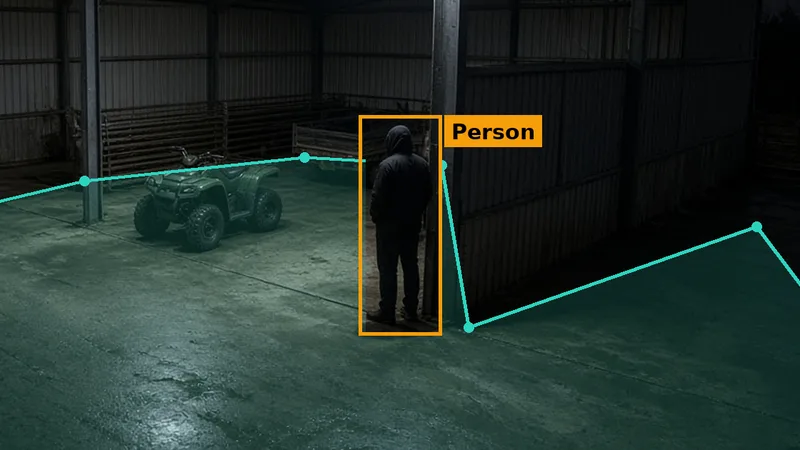
AI detection looks for particular things rather than any movement: a person, a vehicle, smoke or flame. It works on the video from the cameras you already have, and it lets you say where and when each kind of detection matters. You can draw a people zone over the machinery shed, a line across the farm gate, ask for an alert when a vehicle comes up the track at night, and keep smoke and flame detection running over the hay barn all day and all night. When something is detected, an alert with a snapshot and a short clip goes to the phones of the people you choose, so a person can look and decide what to do.
Animals are the question every farmer asks, and the honest answer is that it depends on where the cameras look and when they are armed. We do not promise that animals will never cause an alert. Animals and weather can cause alerts. What keeps alerts useful on a farm is the set-up: point cameras at buildings, stores, tanks, gates and tracks rather than fields and pens; draw zones tightly over doors, yards and stacks; use lines with a direction on gates; and arm people and vehicle detection only when nobody should be there. Our guide to reducing CCTV false alarms goes into more detail.
The value of an alert is time. A quad behind a locked door with a chain on it might take a few minutes to free; a GPS screen might take a few minutes to unbolt; a fire in a bale stack might take a few minutes to spread to the barn. An alert in the first minute, with a clip that shows whether it is a family member, a worker or a stranger, gives you the chance to put the lights on, call a neighbour or call 999 while there is still something to save.
Setting schedules on a farm
Farms do not keep office hours. People are in the yard before dawn for milking and feeding, late in the evening at lambing and harvest, and in and out at weekends. Detection that is armed at the wrong times will send alerts every time a family member fetches something from the shed. Detection that starts too late will miss the teatime and evening thefts the 2026 cases show.
The answer is a schedule that matches how your farm works, set separately for each zone and line. As an example, a people zone over the machinery shed and a zone round the fuel tank might be armed from 20:00 until 06:00, a line across the farm gate and vehicle detection on the track from 21:00 until 05:30, and smoke and flame detection over the barn left on around the clock. In winter, when it is dark by half past four, start times can move earlier, and at harvest or lambing they can move later.
Decide too who gets which alert. The person who lives nearest the yard might get every alert from the shed and the gate. Others might only get smoke alerts, or alerts from the outlying barn. If you use a monitoring company or a keyholder, they can receive alerts as well. The aim is that every alert goes to someone who can act on it, quickly.
Detection on the cameras you have
Most AI detection can now work with existing IP cameras rather than needing new ones, connecting over standard video protocols such as RTSP or ONVIF. Some older analogue systems need an encoder or an upgrade first, and cameras that give a poor picture at night will give poor detection at night too. A site assessment will show which of your cameras are suitable, which need moving or lighting, and where an extra camera would help.
What to do after a rural crime
If you find someone on your farm at night, do not confront them. Thieves who are disturbed can be violent, and hare coursers in particular have threatened and attacked farmers. Put lights on, call 999 if the crime is happening now, and stay safe. Note what you can from a distance: the number of people, what they look like, the vehicle, its colour and any part of the registration, and which way they went.
Afterwards, report the crime to the police and get a crime reference number. Give them serial numbers, photographs and marks for anything stolen, and any CCTV clips or tracker information. Tell your insurer as soon as you can. Report stolen machinery to the equipment register you use, and tell your rural watch scheme so neighbours can look out for it, and for the people and vehicle involved.
Then look at how it happened. Was a building left open, a key left in, a gate unlocked, a camera pointing the wrong way? Thieves often return, sometimes for the replacement, so fix the gap quickly. Many farms find that a theft is the moment they finally put in the changes they had been meaning to make for years.
Insurance
Insurers increasingly expect farms to take reasonable steps to protect what they insure, and many policies have conditions about how machinery, quads and GPS kit are kept. Read your policy for conditions on locked buildings, keys, immobilisers, trackers and marking, and ask your insurer what they recommend or require. Some insurers may offer better terms for farms with trackers, marking and good security.
Keep records that would support a claim: photographs, serial numbers, receipts, marking details and a list of what is kept where. Tell your insurer about changes such as new security, new cameras or a move to keeping kit in a different building. If you suffer a loss, the clips, records and crime reference number will make the claim easier, and will help police if they find the kit.
What the law says now and what is coming
Several recent laws bear on rural crime. Hare coursing offences under the Police, Crime, Sentencing and Courts Act 2022 have applied since August 2022, with prison, unlimited fines, dog disqualification orders and recovery of kennelling costs. The Dogs (Protection of Livestock) (Amendment) Act 2025 has applied in England and Wales since 18 March 2026, with unlimited fines and wider police powers.
Two more changes are on the way. The Equipment Theft (Prevention) Act 2023 will, once regulations are made, require new quad bikes and ATVs to be forensically marked and registered on a database, and could be extended to other equipment. The Crime and Policing Act 2026, which received Royal Assent on 29 April 2026, includes a new power in section 171 that will let police enter and search premises without a warrant where stolen goods have been located by electronic tracking. That matters for rural crime, because tracked quads, tractors and GPS kit are often located by their owners within hours. It is not yet in force.
Law changes slowly, and none of these replaces the basics. But together they make it harder to sell stolen kit, easier to recover it, and more costly for offenders who are caught.
A rural crime prevention checklist
The table below sums up the main steps for each part of a farm or rural site, and what cameras and AI detection add to them.
| What is at risk | Main risk | First steps | What cameras and AI add |
|---|---|---|---|
| Quads and ATVs | Taken from sheds at night | Locked building, keys out, anchor, mark, tracker | A people zone over the shed when the farm is quiet |
| GPS kit | Taken from cabs | Remove when parked, lock away, mark, register | A zone on the machinery shed doors at night |
| Tractors and machinery | Driven or loaded away | Park inside or blocked in, keys out, immobiliser, tracker | A line on the gate and vehicle detection on the track |
| Fuel | Drained overnight | Locked bunded tank, in view, levels checked | A people zone round the tank at night |
| Hay and straw | Arson and fire spread | Stack away from buildings and fuel, tidy barns | Smoke and flame detection, always on |
| Livestock | Theft and dog attacks | Count often, tag and record, check gates | Cameras on loading areas and yard gates |
| Boundary and gates | Vehicles getting in | One way in, gates that cannot be lifted, ditches | A line across the gateway, armed at night |
- The way in: one main route for vehicles, spare gaps blocked, gates locked and hung so they cannot be lifted.
- Machinery and quads: locked inside, keys out, anchored or clamped, marked, registered and tracked.
- GPS kit: removed when parked, locked away, serials recorded, marked and registered.
- Fuel: locked, bunded tank in view, lit, levels checked often.
- Hay and straw: stacked away from buildings, fuel and machinery; barns tidy and wiring checked.
- Livestock: counted often, tagged and recorded, fields near roads checked.
- People: everyone knows what to lock and where keys are kept; rural watch joined; every crime reported.
- Cameras: on the gateway, sheds, tank and barn, with light at night, and alerts that reach someone in minutes.
How Woodcock AI helps on farms and rural sites
Woodcock AI connects to existing IP cameras over RTSP or ONVIF and runs on an edge server on site or on a cloud server. It adds people, vehicle, smoke and flame detection to the cameras you already have. You draw polygon zones that fit the shape of your yard, shed or barn rather than a rough box, draw lines across gates and tracks, and set schedules so each one is armed only when the farm is quiet. When something happens, an alert with a snapshot and short clip goes to the phones of the people you choose, and an AI description says what the camera saw.
Woodcock AI is self-learning, so it gets better at telling the normal from the unusual on each camera over time. It is the result of years of development and is now in use on real sites in the UK. For how the same approach fits other rural sites, see our pages on farm CCTV for fire and intrusion, farm CCTV grants and equestrian yard security. Ask your cameras, a way to ask the system questions about what it has seen, is Coming soon, early 2027.
Ways to start
Start with a site assessment. We look at your yard, sheds, barns, tanks and the way in, which cameras you have and what each one sees by day and at night, and show where people zones, lines, vehicle detection and smoke detection would help. Or ask for a live test on your cameras: we connect two or three of your existing cameras for about a fortnight, so you can see the alerts for yourself before deciding.
Sources
- NFU Mutual, Rural Crime Report 2026 (claims data for 2025).
- NFU Mutual, Farm Fires Report 2026.
- National Police Chiefs’ Council, Rural and Wildlife Crime Strategy 2025 to 2028.
- National Rural Crime Network, National Rural Crime Action Week 2026, and West Mercia Police reporting from the week.
- legislation.gov.uk, Equipment Theft (Prevention) Act 2023, and GOV.UK, summary of call for evidence responses and conclusion.
- legislation.gov.uk, Crime and Policing Act 2026, section 171.
- legislation.gov.uk, Dogs (Protection of Livestock) (Amendment) Act 2025, and GOV.UK, new law to protect farm animals from dog attacks.
- legislation.gov.uk, Police, Crime, Sentencing and Courts Act 2022, offences relating to hares, and the Crown Prosecution Service, hare coursing guidance.
- Police appeals: Cambridgeshire Constabulary (Thorney and Guyhirn GPS, Soham GPS), Police Scotland (Coupar Angus quad), North Yorkshire Police (South Milford hay fire), Hertfordshire Constabulary (Maple Cross quad), and appeals by North Yorkshire Police, Dorset Police, Kent Police and Dyfed-Powys Police as reported in local news.
- Information Commissioner’s Office, Guidance on video surveillance, including CCTV.
We have summarised these sources in our own words. Always read the current versions in full. This page is general guidance, not legal, insurance or security advice; your installer, your insurer, your fire service, your local rural crime team and a solicitor can advise on your own farm or business.
Would you know if someone was in your yard tonight?
Book a site assessment and we will look at your yard, sheds, barns, fuel and the way in, and what your cameras see at night, and show where people zones, lines, vehicle detection and smoke detection would help, or ask for a live test on your cameras.
Related pages
Frequently asked questions
What is the most effective way to prevent rural crime?
There is no single answer, but most rural thefts need a vehicle, a way in and time without being seen. Keep one main way in with locked gates that cannot be lifted, lock quads, tools and GPS kit inside with keys out, mark and register machinery, join your local rural watch, and make sure someone finds out quickly, for example with camera alerts at night.
Is rural crime rising in the UK?
NFU Mutual estimates the cost of rural theft fell by 6% in 2025, a second yearly fall. But its Rural Crime Report 2026 found agricultural vehicle theft claims up 18%, quad and ATV theft up 31% and livestock theft up nearly 30%, with police warning of a new rise in GPS thefts in 2026. The picture varies by region.
When do most farm thefts happen?
Mostly from early evening through the night. In nine 2026 police appeals we looked at, stated times ran from 17:50, when a quad was taken in daylight, to just after 03:00. Locks and lighting should be in place from the end of the working day, and any scheduled camera detection should start in the early evening.
How do I protect a quad bike from theft?
Keep it in a locked building with the key out, secure it with a ground anchor and chain or a wheel clamp, mark it with a forensic marking kit, register the frame number and fit a hidden tracker. A camera zone over the shed at night means you can find out while thieves are still working on it.
Can CCTV cameras on a farm cause false alarms from animals?
Simple motion alerts trigger on animals, weather and headlights. AI detection looks for people, vehicles, smoke and flame instead, but we do not promise animals will never cause an alert. Pointing cameras at buildings, gates and tracks rather than fields, drawing tight zones and arming them only at night keeps alerts useful.
Does Woodcock AI work with the cameras we already have?
Woodcock AI connects to existing IP cameras over RTSP or ONVIF and runs on an edge server on site or on a cloud server. It adds people, vehicle, smoke and flame detection with polygon zones, lines and schedules. A site assessment or a live test on two or three of your cameras shows how it works on your own site.
Last reviewed 2 November 2026