

Christmas shutdown checklist for business premises: security and fire safety
A Christmas shutdown checklist is a written plan for closing business premises safely over the Christmas and New Year break. Plan four weeks ahead: name a shutdown lead, set a keyholder rota and check your insurance. Before closing, remove waste and combustibles from around the building, switch off non-essential equipment but keep alarms, cameras and frost heating on, lock every door, shutter and gate, and set a monitored intruder alarm. Inspect at least as often as your insurer requires, often every seven days, keep a log, and walk round outside and flush the water before reopening.

Last updated 3 November 2026. For most UK businesses the Christmas and New Year break is the longest time the premises stand empty all year. In 2026 Christmas Day falls on a Friday and Boxing Day on a Saturday, so the bank holidays in England and Wales are Friday 25 December, Monday 28 December and Friday 1 January. A unit that closes on Wednesday 23 December and reopens on Monday 4 January will have nobody on site for eleven nights in a row, in the coldest and darkest part of the year.
That is why insurers, the police and fire and rescue services all publish advice on closing a site properly, and why the same problems come up every January: a bin fire against a wall that nobody saw, a burst pipe that ran for a week, a break-in found on the first morning back, tools and materials gone from a building site, an alarm that was set but never reached anyone. This guide pulls that advice together into one Christmas shutdown checklist for business premises: offices, shops, workshops, warehouses, yards and construction sites.
We make AI smoke, flame, people and vehicle detection for existing CCTV cameras, so near the end the guide also explains where camera detection fits during a shutdown, and where it does not. It is not a fire alarm or an intruder alarm system and it does not replace any of the steps below. What it can do is watch the yard, the bin store and the gate when nobody is there, and send an alert with a short clip to the person who can act. Most of this page, though, is about the plain jobs that stop things going wrong in the first place.
Why the Christmas break is different
A business is not normally empty for long. Most premises are closed overnight and at weekends, and the out-of-hours plan is built around those gaps: an alarm, a keyholder, some lighting, perhaps a camera. Over Christmas the gaps join up. The site can be closed for ten days or more, staff are travelling or with family, contractors and suppliers are shut, and the neighbours who might notice smoke or a forced door are away too. Small problems have time to grow before anyone sees them.
The weather adds its own risks. Pipes freeze and burst in empty buildings where the heating has been turned right down. Short days mean long hours of darkness for anyone looking for an easy way in. Waste builds up in the last week before the break, from packaging, parties and year-end clear-outs, and it often ends up stacked against the back wall or in an overflowing bin by the fence. Aviva's loss prevention standard for unoccupied premises puts it simply: empty properties are more vulnerable to damage than similar occupied premises, "even if the vacancy is for a short period".
There is a legal side too. A Christmas shutdown does not pause your duties. The responsible person for fire safety still has to keep the premises safe for anyone who could be there or nearby, including security patrols, contractors who come in to work over the break, and people living above or next door. Employers still owe a duty to anyone they send to check the site, often alone and in the dark. Your insurance policy still applies, but it may have conditions about inspections, alarms and empty buildings that you need to meet.
None of this means a shutdown is unusually dangerous if you plan it well. It means the planning matters more than usual, and it has to be written down, shared with the right people and checked on the last day rather than left to memory. The rest of this guide sets out how.
What goes wrong: six incidents from the 2025 to 2026 break
The festive period is not a quiet time for fire and rescue services or for the police. Here are six incidents from the last Christmas and New Year break, all reported by fire and rescue services or the police and covered by local and national news. We have not named any business, and none of these premises is connected with Woodcock AI. They are here because they show the range of things that happen while people are away.
Boxing Day morning, Oxford. At about 06:00 on 26 December 2025, Oxfordshire Fire and Rescue Service was called to the former Lion Brewery on St Thomas Street, now apartments, after reports of a strong smell of burning. Crews from Rewley Road, Slade and Kidlington found a bin store well alight. A firefighter said afterwards that they were on scene quickly, or "this could have been much worse spreading to the flats above". The cause was not known when the story was published (Oxford Mail).
Boxing Day evening, Hampton. London Fire Brigade was called at 19:44 on Friday 26 December to Broad Lane in Hampton, where a single-storey workshop was completely destroyed. Six fire engines and around 40 firefighters attended, and the Brigade's control room took 35 calls about the fire. Two people were assessed at the scene by ambulance crews. The cause was under investigation (Twickenham Nub News).
Boxing Day evening, South Shields. Shortly before 19:00 on the same day, Tyne and Wear Fire and Rescue Service was called to an amusement arcade at Ocean Beach Pleasure Park on Sea Road. Six fire engines were sent and the fire was out by 03:30. Nobody was hurt. The fire service said it could not yet confirm a cause, and police said the fire was not being treated as malicious (BBC News).
New Year's Eve, Alconbury Hill. Cambridgeshire Fire and Rescue Service was called at 08:24 on Wednesday 31 December to a fire involving waste at a recycling centre on Alconbury Hill. More than 30 firefighters attended, smoke could be seen from a distance, and crews made regular inspections while the fire burned out. The service later confirmed the cause was accidental (Cambridgeshire Live).
2 January, Meadowhall Road. On the evening of Friday 2 January 2026 South Yorkshire Fire and Rescue Service was called to a large warehouse fire on Meadowhall Road, near the Meadowhall shopping centre. At its height about 20:30, ten engines and two turntable ladders were at the scene, and people living nearby were asked to keep their windows closed because of "a large plume of smoke". There were no reports of injuries, and an investigation into the cause began (BBC News).
Over the whole break, Drumnadrochit. Police Scotland appealed for information after two lodges under construction in the Polmaily area near Drumnadrochit were broken into at some point between Monday 22 December 2025 and Tuesday 13 January 2026. Tiles, building materials and tools were stolen from the site. Police asked anyone with dash-cam or private CCTV footage to come forward (STV News).
We do not know the cause of most of these fires, and it would be wrong to guess. But a few patterns are worth noting. Two of the fires began on a bank holiday evening, when most businesses nearby were shut. One was found because people noticed the smell. Waste and stored goods were involved in several, and they burn quickly once they catch. And in the Drumnadrochit case, the break-in could have happened on any of more than twenty days, which tells you how long it can be between one person seeing a site and the next. A shutdown plan is mostly about closing those gaps: less to burn, fewer ways in, and someone told quickly when something does go wrong.
The wider figures point the same way. In the year ending March 2026, fire and rescue services in England attended 13,679 fires in buildings other than homes, such as offices, shops, factories and warehouses, 3.7% more than the year before. The average response time to those fires was 9 minutes 12 seconds (MHCLG fire statistics). Response time starts when the call is made. When nobody is on site, the time before the call can be far longer than the time after it.
Plan the shutdown: dates, people and keys
The best shutdowns are planned a month ahead and run from a single written plan. That plan does not need to be long. It needs to say when the site closes and reopens, who is responsible for what, who holds keys, who checks the site during the break and how often, what the alarm company and insurer need to know, and what gets done on the last day. Everything else on this page is detail that feeds into it.
Pick one shutdown lead
Give one person ownership of the plan. On a small site that may be the owner or office manager; on a larger one, the facilities or site manager. Their job is to make sure the plan is written, the jobs are given out, the last-day checks are done and signed, and the rota for the break is confirmed. They do not have to do every job themselves, but they should be the person who says the site is ready to close.
Write down the dates and who is around
Start with the closing time on the last day and the opening time on the first day back. Then list who, if anyone, will be on site during the break: maintenance contractors, cleaners, a skeleton crew, deliveries, a security patrol. Each of those visits needs to be known in advance, so that alarms, camera schedules and keyholder rotas can allow for them, and so that anyone arriving at an empty site knows the rules for working alone.
Keyholders: a rota, not a list
Every business has a keyholder list somewhere. Over Christmas that list needs to become a rota with dates, so that on any given night someone is named, reachable and close enough to respond. Zurich's temporary closure guidance asks for enough keyholders to be available to respond to an alarm "within 20 minutes" (Zurich), and police.uk advises keeping a list of keyholders who can be contacted in an emergency, with keys kept off the premises and only designated staff holding them (police.uk). Ecclesiastical points out that you need your own keyholder arrangements because the police may not respond to every alarm (Ecclesiastical).
Ask each keyholder in person whether they will actually be around on their dates, and whether they will have their phone with them. Give the alarm company and any monitoring centre the same rota. Record who holds which keys, as Aviva's standard suggests, and get back any keys held by people who have left (Aviva). If you use a keyholding service, check its own Christmas cover.
Tell your insurer or broker
Many commercial policies have conditions that apply when premises are unoccupied, and some define unoccupied by a number of days. A normal Christmas closure may well fall inside what your policy already allows, but you should check rather than assume. Aviva's standard advises telling insurers about any change in occupancy (Aviva). If your policy requires weekly inspections, a working intruder alarm, or certain services to be turned off, those become fixed items on your plan.
Book what needs booking
Waste collections, skip exchanges, repairs to broken lighting or fencing, alarm servicing and boiler checks all get harder to book as December goes on, because the firms that do them are closing too. Two weeks out, ask for a final waste collection as close to your last day as possible, and get any outstanding faults fixed. If you have hot work or contractor jobs planned over the break, agree the permits and supervision now.
Fire: less to burn, fewer ways to start
Fire is the risk that does the most damage during a long closure, because a fire in an empty building can burn for a long time before anyone calls 999. Aviva's standard notes that deliberate fires in empty premises often use combustible materials found near the building, and that they tend to happen at night. The aim of the fire part of your shutdown is to leave as little as possible to burn, especially outside and against the walls, to remove the usual sources of ignition, and to make sure the systems that warn of a fire are working and will reach someone.
Clear the waste and the yard
The week before Christmas produces more waste than most: packaging from the last deliveries, cardboard from the stock room, food and drink from the party, and the year-end clear-out of the office. Book a final collection as close to the last day as you can. Zurich's closure guidance asks for all external waste, pallets and empty skips to be removed before the site closes, and for bins to be emptied and moved at least 10 metres from the building, or fitted with lockable lids (Zurich). Ecclesiastical asks for combustibles and waste bins to be kept at least 20 metres from buildings (Ecclesiastical), and the government's fire safety guide for offices and shops says skips should normally be at least 6 metres from any part of the premises (GOV.UK).
Those figures differ because they come from different insurers and guides, written for different kinds of premises. The point they share is that waste and combustibles should not sit against the building, under windows or eaves, or next to doors and shutters. If you cannot get a collection, lock the bins in a compound away from the building or chain them to a fixed point well away from the walls. Police.uk adds a security reason: wheelie bins can be climbed to reach a first-floor window, so they should be stored away (police.uk).
Walk the outside of the building on the last afternoon, in daylight, and look at it the way someone with a lighter would. Pallets stacked against a shutter, cardboard bales by the loading door, a skip pushed up to the wall, bags of rubbish left by the back door because the bin was full: all of these should go. The National Business Crime Centre puts it neatly for empty premises: lock away anything that could be stolen, used as a climbing aid or targeted for arson (NBCC).

Switch off what does not need to run
A building that is empty for eleven days has no need for most of what is plugged in, and every appliance left on is one more thing that could fail with nobody there to notice. Zurich asks for non-essential electrical equipment and utilities to be shut down (Zurich). In practice that means switching off and unplugging computers that do not need to run, printers, kettles, fridges that have been emptied, portable heaters, decorations and any battery chargers for tools, phones, bikes or scooters. Do not leave anything charging over the break.
Be careful not to go too far. Aviva says non-essential services should be turned off, but heating, fire protection, intruder alarms and video surveillance should be kept running (Aviva). The National Business Crime Centre warns that turning off utilities can disable alarms and CCTV, and that fire safety needs must be considered before anything is isolated (NBCC). Before you turn off the main switch, find out which circuits feed the fire alarm panel, the intruder alarm, the cameras and their recorder, any network equipment they need, and any heating used to stop pipes freezing.
Leave the fire systems working
Your fire alarm and any sprinkler system should stay fully working during the break. Zurich's guidance asks for fire and sprinkler systems to be kept operational and for any faults on the fire alarm to be put right (Zurich). Aviva recommends that the fire alarm is remotely monitored, so that a signal reaches someone even when the building is empty (Aviva). If yours is not monitored, decide now who will hear it and what they will do: a sounder ringing inside a closed unit on an industrial estate at 3am may not be heard by anyone.
Check the panel on the last day and clear any faults, or get them fixed before you leave. Close all internal fire doors, as Zurich asks, so that a fire that does start is held back. Keep escape routes clear for anyone who does need to come in during the break, such as a keyholder answering an alarm or a contractor.
Hot work, heaters and flammables
If you have building work, maintenance or repairs going on, stop hot work before the break or make sure it is properly controlled. Zurich's construction checklist asks for hot work to be put off where possible, and where it goes ahead, for the permit system to be followed (Zurich). Lock flammable liquids and gas cylinders away in their proper stores, drain fuel from anything that does not need it, and make sure the stores are not next to the building wall. Aviva's checklist asks whether oil tanks and other fuel on site have been drained or removed for longer closures (Aviva).
Your fire risk assessment should already cover how your premises are used at quiet times. If the break changes things, for example because stock is being stored in a different place, a contractor is coming in, or there will be nobody on site to hear an alarm, review the assessment and record what you have done. Our guide to the fire risk assessment explains how.
Security: make it hard to get in and quick to be found
Crime against businesses is common at any time of year. In the Home Office's 2023 Commercial Victimisation Survey, 26% of business premises in the sectors surveyed had experienced at least one crime in the previous year, 14% had experienced theft and 8% burglary, including attempts (Home Office). A Christmas closure adds two things a burglar likes: a long stretch of time in which a break-in may not be noticed, and a building whose neighbours are probably shut too. Metal thieves benefit in the same way; Aviva notes that metal theft from empty buildings sometimes only comes to light when someone inspects the site (Aviva).
The National Business Crime Centre's advice for vacant commercial premises is to review security in layers, starting at the boundary and working inwards (NBCC). That is a useful order for the last-day walk round too.
The boundary and the gates
Walk the fence line. Look for gaps, damaged panels, gates that do not close properly, padlocks that have rusted and places where something has been stacked against the fence on either side. The NBCC recommends a boundary of at least 2.1 metres high (NBCC), and NFU Mutual's programme for unoccupied buildings asks for perimeter fencing of 2.4 metres (NFU Mutual). You will not put up new fencing in the last week before Christmas, but you can fix what is broken, and you can make sure every gate is locked on the last day.
If your yard is open to vehicles, think about blocking the entrance during the break. The NBCC suggests heavy concrete blocks or security-rated bollards across an entrance when a site is closed, and notes that parking your own vehicles in front of building entrances can make them harder to reach, provided it is safe and does not break fire safety rules (NBCC). Aviva makes the same point about fly-tipping: sites with easy vehicle access are targeted, and blocks across the entrance can stop it (Aviva). If you do this, make sure the fire service and your keyholders can still get in when they need to.
The yard: light, sightlines and nothing to climb
Police.uk advises keeping the outside of the premises tidy, making sure there is good lighting around the building, especially at loading areas, and pruning bushes and trees that could give someone cover (police.uk). The NBCC recommends low-level dusk-till-dawn lighting, with motion-sensor lighting added where needed. Check every external light works before you go, and check the timers or photocells, because a light that comes on at 18:00 in summer settings may leave the yard dark for two hours in late December.
Take away anything that helps someone climb or break in: wheelie bins, pallets, ladders, scaffold boards, tools left in the yard. Lock ladders away or chain them. Move vehicles and plant into a secure area, take the keys off site, and lock fuel away. On a building site this is a long list, which is why construction sites get their own section below.
The building: doors, shutters and windows
Check every door, shutter and window on the last day, including the ones nobody uses: the side door to the plant room, the fire exit at the back of the warehouse, the roof hatch, the first-floor toilet window. Police.uk asks for service doors to be locked when not in use and for weak points to be made more secure (police.uk). Fire exits must still open from the inside for anyone who is in the building, but they should be closed and secured from the outside. Draw the blinds on ground-floor offices if equipment is visible from outside.
The NBCC suggests a timer switch on some internal lights to give "the illusion of occupancy" (NBCC). That works best if the lights come on and off at sensible times rather than staying on all night.
Inside: stock, cash and keys
Police.uk's advice for keeping burglars out of a business covers most of what to do inside (police.uk): move high-value goods away from display windows, keep stock out of sight and stock rooms locked, try not to keep cash on the premises, use a bolted-down safe, and never leave keys on site. Bank the takings before you close. Lock laptops, tools and small valuable items away, or take them off site with a record of who has what. Police.uk also mentions smoke-generating security devices that fill a room with a harmless fog if someone breaks in; the NBCC mentions fogging systems too.
If you run a kitchen, police.uk warns that used cooking oil is a target for thieves, so lock the oil store or have it collected before the break.
The intruder alarm
Your intruder alarm is one of the most important parts of the shutdown, and one of the easiest to get wrong. Zurich asks for the alarm to be set and to signal remotely (Zurich). Aviva recommends that it is remotely monitored at an alarm receiving centre (Aviva), and police.uk says to make sure you have a monitored alarm that is fully working, and points to the National Security Inspectorate and the Security Systems and Alarms Inspection Board for approved installers (police.uk).
Check that the alarm has been serviced, that there are no faults on the panel, and that the alarm company has your keyholder rota with working phone numbers for every day of the break. Watch out for the effect of Christmas itself on the detectors: decorations, stock moved into the office, new racking or a pallet left in front of a sensor can all block what it sees. Set every zone on the last day, and if you have a monitoring centre, ask them to confirm the system is set before you drive away.
Water and heating: the cold-weather risks
A burst pipe in an empty building can do as much damage as a small fire, because the water keeps running until someone finds it. Aviva's standard warns that if mains water is left on during the colder months, pipes can burst when the water inside them freezes, and that these incidents can go undiscovered for some time in an empty building (Aviva). Over a Christmas break that can mean a week or more of water running through ceilings, across floors and into stock and electrics.
Keep enough heat, drain what you can
Do not turn the heating off completely. Set it low enough to save energy but high enough to stop pipes, tanks and wet systems freezing, and use the frost setting if your system has one. Aviva says that where a sprinkler system is permanently charged with water, the heating should stay on frost-stat control to keep at least 4°C at all times. Ecclesiastical's guidance for unoccupied buildings says that where water systems cannot be isolated and drained down, a minimum temperature of 10°C should be kept (Ecclesiastical).
For a typical Christmas closure, most businesses keep the heating on a low or frost setting rather than draining everything down. If you have parts of the building with no heating, such as an outbuilding, a toilet block or a yard tap, isolate and drain them if you can, and lag any exposed pipes. Make sure the keyholders know where the stopcock is, and that it can be reached and turned. Clear gutters and drains before you go, as Aviva's checklist suggests, so that heavy rain or melting snow can get away (Aviva).
Water hygiene when you come back
Water that sits still in pipes and tanks for a long time can allow legionella bacteria to grow. The Health and Safety Executive's guidance on hot and cold water systems says that infrequently used outlets should be flushed through regularly, weekly, that incoming and stored cold water should be kept below 20°C, and that hot water should be stored at 60°C or more (HSE). If you have a legionella risk assessment, follow what it says for periods when the building is empty. If someone visits the site during the break, running the taps and showers they pass is a sensible addition to their checks. On the first morning back, run the outlets through before anyone uses them, and record that you have done so. HSE's main legionella pages explain the duties in more detail.
IT, data and the office
A long break is also a good time for an attacker to try your systems, because nobody is watching the inbox or the logs. The National Cyber Security Centre's guide for small organisations covers the basics: backing up your data, protecting devices and accounts, and spotting scams (NCSC). Before the break, make sure your backups are working and that a recent copy is held somewhere separate. Install any waiting updates, and turn off and lock away laptops and devices that will not be used.
Agree who will look at the business email during the break, because fake invoices and payment requests often arrive when people are away. Set out-of-office messages that say the business is closed, but think about how much you say in them, and on social media, about exactly when the premises will be empty. The same goes for signs on the door. A short "closed until 4 January" notice is common and helpful to customers; a detailed note on how long the building will be empty is not.
Insurance, inspections and the log
Your insurance policy is the first thing to read when you plan a shutdown, because its conditions decide what you must do, not just what is sensible. We are not insurers and cannot tell you what your policy says, but the insurer guidance we have read for this page shares some common themes. Aviva, NFU Mutual, Zurich and Ecclesiastical all publish guidance on empty or temporarily closed premises, and they ask for broadly the same things.
Inspections every seven days. Aviva asks for weekly internal and external inspections by a competent person, with a log kept (Aviva). NFU Mutual asks for the inside and outside of buildings to be inspected at least every seven days by an appropriate person, with details and observations logged and records kept (NFU Mutual). Zurich's closure guidance asks for a weekly inspection inside and out, and reminds businesses to risk assess lone working for the person who does it (Zurich). For an eleven-night closure, one or two visits fit that pattern; many businesses choose more.
A log that proves it. Ecclesiastical's guidance includes a weekly building inspection log, and both Aviva and NFU Mutual ask for records. Keep a simple sheet: the date and time of each visit, who went, what they checked, what they found and what they did about it. Photos on a phone help. If something does go wrong, a log shows the claim handler that you did what the policy asked.
Services and alarms. Aviva asks for non-essential services to be turned off while heating, fire protection, alarms and video surveillance are kept running, and for intruder and fire alarms to be remotely monitored. If your policy names a particular alarm grade or monitoring arrangement, make sure it is working and set before you leave.
During the break: checks, alerts and who responds
Once the site is closed, three things keep it safe: the systems you left running, the people on the rota, and the checks you agreed. The plan should say who visits, on which days, what they check and how they record it, and what happens when an alarm or alert goes off.
Check visits
For a closure of eleven nights, a common pattern is a visit part way through the break and another just before reopening, with extra visits after storms, heavy frost or snow. Insurer guidance generally asks for at least one inspection every seven days, so check what your own policy says. The person who goes should look at the outside first, including the fence line, gates, yard, roof line and any outbuildings, then go inside and check for water, heat, faults on the alarm panels, doors and windows, and anything out of place. Before they leave, they reset the alarm, lock up and fill in the log.
Visiting an empty site alone in the dark is lone working, and it needs a risk assessment, as Zurich's guidance points out (Zurich). Keep it simple: the visitor tells someone when they are going and when they expect to leave, takes a charged phone and a torch, and checks in when they are done. If they find signs of a break-in, such as a forced door, broken glass or a cut fence, they should not go in. They should move away, call the police and wait for them.
Remote checks
Many businesses can now look at their cameras from a phone. The NBCC notes that some CCTV systems link to an app so you can monitor your buildings (NBCC), and NFU Mutual says CCTV may be monitored remotely, for example by a monitoring centre (NFU Mutual). A quick look at each camera once a day is a useful extra, especially for spotting things a visit might miss between days: a gate that has blown open, a vehicle in the yard, snow on the roof, water on a floor. It is not a replacement for a visit, because cameras do not see everything, and it only works if someone actually does it every day.
Before the break, make sure the camera system, recorder and internet connection will stay powered, that the app works for each keyholder, and that the camera views still show what they need to. Lights that come on at different times in winter, new stock, or decorations can all change what a camera sees.
When an alarm or alert goes off
Write down what should happen, because being woken at 2am on 27 December is not the time to work it out. For fire or smoke, the first step is always 999. For a possible break-in, the keyholder should check what they can, such as a camera clip or a call from the monitoring centre, then call the police if there are signs of a crime in progress. Nobody should go into the building alone or confront anyone they find there. The keyholder's job is to meet the police or fire service safely, let them in, and then secure the building, reset the alarm and record what happened.
The first day back
Reopening deserves as much care as closing. The first person in should walk around the outside before unlocking anything, looking for forced doors or windows, damage to the fence, signs of fire or smoke, and water coming out from under doors. If anything looks wrong, they should stay outside and call the police or fire service as appropriate. Once inside, unset the alarm and check the panel for any events during the break, and do the same with the fire alarm panel.
Then work through the building. Run taps and showers through before anyone uses them, following HSE's guidance and your own water risk assessment (HSE). Switch power back on in a sensible order, check the heating and the freezers, and look for water damage in places that are not visited every day, such as plant rooms, roof voids and store rooms. Check stock and equipment against what was there before the break. Record what you found in the log, report any crime to the police, and tell your insurer about any damage as soon as you can.
Finally, hold a short review. What went well? Did the rota work, did anyone get an alert they could not act on, and did the waste collection happen in time? Write it down while it is fresh, and file it with the plan for next year.
Construction sites over Christmas
Building sites have their own shutdown problems. They are often open to view, have tools, materials and plant stored outside, and may have parts of a structure that are not yet secure. The lodges near Drumnadrochit, broken into some time over the three weeks after 22 December, are a typical case: tiles, building materials and tools were taken while the site was quiet (STV News).
Zurich publishes a temporary construction site closure checklist that covers the same ground as the rest of this guide, with a few site-specific additions (Zurich). It asks whether the fence is complete and effective, whether gates are locked, and for checks for signs of access; whether external lighting works and whether CCTV is operational with enough lighting; whether hot work can be put off or switched to a lower-risk method; and whether hot work permits are being followed. It also asks for waste, pallets and empty skips to be removed, and for the fire alarm and any sprinklers to be working.
On top of that, take ladders off scaffolds or lock them, immobilise and lock away plant and take the keys off site, empty tool stores of anything that can be carried, and lock remaining tools in a secure container. Tell neighbours who to contact if they see something. Our guide to construction site security covers this in more depth.
Where cameras and AI detection fit
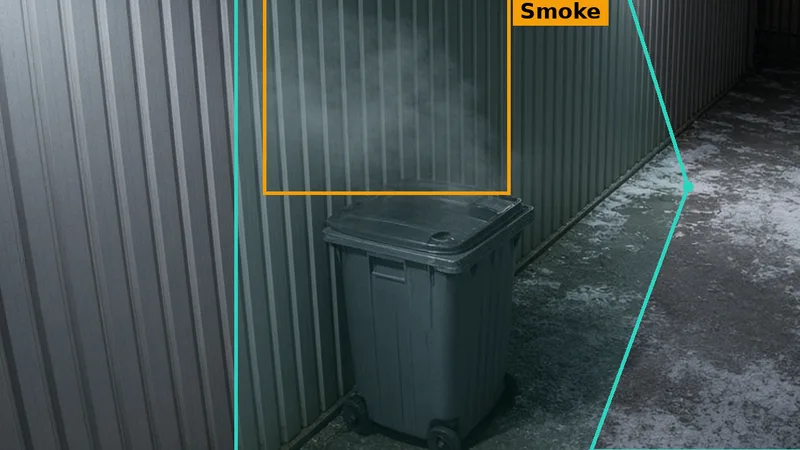
Most of a Christmas shutdown has nothing to do with cameras. Clearing waste, locking up, setting the alarm, keeping the heating on and visiting the site do the heavy lifting. But two gaps remain however well you plan: the outside of the building, where a fire alarm inside cannot see, and the long stretches between visits, when nobody is looking. A bin that catches fire at 02:17 on 27 December may burn for a long time before anyone passes.
That is where AI detection on the cameras you already have can help. Smoke and flame detection on a camera watching the yard, the bin store or the loading bay can send an alert while the smoke is still thin. People detection on the gate or the compound can tell the keyholder that someone has walked onto a site that should be empty. A polygon zone covers exactly the area that matters, such as the bins or the gate, rather than the whole view including the road, and a schedule arms it for the dates of the closure. Alerts go to the keyholders on the rota, with a snapshot, a short clip and an AI description of what the camera saw.
Write it into your plan as what it is: an extra layer of early warning for the outside of the building and for people on site while it is closed, covering named areas, with named people who receive the alerts and a written action for each kind of alert. For smoke or fire, that action is 999. For a person on site, it is to check the clip and call the police if needed, never to go and confront them. Clips are also useful afterwards, for the police and for your insurer.
Different kinds of premises
Each kind of premises has its own priorities over the break. Choose one below to see what matters most, and where cameras could help.
Which kind of premises?
Shops and offices should bank the takings, move high-value goods out of windows, lock stock rooms, unplug equipment, set the alarm and chain or lock the bins well away from the back wall. Keep blinds closed where equipment is visible. A camera on the rear yard, with smoke, flame and people zones armed for the break, covers the bins and the back door while the street is quiet.
Bins, cash, stock and windows
Workshops, warehouses and yards should clear pallets and waste off the walls, lock the gate and block vehicle access, switch off machines and chargers, keep frost heating on and know where the stopcock is. Smoke and flame zones over the yard and loading bay, and people zones on the gate, armed for the break, watch the outside; a daily look at the inside cameras can catch water or damage early.
Yards, loading bays, water and power
Construction sites should check the fence line and gates, lock or remove ladders, immobilise plant and take the keys away, empty tool stores, stop hot work and remove waste. A people zone over the entrance and compound, armed for the break, and smoke and flame zones over waste and stored materials, add early sight on a site where nobody may pass for days.
Fencing, plant, tools and hot work
Each kind of premises has its own shutdown priorities.
What AI on your cameras is not
Be clear about the limits. Smoke and flame detection on cameras is not a fire alarm system, and people detection is not an intruder alarm. Neither replaces the alarms, monitoring, locks, inspections and keyholder arrangements described above, and neither meets an insurance condition on its own. They see only what the cameras can see, so rooms without cameras, dark corners and views blocked by stock stay blind. And someone still has to look at the alert and act. For more on how this works, see our guides to out-of-hours site security and arson prevention with CCTV.
Cameras and privacy
If your cameras capture people, UK GDPR and the Data Protection Act 2018 apply, whether or not the site is open. The ICO's video surveillance guidance covers installation, management, operation, public awareness and signage. Have a clear purpose for each camera, keep signs in place, keep views on your own site rather than neighbouring homes, and keep recordings only as long as you need them. Our guide to AI CCTV and GDPR in the UK explains how AI detection fits into this.
Christmas shutdown checklist
Here is the whole checklist in one place. Print it, add your own items, and give one copy to the shutdown lead and one to each keyholder.
Four weeks before
- Write down the closing and reopening dates and times
- Name a shutdown lead
- Draw up a keyholder rota with dates and confirm each person
- Read your insurance policy and tell your insurer or broker if required
- Agree who visits during the break, how often, and how visits are logged
- Book contractors, permits and supervision for any work over the break
Two weeks before
- Book a final waste collection as close to the last day as possible
- Fix broken lights, fences, gates, locks and alarm faults
- Give the alarm company the keyholder rota
- Check backups and install waiting updates
- Check every camera view, the recorder and remote access
The last week
- Move pallets, cardboard, skips and waste away from the building
- Lock bins away or chain them well away from the walls
- Lock away ladders, tools and anything that can be climbed
- Move high-value goods out of windows and lock stock rooms
- Bank the takings; leave no cash on site
The last day
- Walk the outside in daylight, then the inside
- Switch off and unplug non-essential equipment and chargers
- Keep power to alarms, cameras, sprinklers and frost heating
- Set heating to frost protection; drain what you can
- Close internal fire doors; check exits open from inside
- Clear faults on the fire alarm panel
- Lock every door, window, shutter and gate
- Set the intruder alarm and confirm it is set
- Sign off the checklist and file it
During the break
- Visit at least as often as your policy requires
- Look at the cameras each day if you can
- Follow the alert plan: 999 for fire, never go in alone
- Log every visit, alert and action
The first day back
- Walk round outside before unlocking
- Check alarm and fire panels for events
- Run taps and showers through and record it
- Restore power in order; check for water damage
- Report damage or crime; review the plan for next year
A worked example
Here is how the checklist might look for a fictional small engineering workshop with a yard on an industrial estate, closing at 17:00 on Wednesday 23 December and reopening at 07:00 on Monday 4 January. It is an example, not a real business.
Four weeks out, the owner names the workshop manager as shutdown lead. The manager checks the insurance schedule, which asks for weekly inspections while the premises are closed, and draws up a rota: two keyholders, each covering half of the break, both living within twenty minutes. The alarm company gets the rota. Two weeks out, the manager books the last skip exchange for 22 December and gets a broken yard light fixed. In the last week, the team moves the pallet stack away from the shutter, chains the bins to the far fence and locks the gas cylinders in their cage.
On 23 December the manager walks the yard and the workshop, switches off the machines and chargers, leaves the heating on frost protection, clears a fault on the fire alarm panel, closes the fire doors, locks up and sets the alarm, then signs the checklist. During the break, the keyholder visits on 29 December and again on 2 January, logs each visit and looks at the cameras each evening on their phone. On 4 January the manager walks round outside, finds nothing wrong, runs the taps through and switches the machines back on. At the review, the team notes that the skip exchange nearly did not happen and decides to book it a week earlier next year.
How Woodcock AI fits a Christmas shutdown
Woodcock AI connects to existing IP cameras and runs on an edge server on site or on a cloud server. It adds smoke and flame detection, and people and vehicle detection, to the cameras you already have. For a shutdown, you draw polygon zones over the places your plan has flagged, such as the bins, the yard, the loading bay and the gate, give them a schedule for the dates of the closure, and choose which keyholders get the alerts. Each alert has a snapshot, a short clip and an AI description of what the camera saw.
Woodcock AI is self-learning, so it gets better over time at knowing what is normal on each camera, such as frost haze under a light, steam from a vent on a cold morning or headlights crossing the yard. It is the result of years of development and is now in use on real sites in the UK. It works alongside your alarms, your shutdown plan and your keyholders rather than replacing them. For more, see AI smoke and fire detection on cameras. Ask your cameras (coming soon, early 2027) will let you type a question about what the cameras have seen.
Ways to start
Start with a site assessment. We walk your premises from the outside in, look at what each camera sees by day and after dark, and show where smoke, flame and people zones would cover the gaps in your shutdown plan. Or ask for a live test on your cameras: we connect two or three of your existing cameras for about a fortnight, so you can see the alerts for yourself before the break. We are also happy to arrange an on-site demo.
Sources
- Zurich, temporary closure security guidance and construction site closure checklist (PDF, 2020, hosted by the GCMA).
- Aviva, Loss Prevention Standards: unoccupied premises (PDF, version 1.4, August 2024).
- NFU Mutual, risk management programme for the protection of unoccupied buildings (PDF); Ecclesiastical, unoccupied buildings (PDF).
- National Business Crime Centre, vacant commercial premises (PDF); police.uk, keep burglars out of your business.
- Health and Safety Executive, hot and cold water systems: things to consider and legionella and Legionnaires’ disease.
- National Cyber Security Centre, small organisations guide to cyber security; GOV.UK, UK bank holidays.
- Home Office, fire safety risk assessment: offices and shops, fire and rescue incident statistics: year ending March 2026 and Commercial Victimisation Survey 2023.
- Incident reports: Oxford Mail, Twickenham Nub News, BBC News (South Shields), Cambridgeshire Live, BBC News (Meadowhall Road) and STV News.
- Information Commissioner's Office, video surveillance guidance.
We have summarised these sources in our own words. Guidance is updated from time to time, so read the current versions, and always follow your own insurance policy wording first. This page is general guidance, not legal or insurance advice. In an emergency, always call 999.
Who would see smoke in your yard on 27 December?
Book a site assessment and we will walk your premises from the outside in, look at what your cameras can see by day and after dark, and show where smoke, flame and people zones would cover the outside of the building and the gaps between visits over the break, or ask for a live test on your cameras.
Related pages
Frequently asked questions
What should be on a Christmas shutdown checklist?
Dates and a named shutdown lead; a keyholder rota; a check of your insurance conditions; a final waste collection and a clear yard; non-essential equipment switched off but alarms, cameras, sprinklers and frost heating left on; fire doors closed; every door, window, shutter and gate locked; a monitored intruder alarm set; a plan for check visits and alerts; and a walk round, water flush and log on the first day back.
How often should empty business premises be checked over Christmas?
Follow your insurance policy first. Published insurer guidance for empty premises, from Aviva, NFU Mutual and Zurich, commonly asks for inside and outside inspections at least every seven days, with a log of each visit. For an eleven-night closure many businesses visit part way through and again before reopening, with extra visits after storms or heavy frost.
Should I turn the heating off when closing for Christmas?
Usually not. Keep enough heat to stop pipes, tanks and wet systems freezing, using a frost setting if you have one. Aviva says wet sprinkler systems need frost-stat heating to at least 4°C, and Ecclesiastical says that where water systems cannot be drained, a minimum of 10°C should be kept. Drain and isolate unheated parts of the building where you can.
Should I turn off the electricity when my business closes for Christmas?
Switch off and unplug non-essential equipment, including chargers, heaters and kettles, but do not simply turn off the main switch. Alarms, cameras, their recorder and network, sprinklers and frost heating need power. The National Business Crime Centre warns that turning off utilities can disable alarms and CCTV, so check which circuits feed them first.
Do I need to tell my insurer my business is closed over Christmas?
Check your policy. Many commercial policies have conditions for unoccupied premises, sometimes triggered after a set number of days, and insurer guidance such as Aviva’s advises telling insurers about changes in occupancy. A normal Christmas closure may fall inside what your policy allows, but you should confirm rather than assume, and follow any inspection or alarm conditions.
Can CCTV or AI detection replace an alarm over the Christmas shutdown?
No. AI smoke and flame detection on cameras is not a fire alarm, and people detection is not an intruder alarm. Keep both alarms working and monitored. AI detection adds early warning of smoke, fire and people outside the building and between visits. Woodcock AI runs on an edge server on site or on a cloud server and works alongside your alarms and keyholders.
Last reviewed 3 November 2026
Give the cameras a health check before the break: see our CCTV maintenance checklist for business.