

Garden centre security: night break-ins, outdoor stock theft and fire
Garden centre security means protecting a garden centre or nursery’s shop, café, outdoor plant area, display stock, yard and stores from break-ins, theft, arson and fire, most of all at night when the site is closed. The basics are sound fences and gates, bringing small stock and climbing aids in at closing, lighting, an intruder alarm on the buildings, LPG cylinders in a proper cage, and compost, pallets and bins kept away from walls. AI on the cameras already on site then flags people in the plant area, vehicles at the yard gate and smoke outside, with the clip in every alert.

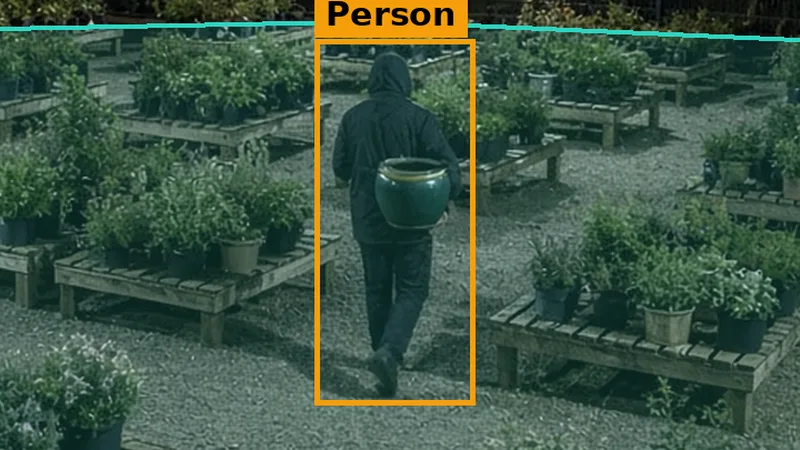
Last updated 1 November 2026. By day a garden centre is one of the busiest places in town: families in the café, gardeners filling trolleys in the plant area, deliveries in the yard. At closing time the doors are locked, the tills are emptied and the staff go home, and the site is left until someone comes in to water the next morning. Most of the stock does not go anywhere. It stays outside all night: benches of shrubs and perennials, rows of glazed pots, statues and bird baths, garden furniture, sheds and summerhouses, barbecues, bagged compost and bark, and often a cage of gas cylinders.
Those empty hours are when garden centres are broken into, when plants, pots and ornaments are carried over the fence, when glass fronts are smashed for the cash and charity boxes inside, and when potting sheds, storage units and stacks of stock catch fire with nobody there to see the first smoke. This guide covers the main risks to UK garden centres and plant nurseries, what the figures and recent cases show, what the garden retail trade body and the police recommend, where cameras should watch, and how AI on the CCTV already on site can watch the plant area, the fences, the yard, the shop front and the stores. It is written for owners and managers of independent and group garden centres, retail and wholesale nurseries, farm shops and garden shops with outdoor sales areas, and the installers who look after their cameras.
What are the main security risks to a garden centre?
A family-run nursery down a country lane, a big destination garden centre on a ring road with a restaurant and a gift hall, and a small garden shop behind a high street look very different. But most face the same four kinds of risk, and three of them peak when the site is closed.
- Night break-ins. Burglaries of the shop, the café, the office and the stores, usually for cash, charity boxes, tools, gift stock and anything easy to sell.
- Outdoor stock theft. Plants, pots, statues and ornaments, garden furniture, barbecues and tools taken from the outdoor plant area and displays, often over a fence.
- Fire. Fires in potting sheds, storage units, staff rooms and café kitchens, in stacks of compost, bark and timber, and in bins and pallets against walls, some started deliberately.
- Daytime theft. Customers taking small, easy-to-pocket lines such as seed packets and secateurs while the shop is open.
These risks overlap. A thief who climbs into the plant area at night can reach the back door of the shop. A pallet of compost parked against the potting shed is a fire risk as well as a climbing aid. The same side gate that lets a supplier’s lorry into the yard lets a van in at 2am. That is why garden centre security works best when it is planned for the whole site, from the car park to the back fence, rather than one building at a time.
The cost of an incident is often far bigger than the value of what was taken. A burglary means broken glass, a closed shop while it is made safe, staff time spent on the police and the insurer, and stock that has to be counted and reordered. A fire can shut a garden centre for weeks in the middle of the season, and smoke can spoil stock that the flames never touched.
How many garden centres are there in the UK?
Garden centres are part of everyday life for millions of people. According to the Horticultural Trades Association’s Garden Industry Statistics 2026, there are an estimated 1,500 garden centres and retail nurseries in the UK, there were an estimated 203 million visits to garden centres in 2025, and 67% of UK adults said they visited a garden centre at least once that year. Many are as much about food as plants: the HTA estimates 142 million visits to garden centre cafés and restaurants.
Those figures explain the risk. A garden centre is a busy retail business with a café, a gift shop and a large outdoor sales area, much of it stocked with goods that are heavy, valuable and left outside overnight. Behind it may be a growing nursery with glasshouses, polytunnels, potting sheds and machinery. The HTA, which represents the garden industry, has over 1,400 businesses among its members.
Garden centres are retail premises, and retail crime is high. The Home Office Commercial Victimisation Survey 2023 found that premises in the wholesale and retail sector had a higher prevalence of crime than other commercial sectors, with 41% experiencing a crime covered by the survey in the previous 12 months, and an estimated 26% experiencing customer theft. The British Retail Consortium’s Crime Report 2026 says customer theft is now firmly embedded across the industry, accounting for the majority of recorded crime. We found no official national figure for burglary or fire at garden centres specifically, so this guide also draws on police, fire service and local news reports.
How big a problem is theft for garden centres?
The best picture of crime inside the garden centre trade comes from the HTA itself. Its report Reducing Opportunistic Crime in Garden Retail, based on a 2022 survey of 45 HTA member garden centres, found that 22% described customer theft as a major issue for their business, with a further 49% reporting it as a minor issue. 40% reported abuse towards staff as a minor issue. Most said that customer violence towards staff and vandalism to stock or property were not an issue for them.
Members told the HTA that the most frequently stolen items were packet seeds, followed by secateurs and other hand tools: small, useful and easy to pocket. The majority, 81%, of the garden centres surveyed had live CCTV cameras in place to deter theft and other crime. Other common measures were signage, fake or dummy CCTV and locked cabinets, and about one in four used security tags and exit alarms.
Two things stand out. First, most garden centres already have cameras, so the question for most is not whether to buy CCTV but how to get more out of the cameras they have. Second, the survey was about theft by customers during opening hours. The night is a different problem: nobody is there to greet, watch or challenge anyone, and the cameras are recording an empty site that nobody is looking at. The rest of this guide is mostly about those hours. We cover daytime theft, and why AI detection is not the tool for it, in its own section.
Why are garden centres broken into at night?
A garden centre at night has a lot going for a burglar. It is often on the edge of town or in the countryside, with fields or a footpath behind it. The plant area is fenced rather than walled, and the fence is usually low enough to climb. The shop has a big glass front. There may be cash, charity collection boxes, power tools, garden machinery and gift stock inside, and statues, pots and plants outside. And it is empty from early evening until the morning.
Recent cases show the pattern:
- Kirkwall, Orkney, January 2026. The Orcadian reported that an overnight break-in at a garden centre was the fourth incident of its kind reported in the town that week. Police Scotland said officers received the report at around 8.20am.
- Aldridge, Walsall, May 2026. West Midlands Police said a burglary at a garden centre was understood to have happened between 4pm on a Sunday and 8am the next morning. The centre said it had been hit hard not just financially but emotionally too, and that it was aware of similar incidents at other local garden centres in the previous week.
- Derry, July 2026. The Derry Journal reported two break-ins at businesses in the same area within minutes of each other in the early hours; in one, at around 3.50am, gardening equipment and plants were stolen. Police said the two may be linked.
- Ringwood, Hampshire, September 2025. The Advertiser and Times reported that overnight, a large ornament was used to smash a glass panel to get in at the front of a garden centre, and three charity boxes containing cash were taken.
Those cases have things in common: the break-in happened at night, it was found when staff arrived, and several came in clusters, with other garden centres or businesses nearby hit in the same week or the same night. In Ringwood, the burglar used the garden centre’s own stock to break the glass. A camera that recorded the front of the shop is useful evidence. A camera that told someone at the time is better.
How do you protect outdoor plants and display stock?
The outdoor plant area is what makes a garden centre a garden centre, and it is the hardest part to secure. Stock sits on open benches and in display beds, often behind a fence that keeps dogs and children in by day rather than burglars out at night. Statues, bird baths, large pots and planters, garden furniture, barbecues, sheds and summerhouses are usually displayed outside too, because they are too big to bring in.
A case reported by the Henley Standard in 2022 shows how it happens. At a herb farm with a shop and café at Sonning Common, Oxfordshire, intruders climbed over a fence at about 10.45pm and stole statues, plant pots, herbs, bird food, gloves and baskets, without going into the shop and café building. The next morning garden chairs were found on either side of the fence. Footage from the CCTV inside the shop showed people outside with a torch, but it was too dark for them to be identified. Since then, the paper reported, a camera has been installed outside, barbed wire put round the fence, and the baskets and trolleys normally left outside are taken in at the end of each day.
- Bring small stock in. Baskets, trolleys, small tools, gloves, bird food and anything easy to carry should go inside at closing, or into a locked store.
- Clear the fence line. Garden chairs, benches, pallets, wheelie bins and stacked pots next to the fence are climbing aids. Move them at closing time and keep the inside of the fence clear.
- Secure the heavy stock. Group statues and large pots away from the fence and the gates, fix or chain the most valuable pieces, and keep heavy ornaments away from the shop glass, where they can be used to break it.
- Light the plant area. Light the fence line, the gates and the main paths through the plant area, so people can be seen and cameras have something to work with.
- Watch it from outside. A camera inside the shop looking out through the glass will not see far into a dark plant area. Put cameras outside, covering the benches, the displays and the fence.
Fences matter too. Check the plant area fence and gates for gaps, weak panels and places where a hedge or a neighbour’s wall makes climbing easy. If you are thinking of adding anti-climb measures such as barbed wire, take advice first, as they can raise legal and planning questions. Our perimeter intrusion detection guide covers fences, gates and lines in more detail.
How do you protect the shop, café and tills?
The shop is usually the building nearest the road and the car park, with a big glazed front, automatic doors and a canopy. Inside are the tills, the office, the safe, gift and food hall stock, power tools and garden machinery, and often charity collection boxes by the tills. The café or restaurant adds a kitchen, a terrace and, in many garden centres, its own entrance and opening hours.
- Glass. Big glass fronts are the obvious way in. In the Ringwood case, a large ornament from the garden centre was used to smash a glass panel. Keep heavy ornaments and pots away from the glass at night, and consider laminated glass, film or shutters on the most exposed panels.
- Cash and charity boxes. Empty the tills, bank cash often, keep the safe out of sight, and take charity collection boxes off the counter at closing.
- Intruder alarm. An intruder alarm on the shop, the café, the office and the stores is often what an insurer expects. Check its zones, its signalling and who gets the call.
- Machinery and tools. Ride-on and battery mowers, hedge trimmers, strimmers and power tools from the garden machinery department are attractive to thieves. The police.uk advice on sheds lists mowers, power tools and garden tools among the items most commonly stolen from sheds, and the same goods sit on a garden centre’s shelves. Keep display machines locked and record serial numbers.
- Events. Christmas shopping evenings, grotto visits, talks and supper clubs bring people in after normal hours. Agree who locks up and checks the building afterwards.
Cameras covering the shop need to see the doors, the glass, the terrace and the car park from outside, not just the tills from inside. At night, a zone over the entrance and the windows flags someone at the doors before the glass goes, and before the alarm inside is triggered. Our commercial burglary prevention guide covers break-ins at business premises in more detail.
How likely is a fire at a garden centre?
Fire is the risk that can turn a bad night into weeks of closure. Garden centres have plenty to burn: timber sheds, summerhouses and furniture, bags of compost and bark, straw and wood chip, pallets, charcoal and firelighters, plastic pots, polytunnel sheeting, and a café kitchen. Much of it is outside, round the back, where nobody would see the first smoke at night.

Fire services, police and the press have reported several garden centre fires in the last two years:
- A nursery near Penrith, Cumbria, October 2025. The Cumberland and Westmorland Herald reported that a fire in the early hours of a Wednesday gutted a potting shed where the business had originally started. Firefighters tackled the fire for almost two hours. The business stayed open, as the fire was not in a public area, and two men were later arrested on suspicion of arson and released on bail.
- A garden centre at Aylsham, Norfolk, February 2026. BBC News reported that crews were called shortly before 07:00 on a Sunday to a fire that began in the staff room. The garden centre was shut for six weeks; the manager said all of its indoor stock had to be thrown away, and praised a colleague for closing doors behind him, which helped keep the fire to a minimum. Norfolk Fire and Rescue Service said it did not believe the fire was arson.
- A garden centre at Bowers Gifford, Essex, March 2026. The Echo reported that Essex County Fire and Rescue Service was called in the early afternoon to a storage unit alight within a garden centre, with a lot of smoke, and asked people nearby to keep their windows and doors shut.
- A garden centre at Battlesbridge, Essex, October 2025. Essex County Fire and Rescue Service said crews from Wickford and Rayleigh extinguished a fire in a garden centre’s restaurant, which then needed repairs and redecoration before it could reopen.
Those cases point to four practical steps. Keep compost, bark, pallets, bins and skips away from the walls of the shop, the potting shed and the stores, and away from the fence where someone outside could reach them. Keep sheds and storage units tidy, locked and free of rubbish. Keep café kitchens, staff rooms and their electrics under the same fire checks as the rest of the building, and close doors at night: in the Aylsham case, a closed door helped limit the damage. And watch the outside of the buildings at night, where a fire in a bin, a shed or a stack of stock can grow for a long time before anyone notices. If you sell or charge battery mowers, tools or e-bikes, our lithium-ion battery storage guide covers charging and storage.
Under fire safety law, someone at the garden centre is the responsible person for fire safety, usually the employer or whoever controls the premises. GOV.UK says the responsible person must carry out a fire risk assessment, tell staff about the risks, put in place and maintain fire safety measures, and plan for an emergency. A fire risk assessment that covers the shop but not the potting shed, the storage units, the compost stacks or the yard at night is only half done. Cameras that watch for smoke and flame outside add an early warning on top of the fire alarm inside, which only reacts once smoke reaches a detector. Our outdoor fire detection guide and our arson prevention guide cover this in more detail.
How should a garden centre store LPG cylinders?
Many garden centres sell bottled gas for barbecues and patio heaters, and keep the cylinders in a cage outside. The trade code for this is Liquid Gas UK’s Code of Practice 7 on the storage of full and empty LPG cylinders and cartridges. It says measures to prevent tampering and vandalism shall be taken, and that the security of the premises and the surrounding area shall be considered when deciding on them. For retail storage of 400 kg or less, it says cylinders may be kept in a small lockable wire cage in a safe place in the open air, with a small mesh to stop anyone tampering with the valves from outside the cage, and with the minimum separation distances kept from the boundary, buildings and sources of ignition.
Liquid Gas UK published a new edition of the code in September 2026, so check the current edition and your gas supplier’s requirements for your site. A camera zone over the cage and the ground around it, armed overnight, flags someone at the cage, and the same camera can watch for smoke and flame nearby around the clock.
Why is a garden centre hard to protect?
Most security advice for shops assumes a building with lockable doors. A garden centre is a building plus a large, open, outdoor shop, and often a working nursery behind it.
- Stock left outside. Much of the most valuable stock by weight and size, from statues to sheds, spends every night in the open.
- Low fences and open edges. Plant area fences are built for customers by day, not intruders at night, and many sites back onto fields, woods, footpaths or other businesses.
- Glass everywhere. Shop fronts, glasshouses and covered plant areas are made of glass or plastic sheeting.
- Seasons. Spring bedding, summer furniture and barbecues, autumn bulbs and a big Christmas display all change what is on show and where, and bring temporary staff and late opening.
- Early starts and deliveries. Watering starts early in summer, and lorries of plants and bagged goods may arrive before opening.
- Wildlife and water. Foxes, cats, badgers and birds are out all night, irrigation and misting systems come on, and plants and netting move in the wind.
- Several businesses on one site. Concessions, a separate café operator, a pet or aquatics shop or a farm shop may share the site, each with its own keys and hours.
That is why security at a garden centre starts with the places that matter most at night, the plant area and its fences, the yard and gates, the shop front and the stores, rather than trying to watch every bench.
Look at the plan of your own site in the same way. Which parts of the plant area can someone reach from a field or a footpath without passing the shop? Which gate lets a van into the yard? Where are the compost, the pallets and the gas cage? Those are the places to fence, light and watch.
Where should cameras watch at a garden centre?
Start with the outdoor stock and the ways in, then the shop front, then the stores. Most garden centres already have cameras over the tills and the car park; the gaps are usually in the plant area, along the back fence and in the yard.
- The outdoor plant area. The benches, the display beds, the statues and the fence behind them. This is often the most important camera on the site at night.
- The yard and gates. The delivery yard, the service gate, the car park entrance and the display of garden buildings and furniture.
- The shop front. The entrance, the glass, the café terrace and the staff door.
- The stores. The LPG cage, the potting shed, storage units, the compost and bark stacks, and the bins and pallets behind the kitchen.
Each camera needs power, a connection and enough light or infrared at night; the Oxfordshire case shows what happens when a camera inside the shop tries to see a dark plant area through the glass. ProtectUK’s site security guidance says CCTV is central to most modern security systems, and that its primary purpose is to detect suspicious activity and act as a verification system for other security measures. Check what each camera sees in rain, in winter darkness at 5pm and when the Christmas display or the summer furniture changes the view.
How does AI on existing CCTV protect a garden centre?
Recording-only CCTV shows what happened after the staff arrive and find the gaps on the benches. AI detection tells someone while it is happening, while the van is still in the yard. Woodcock AI connects to the IP cameras and recorders already on site, over RTSP or ONVIF, including Hikvision, and runs on an edge server on site or on a cloud server (an edge server needs only a power socket and a network connection).
- Polygon zones. Draw a zone of any shape over the plant benches, the statue display, the garden buildings, the gas cage, the shop entrance or the compost stacks, and leave out the road, the footpath, the neighbours’ gardens and the trees.
- Direction-aware lines. Draw a line along the back fence, across the yard gate or the car park entrance and choose which direction counts, so someone climbing in or a van driving in after closing raises an alert while walkers and traffic outside are ignored.
- People and vehicles. Detection counts people and vehicles, so foxes, cats, badgers, birds and the irrigation do not.
- Smoke and flame. The same cameras watch for smoke and flame around the clock, by the potting shed, the storage units, the compost and bark, the bins and the gas cage.
- Schedules. Each zone and line has its own hours, so the plant area can be armed until the first staff arrive to water, the yard gate overnight and the shop front after closing, all built round the garden centre’s week.
- Alerts with the clip. Each alert arrives in the app and by email with a short clip and an AI description of what happened, so the manager, keyholder or monitoring centre receiving it can decide quickly what to do.
The system is self-learning. It learns each camera, so plants moving in the wind, the misting system and the staff’s early starts become part of the normal view, and marking an alert as correct or false feeds into retraining for your site. Woodcock AI has been in development for years and is now running on customer sites across the UK.
Woodcock AI is not a shoplifting detector. It does not watch the tills, judge whether a customer has paid, read number plates or identify people. It flags that a person or vehicle is somewhere it should not be at a time nobody should be there, and the clip shows what happened.
Coming next: Ask your cameras Coming soon, early 2027, which will let you ask the system questions about what your cameras have seen.
What does AI detection look like around a garden centre?
The rules depend on the part of the site. Choose an area to see an example of how a camera there is set up and what an alert looks like. A plant area alert is shown at the top of this page, and a smoke alert in the fire section.
Which part of the garden centre are you protecting?
The outdoor plant area is where most of a garden centre’s stock spends the night, and it is usually fenced rather than walled. A zone over the benches, the display beds and the statues, armed from locking up until the first staff arrive to water, flags a person among the stock. A direction-aware line along the back fence, set to count people crossing inwards only, flags someone climbing in from a field or a footpath before they reach the stock, while walkers on the far side are ignored. Move garden chairs, benches and pallets away from the fence at closing time: in the Oxfordshire case, garden chairs were found on either side of the fence the morning after. Our perimeter intrusion detection guide covers fences and lines in more detail.
Outdoor plant area, display beds, back and side fences
Heavy stock leaves in a vehicle. Statues, planters, garden furniture, barbecues and the machinery from the garden machinery department all need a van, so a line across the service gate or the yard entrance, set to count vehicles coming in and armed overnight, flags a van arriving after closing while traffic on the road is ignored. A second line at the car park entrance flags vehicles arriving at night, and a zone over the garden buildings display catches someone among the sheds and summerhouses. Set the hours round deliveries, so a supplier’s lorry booked for 06:30 is not an alert but a van at the side gate at 01:58 is.
Delivery yard, service gate, car park, garden buildings display
The shop and café hold the tills, the office, gift stock, charity collection boxes and the kitchen, and they usually have a big glazed front facing the car park. In the Ringwood case, a large ornament was used to smash a glass panel at the front. A zone over the entrance, the windows and the café terrace, armed from closing until the first staff arrive, flags someone at the doors before the glass goes, and a smoke zone over the bins by the kitchen door watches for fire around the clock. Set later hours for evening events, such as a Christmas shopping night or a café supper club.
Glazed entrance, windows, café terrace, staff door
Each fence, gate, building and store gets its own zones and lines, with its own schedule.
How does AI detection compare with other garden centre security measures?
No single measure protects a garden centre on its own. Fences, gates and shutters keep people out; a closing routine removes easy targets and climbing aids; lighting helps people and cameras see; alarms and guards detect and respond; and cameras see what is happening. The table compares the usual options.
| Measure | What it does | Strengths | Watch out for |
|---|---|---|---|
| Fences, gates and shutters | Keeps people and vehicles out of the plant area, the yard and the shop | Works around the clock; the basis of everything else | Plant area fences are often low and easy to climb; gates left open for a late delivery |
| Bringing stock in and clearing climbing aids | Removes easy targets and the means to climb the fence | Costs only staff time at closing | Needs a routine that happens every night, in every season |
| Lighting | Lights the plant area, the yard and the fence line | Deters and helps cameras see | Can annoy neighbours; dark corners behind displays remain |
| Intruder alarm | Detects entry to the shop, café and stores and raises an alarm | Often what an insurer expects; can be monitored | Usually covers buildings, not the open plant area where much of the stock is |
| Security guards | People patrolling or watching the site | Can respond in person | Must hold a Security Industry Authority licence; one patrol cannot watch every corner all night |
| Recording-only CCTV | Records what happened | Evidence after the event | Nobody sees it until staff find the gaps on the benches in the morning |
| AI on existing CCTV | Recognises people, vehicles, smoke and flame, in zones and on lines you draw, on a schedule | Watches the plant area, the fences, the yard, the shop front and the stores at once; the alert includes the clip | Cameras need a clear view, power, a connection and enough light or infrared at night; it is not a shoplifting tool |
Guards are one answer where break-ins keep happening, but they must legally hold a Security Industry Authority licence, and one patrol cannot watch the plant area, the yard and the shop front at the same time. AI detection on the cameras you already have watches all of them at once and calls a person in only when something happens, whether alerts go to staff, a keyholder or a monitoring centre.
How do you stop false alarms on garden centre cameras?
A garden centre at night is full of things that move. Foxes and cats cross the plant area, badgers dig in the display beds, birds land on the benches, rats find the bird food, the irrigation and misting come on, shade netting and polytunnel sheeting flap, tall plants sway, and headlights sweep across the car park. A system that alerts on every pixel that changes soon gets ignored by the staff who receive it.
- Count only people and vehicles, so wildlife, water, plants and netting are ignored.
- Draw zones that leave out the noise: trees, the road, the footpath and the neighbours’ gardens.
- Use direction on lines, so only people crossing the fence inwards count, not walkers on the path outside.
- Set schedules that match the week, so each zone is armed only when nobody is expected there.
- Use the feedback button to mark false alerts, so the system learns your site.
Our guide to reducing CCTV false alarms covers this in more detail.
How should detection schedules fit round the garden centre’s day?
A garden centre has a rhythm that a schedule can follow. Staff arrive early to water, especially in summer; suppliers deliver before opening; customers come from mid-morning to late afternoon, with shorter hours on Sundays; the café may close earlier or later than the shop; and events bring people in after dark in the run-up to Christmas. The cameras should be armed where and when nobody is expected, and quiet where people have every right to be.
- Plant area and fences: armed from locking up until the first staff arrive to water. Change the hours with the seasons and the watering rota.
- Yard and service gate: an inbound vehicle line armed overnight, off when deliveries are booked.
- Shop front and café: armed from closing until the first staff arrive, with later hours on event nights.
- Stores and gas cage: armed overnight, and during the day where customers should never be.
- Smoke and flame outside: on around the clock, every day.
Review the schedules when the clocks change, at the start of spring and of the Christmas season, and whenever opening hours change. A trolley of plants moving at 07:15 is expected; a van at the yard gate at 01:58 is not.
Who responds when an alert fires at night?
An alert is only useful if someone acts on it. Before the cameras go live, agree who receives which alerts and at what hours, what they should do, and who they call. For most garden centres that is the owner or manager and a small rota of keyholders, a monitoring centre, or both.
- Check the clip first. The clip and the AI description usually show whether it is a person in the plant area, someone at the shop doors, a van in the yard or smoke by the stores.
- Call 999 for a crime in progress or a fire. Give the address, the entrance to use, the part of the site and what you can see on the clip. Tell the police how the plant area and the yard are reached, which are often round the back.
- Never go alone. Nobody should go into a dark plant area or yard to confront intruders. Wait for the police.
- Review every alert. Mark it correct or false, and fix what it revealed: a gate left open, chairs left against the fence, a dark corner or a schedule that does not match the season.
The National Police Chiefs’ Council requirements for security systems say police response to an intruder alarm with a unique reference number (URN) is withdrawn after three false calls in a rolling 12 months, another reason to keep false alerts down and to have alerts checked by a person before the police are called. Our out-of-hours site security checklist covers response planning for any site.
What should you do after a break-in?
The first hours after a break-in matter, and garden centre break-ins often come in clusters: in Kirkwall, the garden centre break-in was the fourth of its kind in the town that week, and in Aldridge the centre knew of similar incidents at other local garden centres in the previous week.
- Report it straight away. Call 999 if it is still happening; otherwise report it to the police as soon as it is found, and keep the incident reference.
- Keep the evidence. Save the camera clips before they are overwritten, photograph the damage and do not tidy up until the police say so.
- List what was taken. Stock lines, quantities, photographs, product codes and serial numbers for machinery and tools.
- Tell the right people. Your insurer, your staff, other garden centres and businesses nearby, and your local business crime or shopwatch scheme if there is one.
- Make it safe. Board up broken glass, check the alarm and the cameras still work, and walk the fence line before the next night.
- Fix the gap. Work out how they got in, how they got the stock out, and why nobody knew until morning.
How do you reduce theft during opening hours?
Daytime theft by customers is a real cost for many garden centres, and it needs a different answer from the night. The HTA’s report draws on retail crime research. It cites research into how former shoplifters moved around shops, which showed that surveillance is a key deterrent: the threat of being observed and then challenged was the deterrent mentioned most often, with physical security measures seen as easier to overcome.
- Greet every customer and ask if they would like help. It is good service, and it tells people they have been seen.
- Keep enough staff on the shop floor, and train them on the signs to look out for.
- Cut blind spots. Look at the layout for corners hidden behind tall displays, and move the small, costly lines into view or near the tills.
- Think about what is easy to steal. The HTA uses the CRAVED idea: items that are concealable, removable, available, valuable, enjoyable and disposable are the ones taken most. Seed packets and secateurs fit that list.
- Use cameras and signs openly, so people know they are being watched.
Woodcock AI does not replace any of this. It is built for the hours and places where nobody should be, not for judging what customers do while the shop is open. During the day, the same cameras can still watch for smoke and flame outside, and keep watching the stores, the gas cage and the yard where customers should never go.
How do you work with staff, neighbours and the police?
Garden centre security depends on people more than on equipment.
- A closing routine. Agree who brings the baskets, trolleys and small stock in, clears the fence line, empties the tills and charity boxes, locks the gates, checks the stores and sets the alarm each evening, and who checks after events.
- Keys and codes. Keep a list of keyholders, including concessions and the café operator. Change locks and codes when keys go missing or staff leave.
- Staff. Your staff know the site better than anyone. Ask them to report broken fence panels, gaps in hedges, vehicles seen at odd times and anything moved overnight.
- Neighbours. People living beside the garden centre, neighbouring farms and businesses are its best watchers at night. Ask them to report lights, noise or vehicles after closing.
- The police. Get to know your local neighbourhood team and any business or rural watch scheme in your area, and report every incident, however small.
- Other garden centres. Thieves who find one easy plant area often try the next one along. Share warnings with nearby garden centres and nurseries.
Cameras support all of this. A clip of a van at the yard gate at 01:58 and a figure in the plant area at 02:47 gives the police something to work with, and an alert with that clip gives a keyholder a reason to call 999 rather than wait until morning.
How does data protection apply to garden centre CCTV?
Garden centre cameras see customers, children, staff, delivery drivers, people on neighbouring footpaths and sometimes neighbouring homes. The Information Commissioner’s Office guidance on video surveillance sets out what is expected:
- Focus. Cameras should be focussed on a relevant space, and where wider surveillance is possible but unnecessary, it should be restricted.
- Signs. Place signs prominently before people enter the area a camera sees. The ICO says signs should be more prominent and frequent where people are less likely to expect to be monitored.
- Retention. There is no fixed period; the purpose should decide how long footage is kept, and the shortest period for that purpose is the right one.
- Impact assessment. A data protection impact assessment for processing that is likely to result in a high risk to individuals.
- Audio. Audio recording should be switched off by default.
- Staff. Staff should be told what the cameras cover and why, including any in the café and staff areas.
Polygon zones help: a zone over the plant area watches the benches and not the footpath beyond the fence, and a neighbour’s garden or the café terrace during opening hours can be left out entirely. Woodcock AI does not use facial recognition, identify who anyone is or read number plates. Our AI CCTV and GDPR guide has more.
How do you get started?
Start with the basics: check the plant area fence and gates, bring small stock and climbing aids in at closing, keep heavy ornaments away from the glass, light the plant area and the yard, empty the tills and charity boxes, check the intruder alarm, store gas cylinders in a proper cage, keep compost, pallets and bins away from walls, and make sure your fire risk assessment covers the potting shed, the stores and the outside of the buildings at night. Then map the cameras you already have: what each covers, what it sees at night, and where trouble has happened before.
Our site assessment looks at the cameras already at your garden centre and the zones, lines and schedules that would cover the plant area, the fences, the yard, the shop front and the stores, and tells you honestly where a camera cannot do the job. To see it working first, we can run a live test on your cameras: we connect two or three of them for about a fortnight. We can also arrange an on-site demo. If your cameras are looked after by an installer, our guide for installers explains how they can add AI detection to the system. Trade sites with similar yards may also find our builders’ merchant and timber yard guide useful.
What are the limits of cameras at a garden centre?
- A camera needs a view. Benches, tall plants, displays and hedges block views, and the view changes with the seasons.
- It needs light or infrared at night. Check what each camera actually sees in the dark, including the far end of the plant area and the back fence.
- It needs power and a connection. If either is cut, cameras and alerts stop.
- It detects; it does not stop anyone. Fences, locks, shutters and gates still have to do that.
- It does not replace fire or intruder alarms. Smoke detection on cameras is an early warning outside, on top of the fire risk assessment and the fire and intruder alarms your insurer expects.
- It is not a shoplifting tool. Theft during opening hours needs staff, layout and the measures in the HTA advice.
- It does not read number plates or identify people. It flags people and vehicles in zones and on lines; the clip shows what happened.
- Someone has to respond. An alert is only useful if someone acts on it.
Sources
- Horticultural Trades Association, Garden Industry Statistics 2026, and garden industry statistics.
- Horticultural Trades Association, Reducing Opportunistic Crime in Garden Retail (2022 member survey).
- Home Office, Crime against businesses: findings from the 2023 Commercial Victimisation Survey.
- British Retail Consortium, Crime Report 2026.
- The Orcadian, Garden centre break-in in Kirkwall (January 2026).
- Express and Star, Aldridge garden centre break-in appeal (May 2026).
- Derry Journal, Gardening equipment stolen in Derry burglaries (July 2026).
- Advertiser and Times, Charity boxes stolen in garden centre break-in (September 2025).
- Henley Standard, Night-time raid on herb farm (October 2022).
- Cumberland and Westmorland Herald, Garden centre fire near Penrith (November 2025).
- BBC News, Garden centre reopens after fire (April 2026).
- Echo, Bowers Gifford garden centre fire (March 2026).
- Essex County Fire and Rescue Service, Garden centre thanks firefighters for saving restaurant (January 2026).
- Liquid Gas UK, Code of Practice 7: storage of full and empty LPG cylinders and cartridges, and news of the new edition (September 2026).
- police.uk, Keeping your shed or garage safe and secure.
- GOV.UK, Fire safety in the workplace.
- ProtectUK, Site security.
- National Police Chiefs’ Council, Police Operational Advice and Security Industry Requirements for Response to Security Systems (March 2024).
- Information Commissioner’s Office, Guidance on video surveillance, including CCTV.
We have summarised these sources in our own words. Always read the current versions in full. This page is general guidance, not legal, fire safety, gas safety, insurance or security advice; the police, your fire risk assessor, your gas supplier, your insurer, your monitoring centre and your installer can advise on your own site.
Want to know when someone is in your plant area tonight?
Book a site assessment and we will look at the cameras at your garden centre and plan zones, lines and schedules for the plant area, the fences, the yard, the shop front and the stores, or ask for a live test on your cameras.
Related pages
- Commercial burglary prevention
- Perimeter intrusion detection
- Outdoor fire detection
- Arson prevention with CCTV
- Vandalism prevention
- Plant and machinery theft prevention
- Builders’ merchant and timber yard security
- Lithium-ion battery storage fire safety
- Out-of-hours site security checklist
- Book a site assessment
Frequently asked questions
How do you stop plants being stolen from a garden centre at night?
Bring small stock, baskets and trolleys in at closing, clear chairs, benches, pallets and bins away from the fence so they cannot be used to climb it, group heavy statues and pots away from the fence and gates, light the plant area, and put cameras outside covering the benches and the fence line. A camera zone over the plant area, armed from locking up until the first staff arrive, flags anyone inside it at night.
Why are garden centres targeted by burglars?
Many are on the edge of town or in the countryside, with low fences round a large outdoor plant area, valuable stock left outside overnight, big glass shop fronts, and cash, charity boxes, tools and machinery inside. They are empty from closing time until staff arrive in the morning, and break-ins are often found only then.
What is stolen most from garden centres?
In a 2022 Horticultural Trades Association survey, member garden centres said the most frequently stolen items during opening hours were packet seeds, followed by secateurs and other hand tools. At night, reported cases include plants, statues and pots, gardening equipment, garden machinery and charity boxes.
How should a garden centre store gas cylinders?
Follow the trade code, Liquid Gas UK Code of Practice 7, and your gas supplier’s requirements. For smaller retail stocks it allows cylinders to be kept in a lockable wire cage in a safe place in the open air, with a small mesh and separation distances from boundaries, buildings and sources of ignition. A new edition was published in September 2026, so check the current version.
Can AI CCTV stop shoplifting at a garden centre?
Woodcock AI is not a shoplifting detector and does not judge what customers do while the shop is open. It flags people and vehicles in zones and on lines when nobody should be there, and watches for smoke and flame outside. Daytime theft is best reduced with staff on the shop floor, a good layout and the measures in HTA advice.
Does Woodcock AI need new cameras at a garden centre?
Usually not. It connects to existing IP cameras and recorders over RTSP or ONVIF, including Hikvision, and runs on an edge server on site or on a cloud server. A site assessment shows which cameras already cover the plant area, the fences, the yard, the shop front and the stores, and where a camera cannot do the job.
Last reviewed 1 November 2026