

Sports club security: clubhouse break-ins, pavilion fires and equipment theft
Sports club security means protecting a cricket, football, rugby, bowls, tennis or hockey club’s clubhouse, bar, pavilion, groundsman’s equipment and pitch from break-ins, theft, arson and damage, most of all at night and through the winter, when the ground is empty. The basics are strong doors and locks on the clubhouse, a shuttered bar with empty tills, secure sheds and containers with marked and immobilised mowers, gates and posts that keep vehicles off the ground, bins and gas bottles away from buildings, an alarm that calls a keyholder, and a fire plan. AI on the club’s existing cameras then flags people at the clubhouse, at the sheds and at the gate after lock-up, and smoke from the pavilion, with the clip in every alert.

Last updated 1 November 2026. On a Saturday in summer a sports club is the busiest place in the village. Players arrive for the first team and the seconds, juniors train on the outfield, teas are served in the pavilion, the bar is open until late and the car park is full. By midnight the last members have locked up and gone home, and the ground is left empty. On a Tuesday in January it may have been empty for days. Most clubs are run by volunteers, and very few have anyone living on site.
Those empty hours are when clubhouse windows are forced and bars are emptied, when mowers are wheeled out of containers, and when a timber pavilion can catch fire with nobody there to see the first smoke. This guide covers the main security and fire risks to UK cricket, football, rugby, bowls, tennis and hockey clubs, what the figures and recent cases show, what the England and Wales Cricket Board, the police and the fire services recommend, where cameras should watch, and how AI on the CCTV a club already has can watch the clubhouse, the sheds, the gate and the pavilion. It is written for club chairs, secretaries, treasurers, groundsmen, bar managers and the volunteers who end up being the keyholders.
What are the main security risks to a sports club?
A village cricket club with a timber pavilion, a town rugby club with a large clubhouse and function room, and a bowls club with a green and a small hut look very different. Most face the same four kinds of risk, and all four are at their worst when the ground is empty.
- Clubhouse break-ins. Forced doors and windows, emptied bars and tills, stolen alcohol and stock, and damage to the building, the kitchen and the changing rooms.
- Equipment theft. Mowers, rollers, tools, bowling machines and covers taken from the groundsman’s shed, the garage or a steel container.
- Fire. Pavilions, clubhouses, sheds and stores destroyed by fire, some started deliberately and some by faulty electrics, fuel or rubbish.
- Damage. Vehicles driven onto the pitch, fires on the grass, broken windows, damaged nets and fences, and digging or chemicals on the square.
The sports club insurer Club Insure says the majority of cricket clubs are less active over winter and are more vulnerable to theft and malicious damage, and it lists bowling machines, mowers, rollers, covers, sightscreens, defibrillators and bar stock among the things at risk. Football, rugby and hockey clubs play through the winter but are just as empty on weekday nights.
What do the figures show?
There is no single national count of crime at sports clubs: break-ins are recorded as burglaries, and fires as fires in buildings. The figures that do exist give a sense of the scale.
- Around 150,000 clubs. Sport England estimates there are 150,000 sports clubs and groups in England, the great majority run by volunteers.
- 13,134 fires in buildings other than homes. The GOV.UK fire statistics for England for the year ending March 2025 record 13,134 fires in buildings other than homes, the category that includes clubhouses and pavilions, down from 13,297 the year before.
- 44% with no smoke alarm. The same release says a smoke alarm was not present in 44% (5,726) of those fires, and that 26% of them were larger fires.
- 9 minutes and 6 seconds. The average total response time to primary fires in England was 9 minutes and 6 seconds. At a ground on the edge of a village, the fire has to be seen and the call made before that clock starts.
- 83,513 outdoor fires. The release also records 83,513 outdoor fires in the year, up 5.3%, which includes grassland, rubbish and fires in the open.
The press reports of individual cases tell the rest of the story. Looking at the times reported in the cases cited in this guide, break-ins happened late at night or in the early hours, while several of the fires started in daylight or the early evening, when a ground can be just as empty.
How do clubhouse break-ins happen?
The clubhouse is the obvious target. It has a bar full of alcohol, a till, a kitchen, a television, sometimes a safe and a function room, and it is usually closed for most of the week. Recent cases show the pattern:
- Deeping St James, Lincolnshire. In January 2026, at about 2.57am, intruders broke into a rugby clubhouse through a kitchen window and then forced their way into the bar. A small amount of stock was taken, but they fled within minutes when the alarm went off, and after a 999 call officers arrived within minutes.
- Near Burnley, Lancashire. At about 12.30am on a Saturday in September 2026, thieves took cash and several bottles of alcohol from a cricket and bowling club. There were no witnesses, and the police appealed for anyone with CCTV footage.
- Sedgefield, County Durham. Shortly after 11.35pm on a Saturday in August 2026, a group forced their way into a cricket club. The police attended on an immediate response but they had fled; nothing is believed to have been taken, but the building was damaged. The club handed clear CCTV footage to the police.
- Swindon. In July 2026, bottles of alcohol were stolen in a break-in at a rugby club, and the police released a camera image of a man they wanted to speak to.
- Syston, Leicestershire. After a Tuesday night game in August 2026, a car was driven into the main gate of a cricket club, windows were smashed and the till, stock and alcohol were taken. The groundsmen found it at about 8am the next morning.
Two things stand out. The alarm at Deeping St James sent the intruders away within minutes, and at Sedgefield the cameras gave the police clear footage. But in most of these cases the club found out the next morning, and the camera footage was used to look back at what had happened rather than to tell anyone while it was happening.
The ECB’s cricket ground security guidance, produced with police crime prevention advice, applies to any club with a pavilion or clubhouse. In summary, it advises:
- Doors and windows. Proper-fitting, strong doors and frames, good locks, window locks and restrictors, and shutters or grilles where the risk is high.
- Lighting. Lights triggered by movement, mounted high enough that they cannot easily be reached or broken.
- Alarms. An intruder alarm that calls keyholders or a monitoring centre, so somebody knows when it goes off.
- One person checks. A named person checks every door, window, shutter and gate at the end of play, because measures only work if they are used.
- Changing rooms. Lock changing rooms during games, because sneak-in thefts from bags are common.
- Remove the climbing aids. Move benches, bins and anything else that helps someone reach a window or a roof.
How do you protect the bar, the cash and the stock?
For many clubs the bar pays the bills, and it is what most burglars are after. The ECB guidance makes some simple points that cost little:
- Empty the tills and leave them open. An open, empty till tells anyone looking through the window that there is nothing to take, and saves the till being smashed.
- Bank the takings. Do not leave the weekend’s takings on site. If you have a safe, fix it properly to the floor or wall.
- Shutter the bar. A shutter or a lockable cage over the bar and the spirits slows a burglar down, and many clubs keep the most valuable stock in a locked cellar or store.
- Check your insurance limits. Most policies limit how much cash and stock is covered when the club is closed. Check them before the season and before a big function.
- Watch the back door. The bar’s back door and the cellar hatch are often out of sight of the car park and the road.
The ECB guidance also notes that CCTV may be a requirement of holding an alcohol licence, and recommends buying a system that can be expanded later. A camera already watching the bar or the back door is a good starting point for AI detection.
Why is the groundsman’s shed such a target?
The ECB guidance calls the groundsman’s shed probably the most insecure area on the ground, and it often holds the most valuable kit the club owns. A cylinder mower, a ride-on mower or a roller can be worth more than everything in the bar, and a club without its mower cannot cut the square for the next match.
- Roche, Cornwall. Between a Tuesday and a Wednesday in June 2025, thieves broke into a cricket club’s garage and took its specialist cylinder mower, a major blow to a volunteer-run club.
- North Stifford, Thurrock. On a Tuesday evening in April 2026, a mower was stolen from one of a cricket club’s storage containers. The report said another ground nearby had been vandalised and had machinery stolen, and that the council that manages it would improve security.
- March, Cambridgeshire. On New Year’s Day 2025, three storage sheds at a bowls club were burnt, destroying equipment, tools and woods, and a large ride-on mower was stolen. Until the club could replace it, the groundsman was cutting the green with a small domestic mower, which was taking all day.
- Syston, Leicestershire. In the same August 2026 break-in as the clubhouse, a car jack was used to force open containers and sheds holding maintenance equipment were broken into.
In every case the theft was found when someone came to cut the grass or open up. A mower is heavy, so thieves need time, a vehicle, and usually a way to get it to the gate or a gap in the fence. That gives a camera on the shed and the gate a real chance to raise the alarm while they are still there.
The ECB guidance has detailed advice for the shed, summarised here:
- Repair and strengthen it. Fix holes, brace the door, use screws that cannot be undone from outside on hinges and hasps, and board or bar the windows.
- Lock it properly. Use closed-shackle padlocks that are harder to cut, and anchor mowers, rollers and ride-ons to the floor with ground anchors and chains.
- Mark everything. Mark mowers, tools and kit with the club’s postcode and forensic marking, photograph them and record serial numbers.
- Immobilise the machines. Remove keys and immobilise ride-on mowers and tractors when not in use.
- Alarm it. Fit an alarm in the shed as well as the clubhouse.
- Keep the fuel apart. Petrol, diesel and oil kept in the shed can be used to start a fire. Store as little as you need, locked away.
Club Insure also suggests keeping an asset register of every piece of equipment, with photographs and serial numbers, so that stolen kit can be identified and claims made quickly. Steel containers are stronger than timber sheds, but they are not immune: the locks are the weak point, and they are often out of sight at the far end of the ground.
What about gas bottles, barrels and cables?
Thieves do not only want what is in the bar. The ECB guidance warns that beer barrels and gas bottles stored outside are targeted for scrap, and advises keeping them in a locked cage. Metal is a target too: in July 2026 a rugby league club in Wakefield suffered a high-value theft of cables.
- Lock barrels and gas bottles in a cage, ideally where it can be seen from the car park or by a camera.
- Keep gas bottles away from the clubhouse wall, out of reach of a fire in a bin or against the building.
- Return empties promptly, so there are fewer barrels on site to steal.
- Protect cables and metal: floodlight cabling, lead on older pavilion roofs, and copper pipe in the plant room. Our metal theft guide covers this.
How do you protect the pitch from vehicles and damage?
The pitch is the club’s most valuable asset and the hardest to protect. The ECB guidance lists the damage that can be done to a square: vehicles driven across it, broken glass, digging, and weedkiller or other chemicals. One night can undo a season of work.
- Vehicles. At Syston, a car was driven into the main gate. The ECB advises gates and removable posts that are actually locked, and rocks, benches or banks that stop vehicles reaching the grass from the car park or the road.
- Fires on the grass. At Withernsea in East Yorkshire, two small fires were started deliberately on a football club’s pitch in under a week in June 2026, one on a Friday at 17:30 and one on a Sunday just after 20:30, and a resident reported a fire outside the clubhouse. The club, which has 15 junior teams and more than 200 children, said it was looking at CCTV.
- Glass and litter. The ECB suggests sweeping the square and outfield after games and after any gathering, so that glass is found before the mower or a player does.
- Gaps and short cuts. Repair holes in the fence and hedge quickly, because a short cut across the ground soon becomes a path.
Cameras are not the right tool for watching the whole of a playing field at night: dogs, foxes, badgers and people walking home all cross it. They are the right tool for the gate, the car park and the known gaps where vehicles and people get in.
How do pavilion and clubhouse fires happen?
Fire is the risk that can end a club. A burglary costs a till and some stock; a fire can take the pavilion, the honours boards, a century of photographs, the trophies and every piece of kit in one evening. Many pavilions are old timber buildings, with kitchens, bars, electrics and storage under one roof, and many clubhouses have a shed full of fuel and machinery alongside.
- Near Ripon, North Yorkshire. At about 5pm on a Sunday at the end of August 2026, a cricket club’s historic pavilion in a deer park near Ripon was destroyed. The fire service said the building suffered about 70% fire damage, with the rest heavily affected by smoke, and that the cause was undetermined; the club believes it was started deliberately, pointing out that there is no electricity in the building. The club says the fire destroyed all its ground maintenance equipment, match-day kit, scoreboards and furniture, and that the pavilion was uninsured because of its age and construction.
- Throwley, near Faversham, Kent. In August 2026 a historic cricket pavilion was destroyed by fire early in the morning. Three fire engines were sent, and the cause was not yet known.
- Washington, near Sunderland. In May 2026, a bowling club house built in the 1920s, weeks short of its 100th anniversary, was damaged in a suspected arson just after 16:30 on a Tuesday, with the club’s trophies inside.
- Fenton, Stoke-on-Trent. At about 8pm on a Thursday in February 2025, during half-term, a former bowling pavilion in a park was set alight. The fire service said the fire was believed to be deliberate.
- Macclesfield, Cheshire. At about 01:15 one night in March 2026, a fire was set deliberately in two portable toilets at a football ground and an outbuilding next to the club shop was found well alight. Crews stayed until 04:30, using a thermal imaging camera to check for hotspots.
- Ballinamallard, County Fermanagh. On a Saturday afternoon in May 2026, a fire at a football club destroyed a store room, a kitchen and the main club room. Someone smelled smoke while the club was being set up for opening, and the club believed the fire was accidental.
Two things stand out. Several of these fires started in daylight or the early evening, not in the small hours, at times when a ground is often just as empty. And where somebody was there, as at Ballinamallard, it was a person noticing smoke that raised the alarm. On an empty ground, nobody is there to notice.

Smoke detection on the camera watching the pavilion is on around the clock. It flags smoke rising from the eaves or a window as soon as it is visible, and the alert, with the clip, goes to the people on the club’s list, so somebody can call 999 while the fire is still small.
What causes clubhouse and pavilion fires?
Fires at sports clubs have the same causes as fires in other buildings, made worse by old timber, empty buildings and fuel in sheds.
- Arson. Empty buildings at the edge of a village or a park attract fire-setting. Several of the fires above were believed or suspected to be deliberate. The ECB guidance warns that petrol, diesel and oil stored in the shed can be used for damage or arson.
- Electrics. The GOV.UK fire statistics say electrical distribution was the largest single source of ignition for fires in buildings other than homes in 2024-25, at 16% of those with a known source. Old wiring in pavilions, extension leads behind the bar, fridges and cellar coolers, and boiling urns in the tea room all count.
- Fuel, machinery and batteries. Mowers, petrol cans, oil, batteries and chargers are often kept together in a timber shed against the pavilion.
- Bins and rubbish. The ECB advises keeping bins secured away from buildings: wheelie bins pushed against a timber wall, or cardboard and empties stacked outside the bar, are easy to set alight.
- Kitchens and barbecues. Teas, match-day food and barbecues bring cooking, gas and hot fat into a timber building.
How do you reduce the risk of fire at the club?
- Get the electrics inspected and fix faults, especially in older pavilions and in the bar, the kitchen and the cellar.
- Switch off what does not need to be on at lock-up: urns, heaters, chargers, the glass washer and the lights.
- Keep fuel out of the pavilion. Store as little petrol and oil as you need, in a locked metal store away from the clubhouse.
- Move the bins away from walls, under eaves and out of reach of anyone passing, and empty them after every function.
- Lock gas bottles in a cage away from the building.
- Clear the rubbish: old covers, broken furniture, pallets and leaves piled against a pavilion all burn.
- Fit smoke detection inside, and test it. The fire statistics show how many fires in buildings other than homes had no smoke alarm present.
Does fire safety law apply to a sports club?
Yes, for most clubhouses. GOV.UK publishes a guide, Fire safety risk assessment: small and medium places of assembly, under the Regulatory Reform (Fire Safety) Order 2005. It covers premises where up to 60 people (small) or up to 300 people (medium) gather, and its list includes clubs and village halls. The guide says it does not apply to sports grounds, which have separate guidance, so the fire risk assessment for the clubhouse and the arrangements for the ground itself may be different things.
- Someone is responsible. For a club this is usually the committee, or whoever controls the premises. Make sure somebody owns the fire risk assessment and reviews it.
- Functions and hire. A clubhouse hired out for parties, quizzes and wakes may hold more people, and less familiar ones, than on a match day.
- Scotland and Northern Ireland have their own fire safety law. Your fire and rescue service or a fire risk assessor can advise on your club.
Smoke detection on cameras is an early warning on top of this, not a replacement for the fire risk assessment, the fire alarm or the detectors inside the building.
What should the club’s fire plan say?
Most club fires happen when nobody is there, but a fire during a function or a match is the most dangerous. Write a short plan, put it on the wall and walk the committee, the bar staff and the coaches through it at the start of each season.
- Call 999 straight away, with the full address and postcode, the entrance the fire engines should use and what is on fire. Many grounds are down lanes or behind other buildings; write the directions down.
- Get everyone out of the clubhouse and changing rooms by the nearest exit, including children, and count them at an agreed meeting point.
- Never go back in for trophies, the takings or kit.
- Meet the crew at the gate, and tell them about gas bottles, fuel and anyone still unaccounted for.
- Keep the way clear. Keep the gate and the access road clear of parked cars on match days.
Why do insurance and the winter lockdown matter?
Insurers see the damage that empty grounds suffer. Club Insure says most cricket clubs are less active over winter and more vulnerable to theft and malicious damage, and suggests treating the end of the season as a winter lockdown: putting equipment away securely, recording it, and checking the ground regularly until spring.
- Check your cover. The pavilion lost near Ripon was uninsured because of its age and construction. Check what your buildings and contents cover includes, the limits on cash and stock, and any conditions about alarms, locks and keyholders.
- Lock down for the winter. Store the covers, sightscreens, bowling machines and mowers securely, remove valuable stock from the bar, and drain or protect anything that could freeze.
- Agree a rota. The ECB suggests a rota of members to check the ground through the winter, and a full security survey every three to six months.
- Tell the insurer what you have. Many insurers ask about alarms, CCTV and the way keys and alarms are managed. Keep the details to hand.
Cameras with AI detection keep watching through the winter lockdown, when the rota cannot be there every day. Our arson prevention guide covers fire-setting at empty sites in more detail.
Why is a sports club hard to protect?
Most security advice is written for a building with a fixed opening time and staff who lock up. A sports club is a group of buildings on an open field, run by volunteers, used at different hours on different days, and empty for long stretches.
- Volunteers, not staff. The people who lock up, hold the keys and answer the alarm are volunteers with jobs and families. Many clubs have one or two people who do almost everything.
- Many keyholders. Captains, coaches, the bar steward, the groundsman and hirers may all hold keys or codes.
- Irregular hours. Training on weekday evenings, matches at weekends, functions late into the night, and then nothing for days. There is rarely a fixed closing time.
- Long empty seasons. Summer sports leave the ground empty through the winter, and winter sports leave it empty through the summer.
- Open grounds. Hedges, chain-link and footpaths run round the boundary, and many grounds are in parks or on the edge of a village, out of sight of houses.
That is why club security starts with the places that matter most when the ground is empty, the clubhouse, the bar, the sheds and the gate, rather than trying to watch every corner of the field.
Look at a plan of your own ground the same way. Which buildings can be reached from a footpath without passing the gate, and where are the mower, the bins and the gas bottles? Those are the places to lock, light and watch.
Where should cameras watch at a sports club?
Start with the clubhouse and the ways in, then the sheds and containers, then the outside of the pavilion for smoke. Many clubs already have a camera or two, often over the bar, the till or the car park, put in when the licence was renewed or after a break-in. The gaps are usually the groundsman’s shed, the containers and the back of the clubhouse.
- The clubhouse. The doors, the windows, the veranda and the back door of the bar. This is often the most important camera on the ground at night.
- The sheds and containers. The groundsman’s shed, the garage, the steel containers and the fuel store, and the route from them to the gate.
- The gate and the car park. The main gate, where any vehicle has to come in, and known gaps in the boundary.
- The pavilion and the bins. The walls and eaves of the pavilion, the bins and the gas cage, for smoke and flame.
Each camera needs power, a connection and enough light or infrared at night. ProtectUK’s site security guidance says CCTV is central to most modern security systems, and that its primary purpose is to detect suspicious activity and act as a verification system for other security measures. Check what each camera sees on a winter evening at 5pm, in rain, and when the covers are out, because the view changes with the season.
How does AI on existing CCTV protect a sports club?
Recording-only CCTV shows what happened after the groundsman finds the shed open. AI detection tells someone while it is happening, while the mower is still on the ground. Woodcock AI connects to the IP cameras and recorders already on site, over RTSP or ONVIF, including Hikvision, and runs on an edge server on site or on a cloud server (an edge server needs only a power socket and a network connection).
- Polygon zones. Draw a zone of any shape over the clubhouse doors and veranda, the back of the bar, the shed and container doors or the gas cage, and leave out the pitch, the nets, the footpath and the neighbours’ gardens.
- Direction-aware lines. Draw a line across the main gate or along a known gap in the fence and choose which direction counts, so a person or vehicle coming in after lock-up raises an alert while walkers and traffic outside are ignored.
- People and vehicles. Detection counts people and vehicles, not every movement, so most of the movement from foxes, badgers, birds, covers and nets is ignored.
- Smoke and flame. The same cameras watch for smoke and flame around the clock, by the pavilion, the sheds, the bins and the gas cage.
- Schedules. Each zone and line has its own hours, so the clubhouse can be armed from lock-up until the morning, the sheds overnight, and smoke detection all the time.
- Alerts with the clip. Each alert arrives in the app and by email with a short clip and an AI description of what happened, so the keyholder, committee member or monitoring centre receiving it can decide quickly what to do.
The system is self-learning. It learns each camera, so floodlights switching off, covers moving in the wind and the groundsman’s usual early start become part of the normal view, and marking an alert as correct or false feeds into retraining for your site. Woodcock AI has been in development for years and is now running on customer sites across the UK.
Woodcock AI does not read number plates or identify people. It flags that a person or vehicle is somewhere it should not be at a time nobody should be there, and watches for smoke and flame, and the clip shows what happened.
Coming next: Ask your cameras Coming soon, early 2027, which will let you ask the system questions about what your cameras have seen.
What does AI detection look like around a sports ground?
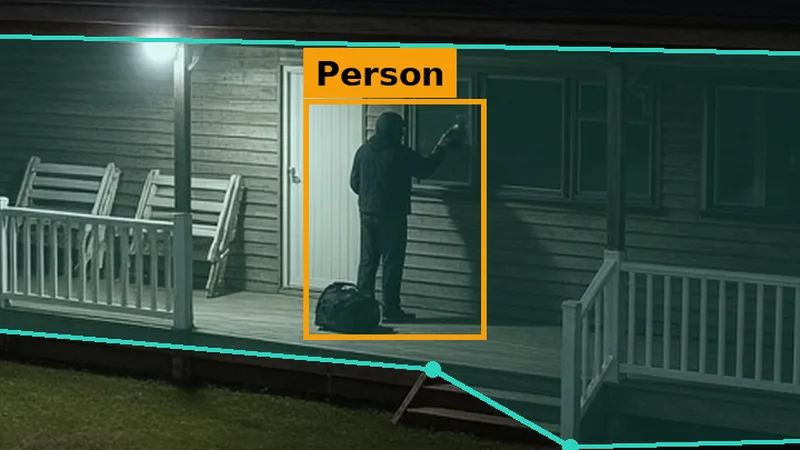
The rules depend on the part of the ground. Choose an area to see an example of how a camera there is set up and what an alert looks like. A clubhouse alert is shown at the top of this page, and a smoke alert in the fire section.
Which part of the ground are you protecting?
The clubhouse is where the cash, the alcohol, the stock and the trophies are, and on most grounds it is the first building a burglar tries. A zone over the doors, the windows and the veranda, armed from lock-up until the first person arrives in the morning, flags a person there at night. Add a zone over the back door of the bar and the cage where the beer barrels and gas bottles are kept: they are targeted for scrap as well as for what is in them. If the bar steward or a committee member sometimes locks up late, agree how they let the others know, and the clip will show who it is.
Doors, windows, the veranda, the bar’s back door, the cellar, the barrel and gas cage
The groundsman’s shed is often the least secure building on the ground and holds the most valuable kit: mowers, rollers, tools, and petrol and oil. A zone over the shed and container doors, armed overnight, flags a person there after dark. Draw it over the doors and the hardstanding in front of them, not over the outfield where foxes and badgers cross. A camera does not stop anyone forcing a container; strong locks, ground anchors and immobilised mowers slow them down, and the alert tells someone while they are still there.
The shed, steel containers, the garage, the roller and covers store, the fuel store
Most grounds have one gate a vehicle can use and many places a person can walk in. A direction-aware line across the main gate or along a known gap, set to count people and vehicles coming in and armed overnight, flags someone arriving after the last members have gone, while walkers and traffic outside the fence are ignored. Do not try to watch the whole pitch: people cut across playing fields, dogs are walked and foxes cross all night. The square is better protected by fencing, gates and posts that stop vehicles, and a walk round after every game. Our perimeter intrusion detection guide covers lines and fences in more detail.
The main gate, the car park, gaps in hedges and fences, the footpath edge
Each door, shed, container and gate gets its own zones and lines, with its own schedule.
How does AI detection compare with other club security measures?
No single measure protects a club on its own. Locks, doors and shutters keep people out; fences, gates and posts keep vehicles off the ground; marking and records make stolen kit harder to sell and easier to return; lighting helps people and cameras see; alarms detect entry to buildings; volunteers find problems early; and cameras see what is happening. The table compares the usual options.
| Measure | What it does | Strengths | Watch out for |
|---|---|---|---|
| Locks, doors and shutters | Keeps people out of the clubhouse, the bar and the sheds | Works around the clock; the basis of everything else | Old timber pavilions, sheds with weak walls, and doors left on the latch after a function |
| Fences, gates and posts | Keeps vehicles off the ground and slows people down | Protects the square and the outfield as well as the buildings | Gates only work if someone locks them; gaps in hedges and fences appear over the winter |
| Marking and records | Postcodes and forensic marking on mowers, rollers and tools; photos and serial numbers | Deters thieves and helps the police return stolen kit | Only works if every item is done and the list is kept up to date |
| Lighting | Lights doors, the car park and the shed | Deters and helps cameras see | Can disturb neighbours; lights mounted low get broken |
| Intruder alarm | Detects entry to the clubhouse or shed and calls keyholders or a monitoring centre | Often what an insurer expects; can scare intruders off | Usually covers a building, not the containers, the gate or the outside of the pavilion |
| Volunteer checks | A member walks the ground and checks the buildings | Finds damage, gaps and problems early | Volunteers cannot be there every night, least of all in winter |
| Recording-only CCTV | Records what happened | Evidence after the event | Nobody sees it until the groundsman finds the shed open in the morning |
| AI on existing CCTV | Recognises people, vehicles, smoke and flame, in zones and on lines you draw, on a schedule | Watches the clubhouse, the sheds, the gate and the pavilion at once; the alert includes the clip | Cameras need a clear view, power, a connection and enough light or infrared at night; animals can still cause some alerts |
An intruder alarm is the backbone for the clubhouse, as Deeping St James showed. But an alarm usually covers the inside of one building. It does not see the mower leaving a container at the far end of the ground, a car coming through the gate, or smoke from under the pavilion eaves on a Sunday afternoon. AI detection on the cameras you already have watches all of those at once, and wakes a person only when something happens.
Will foxes and the wind trigger false alerts?
This is the first question most committees ask, and the honest answer is that it depends on where the cameras look and when they are armed. A sports ground at night is full of things that move: foxes, badgers, cats and birds, covers, nets and flags in the wind, trees along the boundary, headlights on the lane, and members who stay late. We do not promise that animals will never cause an alert.
What keeps alerts useful at a club is the set-up:
- Point cameras at buildings, stores and gates, not the pitch. Watch the clubhouse doors, the shed and the gate, not the outfield.
- Count only people and vehicles, so most animals, weather and lights are ignored.
- Draw tight zones over doors, verandas and hardstanding, leaving out hedges, nets, trees and the footpath.
- Use direction on lines, so only people and vehicles coming in through the gate count.
- Set schedules round the club’s week, so each zone is armed only when nobody is expected.
- Use the feedback button to mark false alerts, so the system learns your ground.
Our guide to reducing CCTV false alarms covers this in more detail.
How should detection schedules fit round the club’s week?
A club has a rhythm that a schedule can follow. In season, the groundsman is in on weekday mornings, juniors train after school, seniors train on weekday evenings, matches run on Saturdays and Sundays, and the bar stays open late after games and functions. Out of season, the ground may be empty for days. The cameras should be armed where and when nobody is expected, and quiet when members have every right to be there.
- Clubhouse doors and windows: armed from lock-up, after the bar closes, until the first person arrives in the morning.
- Groundsman’s shed and containers: armed from dusk until the groundsman starts.
- Main gate: an inbound line armed overnight, off for training and matches.
- Smoke and flame: on around the clock, every day, all year.
In the winter lockdown, arm the clubhouse and the sheds for longer, or all day on weekdays when nobody is expected. Agree a simple rule for members who need to come in at odd hours, such as a message to the club’s alert group first, so the groundsman rolling the square at 07:00 or the bar steward restocking on a Monday is expected and the alert is no surprise. Review the schedules when the clocks change, at the start and end of each season, and before a big function.
Who responds when an alert fires at night?
An alert is only useful if someone acts on it, and at a volunteer-run club that needs agreeing in advance. Before the cameras go live, decide who receives which alerts and at what hours, what they should do and who they call. For most clubs that is two or three keyholders who live nearby, a monitoring centre, or both.
- Check the clip first. The clip and the AI description usually show whether it is a person at the clubhouse, a vehicle at the gate, smoke from the pavilion, or the groundsman starting early.
- Call 999 for a crime in progress or a fire. Give the address and postcode, the entrance to use, the part of the ground and what you can see on the clip.
- Never go alone. No volunteer should go to confront people on a dark ground at night. Wait for the police.
- Review every alert. Mark it correct or false, and fix what it revealed: a gate left open, a light that has failed, a schedule that does not match the fixture list.
The National Police Chiefs’ Council requirements for security systems say police response to an intruder alarm with a unique reference number (URN) is withdrawn after three false calls in a rolling 12 months, another reason to keep false alerts down and to have alerts checked by a person before the police are called. Our out-of-hours site security checklist covers response planning for any site.
What should the club do after a break-in?
The first hours after a break-in matter. Stolen mowers and stock are often moved and sold on quickly, and thieves who find one easy ground may try the next.
- Report it straight away. Call 999 if it is still happening; otherwise report it to the police as soon as it is found, and keep the reference.
- Keep the evidence. Save the camera clips before they are overwritten, photograph the damage and do not tidy up until the police say so.
- List what was taken. Use your asset register: makes, models, serial numbers, postcode marks and photographs.
- Tell the right people. Your insurer, your members, neighbouring clubs, your league or county board, and local machinery dealers, so others can look out for the kit.
- Make it safe. Repair doors, windows and locks, check the cameras and alarm still work, and walk the boundary before the next night.
- Fix the gap. Work out how they got in, how they got the kit out, and why nobody knew until morning.
How do you work with members, neighbours and the police?
Club security depends on people more than on equipment.
- A security lead. Give one committee member the job of security, with a simple checklist for lock-up and a list of who has keys and codes.
- Keys and codes. Change codes and recover keys when people leave or keys go missing, and do not hand them out to every hirer.
- The end-of-play check. The ECB guidance suggests delegating one person to check every door, window and gate at the end of play, every time.
- Neighbours. Houses that overlook the ground are your best watchers. Give them a contact number for a committee member and ask them to report anything unusual.
- The police. Ask your local neighbourhood team or a police crime prevention design adviser for a visit, report every incident however small, and join local watch schemes.
- Other clubs. Share warnings with neighbouring clubs and your league. Thieves often work through several grounds in one area.
Cameras support all of this. A clip of a figure at the shed at 23:56 and a vehicle at the gate a few minutes later gives the police something to work with, and an alert with that clip gives a keyholder a reason to call 999 rather than wait until morning.
How does data protection apply to club CCTV?
Club cameras see members, juniors, parents, visitors, staff and hirers, and sometimes a footpath or a neighbour’s garden. The Information Commissioner’s Office guidance on video surveillance sets out what is expected:
- Focus. Cameras should be focussed on a relevant space, and where wider surveillance is possible but unnecessary, it should be restricted.
- Signs. Place signs prominently before people enter the area a camera sees.
- Retention. There is no fixed period; the purpose should decide how long footage is kept, and the shortest period for that purpose is the right one.
- Impact assessment. A data protection impact assessment for processing that is likely to result in a high risk to individuals.
- Audio. Audio recording should be switched off by default.
- Children and changing rooms. Never point a camera into changing rooms, showers or toilets, and check your sport’s safeguarding guidance before placing cameras where juniors gather.
Polygon zones help: a zone over the clubhouse door watches the door, not the veranda where members sit on a summer evening, and a footpath or a neighbour’s garden can be left out entirely. Woodcock AI does not use facial recognition, identify who anyone is or read number plates. Our AI CCTV and GDPR guide has more.
How does a club get started?
Start with the basics: strong doors and locks on the clubhouse, a shuttered bar with empty, open tills, a repaired and anchored shed with marked and immobilised mowers, locked gates and posts that keep vehicles off the ground, bins and gas bottles caged away from buildings, an alarm that calls a keyholder, inspected electrics, and a fire plan everyone knows. Then map the cameras you already have: what each covers, what it sees at night, and where trouble has happened before.
Our site assessment looks at the cameras already at your ground and the zones, lines and schedules that would cover the clubhouse, the bar, the sheds, the gate and the pavilion, and tells you honestly where a camera cannot do the job. To see it working first, we can run a live test on your cameras: we connect two or three of them for about a fortnight. We can also arrange an on-site demo. If your cameras are looked after by an installer, our guide for installers explains how they can add AI detection to the system.
What are the limits of cameras at a sports club?
- A camera needs a view. Hedges, containers, the pavilion and the sightscreens block views, and the view changes with the seasons.
- It needs light or infrared at night. Check what each camera actually sees in the dark, including the far end of the ground.
- It needs power and a connection. If either is cut, cameras and alerts stop. Sheds on long cable runs are the weak point.
- It detects; it does not stop anyone. Locks, shutters, gates and anchors still have to do that.
- It does not replace fire or intruder alarms. Smoke detection on cameras is an early warning, on top of the fire risk assessment, the detectors inside the clubhouse and the alarms your insurer expects. It cannot see a fire starting inside a closed room it does not view.
- It is not for watching the pitch. The square and the outfield are better protected by fences, gates, posts and walks round after games.
- Animals can still cause some alerts. Good set-up keeps them down, but we do not promise none.
- Someone has to respond. An alert is only useful if a volunteer, a keyholder or a monitoring centre acts on it.
Sources
- England and Wales Cricket Board, Cricket ground security, crime and anti-social behaviour prevention (Developing Your Club guidance).
- Club Insure, Cricket club security white paper.
- Sport England, New fund to create the world’s greenest sports industry (June 2025).
- GOV.UK, Detailed analysis of fires and response times to fires attended by fire and rescue services, England, April 2024 to March 2025.
- GOV.UK, Fire safety risk assessment: small and medium places of assembly.
- The Stray Ferret, pavilion fire near Ripon; The Northern Echo, fire destroys a North Yorkshire cricket pavilion; and Harrogate Advertiser, appeal to rebuild the pavilion (August and September 2026).
- KentOnline, fire destroys a historic cricket pavilion near Faversham (August 2026).
- BBC News, suspected arson at a bowling club in Washington (May 2026), bowls club arson in March (April 2025), football ground fire in Macclesfield (March 2026), football clubhouse fire in County Fermanagh (May 2026), pitch fires in Withernsea (June 2026) and cricket club break-in in Syston (August 2026).
- Stoke Sentinel, bowling pavilion fire in Fenton (February 2025).
- Peterborough Telegraph, rugby club break-in at Deeping St James (January 2026).
- Lancashire Evening Post, cricket and bowling club burglary near Burnley (September 2026).
- The Northern Echo, cricket club break-in in Sedgefield (August 2026).
- Swindon Advertiser, rugby club break-in in Swindon (July 2026).
- Cornish Times, mower stolen from a cricket club in Roche (June 2025).
- Thurrock Nub News, mower stolen from a cricket club in North Stifford (April 2026).
- Yorkshire Evening Post, cable theft from a rugby league club in Wakefield (September 2026).
- ProtectUK, Site security.
- National Police Chiefs’ Council, Police Operational Advice and Security Industry Requirements for Response to Security Systems (March 2024).
- Information Commissioner’s Office, Guidance on video surveillance, including CCTV.
We have summarised these sources in our own words. Always read the current versions in full. This page is general guidance, not legal, fire safety, insurance, safeguarding or security advice; the police, your fire and rescue service, your fire risk assessor, your insurer, your governing body, your monitoring centre and your installer can advise on your own club.
Want to know when someone is at your clubhouse tonight?
Book a site assessment and we will look at the cameras at your ground and plan zones, lines and schedules for the clubhouse and bar, the groundsman’s shed and containers, the gate and the pavilion, or ask for a live test on your cameras.
Related pages
Frequently asked questions
How do you stop a sports club being broken into?
Fit strong doors, frames and locks, window locks and shutters on the clubhouse and bar, empty the tills and leave them open, bank the takings, and fit an intruder alarm that calls a keyholder or a monitoring centre. Have one named person check every door, window and gate at the end of play. A camera zone over the clubhouse doors and windows, armed from lock-up until the morning, flags anyone there at night.
How do you stop a club mower being stolen?
Keep mowers and rollers in a repaired, braced shed or a steel container with closed-shackle padlocks, anchor them to the floor, remove the keys and immobilise ride-ons, and mark them with the club’s postcode and forensic marking, with photographs and serial numbers on file. A camera zone over the shed and container doors, armed overnight, flags anyone there after dark.
How do pavilion fires start?
Common causes are arson, faulty electrics, fuel and machinery stored in or next to the pavilion, and bins or rubbish against timber walls. GOV.UK figures for England show electrical distribution was the largest single known source of ignition in fires in buildings other than homes in 2024-25, at 16%.
Will foxes and the wind set off AI camera alerts?
We do not promise that animals will never cause an alert. Pointing cameras at buildings, sheds and gates rather than the pitch, counting only people and vehicles, drawing tight zones over doors and hardstanding, using direction on lines and arming each zone only when nobody is expected keeps alerts from foxes, birds, covers and nets down.
Does fire safety law apply to a sports clubhouse?
For most clubhouses, yes. GOV.UK publishes a fire safety risk assessment guide for small and medium places of assembly, holding up to 60 or up to 300 people, which includes clubs and village halls, under the Regulatory Reform (Fire Safety) Order 2005. It says it does not apply to sports grounds themselves. Your fire and rescue service or a fire risk assessor can advise on your club.
Does Woodcock AI need new cameras at a sports club?
Usually not. It connects to existing IP cameras and recorders over RTSP or ONVIF, including Hikvision, and runs on an edge server on site or on a cloud server. A site assessment shows which cameras already cover the clubhouse, the sheds, the gate and the pavilion, and where a camera cannot do the job.
Last reviewed 1 November 2026
Running a pub rather than a clubhouse bar? See our pub security guide.