

Golf course security: machinery theft, arson and damage out of hours
Golf course security means protecting a golf club’s machinery, clubhouse, buggies, fuel and playing surfaces from theft, burglary, arson and damage, most of all at night when the course is empty. The basics are storing and immobilising machinery, keeping keys off site, blocking vehicle access to the course, an intruder alarm on the clubhouse and shed, and keeping buggies and bins away from buildings. AI on the cameras already at the club then flags people at the shed, vehicles at the gates or on the greens, and smoke by the buildings, with the clip in every alert.

Last updated 1 November 2026. A golf course is one of the biggest pieces of private land in most communities, and for most of the night it is completely empty. The clubhouse closes in the evening, the last greenkeeper locks the shed in the late afternoon, and the course is left to the deer and the sprinklers until the first mower goes out before dawn. Meanwhile the greenkeeping shed, often a long way from the clubhouse and down a track nobody overlooks, holds the club’s mowers, tractors, utility vehicles and tools.
Those empty hours are when greenkeeping sheds are broken into and machinery driven away, when clubhouses and pro shops are burgled, when buggies and bins are set alight, and when cars are driven across greens that take months to recover. This guide covers the main risks to UK golf courses and golf clubs, what the figures and recent cases show, what greenkeeping and insurance advisers and the police recommend, where cameras should watch, and how AI on the CCTV already at the club can watch the shed, the gates, the clubhouse and the greens near the road. It is written for club managers, secretaries, course managers and head greenkeepers, committees, owners of proprietary and pay-and-play courses, and the installers who look after their cameras. Much of it applies to other big open sports sites too, such as sports clubs, playing fields and driving ranges.
What are the main security risks to a golf course?
A members’ club on the edge of a town, a links course on the coast, a heathland course in the middle of a common and a pay-and-play nine holes beside a driving range look very different. But most face the same four kinds of risk, and almost all of them peak when the course is closed.
- Machinery and tool theft. Ride-on and fairway mowers, compact tractors, utility vehicles, buggies, trailers and hand tools such as blowers and strimmers, usually from the greenkeeping shed.
- Clubhouse and pro shop break-ins. Golf equipment and clothing from the pro shop, wines and spirits from the bar, cash, computers, and trophies and silverware.
- Arson and fire. Buggies set alight next to buildings, fires in bins and empty or derelict buildings, accidental fires during building works, and fires in gorse, heather and rough in a dry spell.
- Damage to the course. Cars, motorbikes and quad bikes driven across greens, tees and fairways at night, plus vandalism to flags, signs, buildings and equipment.
These risks overlap. A burglar who finds the keys in the shed can drive a utility vehicle out through the course. A buggy store full of vehicles parked against the clubhouse wall is a fire risk as well as a theft risk. The same gap in the hedge that lets a car onto the greens lets a van reach the shed. That is why golf course security works best when it is planned for the whole site, from the main gate to the furthest corner of the course, rather than one building at a time.
The cost of an incident is often far bigger than the value of what was taken. Without its mowers a greenkeeping team cannot cut the greens, so the course suffers within days while hire machines are found and claims are made. A burnt-out buggy store can take the clubhouse with it. A green ripped up by a car can take months to grow back, and members notice every one of them.
How many golf courses are there in the UK?
Golf takes up a great deal of land, much of it unwatched at night. According to an England Golf sustainability presentation published in 2025, there are 2,423 golf clubs in England, 1,732 of which are affiliated to England Golf, and golf courses take up approximately 1,200 km² of land in England. When it launched its strategy for 2025 to 2030, England Golf said golf club membership had increased by 8,000 to 730,000 in 2024.
Scotland, Wales and Northern Ireland add hundreds more courses, many of them on remote links and moorland. On top of the courses themselves come driving ranges, practice grounds, pitch-and-putt and footgolf courses, all with the same mix of open ground, machinery and buildings that stand empty at night.
We found no single official national figure for crime against golf clubs, so this guide uses guidance from greenkeeping and insurance advisers, police and fire service reports, and recent cases reported in the local press.
Why are greenkeeping sheds a target for thieves?
The greenkeeping shed, also called the maintenance facility or machinery store, is usually the most valuable building on a course after the clubhouse, and the least watched. The British and International Golf Greenkeepers Association (BIGGA) puts it plainly: golf clubs have long been the victim of crime due to high value equipment being stored away from population centres in storage facilities that often haven’t been adequately funded to make them properly secure.
Risk management guidance from RiskStop, written for insurers of golf clubs, makes the same point. It says maintenance sheds are often targeted by thieves due to the high value of modern compact tractors and the attractiveness of hand tools such as blowers and strimmers, together with the fact that they are often remotely situated away from the clubhouse. It describes golf clubs as having a large expanse of unmanned ground, often remotely situated, with high values of attractive goods and equipment, and says they have historically been a target for thieves.
Recent cases show the pattern. In October 2026, Kent Police said it was called at 5.55am to a golf club near Sevenoaks after an overnight burglary in which several buildings were damaged and items taken, including a utility vehicle and a ride-on buggy. Officers searched the surrounding area and found both vehicles in a nearby field. In September 2026, Cambridgeshire Police were called just after 10.30pm to a golf club in St Ives, where a gate and glass doors had been smashed and golfing equipment stolen; officers asked to hear from anyone who saw a particular vehicle in the area around the time.
Those two cases have things in common with many others: the break-in happened at night, it was found by staff or reported by someone nearby, and the police then appealed for witnesses and footage. A camera that recorded the gate and the shed is useful evidence. A camera that told someone at the time is better.
How do you make a machinery shed harder to break into?
Start with the building and the habits of the people who use it. BIGGA’s advice, drawn up with an insurer, includes:
- Store machinery inside. Store buggies and other ride-on equipment inside your facilities, not in the yard.
- Keys off site. Make sure keys are not left on the premises.
- Move climbing aids. Bins should be stored away, as these can be used to climb on to gain access to buildings.
- Block vehicle access. Block all potential access points using bollards, rubble or fallen trees.
- Light it. Put carts in a well-lit location close to main buildings.
RiskStop adds that valuable tractors should be immobilised and that consideration should be given to steel containers or cages for the safekeeping of hand tools. For buggies, it says keys to unattended buggies should always be removed and kept in a secure key cabinet or safe in a secure area of the clubhouse or pro shop, and that buggies should preferably be garaged in a building of robust construction protected by an intruder alarm.
The police.uk advice on sheds and outbuildings was written for homes, but it applies to a greenkeeping shed too. It says to pay attention to hinges, as these are sometimes easily removable; to secure windows with wire mesh or grills; to keep the door closed between uses so that no one can see what’s inside; and to property mark items, take photographs of them and register anything with a serial number with Immobilise. Mowers, power tools and garden tools are all on its list of the items most commonly stolen from sheds.
Keep an up-to-date list of every machine, its make, model, serial number and photographs, stored away from the shed. If something is stolen, the police need that list straight away. Our plant and machinery theft prevention guide covers machinery theft on construction and agricultural sites, much of which applies to a greenkeeping fleet.
Look at the plan of your own course in the same way. Which buildings and greens can a vehicle reach without passing the clubhouse? Which tracks lead from a public road straight to the shed? Where does a public footpath cross the course? Those are the places to block, light and watch.
How do you protect the clubhouse and pro shop?
The clubhouse is usually the busiest building on the site by day and empty by night. It holds the bar and its stock, the kitchen, the office, the pro shop with its clubs, clothing and electronics, and the trophy cabinet. RiskStop lists golf equipment and clothing, maintenance machinery and wines and spirits among the attractive goods on a golf club site, and notes a recent trend of increased theft of trophies and other silverware.
- Doors and glass. Clubhouses often have large glass doors onto a terrace and big pro shop windows. The St Ives burglary began with a gate and glass doors being smashed.
- Intruder alarm. RiskStop recommends an intruder alarm to EN 50131-1, Grade 2 or above, with remote, dual-path signalling, and a higher grade where significant values are involved. Your insurer may set its own requirements.
- Pro shop. Where the pro shop is run separately by the club professional, agree who is responsible for its alarm, its stock and its cameras.
- Trophies and cash. Keep trophies and silverware valued, recorded and photographed, keep cash on site to a minimum, and keep the safe out of sight.
- Functions. Weddings, dinners and society days bring people to the clubhouse late. Agree who locks up and checks the building afterwards.
Cameras covering the clubhouse need to see the doors, the terrace, the car park and the buggy store, not just the inside of the bar. At night, a zone over the terrace and the doors flags someone trying the glass long before the alarm goes off inside. Our commercial burglary prevention guide covers break-ins at business premises in more detail.
How likely is a fire at a golf club?
Fire is the risk that can turn a bad night into the loss of a building. Golf clubs have plenty to burn and often nobody about to see the first smoke: buggies parked in rows, bins against the clubhouse wall, timber buildings, fuel and chemical stores in the shed, and on heathland and links courses, acres of gorse, heather and rough.

RiskStop says golf buggies have been particularly targeted and that cases have arisen where buggies have been set on fire, resulting in major damage to the clubhouse and other buildings. Where buggies cannot be garaged in a secure building or compound, it recommends locating them a safe distance, ideally 10 metres, from all buildings.
Fire services and police have reported several golf club fires in the last two years:
- A former clubhouse at Longham, Dorset, June 2025. Dorset and Wiltshire Fire and Rescue Service was called at 6.10pm to a derelict building well alight, with approximately 40 firefighters attending. The building, a former golf course clubhouse, was destroyed. The fire service said it was believed to have been started deliberately, and Dorset Police appealed for doorbell, CCTV and dashcam footage.
- A golf park in Woolacombe, North Devon, February 2025. Devon Live reported that emergency services were called at around 7.30am to a substantial fire that included a golf driving range and other buildings, and that it was being treated as a high value arson.
- A golf club in Waltham Abbey, Essex, January 2026. Essex County Fire and Rescue Service sent around 60 firefighters, and its investigation found the fire was started accidentally during roofing works.
- A wildfire on the edge of a golf club in Littlehampton, West Sussex, July 2025. The BBC reported that West Sussex Fire and Rescue Service sent four fire engines and three off-road vehicles to a fire that affected gorse, reeds, grassland, trees and around ten tonnes of hay, damaged approximately two acres, and was not believed to have begun accidentally.
Those cases point to four practical steps. Keep buggies, bins and skips away from the walls. Keep empty buildings, such as an old clubhouse or a halfway hut out of use for the winter, locked, cleared and watched. Make sure contractors doing roofing and other hot works follow a permit and a fire watch: our hot works fire risk guide covers what that involves. And in a dry spell, watch the gorse, heather and stored hay near paths and boundaries, where a fire can be started by someone passing. If your buggies or machinery use lithium-ion batteries, our lithium-ion battery storage guide covers charging and storage.
Under fire safety law, someone at the club is the responsible person for fire safety, usually the employer or whoever controls the premises. GOV.UK says the responsible person must carry out a fire risk assessment, tell staff about the risks, put in place and maintain fire safety measures, and plan for an emergency. A fire risk assessment that covers the clubhouse but not the buggy store, the shed or the gorse beside the car park is only half done. Cameras that watch for smoke and flame outside add an early warning on top of the fire alarm inside, which only reacts once smoke reaches a detector. Our outdoor fire detection guide and our arson prevention guide cover this in more detail.
How do you stop vehicles damaging the greens?
Driving on a golf course at night costs the thieves nothing and the club a great deal. A car spinning on a green can leave ruts that take months to recover, and the club has to pay for the repairs and play round the damage in the meantime.
- Dornoch, Sutherland, October 2026. The Northern Times reported that a vehicle drove over two greens on a course at Dornoch between 6pm on a Friday and 6am the next morning. Police Scotland described the damage to the two greens as deliberate. The course manager said the impact goes far beyond the visible damage, and that repairs can take considerable time to grow back at this time of year.
- High Peak, Derbyshire, January 2026. The Buxton Advertiser reported a local police team saying that significant damage had been caused to the course by individuals driving their vehicles on the grass.
The first defence is physical. BIGGA’s advice is to block all potential access points using bollards, rubble or fallen trees, and RiskStop notes that many clubs have found it necessary to install automatic rising arm or other barriers at their vehicle entrances. Walk the boundary and look for gaps a car could get through: field gates, farm tracks, maintenance access, gaps in hedges and the edge of the car park.
The second is knowing when it happens. Most damage to greens is found by the greenkeepers at dawn. A zone over the greens and fairways nearest the car park and the road, armed after dark, flags a vehicle on them at the time, so someone can call the police while the car is still there. Our vandalism prevention guide covers damage and antisocial behaviour on any site.
How do you protect fuel and chemical stores?
Most greenkeeping yards have a diesel or petrol tank for the machinery, and many clubhouses are heated by oil. RiskStop says golf clubs can become vulnerable to the theft of heating oil and diesel, and that the risk should be included in the club’s risk management. The shed may also hold fertilisers, pesticides and other chemicals that need to be locked away.
In England, the GOV.UK guidance on storing oil at a home or business applies to businesses that store 201 litres or more of oil above ground. It requires secondary containment, such as a bund, that can hold 110% of the capacity of the container, says valves should be locked shut when not in use, and says pumps should be secured to prevent theft of the oil. Other rules apply in Scotland, Wales and Northern Ireland.
A camera zone over the fuel tank and the yard around it, armed overnight, flags someone at the tank or a vehicle pulling up beside it. Our fuel theft prevention guide covers fuel theft in more detail.
Why is a golf course hard to protect?
Most of the usual security advice assumes a building with a fence round it. A golf course is the opposite: a large, open, green site, often with public rights of way across it, and buildings scattered across it.
- Size. An 18-hole course can cover a large area, with long boundaries of hedges, woods, ditches and fences. Fencing all of it is rarely practical, and nobody can watch all of it.
- Remote buildings. The shed, the fuel, halfway huts, pump houses and storage containers are often far from the clubhouse and from any house.
- Public access. Public footpaths and bridleways cross many courses, and dog walkers use them early and late.
- Long and changing hours. Greenkeepers start before dawn in summer, members play until dusk, and functions can keep the clubhouse open late.
- Wildlife and the weather. Deer, foxes, badgers, rabbits and geese are out all night, and fog, frost and rain roll in off the course.
- Irrigation. Sprinklers on the greens and tees often run at night, exactly when the cameras are watching.
- Volunteers and committees. Many clubs are run by volunteer committees, so nobody may own security day to day.
That is why security on a golf course starts with the places that matter most, the shed, the gates, the clubhouse and the greens near the road, rather than trying to watch every acre.
Where should cameras watch on a golf course?
Start with value and vehicle access, then the clubhouse, then the course edges. Most clubs already have some cameras round the clubhouse and car park; the gaps are usually at the shed and the service gate.
- The greenkeeping yard. The roller doors, the yard, the fuel tank and the track in. This is often the most important camera on the site.
- Gates and tracks. The main entrance and car park, the service gate and any farm or maintenance track a vehicle could use.
- The clubhouse and pro shop. Doors, glass, the terrace, the pro shop, the bins and the buggy store.
- The course edges. The greens and tees nearest the car park, the road and any gap a car could get through, and the gorse and rough beside paths in a dry spell.
Each camera needs power, a connection and enough light or infrared at night. Remote sheds are often the hardest part: they may need a wireless link or their own connection back to the clubhouse. ProtectUK’s site security guidance says CCTV is central to most modern security systems, and that its primary purpose is to detect suspicious activity and act as a verification system for other security measures. Check what each camera sees in fog, in rain and in winter, when the leaves are off the trees and the sun is low.
How does AI on existing CCTV protect a golf course?
Recording-only CCTV shows what happened after the head greenkeeper opens the shed and finds the mowers gone. AI detection tells someone while it is happening, while the trailer is still in the yard. Woodcock AI connects to the IP cameras and recorders already on site, over RTSP or ONVIF, including Hikvision, and runs on an edge server on site or on a cloud server (an edge server needs only a power socket and a network connection).
- Polygon zones. Draw a zone of any shape over the shed doors and yard, the fuel tank, the clubhouse terrace, the buggy store or the greens near the road, and leave out the public footpath, the road, the neighbours’ gardens and the trees.
- Direction-aware lines. Draw a line across the service gate, a track or the car park entrance and choose which direction counts, so a vehicle driving in after dark raises an alert while traffic on the road is ignored.
- People and vehicles. Detection counts people and vehicles, so deer, foxes, badgers, rabbits, geese and the sprinklers do not.
- Smoke and flame. The same cameras watch for smoke and flame around the clock, by the buggy store, the bins, the shed and the gorse beside the car park.
- Schedules. Each zone and line has its own hours, so the shed yard can be armed until the greenkeepers arrive, the clubhouse after closing and the gates overnight, all built round the club’s week.
- Alerts with the clip. Each alert arrives in the app and by email with a short clip and an AI description of what happened, so the course manager, keyholder or monitoring centre receiving it can decide quickly what to do.
The system is self-learning. It learns each camera, so the trees moving in the wind, the floodlights on the range and the greenkeepers’ early starts become part of the normal view, and marking an alert as correct or false feeds into retraining for your site. Woodcock AI has been in development for years and is now running on customer sites across the UK.
Woodcock AI does not read number plates or identify people. It flags that a person or vehicle is somewhere it should not be, and the clip shows what happened.
Coming next: Ask your cameras Coming soon, early 2027, which will let you ask the system questions about what your cameras have seen.
What does AI detection look like around a golf course?
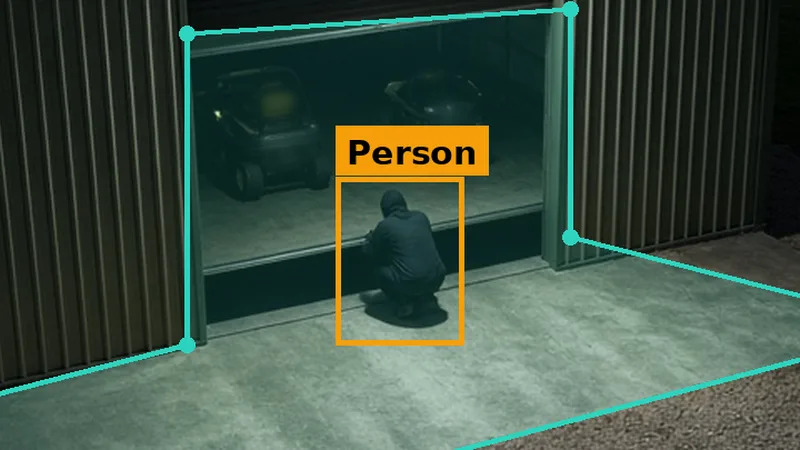
The rules depend on the part of the site. Choose an area to see an example of how a camera there is set up and what an alert looks like. A greenkeeping shed alert is shown at the top of this page, and a smoke alert in the fire section.
Which part of the course are you protecting?
Machinery is heavy, so most thefts of mowers, tractors and utility vehicles need a vehicle and often a trailer close by. A line across the service gate or the track into the greenkeeping yard, set to count vehicles coming in and armed overnight, flags a pick-up or van arriving after dark, while traffic on the road outside is ignored. A second line at the main entrance to the car park flags vehicles arriving after the clubhouse has closed. RiskStop notes that many clubs have fitted rising arm or other barriers at their vehicle entrances; a camera line on the same spot tells someone when a vehicle is there. Our perimeter intrusion detection guide covers gates and lines in more detail.
Main entrance, car park, service gate, farm tracks
Most of a course is too big to watch, and it does not need to be. The greens, tees and fairways that are at risk are usually the ones a car can reach: those beside the car park, an access road, a lane or a gap in the hedge. A zone over those greens, armed after dark, flags a vehicle or a group of people on them at night, so someone can call the police before the ruts are any deeper. Leave the public footpath and the neighbours’ gardens out of the zone, and remember that irrigation runs at night.
Greens, tees and fairways near roads and car parks
The clubhouse holds the bar stock, the pro shop, the office, the trophy cabinet and often the buggy store, and it is usually the building nearest the road. A zone over the terrace, the doors and the pro shop windows, armed from closing time until the first staff arrive, flags someone trying the doors or a window. A smoke zone over the buggy store and the bins watches for fire around the clock. Set the hours round functions, so a late wedding party on the terrace is not an alert but someone at the pro shop door at 01:26 is.
Doors, windows, terrace, pro shop, buggy store
Each gate, green, building and yard gets its own zones and lines, with its own schedule.
How does AI detection compare with other golf course security measures?
No single measure protects a golf course on its own. Locks, immobilisers and key control keep machinery where it belongs; barriers and blocked tracks keep vehicles off the course; marking makes stolen property traceable; alarms and guards detect and respond; and cameras see what is happening. The table compares the usual options.
| Measure | What it does | Strengths | Watch out for |
|---|---|---|---|
| Locks, key control and immobilisers | Keeps sheds shut and machinery from being driven away | Cheap and expected; the basis of everything else | Does nothing if keys are left on site or a door is forced unseen |
| Barriers, bollards and blocked tracks | Stops vehicles reaching the shed, the greens or the clubhouse | Recommended by greenkeeping and insurance advisers; works around the clock | Must still let greenkeepers, deliveries and emergency services in |
| Marking and recording serial numbers | Makes stolen machinery and tools traceable | Helps the police return property and link it to a suspect | Works mostly after the event |
| Intruder alarm | Detects entry to the clubhouse or shed and raises an alarm | Often what an insurer expects; can be monitored | Needs a response; a remote shed may need its own signalling |
| Security guards | People patrolling or watching the site | Can respond in person | Must hold a Security Industry Authority licence; one patrol cannot cover a whole course |
| Recording-only CCTV | Records what happened | Evidence after the event | Nobody sees it until the greenkeepers find the shed empty |
| AI on existing CCTV | Recognises people, vehicles, smoke and flame, in zones and on lines you draw, on a schedule | Watches the shed, the gates, the clubhouse and the greens near the road at once; the alert includes the clip | Cameras need a clear view, power, a connection and enough light or infrared at night |
RiskStop notes that at some clubs repeated theft and vandalism have led to manned guarding, and that static and mobile guards must legally hold a Security Industry Authority licence. It also says a detector-activated CCTV system connected to a remote video response centre can be an alternative. AI detection on the cameras you already have is one way to make the existing system detector-activated, whether alerts go to club staff or to a monitoring centre.
How do you stop false alarms on golf course cameras?
A golf course at night is full of things that move. Deer cross the fairways, foxes and badgers work the rough, rabbits graze the tees, geese land on the greens, sprinklers come on, trees sway, fog rolls in and headlights sweep across the car park. A system that alerts on every pixel that changes soon gets ignored by the staff who receive it.
- Count only people and vehicles, so wildlife, sprinklers, trees and weather are ignored.
- Draw zones that leave out the noise: trees, the public footpath, the road and the neighbours’ gardens.
- Use direction on lines, so only vehicles coming in through the gate count, not those passing on the road.
- Set schedules that match the club’s week, so each zone is armed only when nobody is expected there.
- Use the feedback button to mark false alerts, so the system learns your site.
Our guide to reducing CCTV false alarms covers this in more detail.
How should detection schedules fit round the club’s day?
A golf club has a rhythm that a schedule can follow. The greenkeepers arrive before dawn in summer and later in winter; members tee off from early morning until dusk; the bar and restaurant may stay open into the evening, and later for functions; and the course is empty from late evening until the first mower goes out. The cameras should be armed where and when nobody is expected, and quiet where people have every right to be.
- Shed yard: armed from the time the last greenkeeper locks up until the first one arrives. Change the hours with the seasons and the greenkeepers’ rota.
- Service gate and tracks: an inbound vehicle line armed overnight.
- Clubhouse and pro shop: armed from closing until the first staff arrive, with later hours on function nights.
- Greens near the road: armed after dark, with irrigation and early tee times taken into account.
- Smoke and flame outside: on around the clock, every day, especially in a dry spell.
Review the schedules when the clocks change, at the start and end of the main season and whenever the greenkeepers’ hours change. A mower leaving the shed at 05:30 is expected; a pick-up at the service gate at 02:40 is not.
Who responds when an alert fires at night?
An alert is only useful if someone acts on it. Before the cameras go live, agree who receives which alerts and at what hours, what they should do, and who they call. For most clubs that is the course manager, the club manager and a small rota of keyholders, a monitoring centre, or both, and the person receiving the alert may live some distance from the course.
- Check the clip first. The clip and the AI description usually show whether it is a person at the shed, a vehicle at the gate, a car on a green or smoke by the clubhouse.
- Call 999 for a crime in progress or a fire. Give the address, the entrance to use, the part of the course and what you can see on the clip. Courses are big and confusing at night, so tell the police which gate and which track lead to the shed.
- Never go alone. Nobody should go out onto a dark course or into the shed yard to confront thieves. Wait for the police.
- Review every alert. Mark it correct or false, and fix what it revealed: a gate left open, keys left in a machine, a dark corner or a schedule that does not match the season.
The National Police Chiefs’ Council requirements for security systems say police response to an intruder alarm with a unique reference number (URN) is withdrawn after three false calls in a rolling 12 months, another reason to keep false alerts down and to have alerts checked by a person before the police are called. Our out-of-hours site security checklist covers response planning for any site.
What should you do after machinery is stolen?
The first hours after a theft matter. Stolen machinery is sometimes left nearby: in the Sevenoaks case, officers searched the surrounding area and found both stolen vehicles in a nearby field.
- Report it straight away. Call 999 if it is still happening; otherwise report it to the police as soon as it is found, and keep the incident reference.
- Give the police the details. Make, model, serial numbers, photographs and any marking, from the list you keep away from the shed.
- Keep the evidence. Save the camera clips before they are overwritten, photograph the damage and do not tidy up until the police say so.
- Tell the right people. Your insurer, your committee or owners, neighbouring farms and businesses, and nearby clubs, who may be next.
- Keep the course going. Arrange hire or loan machinery so the greens can still be cut, and tell members what has happened.
- Fix the gap. Work out how they got in, how they got the machines out, and why nobody knew until morning.
How do you work with staff, members and the police?
Golf course security depends on people more than on equipment.
- Lock up and check. Agree who locks the shed, the clubhouse and the gates each evening, and who checks them after functions.
- Keys. Keep machine keys off site or in a secure key cabinet, and keep a list of keyholders. Change locks and codes when keys go missing.
- Greenkeepers. Your greenkeeping team knows the course better than anyone. Ask them to report broken fences, gaps in hedges, vehicles seen at odd times and anything moved in the shed.
- Members and neighbours. Members, dog walkers and people living beside the course are its best watchers. Ask them to report vehicles on the course, lights or noise at night.
- The police. Get to know your local neighbourhood or rural crime team and any farm or rural watch scheme in your area, and report every incident, however small.
- Other clubs. Thieves who find one easy shed often try the next course along. Share warnings with nearby clubs and greenkeepers.
Cameras support all of this. A clip of a pick-up at the service gate at 02:40 and a figure at the shed door at 03:12 gives the police something to work with, and an alert with that clip gives a keyholder a reason to call 999 rather than wait until morning.
How does data protection apply to golf course CCTV?
Golf course cameras see members, visitors, staff, walkers on public footpaths and sometimes neighbouring homes. The Information Commissioner’s Office guidance on video surveillance sets out what is expected:
- Focus. Cameras should be focussed on a relevant space, and where wider surveillance is possible but unnecessary, it should be restricted.
- Signs. Place signs prominently before people enter the area a camera sees. The ICO says signs should be more prominent and frequent where people are less likely to expect to be monitored, particularly when a system covers a large public area.
- Retention. There is no fixed period; the purpose should decide how long footage is kept, and the shortest period for that purpose is the right one.
- Impact assessment. A data protection impact assessment for processing that is likely to result in a high risk to individuals.
- Audio. Audio recording should be switched off by default.
- Staff. Greenkeepers and clubhouse staff should be told what the cameras cover and why.
Polygon zones help: a zone over the shed yard watches the yard and not the footpath beside it, and a public footpath, a neighbour’s garden or the practice ground where members are playing can be left out entirely. Woodcock AI does not use facial recognition, identify who anyone is or read number plates. Our AI CCTV and GDPR guide has more.
How do you get started?
Start with the basics: store machinery inside and immobilise it, take keys off site, cage hand tools, keep buggies and bins away from the walls, block the tracks and gaps a vehicle could use, lock the fuel, check the intruder alarm on the clubhouse and the shed, and make sure your fire risk assessment covers the buggy store, the shed and the outside of the buildings at night. Keep the list of machines and serial numbers up to date. Then map the cameras you already have: what each covers, what it sees at night, and where trouble has happened before.
Our site assessment looks at the cameras already at your club and the zones, lines and schedules that would cover the shed, the gates, the clubhouse and the greens near the road, and tells you honestly where a camera cannot do the job. To see it working first, we can run a live test on your cameras: we connect two or three of them for about a fortnight. We can also arrange an on-site demo. If the club’s cameras are looked after by an installer, our guide for installers explains how they can add AI detection to the system.
What are the limits of cameras on a golf course?
- A camera needs a view. No club can watch every acre; hedges, woods, banks and buildings block views.
- It needs light or infrared at night. Check what each camera actually sees in the dark, including the far end of the shed yard and the greens beyond the car park lights.
- It needs power and a connection. Remote sheds may need their own link. If either is cut, cameras and alerts stop.
- It detects; it does not stop anyone. Locks, immobilisers, barriers and bollards still have to do that.
- It does not replace fire or intruder alarms. Smoke detection on cameras is an early warning outside, on top of the fire risk assessment and the fire and intruder alarms your insurer expects.
- It does not read number plates or identify people. It flags people and vehicles in zones and on lines; the clip shows what happened.
- Someone has to respond. An alert is only useful if someone acts on it.
Sources
- England Golf, sustainability presentation (2025).
- England Golf, England Golf launches new strategy for 2025–2030.
- British and International Golf Greenkeepers Association, Advice on how to secure your facility (January 2021).
- RiskStop, TG11: Golf club security.
- Sevenoaks Online, report of a Kent Police appeal after a golf club burglary (October 2026).
- Cambridgeshire Police, Appeal following burglary at St Ives golf club (September 2026).
- Dorset and Wiltshire Fire and Rescue Service, Arson appeal after clubhouse fire (June 2025), and Dorset Police appeal.
- Devon Live, North Devon golf club fire (February 2025).
- Essex County Fire and Rescue Service, Fire at golf club, Waltham Abbey (January 2026).
- BBC News, Warning after large wildfire near golf club (July 2025).
- Northern Times, Damage to greens at Dornoch (October 2026).
- Buxton Advertiser, Damage at a High Peak golf club (January 2026).
- GOV.UK, Storing oil at a home or business.
- police.uk, Keeping your shed or garage safe and secure.
- GOV.UK, Fire safety in the workplace.
- ProtectUK, Site security.
- National Police Chiefs’ Council, Police Operational Advice and Security Industry Requirements for Response to Security Systems (March 2024).
- Information Commissioner’s Office, Guidance on video surveillance, including CCTV.
We have summarised these sources in our own words. Always read the current versions in full. This page is general guidance, not legal, fire safety, insurance or security advice; the police, your fire risk assessor, your insurer, your monitoring centre and a competent installer decide what applies to your club.
Want to know when someone is at your greenkeeping shed tonight?
Book a site assessment and we will look at the cameras at your club and plan zones, lines and schedules for the shed, the gates, the clubhouse and the greens near the road, built round your greenkeepers’ hours and your members’ tee times, with smoke and flame detection outside from the same cameras. Or ask for a live test on your cameras first: we connect two or three of them for about a fortnight.
Related pages
Frequently asked questions
How do you stop machinery being stolen from a golf course?
Store mowers, tractors, utility vehicles and buggies inside a robust, alarmed building, immobilise them and keep the keys off site, cage hand tools, mark everything and keep a list of serial numbers and photographs, and block the tracks a vehicle could use to reach the shed. Cameras with AI detection add an alert, with the clip, when someone is in the shed yard or a vehicle comes through the service gate at night, so a keyholder can call 999 while it is happening.
Why are golf clubs targeted by thieves?
Greenkeeping and insurance advisers point to high value machinery and tools stored in sheds that are often remote from the clubhouse and from any houses, large areas of unmanned ground, and attractive goods in the clubhouse and pro shop such as golf equipment, clothing, wines and spirits, trophies and silverware.
How do you stop cars driving on golf greens?
Block every point a vehicle could use to get onto the course, using barriers, bollards, rubble, banks or fallen trees, and check the boundary for gaps in hedges and fences. A camera zone over the greens nearest the car park and the road, armed after dark, then flags a vehicle on them at the time, so the police can be called before more damage is done.
How do you protect golf buggies from theft and arson?
Remove the keys from unattended buggies and keep them in a secure key cabinet or safe, and garage buggies in a robust, alarmed building or a secure compound. Where that is not possible, risk management guidance recommends keeping them a safe distance, ideally 10 metres, from all buildings. A smoke zone over the buggy store adds an early warning of fire.
Can CCTV cover the whole golf course?
Rarely, and it does not need to. Start with the greenkeeping shed and yard, the fuel tank, the gates and tracks, the clubhouse and pro shop, and the greens and tees a vehicle can reach from a road or car park. Leave public footpaths and neighbours’ gardens out of the zones, and put up clear signs where people enter the areas the cameras see.
Does Woodcock AI need new cameras at a golf club?
Usually not. It connects to existing IP cameras and recorders over RTSP or ONVIF, including Hikvision, and runs on an edge server on site or on a cloud server. A site assessment shows which cameras already cover the shed, the gates, the clubhouse and the greens near the road, and where moving or adding a camera would help.
Last reviewed 1 November 2026