

Electrical fire safety at work: a UK guide
Electrical fire safety at work means keeping the fixed wiring and portable equipment in a condition that prevents fire, using them sensibly and controlling them as ignition sources in your fire risk assessment. The Electricity at Work Regulations 1989 require systems to be built and maintained to prevent danger, which includes fire. The law sets no fixed testing interval: inspect the installation (EICR) and check portable equipment by risk, keep leads, heaters and chargers under control, and switch off at close.

What is electrical fire safety at work?
Electrical fire safety at work means making sure the electricity in your building, and everything plugged into it, does not start a fire. It covers the fixed installation (the wiring, distribution boards, sockets, switches and lighting circuits built into the building), the portable and transportable equipment people plug in (computers, kettles, power tools, heaters, chargers, fridges and machines), and the way that equipment is used day to day. It also covers what happens if a fault does start a fire: who would notice, how the supply can be isolated and how people get out.
Electricity causes fires in three main ways. A fault, such as a loose connection, damaged insulation or a failing component, can create heat where there should be none. Equipment can be overloaded, so cables and plugs carry more current than they were designed for and warm up. And equipment that is working normally can still start a fire if it is used in the wrong place, for example a heater against cardboard or a charger buried under clothing. The Health and Safety Executive (HSE) lists "fire from faulty electrical equipment or installations" among the main hazards of working with electricity, alongside shock, burns, arcing and explosion.
This guide is for business owners, facilities and site managers, health and safety leads, landlords of commercial units and anyone responsible for a workplace in the UK. It explains the law, including the Electricity at Work Regulations 1989 and the fire safety laws in each of the four nations. It covers inspection and testing of the fixed installation, what portable appliance testing really requires, extension leads, heaters, chargers, refrigeration and dusty environments, how electrical risks fit into your fire risk assessment, what to do if an electrical fire starts, and four 2026 cases. It finishes with the hours when nobody is on site, which is where AI on existing CCTV can help.
Why it matters
Electrical faults are one of the most common causes of fires in workplaces. In England, official figures for the year ending March 2026 record 13,679 fires in "other buildings", the category that covers buildings other than homes, such as offices, shops, factories, warehouses and public buildings. The government's detailed analysis of fires says that, leaving aside fires where the source of ignition was recorded as other or unspecified, the source that accounted for the largest proportion of other building fires was "electrical distribution", at 17%. The same release records that 30% of other building fires were larger fires, spreading beyond the room where they started, while 22% caused no fire damage and 29% were limited to the item first ignited.
Those figures cover England only, and "electrical distribution" is one ignition category among several: fires started by faulty appliances, heaters, cooking equipment and machinery are recorded separately, so the full electrical picture is wider than any one number. The pattern is consistent, though. Electrical installations and equipment run continuously, often unattended and often out of sight, in buildings full of things that burn: stock, packaging, paper, furniture and dust. A fault that develops at two in the morning can smoulder for a long time before anyone knows. Our guide to fire risk assessment explains how electrical risks fit into the wider assessment every business must do.
Electrical fires also cause damage well beyond the flames. A fire in a distribution board can cut power to a whole building, stop refrigeration, take down IT and phones, and leave a business unable to trade while the installation is repaired and re-certified. In the West Thurrock case described later in this guide, the fire service noted that businesses not directly affected by the fire were also disrupted by power outages and road closures.
How an electrical fault becomes a fire
Every electrical conductor has some resistance, and current flowing through resistance produces heat. In a healthy circuit, the cable, the connections and the protective device are matched, so the heat is small and spreads away safely. Problems start when something changes that balance. A terminal screw that has worked loose creates a small, high-resistance joint that gets hot every time current flows. A cable crushed under a desk leg or a pallet loses some of its copper and insulation, so it heats at that point. An extension lead coiled on its drum cannot shed heat. A plug carrying a three-kilowatt heater and a kettle at the same time runs at the limit of its rating for hours.
Heat on its own is not yet a fire. It becomes one when it reaches something that will ignite: the insulation of the cable itself, the plastic case of an adaptor, dust built up behind a machine, cardboard packaging stacked against a heater, or the paper and stock stored in a switch cupboard. Arcing, where current jumps across a gap, produces very high temperatures in a small area and can ignite nearby material quickly. Some electrical fires grow fast. Many smoulder first, producing smoke for some time before flames appear, which is why the place a fault develops, and whether anyone can see or smell it, matters so much.
Protective devices, such as fuses, circuit breakers and residual current devices (RCDs), are designed to cut the supply when they detect particular kinds of fault. They are essential, but they do not catch everything. A loose connection that heats up without drawing extra current, a cable overheating under insulation at its normal load, or equipment placed against combustible material may never trip a breaker. That is why inspection, sensible use and good housekeeping matter as much as the devices themselves.
The common causes
Fire and rescue services and safety bodies point to the same handful of causes again and again. Overloading is the first: too many appliances plugged into one socket through adaptors and extension leads, or high-power equipment such as heaters, kettles and power tools sharing a lead. Damage is the second: cables trapped in doors, run under carpets, crushed by furniture or vehicles, nibbled by rodents or repaired with tape. Loose or poor connections, inside plugs, sockets, distribution boards and junction boxes, are a third. Blocked ventilation is a fourth: equipment that relies on airflow, such as fridges, chillers, computers and battery chargers, overheats when vents are covered or clogged with dust.
The fifth is misuse, which covers a wide range: using domestic equipment in a harsh industrial setting, using an indoor extension lead outdoors or in a wet area, charging batteries on a flammable surface, leaving heaters on overnight, using a non-genuine charger, or carrying on with equipment that has a scorched plug or smells hot. The government's fire risk assessment guides for offices and shops and for factories and warehouses both list faulty or misused electrical equipment among the sources of ignition the assessment must consider.
Age is a background factor. Installations that have been altered many times over the years, with circuits added for new machines and sockets extended into new offices, can end up with overloaded circuits, mismatched protection and connections nobody has looked at for a decade. Equipment also ages: plugs crack, cable sheaths stiffen and split, fans wear and dust builds up inside cases.
Where electrical fires tend to start
In most workplaces, the places to watch are the same. Distribution boards and switch rooms, where the supply is divided up and where loose terminals, overloaded circuits and stored rubbish combine. Extension leads, adaptors and cable reels, especially under desks, behind counters and on workshop floors. Heaters, chargers and kettles, particularly in welfare areas, site cabins and break rooms. Machines that run hot or collect dust, such as compressors, grinders, extraction fans and printers. Refrigeration, including drinks chillers, display fridges and freezers, whose compressors and condensers run day and night and need airflow.
Many of these places share two features: the equipment runs when nobody is around, and nobody looks at it closely from one month to the next. A heater left on in a site cabin, a chiller at the back of a stockroom or a charger on a workbench is easy to forget. The rest of this guide explains how to reduce those risks, starting with what the law requires.
The law on electrical safety at work
In Great Britain, the main law is the Electricity at Work Regulations 1989, made under the Health and Safety at Work etc. Act 1974. They apply to almost every workplace and to every electrical system used for work, from a high-voltage substation to a desk lamp. They do not list specific tasks, such as testing every plug once a year. Instead they set goals: systems and equipment must be built, maintained and used so as to prevent danger, so far as is reasonably practicable. Northern Ireland has its own, closely matching Electricity at Work Regulations (Northern Ireland) 1991.
The regulations matter for fire safety because of how they define harm. Regulation 2 says that "injury" means death or personal injury from electric shock, electric burn, electrical explosion or arcing, "or from fire or explosion initiated by electrical energy", and that "danger" means the risk of injury. So the duty to prevent danger is, in part, a duty to prevent electrical fires. A badly maintained distribution board that could set fire to a store room is a breach of the regulations whether or not anyone has had a shock from it.
The regulations that matter most for fire
Regulation 4 is the core duty. All systems must at all times be of such construction as to prevent danger, so far as is reasonably practicable. As may be necessary to prevent danger, all systems must be maintained so as to prevent, so far as is reasonably practicable, such danger. Work activities on or near systems must be carried out in a way that does not give rise to danger, and any protective equipment provided must be suitable, maintained and properly used. Regulation 4(2), the maintenance duty, is the legal basis for inspecting and testing both the fixed installation and portable equipment.
Regulation 5 says that no electrical equipment may be put into use where its strength and capability may be exceeded in a way that gives rise to danger. That is the regulation behind overloading: an extension lead rated for 13 amps running two heaters, or a cable sized for lighting feeding a workshop machine. Regulation 6 covers adverse or hazardous environments. Equipment that may reasonably foreseeably be exposed to mechanical damage, the weather, wet, dirty, dusty or corrosive conditions, or flammable or explosive substances including dusts, must be constructed or protected so as to prevent danger from that exposure. Domestic extension leads on a dusty workshop floor or in a wet yard are a classic regulation 6 problem.
Regulation 7 requires conductors to be insulated, or otherwise protected or placed, to prevent danger. Regulation 11 requires effective means, suitably located, to protect every part of a system from excess current, which is the job fuses and circuit breakers do. Regulation 12 requires suitable means for cutting off the supply and for isolating equipment, which matters both for maintenance and for an emergency: someone needs to know where the isolators are and be able to reach them. Regulation 14 restricts work on or near live conductors, and regulation 16 requires that nobody does work needing technical knowledge or experience to prevent danger unless they have it or are suitably supervised.
Where fire safety law comes in
Fire safety law applies alongside the electrical regulations. In England and Wales, the Regulatory Reform (Fire Safety) Order 2005 requires the responsible person to carry out a suitable and sufficient assessment of the fire risks to which people are exposed (article 9). Schedule 1 sets out matters the assessment must consider, and the government guides list faulty or misused electrical equipment among the sources of ignition to look for. Article 17 requires facilities, equipment and devices provided for fire safety, such as alarms, emergency lighting and extinguishers, to be maintained in an efficient state, in efficient working order and in good repair. Scotland and Northern Ireland have their own fire safety laws, covered later in this guide.
In practice, the two sets of law meet in your fire risk assessment. The assessment identifies electrical ignition sources and asks whether they are controlled. The evidence that they are controlled usually comes from electrical maintenance: a current installation condition report, a sensible regime for checking portable equipment, records of remedial work and a housekeeping routine that keeps combustibles away from electrical equipment. A fire risk assessor who finds an out-of-date installation report, overloaded adaptors or a switch room used as a store will normally raise it as an action. The GOV.UK page on workplace fire safety responsibilities summarises the duties.
Who holds the duties?
The Electricity at Work Regulations place duties on employers, the self-employed and employees, each in relation to matters within their control. An employer is responsible for the systems and equipment their staff use at work. A self-employed electrician is responsible for their own work. Employees must co-operate with the arrangements, use equipment properly and report faults. In a rented unit, the lease usually decides who maintains the fixed installation: often the tenant for everything inside the unit and the landlord for supplies to the building and the common parts, but it varies, and both parties can hold duties at the same time.
Shared buildings need particular care. If the landlord controls the main switch room and the tenants each have their own boards, everyone needs to know who inspects what, where the isolators are and who has keys. A fire in a landlord's riser cupboard can affect every tenant, and a tenant's overloaded circuit can damage the landlord's installation. Agree it in writing and keep copies of each other's reports.
Competence
Regulation 16 is about competence, and it is often misunderstood. It does not say that only qualified electricians can touch anything electrical. It says that people doing work that needs technical knowledge or experience to prevent danger must have that knowledge or experience, or be supervised. A trained member of staff can do a user check or a formal visual inspection of a kettle. Combined inspection and testing of portable equipment needs more knowledge and suitable instruments. Inspecting and testing the fixed installation, and any alterations or repairs to it, need a skilled electrician.
When choosing an electrical contractor, it is reasonable to ask about their experience with premises like yours, whether they belong to a recognised scheme, who will do the work and how they will report it. HSE suggests that a competent electrical contractor is the first person to ask for advice on electrical safety. Electrical Safety First publishes advice on choosing an electrician.
What the law does not say
Several things are widely believed to be legal requirements and are not. There is no law saying portable appliances must be tested every year. HSE's own portable appliance testing FAQs say the law simply requires employers to ensure electrical equipment is maintained to prevent harm, and does not make inspection or testing of electrical appliances a legal requirement or say it must be done annually. There is no legal requirement to label equipment that has been tested or to keep records, although HSE notes that a record can be a useful management tool. There is no legal "PAT certificate".
Nor is there a fixed legal interval for inspecting the fixed installation in a workplace. The Institution of Engineering and Technology (IET), which publishes the wiring regulations, says on its inspection and testing FAQs that the recommended intervals in its guidance are recommendations, not legal requirements, and that the interval after the first inspection should be recommended by the competent person doing it. The private rented housing rules in England, which do require an inspection at least every five years, apply to homes, not workplaces. None of this means you can do nothing. It means you decide the regime based on risk, and you should be able to explain why it is enough.
The fixed installation
The fixed installation is the wiring built into the building: the supply intake and main switch, distribution boards (sometimes called consumer units in smaller premises, or fuse boards), the cables running through walls, ceilings, floors and cable trays, and the sockets, switches, lights and fixed connections at the end of each circuit. In a commercial unit it may also include sub-main cables to other floors or buildings, three-phase supplies to machines, and dedicated circuits for things such as server rooms, refrigeration and electric vehicle chargers.
Faults in the fixed installation are a significant share of electrical fires, and they are among the hardest to spot because most of the installation is hidden. A cable run through insulation in a ceiling void, a junction box above a suspended ceiling or a terminal inside a board can overheat for weeks without anyone seeing it. This is why the standard for the installation in the UK, BS 7671 (the IET Wiring Regulations), puts so much weight on periodic inspection and testing by a skilled person.
Electrical installation condition reports (EICRs)
The usual way to check the fixed installation is a periodic inspection and test, recorded on an electrical installation condition report, or EICR. The electrician inspects the installation for damage, deterioration, defects and anything that does not meet current standards, and tests a sample of circuits to check, for example, that protective devices will operate as they should and that insulation is sound. In larger premises, it is normal to agree the extent and any sampling in advance, because testing every circuit may need shutdowns that the business cannot easily accommodate.
The report records each observation with a code. C1 means danger is present and immediate action is needed; the electrician will usually make it safe there and then. C2 means potentially dangerous, needing urgent remedial work. C3 means improvement is recommended. FI means further investigation is needed without delay. If the report has any C1 or C2 observations, the overall condition will be recorded as unsatisfactory. Arrange the remedial work promptly, have FI items investigated without delay, and keep evidence that it has all been done.
Read the limitations section carefully. An EICR covers what the electrician was able to inspect and test. If a board could not be opened, a ceiling void was inaccessible or a circuit could not be switched off, the report should say so. Areas that were never inspected are exactly where problems can sit for years. Ask for anything significant to be covered at the next visit, or arrange access so that it can be.
How often?
As explained above, there is no fixed legal interval for workplaces. The duty is to maintain the system to prevent danger, and periodic inspection is how most businesses show they do. The IET's inspection and testing FAQs say that the interval should depend on the type of installation and equipment, its use and operation, the frequency and quality of maintenance and the external influences it is subject to. They point to a table of recommended initial frequencies in IET Guidance Note 3, and stress that these are recommendations and not legal requirements.
The figures commonly quoted from that table are a maximum of five years between inspections for offices and shops and three years for industrial premises, with much shorter intervals for places such as swimming pools, petrol stations and caravan parks. Guidance Note 3 was updated in 2026, so ask your electrician for the current recommendation for your type of premises. More important than any table is the date the inspector writes on your last report: that is their judgement of your installation, and you should treat it as the deadline. Inspect sooner after a fire, flood or other damage, a change of use or tenant, major alterations, or a request from your insurer or landlord.
Distribution boards and switch rooms
Distribution boards deserve special attention because they concentrate risk. Every circuit in an area passes through one board, so a loose terminal, an overloaded circuit or a failing device there can generate a lot of heat in a small metal box. Boards are also often in places nobody visits: the back of a warehouse, a riser cupboard, an under-stair store or a corner of a stockroom. HSE's introduction to electrical safety says that isolators and fuse-box cases should be kept closed and, if possible, locked.
Keep the area in front of boards clear, both so that someone can reach the isolators quickly in an emergency and so that nothing combustible is stacked against them. Switch rooms and riser cupboards are not store rooms, however tempting the space. Make sure circuits are labelled, so that the right one can be isolated, and that someone on every shift knows where the main isolator is. Do not leave covers off or blanks missing; open ways in a board let dust and debris in and expose live parts.
Some businesses commission thermal imaging surveys of distribution boards and switchgear, in which a specialist uses a thermal camera to look for hot spots while the installation is under load. This can find loose connections and overloaded circuits that a visual inspection would miss. Ask your electrician or insurer whether it would help on your site. It complements, rather than replaces, the EICR.
Warning signs
Most people in a building will never see inside a board, but everyone can notice the warning signs that something in the installation is wrong. Brown scorch marks on sockets or plugs, plugs or socket faces that feel hot, a smell of hot plastic or burning, buzzing or crackling from a board, lights that flicker or dim when equipment starts, and breakers or fuses that keep tripping all deserve attention. A breaker that trips repeatedly is doing its job; resetting it again and again, or swapping in a larger fuse, is not a fix.
Tell staff what to look for and make it easy to report. A short line in your induction, a note on the noticeboard and a named person to tell are usually enough. If someone reports a warning sign, stop using the circuit or equipment if it is safe to do so and ask a competent electrician to investigate. Record what was found and fixed.
Alterations, additions and RCDs
Many installation problems start with small changes. A new machine is wired into the nearest socket circuit. A partition creates a new office, and sockets are extended from an existing spur. An outbuilding is fed by a cable from the main unit. Over the years, these additions can overload circuits, leave protection mismatched and create joints and junction boxes nobody remembers. Any new work should be designed and installed by a competent person to BS 7671, certified, and recorded on your drawings and schedules, so that the next inspector knows what is there.
Residual current devices (RCDs) cut the supply very quickly when they detect current leaking to earth, which protects people from shock and can also cut power to some earth faults that might otherwise lead to fire. Modern installations make wide use of them, and HSE's guidance on work using electrically powered equipment says it is often beneficial to use an RCD between the supply and equipment, particularly where equipment is used outdoors or in harsh conditions. Test RCDs using their test button as the manufacturer recommends. Remember that RCDs do not protect against every fault: a loose connection overheating, or an overloaded lead, may never trip one.
Portable equipment and PAT
Portable equipment means anything that connects to the fixed installation by a plug and lead, or that is intended to be moved while connected. HSE's guidance covers portable items such as kettles, fans and heaters, hand-held tools such as drills and grinders, movable equipment such as fridges, printers and photocopiers, and the extension leads, adaptors and cable reels used to connect them. In most workplaces this is where the largest number of electrical items sits, and where damage and misuse are most common.
Portable appliance testing, or PAT, is the familiar term for checking this equipment. HSE uses the term to describe the examination of electrical appliances and equipment to ensure they are safe to use. Its PAT FAQs make the key point: most electrical safety defects can be found by visual examination, some can only be found by testing, and visual examination is essential because some defects cannot be detected by testing alone. A sticker saying an item passed a test some months ago tells you less than a careful look at the plug and cable today.
Three levels of checking
HSE's guidance describes three levels. The first is a user check: a brief look at the equipment by the person about to use it, based on simple training and perhaps a short checklist. The second is a formal visual inspection by someone with enough knowledge and training, often a sensible member of staff in a low-risk workplace, which goes further, for example removing the plug cover to check the fuse and connections where the person is competent to do so. The third is combined inspection and testing, which adds electrical tests with suitable instruments and needs more knowledge and experience: the right equipment, the ability to use it properly and the ability to understand the results.
A sensible regime uses all three. User checks catch damage as it happens. Formal visual inspections pick up problems users miss and keep the register up to date. Combined testing, where the risk justifies it, finds faults that cannot be seen, such as a broken earth connection or failing insulation. HSE's leaflet on maintaining portable electrical equipment in low-risk environments (INDG236) explains how this works in offices, shops, hotels and similar places, and its book Maintaining portable and transportable electrical equipment (HSG107) covers higher-risk settings.
User checks
A user check takes seconds. HSE's guidance on work using electrically powered equipment lists what to look for. Switch off and unplug the equipment first. Check the plug is not damaged and that the cable is properly secured in it, with no internal wires visible. Check the cable is not damaged and has not been repaired with insulating tape or an unsuitable connector. Check the outer cover of the equipment is not damaged in a way that could give rise to electrical or mechanical hazards. Check for burn marks or staining that suggest the equipment is overheating. Position trailing cables so they are not a trip hazard and are less likely to be damaged.
From a fire point of view, scorch marks, discoloured plastic, a warm plug and a smell of hot plastic are the signs that matter most. They usually mean a poor connection or an overloaded plug, both classic starting points for fires. HSE's advice is clear: if you are concerned about the safety of equipment, stop it being used and ask a competent person to undertake a more thorough check. Make that easy by giving staff somewhere to put faulty items and a label to say "do not use".
How often?
HSE says the frequency of inspection and testing depends on the type of equipment and the environment it is used in, giving the example that a power tool used on a construction site should be examined more frequently than a lamp in a hotel bedroom. Equipment that is moved often, used hard, used outdoors or in wet, dusty or dirty conditions, or that is hand-held, needs more frequent checks. Equipment that sits in one place in a clean, dry office, such as a desktop computer, needs very few. Increase the frequency where checks keep finding faults; reduce it where they consistently find none.
HSE's INDG236 says that it is a myth that all portable appliances in low-risk environments need an annual test. HSE's own worked case, from its PAT FAQs, describes a high street travel agency: the manager listed the equipment, found that computers, printers and a fax were rarely moved and positioned so their cables could not be trapped, and decided they would have a visual inspection every five years. The heavily used vacuum cleaner, whose cable had already needed a repair, got a visual inspection every six months, a test after twelve months and a review after twenty-four months. That is the kind of reasoning HSE expects.
Records, labels and new equipment
There is no legal requirement to label equipment that has been inspected or tested, or to keep records. HSE notes, though, that records and labels can be a useful management tool for monitoring and reviewing the effectiveness of the regime and for demonstrating that one exists. For most businesses, a simple register works: what the item is, where it is, how often it should be checked, when it was last checked and what was found. Your fire risk assessor and insurer may well ask to see it.
New equipment should be supplied in a safe condition and should not need a formal inspection or test, HSE says, but a simple visual check is recommended to make sure it has not been damaged. Buy from reputable suppliers. Product safety law, including the Electrical Equipment (Safety) Regulations 2016, places duties on manufacturers, importers and distributors, and goods bought from unknown online sellers are more likely to be counterfeit or unsafe, especially chargers and adaptors.
Equipment that slips through
Every regime has gaps. Staff bring in their own heaters, fans, phone chargers and kettles, especially in cold offices and welfare cabins. Contractors bring their own tools and leads. Hired equipment arrives and leaves. Second-hand machines are bought from auctions. Decide what personal equipment is allowed, and make sure anything that is allowed is included in checks. HSE strongly recommends that hire companies inspect and test equipment before each hire, and the person hiring should also take steps to make sure it stays safe throughout the hire period. Ask contractors how their equipment is maintained and check it visually when they arrive.
Personal heaters are the item most worth controlling. They are high-power, they are often used under desks among paper and bags, and they are easily forgotten at the end of the day. If people need extra heat, it is usually safer to provide suitable heaters centrally, include them in checks and make switching them off part of the closing routine.
The equipment that most often causes trouble
The general rules apply to everything, but some kinds of equipment and some places deserve particular attention. They are the items fire services repeatedly mention when they explain how workplace fires start, and they are worth naming in your fire risk assessment and your checks.
Extension leads and adaptors
Extension leads and adaptors are convenient and cheap, which is why there are too many of them in most workplaces. The main fire risk is overloading. A typical extension lead with four or six sockets is fitted with a 13 amp plug and fuse, so the total load of everything plugged into it must not exceed 13 amps, however many sockets it has. Two heaters on one lead can exceed that on their own. Electrical Safety First's guidance on overloading sockets explains how to check the load and has a simple calculator.
Do not plug one extension lead into another, or an adaptor into an adaptor. Plug high-power items, such as heaters, kettles and microwaves, directly into a wall socket. Fully unwind cable reels before use: the London Fire Brigade's electrical safety advice warns that cable drum extension leads should always be completely unwound to avoid overheating. Do not run leads under carpets or mats, where damage cannot be seen and heat cannot escape, or through doorways and windows where they can be trapped. If a room depends on extension leads all the time, the real answer is more sockets, installed properly.
Heaters
Portable heaters cause a disproportionate number of fires for the number in use, because they are designed to get hot and are often placed close to combustible material. Keep them well away from anything that can burn, and switch them off when they are not needed. A heater under a desk next to a bin, a box of paperwork or a coat is a common starting point.
Keep heaters upright, stable and clear of combustibles; never cover them or use them to dry clothes. Plug them directly into a wall socket. Use heaters with a tip-over cut-out and an overheat cut-out, and include them in your checks. Make switching them off part of the closing routine, and consider whether timers or central controls would reduce the chance of one being left on. In larger buildings, the long-term answer is usually adequate fixed heating rather than a scatter of portable heaters.
Chargers and batteries
Lithium-ion batteries are now everywhere at work: in phones, laptops, cordless tools, e-bikes and e-scooters, cleaning machines and warehouse equipment. When they fail, they can do so suddenly and violently, and the fires are hard to put out. Our guide to lithium-ion battery storage and charging covers this in depth. In short: use the charger supplied or approved by the manufacturer, charge on a hard, non-combustible surface away from escape routes and combustible materials, do not leave large batteries charging unattended overnight where you can avoid it, and remove damaged or swollen batteries from use.
Staff e-bikes and e-scooters need a clear policy. Charging them inside a building, particularly in an escape route or a small office, carries a real risk. Many businesses now provide a dedicated outside or separated charging area, or do not allow charging on site at all. Tool batteries in workshops and vans need similar thought: a charging station on a cluttered bench is a fire waiting to happen.
Equipment that runs unattended
Some equipment is designed to run when nobody is there. Fridges, freezers and display chillers run all night, and their compressors and condenser coils collect dust and fluff that can overheat. Commercial dishwashers, tumble dryers and washing machines are often left to finish a cycle at the end of the day. Vending machines, servers, routers and phone systems are always on. These items are not wrong to leave on, but they need suitable siting, ventilation, cleaning and maintenance, and they are worth including in any out-of-hours fire precautions.
Keep the area around chillers and freezers clear so that air can circulate, and have condensers cleaned as part of servicing. Clean lint filters on dryers after every load. Do not stack stock or packaging against the back of refrigeration units. In kitchens, which combine heat, oil and electrical equipment, see our guide to commercial kitchen fire safety.

Dust, wet and damage
Regulation 6 of the Electricity at Work Regulations requires equipment that may be exposed to adverse or hazardous conditions to be constructed or protected to prevent danger. In fire terms, dust is the biggest issue. Wood dust, flour, paper fibre, plastic dust and lint settle on motors, lights, sockets and inside boards, where they can be ignited by heat or sparks. Fine dust in the air can, in some conditions, form an explosive atmosphere, which brings in other regulations and specialist equipment. Keep dust down with extraction and cleaning, and use equipment rated for the conditions.
Wet conditions, such as yards, wash-down areas and cold stores, call for suitably protected equipment, RCD protection and often reduced-voltage or battery tools. HSE suggests reduced-voltage or battery-powered equipment where conditions are wet or harsh. Mechanical damage is a constant risk in warehouses and workshops: cables crushed by trolleys, conduits hit by vehicles and sockets damaged by stock. Protect cables at low level and route them away from traffic. Our guides to warehouse fire safety and factory fire safety cover these environments in more detail.
Welfare cabins and site offices
Portable cabins on construction sites, depots and yards pack several heat sources into a small space: a heater, a kettle, a microwave, phone chargers and sometimes a drying room, all fed by a single supply and often by extension leads. They are frequently left with heaters on overnight, and nobody is nearby when something goes wrong. HSE's guidance on work using electrically powered equipment points to the same basics.
Use equipment and leads suitable for site use, protected by RCDs. Allow only the heaters the site provides, and keep them clear of coats and paperwork. Keep kettles and microwaves away from the heater. Isolate the cabin supply at the end of the day, apart from anything that genuinely needs to stay on, and make that part of a named person's closing duties.
Electrical risks in your fire risk assessment
Your fire risk assessment is where electrical fire safety comes together. The government's guides, such as Fire safety risk assessment: offices and shops and Fire safety risk assessment: factories and warehouses, list faulty or misused electrical equipment among the sources of ignition to identify. The assessment should record what electrical risks exist, who could be harmed and when, what controls are in place and what further action is needed.
Useful evidence includes the latest EICR and proof that remedial work was done; your portable equipment register and any test results; your policy on personal heaters, chargers and e-bikes; and the closing routine. Revisit the assessment when something changes: new machinery, a new tenant, a change of use, an extension or new shift patterns. Pay particular attention to the hours when the building is empty, because that is when an electrical fault can develop unseen.
An end-of-day shutdown routine
A short, consistent closing routine prevents many fires. It should be the job of a named person on each shift, it should take minutes, and it should be written down so a stand-in can follow it. Switch off and unplug heaters, kettles, toasters, fans and anything else that does not need to stay on. Turn off chargers unless overnight charging has been planned and sited. Check that nothing has been stacked against boards, heaters or chillers. Close fire doors. Look and listen for anything unusual: a smell of burning, a buzzing board, a hot plug.
Some equipment must stay on: refrigeration, servers, alarms, security systems and emergency lighting. Know which circuits these are on, and make sure the routine does not switch off anything it should not. In units where many circuits can be safely isolated at close, consider labelled switches that make the shutdown quick and reliable.
If an electrical fire starts
Life safety comes first. Raise the alarm, get people out using your evacuation plan, and call 999. Only tackle a fire if you have been trained, it is small, you have the right extinguisher and you have a clear escape route behind you. If it is safe to reach, isolating the supply to the equipment or the board helps, because a fire fed by electricity can keep reigniting. Never use water or a water-based extinguisher on live electrical equipment. Carbon dioxide (CO2) extinguishers are commonly used for fires involving electrical equipment; our guide to fire extinguisher types explains the options and their limits.
Afterwards, do not reuse the equipment or reset the circuit until a competent person has checked it. Record what happened, report it where required, and update the fire risk assessment. A fire in a board or a fixed circuit usually means the installation needs inspection before it is put back into service.
Electrical faults in 2026: four fires
Fire and rescue services regularly report fires in commercial premises that are found to have been caused by electrical faults. Four from 2026 show the range. On Sunday 22 March, at 23:31, Essex crews were called to a fire involving three commercial buildings on London Road, West Thurrock. Crews from across the county attended, supported by London Fire Brigade, and the investigation found it was accidental and due to an electrical fault, and power cuts and road closures disrupted local businesses. The same evening, at 19:33, London Fire Brigade sent four engines and around 25 firefighters to a commercial building on Coronation Road, Park Royal. A small part of an electrical unit was damaged, the fire was under control by 20:54, and it was believed to be accidental, caused by an electrical fault.
On Wednesday 23 September, at 13:41, Kent Fire and Rescue Service sent six engines to a fire at commercial premises on Halcrow Avenue, Dartford. Crews used breathing apparatus and hose reel jets, nobody was hurt, and the fire was believed to be accidental and linked to an electrical fault. On 25 October, at 06:40, London Fire Brigade sent four engines and around 25 firefighters to a restaurant with flats above on Kilburn High Road. Eleven people were led from two flats, the fire was out by 07:57, and it was believed to be accidental, caused by an electrical fault. Three of the four started in the evening, late at night or early in the morning, when fewer people are around to notice.
Scotland, Wales and Northern Ireland
The Electricity at Work Regulations 1989 apply across Great Britain: England, Wales and Scotland. Northern Ireland has the Electricity at Work Regulations (Northern Ireland) 1991, which follow the same pattern. Fire safety law differs. The Fire Safety Order applies in England and Wales. In Scotland, Part 3 of the Fire (Scotland) Act 2005 and the Fire Safety (Scotland) Regulations 2006 require a fire safety risk assessment, and the Scottish Government's practical fire safety guidance covers sources of ignition. In Northern Ireland, the Fire and Rescue Services (Northern Ireland) Order 2006 and the Fire Safety Regulations (Northern Ireland) 2010 apply, and the Northern Ireland Fire and Rescue Service publishes business fire safety advice.
Common mistakes
The same problems come up again and again. Businesses pay for annual PAT stickers but do nothing between visits, so damage goes unnoticed for months. EICRs go out of date, or C2 observations are never fixed. Switch rooms and riser cupboards fill up with stock and packaging. Extension leads become permanent wiring, chained together under desks. Personal heaters appear every winter and are left on. And nobody is watching when a fault develops after close, so a small fire becomes a large one before anyone knows.
A one-page checklist
If you do nothing else, check these six things. Is the EICR current, and have its actions been closed? Is there a register of portable equipment, with user checks and risk-based intervals? Are leads and heaters controlled, correctly rated and never chained? Is charging approved, sensibly sited and covered by a policy for e-bikes and e-scooters? Does a named person run a short closing routine? And what happens out of hours: is there an alarm, is it monitored, and is there any way to see what is happening on site?
When nobody is there: where AI on existing CCTV fits
Everything above is about preventing electrical fires: sound installations, checked equipment, sensible use and a good closing routine. Prevention is the most important part, and nothing replaces it. But faults still happen, and many develop when the building is empty. Overnight, at weekends and on bank holidays, nobody is there to smell burning, hear a buzzing board or see smoke from a heater. If the fire alarm is not monitored, nobody may know until the fire is seen from outside. Many of the places where electrical fires start, such as stockrooms, workshops, aisle ends with boards and cabins, already have a camera pointing at them.
AI video detection watches for visible smoke and flame inside areas you choose, at the times you choose, and sends an alert with a snapshot and a short clip so a person can decide what to do. It can spot smoke escaping from a board, a chiller or a heater out of hours, in the area a camera can see.
We want to be clear about what this is and is not. Video smoke and flame detection is not electrical maintenance. It does not inspect or test anything, it cannot see heat building up inside a closed board or a ceiling void, and it is not a thermal imaging survey. It does not replace your EICR, your portable equipment checks, your fire alarm, your fire risk assessment or any other precaution your assessor, insurer or the law requires. It does not sound your fire alarm or call the fire service. It is an extra layer of early visual warning, most useful in the hours when nobody is on site.
Out of hours, if a clip shows smoke or flame, the person who receives it can call 999 and say what they can see and where. If your fire alarm is monitored, keep those arrangements in place; camera alerts sit alongside them. If you are considering camera detection, talk to your fire risk assessor and insurer first. Our guides to video smoke detection on existing CCTV and commercial fire alarm systems explain how the two fit together.
Where it can help
The places where camera detection adds most are those where electrical equipment keeps running, or is left on, while nobody is around. Choose an area below to see how a zone might be set up. Each image is a camera view with a zone drawn over the area to watch.
Which area?
Refrigeration runs when nobody is there, and stockrooms are full of packaging. Keep condensers clean and the backs of units clear. Out of hours, a camera that already covers the stockroom can watch a zone over the chillers, and send an alert with a clip if visible smoke or flame appears, so a keyholder can check and call 999.
Smoke and flame, out of hours
Welfare cabins combine heaters, kettles, microwaves and chargers in a small space, often on a remote part of a site. Isolate them at close where you can. Where a camera covers the cabin, a zone over the heater and counter can add a visual check for smoke or flame overnight.
Smoke and flame, overnight
Workshops mix motors, leads and dust. Clean down at the end of each day and unplug tools that do not need to stay on. Out of hours, a zone over the bench and machines can alert someone if smoke appears. It does not replace any detection the workshop already has.
Smoke and flame, out of hours
Each area needs its own zone and schedule.
Other places worth considering include aisle ends and walls with distribution boards, charging areas, loading bays and plant rooms. Our guides to lithium-ion battery storage and warehouse fire safety cover related ground.
The limits of camera detection
Every detection method has limits, and they matter more than usual for electrical fires. A camera can only see what is in its view, and many electrical fires start out of sight: inside a closed board, in a ceiling void, behind a chiller or in a riser. Smoke will not be seen until it comes into view, which may be some time after the fault started. Cameras need enough light, or infrared, to see at night, and thin smoke in the dark is harder to see. A camera cannot find a loose connection or a failing cable before it overheats; only inspection and testing can do that.
What about false alerts?
Steam, dust, headlights, reflections and insects near the lens can all look like smoke to a camera. Good set-up keeps false alerts down. Tight polygon zones cover the risk, not the whole view. Schedules arm zones only when the area should be empty. Clean lenses and steady lighting help, and a self-learning system gets better over time at knowing what is normal for each camera. Looking back at alerts after the first week or two, and adjusting zones, makes a big difference.
A worked example
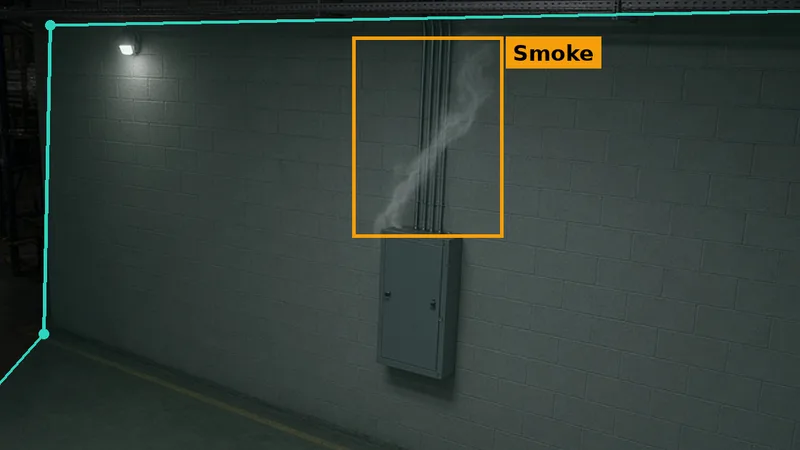
Here is how this might look for the fictional distribution unit shown at the top of this page. It is an example, not a real business. The unit has a fire risk assessment, a fire alarm, a current EICR, a portable equipment register with user checks, and a closing routine run by the shift supervisor. After a conversation with its fire risk assessor and insurer, the business adds smoke and flame detection to an existing camera covering the aisle end where a distribution board is fixed to the wall, with a zone over the unit floor armed from 18:00 to 07:00.
One evening the supervisor runs the shutdown at 17:45: heaters off, chargers off, nothing stacked against the board. The zone arms at 18:00. At 02:14, thin grey smoke starts to escape from the top edge of the board. The camera zone sees it, and within a minute the alert reaches the keyholder with the clip and an AI description. They can see smoke at the board, call 999, tell the fire service exactly where it is and how to get in, and say that nobody is believed to be inside, based on the access log.
Crews deal with the fire at the board. The following week, an electrician inspects and tests the board and the circuits it feeds, finds the cause and makes repairs, and the business brings forward the next full EICR. The fire risk assessment is updated. The closing routine had done its job, but no routine can stop a fault developing inside a board. The camera meant the fire was found at 02:14 by the keyholder, not at 06:30 by the first person in.
How Woodcock AI fits
Woodcock AI connects to existing IP cameras, and detection runs on an edge server on site or on a cloud server. It adds smoke and flame detection, and people and vehicle detection, to the cameras you already have. You draw polygon detection areas over the places that matter, choose when they are armed and who gets the alerts. Each alert has a snapshot, a short clip and an AI description of what the camera saw. Our smoke and fire detection page and how it works page show more.
Woodcock AI is self-learning, so it gets better over time at knowing what is normal on each camera. It is the result of years of development and is now in use on real sites in the UK. It works alongside your electrical maintenance, fire alarm, fire risk assessment and emergency plan rather than replacing them. Ask your cameras (Coming soon, early 2027) will let you ask questions about what your cameras have seen in everyday words.
Ways to start
Book a site assessment. We look at what your cameras see by day and after dark, and show where zones would help, such as stockrooms, workshops, welfare cabins and aisle ends with distribution boards. Or ask for a live test on your cameras: we connect two or three of your existing cameras for about a fortnight, so you can see the alerts for yourself. We are also happy to arrange an on-site demo.
Sources
- Electricity at Work Regulations 1989, regulations 4, 5, 6, 7, 11, 12, 14 and 16; Electricity at Work Regulations (Northern Ireland) 1991.
- HSE, electrical safety at work, introduction to electrical safety, work using electrically powered equipment, electrical safety FAQs, portable appliance testing FAQs and maintaining portable electrical equipment; INDG236, HSG107, HSR25 and HSG85.
- IET, inspection and testing FAQs.
- Regulatory Reform (Fire Safety) Order 2005, articles 9 and 17 and schedule 1; GOV.UK, workplace fire safety: your responsibilities; HM Government, Fire safety risk assessment: offices and shops and factories and warehouses.
- Ministry of Housing, Communities and Local Government, Detailed analysis of fires, England, year ending March 2026, from the fire statistics collection and data tables.
- Electrical Safety First, home page and overloading sockets; London Fire Brigade, electrical items and the workplace; Electrical Equipment (Safety) Regulations 2016; Electrical Safety Standards in the Private Rented Sector (England) Regulations 2020 and guidance.
- Scotland and Northern Ireland: Fire (Scotland) Act 2005, Part 3; Fire Safety (Scotland) Regulations 2006; Scottish Government, practical fire safety guidance; Fire and Rescue Services (Northern Ireland) Order 2006; Fire Safety Regulations (Northern Ireland) 2010; NIFRS, business fire safety.
- 2026 reports: Essex County FRS, West Thurrock; London Fire Brigade, Park Royal and Kilburn; Kent FRS, Dartford.
We have summarised these sources in our own words and checked them on 3 November 2026. This guide is general information, not electrical or fire safety advice for your premises. Details of the 2026 cases are as stated in the reports at the time; we name places, not people or businesses. The Electricity at Work Regulations 1989 apply in Great Britain and Northern Ireland has its own regulations; the Fire Safety Order applies in England and Wales, and Scotland and Northern Ireland have their own fire safety laws. A competent electrician, your fire risk assessor, your insurer and your local fire and rescue service can advise on your building.
The last shift goes home. Who sees the smoke at 2am?
Book a site assessment and we will look at what your cameras see by day and after dark, and show where smoke and flame zones would help over stockrooms, workshops, welfare cabins and aisle ends with distribution boards, or ask for a live test on your cameras.
Related pages
- Fire risk assessment
- Fire extinguisher types
- Commercial fire alarm systems
- Fire warden duties
- Fire evacuation plan
- Lithium-ion battery storage
- Commercial kitchen fire safety
- Warehouse fire safety
- Factory fire safety
- Video smoke detection on existing CCTV
- Smoke and fire detection cameras
- Book a site assessment
Frequently asked questions
Is PAT testing a legal requirement?
No. The Electricity at Work Regulations 1989 require electrical equipment that could cause injury to be maintained in a safe condition, but they do not say what must be done, by whom or how often. HSE says they do not make inspection or testing of appliances a legal requirement, or require it annually. You decide the checks by risk: user checks, formal visual inspections and, where justified, combined inspection and testing.
How often does a commercial EICR need doing?
There is no fixed legal interval for workplaces. The IET says its recommended intervals are recommendations, not legal requirements, and that the inspector should set the date of the next inspection. Commonly quoted guidance is up to five years for offices and shops and three for industrial premises, with shorter intervals in harsh conditions. Treat the date on your last report as the deadline, and inspect sooner after damage or change.
What do C1, C2, C3 and FI mean on an EICR?
C1 means danger is present and immediate action is needed. C2 means potentially dangerous, needing urgent remedial work. C3 means improvement is recommended. FI means further investigation is needed without delay. Any C1 or C2 makes the report unsatisfactory. Arrange remedial work promptly and keep evidence that it has been done.
Can I use extension leads at work?
Yes, sensibly. Most extension leads are limited to 13 amps in total, however many sockets they have, so do not overload them, do not plug one into another, plug heaters and kettles directly into wall sockets and fully unwind cable reels. If a room relies on extension leads all the time, more fixed sockets, installed properly, are the better answer.
What extinguisher should be used on an electrical fire?
Raise the alarm and call 999 first. Only tackle a small fire if you are trained and have a clear way out. Isolate the supply if it is safe to reach. Never use water on live electrical equipment. Carbon dioxide (CO2) extinguishers are commonly used for fires involving electrical equipment; your fire risk assessment should say which extinguishers you need and where.
Can AI on CCTV prevent electrical fires?
No. AI video detection cannot inspect or test anything, see heat inside a closed board or find a loose connection, and it is not a fire alarm or a thermal survey. It watches for visible smoke and flame in zones on your existing cameras, mostly out of hours when nobody is there, and sends an alert with a clip so someone can call 999. Woodcock AI runs on an edge server on site or on a cloud server.
Last reviewed 3 November 2026