

Fire extinguisher types: a UK guide for businesses
UK fire extinguishers all have red bodies, with a coloured band showing the type: water (red) for Class A solids such as wood and paper; foam (cream) for Class A and B liquids; dry powder (blue) for most classes, though not ideal indoors; CO2 (black) for electrical equipment and Class B; and wet chemical (yellow) for Class F cooking oil fires. Choose by fire risk assessment and rating, not size. As a rule of thumb, have one water-based extinguisher per 200 square metres with at least two per floor, near exits on escape routes, checked monthly and serviced every year.

Walk into almost any UK workplace and you will find a red fire extinguisher on the wall by the door. Ask the people who work there which fires it can be used on, what the coloured band means, when it was last serviced, or whether they have ever been shown how to use one, and the answers are often less certain. This guide explains the types of fire extinguisher in plain terms, so that you can check you have the right ones, in the right places, in the right condition, with people who know how to use them.
Two points before we start. First, the guidance here is general. The type, number and position of the extinguishers in your premises should come from your fire risk assessment, and your assessor, your extinguisher supplier, your insurer and your local fire and rescue service can tell you what applies to you. Second, we do not name brands, and we do not give prices. Where we say what an extinguisher can or cannot do, it comes from the official guidance listed at the end of this page.
Fire extinguisher types: the short answer
In the UK, every new fire extinguisher has a red body. What tells you the type is a band or panel of colour on the body, usually around the label, taking up no more than about five per cent of the surface. The main types are water (red band), water with additives (red band), water mist (often a white body), foam (cream band), dry powder (blue band), carbon dioxide or CO2 (black band), wet chemical (yellow band) and, less often, special powder for metal fires (violet band) and clean agent (green band). Each is designed for particular classes of fire, and some are dangerous on others.
| Type | Colour band | Use on | Do not use on |
|---|---|---|---|
| Water | Red | Class A: wood, paper, textiles, solids | Liquids, live electrical equipment, metals |
| Water with additives | Red | Class A; some also Class B, if marked | Live electrical equipment, metals |
| Foam | Cream | Class A and B: solids, petrol, diesel | Electrical fires, deep-fat fryers, chip pans, metals |
| Dry powder | Blue | Most classes, including electrical; good knock-down | Confined spaces; metals, unless special powder |
| CO2 | Black | Electrical equipment, Class B liquids | Solid materials (it does not cool them), metals |
| Wet chemical | Yellow | Class F: cooking oils and fats in deep-fat fryers | Liquid, gas and electrical fires |
| Special powder | Violet | Class D: burning metals, with specialist advice | Other fires, unless marked |
The table is a summary. The label on each extinguisher shows the classes it is rated for, with pictograms and numbers, and that label is the final word. Some newer extinguishers cover more classes than the table suggests, and some older ones are colour-coded differently. We explain each type in detail further down.
What a fire extinguisher is for
It is easy to think of an extinguisher as the thing you use to put out a fire. The official guidance puts it more carefully. Greater Manchester Fire and Rescue Service says the primary purpose of a fire extinguisher is to aid escape from a fire. Dorset and Wiltshire Fire and Rescue Service says the main reason for providing them is to reduce the risk of a small fire becoming a large one, by attacking it in its earliest stage. The government guide for factories and warehouses gives the example of a fire in a waste-paper bin, and adds that using an extinguisher safely early on can let people help others who are at risk.
All three points lead to the same place. A portable extinguisher is for a small fire, caught in its first minutes, by someone who knows how to use it and can do so without putting themselves in danger. It is not for a fire that has already spread, a room that is filling with smoke, or a fire you can only reach by going past it. The Scottish Fire and Rescue Service says portable extinguishers are only designed to tackle a fire in its very early stages, that you should always make sure the fire service has been called, and that a fire should not be tackled if it has started to spread to other items or the room is filling with smoke.
That has a consequence that is easy to overlook. An extinguisher only works if somebody is there. In the working day, with trained staff nearby, a small fire in a bin, a fryer or a piece of equipment can often be dealt with in seconds. At night, at weekends and over holidays, the same extinguisher hangs on the same wall with nobody to lift it. We come back to this at the end of the guide, because it is where many serious business fires begin.
The law: what UK businesses must provide
In England and Wales, the main law is the Regulatory Reform (Fire Safety) Order 2005, often called the Fire Safety Order or the RRO. It applies to almost all non-domestic premises, and it puts the duty on the responsible person: usually the employer, or the owner or person in control of the premises. The responsible person must carry out a fire risk assessment and put in place the general fire precautions it shows are needed. Extinguishers are one of those precautions.
Article 13 says that, where necessary, the premises must be equipped with appropriate fire-fighting equipment, and that any non-automatic equipment, which includes portable extinguishers, must be easily accessible, simple to use and indicated by signs. What is appropriate depends on the dimensions and use of the building, the equipment it contains, the physical and chemical properties of the substances likely to be present, and the maximum number of people who may be there. Article 13 also requires the responsible person to take measures for fire-fighting suited to the size and nature of the business, to nominate competent persons to carry them out, and to make sure those people are adequately trained and equipped.
Article 17 requires the facilities and equipment provided to be subject to a suitable system of maintenance and kept in an efficient state, in efficient working order and in good repair. Article 21 requires the responsible person to give employees adequate safety training when they start, when they are exposed to new or increased risks, and again periodically, during working hours.
The government guidance makes clear that you are responsible for providing appropriate fire-fighting equipment, and for checking that all of it is in the correct position and in satisfactory order before the premises are used. It also says that appropriate staff should be trained in the use of all the equipment. In simple premises, one or two portable extinguishers of the right type, readily available, may be all that is needed. In more complex premises, a number of extinguishers may be required, sited at suitable places such as the escape routes on each floor, with signs if they are not easy to see.
Who decides what you need
The responsible person is accountable, but they rarely decide alone. Many businesses have a fire risk assessor who recommends the type, number and position of extinguishers. Suppliers and service engineers advise on the right models and check that they are fitted and maintained properly. The London Fire Brigade notes that insurers may also want to add to the number and type of extinguishers covering a particular risk as a condition of a policy, so it is worth checking your policy wording. The local fire and rescue service enforces the law for most premises and can inspect.
The fire risk assessment is the document that ties it all together. Cheshire Fire and Rescue Service points out that, under section 156 of the Building Safety Act 2022, the fire risk assessment in England must now be recorded in full, whatever the size of the business. If your assessment is old, or your premises, processes or layout have changed since it was done, the extinguishers it recommends may no longer match the risks.
Scotland and Northern Ireland
In Scotland, the main law is the Fire (Scotland) Act 2005 and the regulations made under it. The people responsible are called duty holders, and the Scottish Fire and Rescue Service enforces the law for most premises. Its business advice says you should know where your firefighting equipment is, how it works and what type of fire it is for, and it sets out practical do and do not rules that we use in this guide. Northern Ireland has its own fire safety regulations. The basic duties are much the same across the UK: assess the risk, provide suitable equipment, keep it maintained and make sure people know how to use it.
The classes of fire
Before you can choose an extinguisher, you need to know what might burn. Fires are grouped by what is burning, using the British and European standard BS EN 2. Each extinguisher is designed and tested for particular classes, and the class symbols on its label show which. The government guidance for workplaces uses the same classes, and so do the fire and rescue services.
Class A fires involve solid materials, usually of an organic nature, which burn with glowing embers: wood, paper, card, textiles, many plastics, packaging and general waste. They are the most common class in offices, shops, warehouses and workshops. A waste bin, a pile of cardboard, a stack of pallets or a sofa are all Class A.
Class B fires involve flammable liquids, or solids that melt into liquids: petrol, diesel, oils, paints, solvents, adhesives and some waxes. They are found in vehicle workshops, plant rooms, print shops, paint stores, labs and anywhere with fuel. Burning liquids spread, so the wrong extinguisher, or the right one used badly, can make them worse.
Class C fires involve flammable gases, such as propane, butane, acetylene and natural gas. The usual advice is that the first and most important step with a gas fire is to shut off the supply if it is safe to do so, and the guidance says to seek specialist advice. The London Fire Brigade lists foam, according to the risk, alongside that advice.
Class D fires involve burning metals, such as magnesium, aluminium swarf or powder, and lithium metal. They need special powder extinguishers or dry sand, chosen for the metal, and specialist advice. Ordinary extinguishers can make them far worse.
Class F fires involve cooking oils and fats, as in deep-fat fryers. They burn so hot that ordinary extinguishers can fail, or can throw burning oil out of the fryer. The government guidance says Class F extinguishers are particularly suited to commercial catering with deep-fat fryers.
Most workplaces need to cover Class A, and many also need cover for Class B, electrical equipment or both. Kitchens add Class F. Classes C and D are usually confined to specific processes or stores, and that is where specialist advice comes in. The government guidance says that if there is a chance of a fire involving gases or metals in your premises, you should seek advice from a competent person.
The same guidance gives one more warning that surprises many people: it is not safe to fight fires involving aerosols with fire extinguishers. Aerosol cans can burst in a fire. If you store large numbers of them, for example in a shop or a warehouse, that belongs in your fire risk assessment and in the way you store them, not in the choice of extinguisher.
What about electrical fires?
Electrical fires are not a class of their own under BS EN 2. Electricity is a source of ignition, and once the power is removed, what is left burning is usually Class A or B. But while the power is on, electrical equipment is dangerous in two ways: it can keep the fire going, and some extinguishing agents, such as plain water, conduct electricity back to the person holding the extinguisher. That is why the label on many extinguishers carries an electrical warning or a safe use symbol, often with a voltage and a distance.
The government guidance says CO2 extinguishers are particularly suitable for fires involving electrical equipment, because they put the fire out without causing further damage, except to some electronic equipment such as computers. Powder can be used on electrical fires too, but will almost certainly ruin the equipment. Plain water is not suitable for live electrical equipment. And, as with all electrical fires, the power should be disconnected if possible.
In a switch room, a server room, a plant room or by a bank of chargers, the right extinguisher is usually CO2, sited near the door so that someone can use it from the way out. Some water mist and specially tested foam and water additive extinguishers are marked as safe on electrical equipment up to a stated voltage, at a stated distance, after testing. If yours carries such a marking, follow it exactly. If it does not, assume it is not safe.
Lithium-ion batteries need a word of their own. A battery in thermal runaway can produce flame, intense heat and toxic smoke, and can reignite after it seems to be out. Fire and rescue services advise getting out and calling 999 rather than fighting a battery fire in a building. The London Fire Brigade notes that some newer extinguishers with a green colour coding, containing clean agent gases or wet chemical solutions, can be used on small lithium-ion battery fires. If batteries, e-bikes, scooters or battery storage are part of your business, ask your fire risk assessor what is right for you, and see our guides to lithium-ion battery storage and EV charging fire safety.
Fire ratings: what 13A, 34B and 15F mean
Every extinguisher made to BS EN 3 carries a fire test rating on its label, such as 13A, 34B or 15F. The letter is the class of fire. The number comes from the size of the standard test fire the extinguisher has been shown to put out, under the test methods in BS EN 3-7. A bigger number means a bigger test fire. So an extinguisher rated 21A has put out a larger Class A test fire than one rated 13A, and one rated 144B a larger Class B fire than one rated 34B.
The London Fire Brigade makes a point that saves many businesses a lot of trouble: extinguishers should be allocated by their rating, not by their size, weight or content in litres. A 13A extinguisher need not be the heavy 9 litre water extinguisher found in many premises. A smaller version that still meets the 13A rating is just as effective. The government guidance says the same of water extinguishers with additives, which can reach the same rating as a 9 litre water extinguisher while being smaller and considerably lighter. As an example of a Class B rating, the London Fire Brigade notes that a 2.5 kilogram CO2 extinguisher is rated 34B.
Weight matters because people have to lift, carry and aim the extinguisher. The government guidance asks you to consider the Manual Handling Operations Regulations 1992 when selecting and siting firefighting equipment. A large, heavy extinguisher that some of your staff cannot lift easily is less use than a lighter one of the same rating that they can.
Reading the label
The label on a modern extinguisher has most of what you need to know. It says what the extinguisher contains and gives its ratings. It shows pictograms for the classes of fire it can be used on, and often crossed-out symbols for those it must not. It carries warnings, such as not for use on live electrical equipment, and short instructions on how to use it, usually with pictures. It should also show the standard it was made to. Dorset and Wiltshire Fire and Rescue Service advises making sure any extinguisher you choose conforms to the relevant British Standards, and notes that a Kitemark or the mark of the British Approvals for Fire Equipment scheme confirms it.
Fire extinguisher colours
New fire extinguishers in the UK are made to BS EN 3, and their bodies are signal red. The type is shown by a zone of colour on the body, usually a band or a panel around or above the instructions, which the London Fire Brigade says may take up to five per cent of the surface. The colour codes follow BS 7863. The government guidance gives the same picture: extinguishers made to current standards are mostly red, with a colour-coded area showing the type.
The colours are water red, foam pale cream, dry powder blue, CO2 black and wet chemical canary yellow. Special powders for metal fires are signal violet. The London Fire Brigade notes that newer extinguishers containing clean agent gases or wet chemical solutions for small lithium-ion battery fires are coded green, and that water mist extinguishers have a white body rather than a red one.
Older extinguishers, made before the current standard, often have bodies painted entirely in one colour, such as all blue for powder or all black for CO2. The government guidance says these older extinguishers remain acceptable until they are no longer serviceable, but that it is good practice not to mix old and new styles on the same floor. In a hurry, someone who has learned to look for a band may misread a solid colour, or the other way round. The Scottish Fire and Rescue Service gives the same advice on older units made to the previous British Standard.
The types of fire extinguisher, one by one
Water extinguishers (red)
Water extinguishers are the most familiar type. They work by cooling the burning material below the temperature at which it keeps burning, and they are for Class A fires only: wood, paper, textiles, packaging and similar solids. The government guidance says they let the user direct water onto a fire from a considerable distance, which helps keep you away from the heat. They must not be used on burning liquids, which they can spread, on live electrical equipment, because water conducts electricity, on burning metals, or on cooking oil fires.
The classic water extinguisher holds 9 litres and is heavy when full. The government guidance notes that it can be quite heavy, and that some extinguishers with additives achieve the same rating while being smaller and considerably lighter. For staff who may struggle with a full 9 litre unit, that is worth discussing with your supplier.
Water with additives, and water mist
Water extinguishers with additives, sometimes called water spray or water additive extinguishers, are also coded red. The additive helps the water spread and soak into burning material. The government guidance says they are suitable for Class A fires, can also be suitable for Class B where this is shown on the extinguisher, and are generally more efficient than plain water. As with any water-based extinguisher, check the label before going near electrical equipment.
Water mist extinguishers break water into very fine droplets. The London Fire Brigade says they are white-bodied rather than red, and suitable for Class A, B and C fires and for use on electrical equipment, depending on the model's testing. They are sometimes chosen where one type is wanted for several kinds of risk, but the ratings for some classes can be lower than those of a specialist type, so read the label and follow your fire risk assessment.
Foam extinguishers (cream)
Foam extinguishers are coded pale cream and can be used on Class A and B fires. The government guidance says they are particularly suited to liquid fires such as petrol and diesel, where the foam forms a blanket over the surface and cuts off the vapour that feeds the flames. They should not be used on liquids that are flowing or spilling, unless the user has had special training, because this can spread the fire to nearby material. They are not suitable for deep-fat fryers or chip pans, and standard foam is not for live electrical equipment.
Many foam extinguishers have traditionally used foams containing PFAS, a group of long-lasting chemicals. The London Fire Brigade notes that foams without fluorine are replacing them, in line with the move away from PFAS. If you are replacing foam extinguishers, ask your supplier about the newer agents, their ratings and what to do with the old units.
Dry powder extinguishers (blue)
Dry powder extinguishers are coded blue. Standard powder covers most classes of fire, including Class A, B and C and fires in electrical equipment, which is why they are often described as multi-purpose. The government guidance says they achieve a good knock-down of the fire and can be used on electrical equipment, but will almost certainly ruin it. Because powder does not cool the fire much, it can reignite.
Powder has real drawbacks indoors. When it is discharged, it forms a thick haze that cuts visibility and can affect people with breathing problems, so the government guidance says powder extinguishers are generally not suitable for confined spaces. It also leaves a fine residue that gets into equipment and stock and is hard to clean. For these reasons, many businesses keep powder for outdoor areas, vehicles, fuel stores and plant, and use other types inside. Your fire risk assessment should say which.
CO2 extinguishers (black)
Carbon dioxide extinguishers are coded black. They work by displacing the oxygen around a fire. The government guidance says they are particularly suitable for fires involving electrical equipment, because they put the fire out without causing further damage, apart from some electronic equipment such as computers. They are also suitable for Class B fires. They leave no residue, which is why they are often found in offices, server rooms and switch rooms.
CO2 has limits that people sometimes forget. It does not cool the fire, so once the gas disperses, a hot fire can reignite. Dorset and Wiltshire Fire and Rescue Service says CO2 is not suitable for solid materials such as wood or paper. In a small enclosed room, a large discharge reduces the oxygen available to the person using it too. The discharge horn becomes extremely cold, so the extinguisher should be held by its handle and any insulated grip, never by the horn, as the label will show. Turn off the power to electrical equipment if you can.
Wet chemical extinguishers (yellow)
Wet chemical extinguishers are coded canary yellow and are made for Class F fires: cooking oils and fats in deep-fat fryers. The agent is applied as a gentle spray that cools the oil and reacts with it to form a soapy layer on the surface, sealing it from the air. The government guidance says Class F extinguishers are particularly suitable for commercial catering with deep-fat fryers.
Wet chemical extinguishers usually have a long lance so you can stand back, and they must be applied gently: a forceful jet into burning oil can splash it out of the fryer. Do not try to move the fryer, and do not leave the area as safe until the oil has cooled. If the fire has spread beyond the fryer, or into the extraction, leave. Our guide to commercial kitchen fire safety goes into fryer, extraction and duct fires in more depth.
Special powder, clean agent and other types
Special powder extinguishers for Class D fires are coded signal violet. The powder is matched to the metal involved, and the London Fire Brigade says to seek specialist advice. Dry sand may also be suggested for some metal risks. If your business machines, grinds or stores magnesium, aluminium powder or other reactive metals, this belongs in your fire risk assessment and in specialist advice from a competent person.
Clean agent extinguishers use gases that leave no residue and are sometimes used for sensitive equipment. As noted above, the London Fire Brigade says some newer green-coded extinguishers, with clean agent gases or wet chemical solutions, can be used on small lithium-ion battery fires. Halon extinguishers, once common, are no longer produced in the UK and are only permitted in a small number of critical uses.
The London Fire Brigade also describes 20 year life cycle extinguishers, containing powder or foam in a lined container with a composite casing. They are designed to be returned to the manufacturer for refurbishment after ten years, and to need at least an annual visual inspection, possibly monthly depending on where they are. The brigade says they are acceptable to it. If you use them, the people who carry out in-house inspections need suitable training.
Fire blankets
Fire blankets are not extinguishers, but they are often found next to them. The government guidance says light-duty blankets are suitable for small fires in containers of cooking oil or fat, and for fires involving clothing, while heavy-duty blankets are for industrial use where they need to resist molten material. They should be sited near the hazard they are meant for, but in a position that can be reached safely during a fire. The Scottish Fire and Rescue Service says blankets should conform to BS EN 1869, and the London Fire Brigade refers to BS 7944 for heavy-duty types.
Commercial deep-fat fryers are generally too large for a blanket. That is why kitchens with fryers need wet chemical extinguishers. A blanket used on a pan should be left in place until the pan has completely cooled, and then replaced.
Which extinguisher for which fire
Putting it together, the choice comes down to what might burn in each area, and who will be there to deal with it. The government guidance says that where the fire risk is spread across an area, as with Class A materials, extinguishers should be on escape routes, close to the exit from the room or floor, or the final exit from the building. Where the risk is in one place, such as flammable liquids, the right extinguisher should be near the hazard, positioned so that it can be used safely.
| Area or hazard | Typical choice | Points to check |
|---|---|---|
| General Class A areas | Water, water with additive or foam | On escape routes, near exits, on every floor |
| Electrical equipment and panels | CO2 | By the door; turn off the power if you can |
| Fuels, oils, paints | Foam or powder, as assessed | Near the hazard, not past it; spills need training |
| Commercial fryers | Wet chemical, plus a blanket for small pans | Not over the fryer; reachable from the exit side |
| Outdoor yards, vehicles, plant | Powder or foam, as assessed | Protected from weather and misuse |
| Metals, gases, batteries | Specialist advice | Shut off gas if safe; batteries usually mean leaving |
These are typical patterns, not a recommendation for your premises. Your fire risk assessment should say what is needed in each area, and if it does not, ask your assessor to add it.
How many fire extinguishers do you need?
There is no fixed number in the law. The number comes from your fire risk assessment, which should take into account the size and layout of the building, what is in it and who uses it. But the government guidance does give a starting point. For the Class A fire risk, it says that one water-based extinguisher for approximately every 200 square metres of floor space, with a minimum of two extinguishers per floor, will normally be adequate.
Fire and rescue services give the same figure, with slight differences in wording. Cheshire Fire and Rescue Service says one extinguisher for every 200 square metres with at least two per floor, and that in a very small premises on one floor, one extinguisher appropriate to the risk may be enough. Greater Manchester Fire and Rescue Service gives one per 200 square metres with at least one on each floor as a rule of thumb. The government guidance says that in self-contained small premises, multi-purpose extinguishers covering a range of risks may be appropriate and that, depending on the assessment, it may be possible to have just one in very small premises with a floor space under 90 square metres.
On top of the Class A cover, you need the right type of extinguisher for any other class of fire risk. The government guidance says that where there are other classes of risk, the appropriate type, number and size of extinguisher should be provided, and refers to the British Standard for selection and installation, BS 5306-8, which the London Fire Brigade also cites. In practice, that means a CO2 extinguisher by a switch room or a server cabinet, wet chemical by the fryers, foam or powder by a fuel store, and specialist types where the risk calls for them.
Working it through
Take a fictional single-storey unit with a workshop of 640 square metres and an office of 120 square metres on the same floor, 760 square metres in all. Dividing by 200 and rounding up gives four water-based extinguishers for the Class A risk, comfortably above the minimum of two. The next question is whether those four can be placed so that, ideally, nobody has to travel more than about 30 metres to reach one, using real walking routes around benches and racking rather than straight lines on a plan. If they cannot, the assessment may add more.
The unit also has an electrical intake cupboard, a compressor and two welding sets, which suggests CO2 extinguishers by the intake and in the workshop. If it stores cans of paint or solvent, foam or powder may be added near the store. If there is a small kitchen with a toaster and microwave, many assessors would add a fire blanket. None of this is a formula, and your assessor may come to a different answer. It shows how the rule of thumb and the special risks fit together.
If you have more than one floor, work out each floor separately. A mezzanine used for storage or offices is usually treated as a floor for this purpose. Rooms that are kept locked, or only used now and then, still need to be reachable, either by an extinguisher inside the room or one close outside it.
Where to put fire extinguishers
Position matters as much as number. The government guidance says that where the fire risk is not confined to one place, as with Class A materials, extinguishers should be positioned on escape routes, close to the exit from the room or floor, or the final exit from the building. Where the risk is in one place, such as flammable liquids, the right extinguisher should be near the hazard, placed so that it can be used safely. Ideally, nobody should have to travel more than 30 metres to reach an extinguisher.
The London Fire Brigade says extinguishers should normally be in conspicuous positions on escape routes, preferably near exit doors, and that wherever possible firefighting equipment should be grouped to form fire points. Dorset and Wiltshire Fire and Rescue Service adds corridors, stairways and landings, and says extinguishers should be in similar positions on each floor. Placing them by the way out matters for a reason: someone who picks up an extinguisher at the exit has the exit behind them, which is exactly where the Scottish Fire and Rescue Service says you should keep yourself.
Height, brackets and stands
The government guidance says extinguishers should be on a dedicated stand or hung on a wall at a convenient height so that employees can easily lift them off: about 1 metre for larger extinguishers and 1.5 metres for smaller ones, measured to the handle. The London Fire Brigade notes that a stand with an empty space quickly shows that an extinguisher is missing, which is useful in busy areas.
Where not to put them
Dorset and Wiltshire Fire and Rescue Service lists the places extinguishers should not be: where a fire could block access to them, where they are hidden from view, where they obstruct an escape route, away from escape routes unless they are for a specific hazard, and where they are at risk of damage or vandalism. The Scottish Fire and Rescue Service adds that they should not be placed over cookers, heaters or other places of extreme heat.
Signs and visibility
Article 13 of the Fire Safety Order says non-automatic fire-fighting equipment must be indicated by signs. The London Fire Brigade says that where extinguishers are placed out of direct view, their position should be shown by signs, with directional arrows where appropriate, under the Health and Safety (Safety Signs and Signals) Regulations 1996. In most workplaces, that means a red sign with a white extinguisher symbol above the fire point.
Misuse, weather and manual handling
The government guidance says that if there is a risk of malicious use, you may need to use alternative, more secure locations, and its checklist asks whether you have taken steps to prevent misuse. Extinguishers in public areas, car parks and shared entrances are the most likely to be set off or stolen. Tamper seals and indicators, which should be checked every month, show at a glance whether an extinguisher may have been used.
Extinguishers outdoors, in yards, on loading bays or by fuel points, need protection from frost, rain and sun, often in a cabinet or under a cover. Check with your supplier that the type you choose is suitable for the temperatures it will face. Indoors and out, think about who will need to lift each extinguisher, as the government guidance asks you to consider the Manual Handling Operations Regulations 1992 when selecting and siting them.
When to use a fire extinguisher, and when not to
The most important decision is not which extinguisher to pick up, but whether to pick one up at all. Every official source makes the same point in different words. The Scottish Fire and Rescue Service says portable extinguishers are only for a fire in its very early stages, that the fire service should always be called, and that a fire should not be tackled if it has spread to other items in the room or if the room is filling with smoke. If you cannot put the fire out, or the extinguisher runs out, move away from the fire and close the doors behind you.
The London Fire Brigade says staff should be aware of the dangers of tackling fires, including smoke inhalation and toxic fumes, that extinguishers should only be used on small, contained fires, and that evacuation should come first. Where using an extinguisher is not safe for staff, they should wait for the fire and rescue service. The government guidance says people with no training should not be expected to attempt to put out a fire.
So the order is: raise the alarm, make sure everyone is leaving and that 999 has been called, and only then, if the fire is small, you are trained, you have the right extinguisher and you have a clear way out behind you, try to put it out. The Scottish Fire and Rescue Service puts the last point simply: always keep yourself between the fire and the exit.
How to use a fire extinguisher
Extinguishers differ, and the instructions on the label of each one, together with your training, are what to follow. In general terms, most extinguishers are used in a similar way. Check that it is the right type for the fire. Remove the safety pin or break the seal, as the label shows. Holding the extinguisher upright, aim the hose or nozzle at the base of the fire rather than the flames, and squeeze the handle. Use short bursts and watch the effect. If the fire does not die down quickly, stop and leave.
Each type has its own points. With water and foam, start a few metres away and move closer as the fire dies down; with foam on a pool of liquid, the aim is to let it flow across the surface rather than to drive it into the liquid. With CO2, hold the extinguisher by its handle, not the horn, and expect a loud discharge. With powder, expect a dense haze that hides the fire and the way out, which is one reason it is not suited to small rooms. With wet chemical, use the lance at arm's length and apply it gently. If you have never discharged an extinguisher, a training session with a real one makes a great difference to how you react on the day.
After any use, even a short burst, the extinguisher must be recharged or replaced. The Scottish Fire and Rescue Service says to recharge an extinguisher if it has been fully or partly discharged. A partly used extinguisher may have lost pressure and could fail the next time it is needed. Report it, take it out of use and tell your service provider.
Training
Article 21 of the Fire Safety Order requires adequate safety training at induction, when people are exposed to new or increased risks, and periodically after that, during working hours. Article 13 requires competent persons to be nominated for fire-fighting and to be adequately trained and equipped. The government guidance and the London Fire Brigade both say that all staff should be familiar with where the equipment is and how it works, in case they need to use it, and that if your fire strategy gives some people, such as fire marshals, a more active role, they should have more comprehensive training.
Good training covers more than squeezing a handle. It covers when not to use an extinguisher, how to tell the types apart, how to remove the pin or seal on the models you actually have, how to keep yourself between the fire and the exit, and what to do afterwards. It is also a good time to walk the building and show people where every fire point is.
Nine fires from 2026 where extinguishers played a part
Reports from fire and rescue services and local news show how extinguishers are used in practice, by staff, by the public and by firefighters. We have summarised nine from 2026 below, using place names only. Each summary comes from the report listed in the sources at the end of this page.
Greenham Common, Newbury, 25 February. An excavator caught fire during gorse clearance on the common. The local paper reported that the operator saw smoke coming from the cab and jumped clear, and that attempts were made to tackle the fire with an extinguisher, but the flames rapidly took hold of the machine. Crews from Royal Berkshire Fire and Rescue Service brought it under control, and nobody was reported hurt. Getting clear first was the right call: machinery fires can grow faster than a hand-held extinguisher can deal with.
Near Glasgow Central, 8 March. On a Sunday afternoon, a fire broke out in a vape shop in a historic building near Glasgow Central Station. Members of the public ran in to try to fight the first flames before crews arrived. One man told a newspaper he was handed a foam extinguisher from a nearby shop but could not get the pin out, and was then given a water extinguisher but did not use it because he thought the fire might be electrical. The men were beaten back by the smoke. The fire went on to partly destroy the 19th-century building, and a dome collapsed. Their courage was real, but the report shows two of the lessons in this guide: know how your extinguisher works before you need it, and know what it can be used on.
Argyle Street, Glasgow, 26 May. At 10.58pm, the Scottish Fire and Rescue Service was alerted to a fire near the doorway of a building. Images showed members of the public using an extinguisher, and the fire, in a pile of rubbish, was out before crews arrived. Crews made sure the area was safe. It is a textbook small Class A fire, caught early.
Oxford Road, Reading, 25 September. Crews from Royal Berkshire Fire and Rescue Service were called at 8.14am to an electrical fire at a café. Firefighters in breathing apparatus used three CO2 extinguishers to put it out, a reminder that CO2 is the standard choice for electrical fires.
Gun Street, Reading, 7 October. At 8.54am, crews were called to a smouldering cable on a rooftop. They used an aerial ladder platform and a CO2 extinguisher to deal with it.
Greenham Wood, Bracknell, 9 October. Shortly before midnight, crews were called to a kitchen fire. The occupants had already put most of it out with an extinguisher. Firefighters used a hose reel and a thermal imaging camera to make sure it was out, and gave emergency care to one person.
Church Side, East Ilsley, 11 October. Early in the afternoon, an electrical fire on a pole was put out by members of the public before crews arrived.
Bungay, Suffolk, 29 October. At 4.13am, Suffolk Fire and Rescue Service was called to a small fire in an extraction system at a factory. Staff on site had already begun tackling it before crews arrived. Firefighters then worked with site engineers, using breathing apparatus, hose reels and thermal imaging cameras to put out remaining pockets of fire in the pipework and upper voids, and it was under control shortly before 6.45am. Extraction fires can travel through ducts out of sight, which is why they need firefighters even when staff have made a start.
Ashton-on-Ribble, Preston, 30 October. In the evening, an electrical box overheated at a restaurant on Watery Lane. Some staff escorted customers outside while chefs tackled the fire with an extinguisher. Firefighters used a thermal imaging camera and a dry powder extinguisher, and stayed for about two hours.
Several patterns stand out. Small fires caught early, in a rubbish pile, on a pole or in a kitchen, were put out by the people who found them. Where an attempt failed, it was because the fire was in a hard-to-reach place or had grown, or because the person did not know how to work the extinguisher or which type to use. Firefighters reach for CO2 and powder on electrical fires too. And in every case, the fire service was still called, and checked that the fire was fully out. What all nine share is that someone was there. A fire that starts in an empty building at night has nobody to raise the alarm, reach for an extinguisher or call 999 until it is found.
Checks, servicing and records
An extinguisher that is empty, damaged, missing or out of service is worse than none, because people rely on it. The law requires fire-fighting equipment to be maintained, and the official guidance sets out a simple pattern: regular checks by the user, an annual service by a competent person, extended servicing at longer intervals, and a record of all of it.
The monthly check
The government guidance says that, depending on local conditions such as the likelihood of vandalism or the environment, you should carry out brief checks to make sure extinguishers remain serviceable, and that in normal conditions a monthly check should be enough. The London Fire Brigade lists what that check should confirm: that each extinguisher is in its designated place, that its operating instructions are clean and legible, that it has not been used and is not obviously damaged, that any pressure gauge or indicator is within its operating limits, and that the seals and tamper indicators are not broken or missing.
Annual and extended servicing
The London Fire Brigade says basic servicing should be carried out annually by a competent person, and that extended servicing, including discharging and recharging, should be carried out as set out in BS 5306-3, the code of practice for commissioning and maintaining portable extinguishers. The government guidance also says maintenance by a competent person should be carried out annually. The Scottish Fire and Rescue Service advises servicing once a year or as the manufacturer recommends.
A competent service engineer will check each extinguisher, its pressure, its mechanism and its contents, and replace or recharge any that need it. At longer intervals, depending on the type, extinguishers are discharged and refilled, or replaced. The engineer should also tell you if any are of the wrong type for where they are, poorly placed or past their useful life. Twenty year life cycle extinguishers follow a different pattern, with in-house visual inspections by trained staff and refurbishment by the manufacturer after ten years, as described earlier.
How do you know your provider is competent? The London Fire Brigade notes that schemes for conformity with the extinguisher and maintenance standards have been adopted by British Approvals for Fire Equipment (BAFE), and that conforming equipment and services carry its mark, and Dorset and Wiltshire Fire and Rescue Service points to the BAFE mark and the Kitemark for the extinguishers themselves. Asking a provider which schemes they are registered with, and checking it, is a sensible step.
After an extinguisher has been used
Once an extinguisher has been used, even briefly, it needs to be recharged or replaced, as the Scottish Fire and Rescue Service advises. Take it out of service, put a replacement in its place if you have one, and tell your provider. If the extinguisher was used on a fire, make sure the fire service has checked that the fire is fully out, especially if it involved electrical equipment, an extraction system or anything that could smoulder unseen.

Clearing up after powder takes time. It gets into machines, electrical panels and stock, and it should be cleared up carefully, with the area ventilated. Anything electrical that was covered in powder should be checked by a competent person before it is used again. It is also a good moment to ask why the fire started, and whether the fire risk assessment needs updating.
Records
The London Fire Brigade says maintenance tests of all extinguisher types should be recorded. The government guidance notes that keeping records of maintenance helps you show the enforcing authority that you have complied with fire safety law, and includes a sample maintenance checklist. The Scottish Fire and Rescue Service describes a fire precautions log book recording a programme of routine inspection, testing and maintenance, and a programme of fire safety training for staff.
Old, unwanted and damaged extinguishers
Extinguishers do not last for ever, and the government guidance says older extinguishers made to previous standards remain acceptable only until they are no longer serviceable. When they need to go, Cheshire Fire and Rescue Service says to contact the manufacturer or your maintenance provider, who may collect them, or to use a licensed hazardous waste disposal company and keep a copy of the waste transfer note, or to follow your local council's guidance. It says fire stations cannot accept them.
Common mistakes
Fire safety advice from the fire and rescue services points to the same mistakes again and again. The wrong type of extinguisher for the hazard is one of the most serious: a water extinguisher in a server room, foam next to the fryers, or a single type everywhere because it was easiest to order. Extinguishers hidden behind stock, racking, doors or coats are another. Then there are extinguishers used to prop open fire doors, extinguishers never checked from one service to the next, part-used extinguishers hung back on the wall, and staff who have never been shown how to remove the pin. Each of these is quick to fix once it is spotted.
Extinguisher checklist
- Your fire risk assessment is up to date and lists the extinguishers needed in each area.
- Each fire risk in each area has the right type of extinguisher, with the right rating.
- There are enough for the floor area, with at least the minimum on each floor.
Siting
- Extinguishers are on escape routes, by exits, in the same place on each floor.
- Nobody has to pass a likely fire, or travel too far, to reach one.
- They are on brackets or stands, at a height people can lift from, with signs if out of view.
Checks
- A named person checks each one monthly and records it.
- A competent person services them every year, with extended servicing as the standard requires.
- Anything used, damaged or missing is replaced straight away.
People
- Everyone knows where the extinguishers are, what each is for, and when not to use one.
- Fire marshals have more practical training, repeated periodically.
- Out of hours, you know how a fire would be found when nobody is there.
When nobody is there: where AI on existing CCTV fits
Everything in this guide so far assumes that someone is there when the fire starts: someone to notice it, raise the alarm, call 999 and, if it is safe, reach for the right extinguisher. In the nine fires above, someone was. But most businesses are empty for more hours of the week than they are occupied. At night, at weekends and over holidays, the extinguishers hang on the wall, serviced and in date, with nobody to lift them. A small fire in a bin, a panel or a pallet stack can grow unseen for a long time.
Many of those places already have a camera pointing at them. AI video detection watches for visible smoke and flame inside areas you choose, at the times you choose, and sends an alert with a snapshot and a short clip so a person can decide what to do.
We want to be clear about what this is and is not. Video smoke and flame detection does not replace your extinguishers, your fire alarm, your fire risk assessment or any other precaution your assessor, insurer or the law requires. It does not put out a fire, sound your fire alarm or call the fire service. It is not a fire alarm. It is an extra layer of early visual warning, most useful in the hours when nobody is on site to use an extinguisher.
If you are considering it, talk to your fire risk assessor and insurer first. Ask whether it would help with the risks in your assessment, and make sure your arrangements do not come to rely on it in place of a fire alarm or anything else. Our guides to video smoke detection on existing CCTV and commercial fire alarm systems explain how the two fit together.
Where it can help
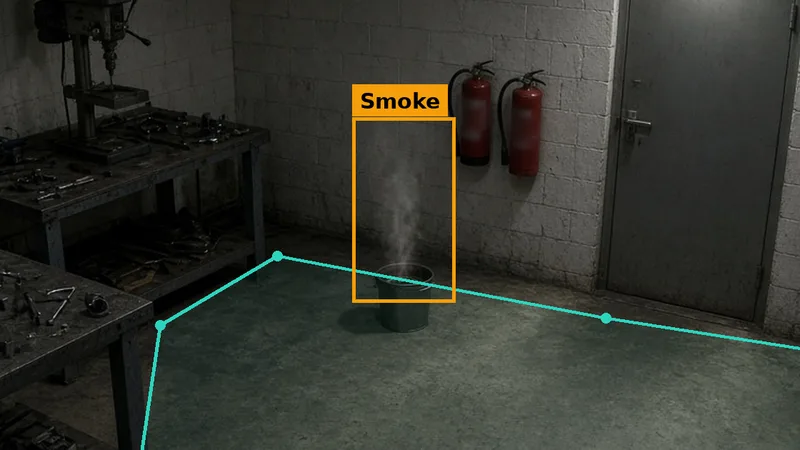
The places where camera detection adds most are those where a fire is likely to start and nobody is around out of hours. Choose an area below to see how a zone might be set up. Each image is a camera view with a zone drawn over the area to watch.
Which area?
Switch rooms, plant rooms and server cupboards are the places where a CO2 extinguisher is most likely to be fitted, and where nobody is likely to be at night. If a camera already looks over the panels or the door, a zone over the cabinets can send an alert with a clip if visible smoke or flame appears, so someone can check and call 999. It does not isolate the power or replace a fire alarm.
Smoke and flame, out of hours
Goods-in areas hold packaging, pallets and stock waiting to be put away, all Class A material, often near a fire point with water or foam extinguishers. After the last shift, nobody is there to use them. A camera covering the bay can watch a zone over the pallets and alert someone with a clip if smoke or flame appears.
Smoke and flame, after the last delivery
Outdoor bins, skips and pallet stacks are a common starting point for fires, accidental and deliberate, and an outdoor extinguisher cabinet is of no use with nobody on site. A camera over the compound can watch a zone after closing and send an alert with a clip if smoke or flame appears, before a fire reaches the building.
Smoke and flame, all night
Each area needs its own zone and schedule.
Other places worth considering include workshops, as in the picture at the top of this page, charging areas, loading bays, and the outside of kitchens where bins and extraction meet. Our guides to bin store fire safety and arson prevention with CCTV cover the outdoor risks in more detail.
The limits of camera detection
Every detection method has limits. A camera can only see what is in its view: smoke inside a closed cabinet, a room without a camera, or behind a stack of stock will not be seen until it comes into view. Cameras need enough light, or infrared, to see at night, and thin smoke in the dark is harder to see. And a camera can only tell someone; it cannot reach for an extinguisher.
What about false alerts?
Dust, steam from a vent, headlights, reflections and insects near the lens can all look like smoke to a camera. Good set-up keeps false alerts down. Tight polygon zones cover the risk, not the whole view. Schedules arm zones only when the area should be quiet. Clean lenses and steady lighting help, and a self-learning system gets better over time at knowing what is normal for each camera. Reviewing alerts after the first week or two, and adjusting zones, makes a big difference.
A worked example
Here is how this might look for the fictional engineering workshop in the picture at the top of this page. It is an example, not a real business. The workshop has two extinguishers at a fire point by the door, one water and one dry powder, serviced every year and checked every month, and staff who know how to use them. It closes at 18:00. After a conversation with its fire risk assessor and insurer, the owner adds smoke and flame detection to an existing camera that looks down the workshop floor, with a zone armed from 18:00 to 07:00.
One night, swarf and rags in a metal waste bin by a bench start to smoulder. At 02:41, a thin line of grey smoke starts to rise from the bin. The camera zone sees it, and within a minute the alert reaches the owner, with the clip. They can see smoke coming from the bin, call 999 and tell the fire service exactly where it is and how to get in.
Crews arrive, put the bin out with the powder extinguisher from the fire point and check that nothing else is smouldering. In the morning, the scorched bin, the discharged extinguisher on its side and a dusting of powder are the only damage, as in the picture earlier in this guide. The used extinguisher is replaced, and the next week the owner reviews what happened with the assessor: rags now go into a lidded metal bin, and the bins are emptied as part of the closing-up routine. The extinguishers on the wall could not have helped at 02:41, with nobody there. The camera meant the fire was found at 02:41 by the owner, not at 07:30 by the first person in.
How Woodcock AI fits
Woodcock AI connects to existing IP cameras, and detection runs on an edge server on site or on a cloud server. It adds smoke and flame detection, and people and vehicle detection, to the cameras you already have. You draw polygon detection areas over the places that matter, choose when they are armed and who gets the alerts. Each alert has a snapshot, a short clip and an AI description of what the camera saw. Our smoke and fire detection page and how it works page show more, and our industrial and warehousing and logistics pages show how it is used in those settings.
Woodcock AI is self-learning, so it gets better over time at knowing what is normal on each camera, including the dust and reflections of a working site. It is the result of years of development and is now in use on real sites in the UK. It works alongside your extinguishers, fire alarm, fire risk assessment and people rather than replacing them. Ask your cameras (Coming soon, early 2027) will let you ask questions about what your cameras have seen in plain words.
Ways to start
Book a site assessment. We look at what your cameras see by day and after dark, and show where zones would help, such as workshops, switch rooms, goods-in areas and bin compounds. Or ask for a live test on your cameras: we connect two or three of your existing cameras for about a fortnight, so you can see the alerts for yourself. We are also happy to arrange an on-site demo.
Sources
- HM Government, Fire safety risk assessment: factories and warehouses (Part 1, section 3.4.2, and Part 2, section 3.1).
- London Fire Brigade, Fire safety guidance note GN08: hand-held portable firefighting equipment, revision 20, January 2025.
- Dorset and Wiltshire Fire and Rescue Service, Fire extinguishers; Scottish Fire and Rescue Service, Business advice and guidance.
- Greater Manchester Fire and Rescue Service, Firefighting equipment; Cheshire Fire and Rescue Service, Fire protection frequently asked questions.
- Regulatory Reform (Fire Safety) Order 2005 (legislation.gov.uk), articles 13, 17 and 21; GOV.UK, Fire safety in the workplace.
- Reports of 2026 fires: Royal Berkshire Fire and Rescue Service, Oxford Road, Reading, Gun Street, Reading, Bracknell and East Ilsley; Suffolk Fire and Rescue Service, Bungay; Newbury Today, Greenham Common; Daily Record, near Glasgow Central; Glasgow Live, Argyle Street; Lancashire Post, Preston.
We have summarised these sources in our own words and checked them on 3 November 2026. This guide is general information, not fire safety advice for your premises. Details of the 2026 fires are as stated in the reports at the time. The government guidance and the Fire Safety Order apply in England and Wales; Scotland and Northern Ireland have their own laws. Your fire risk assessor, extinguisher provider, insurer and local fire and rescue service can tell you what applies to your premises.
Who would see a fire start at 2am, with the extinguishers on the wall?
Book a site assessment and we will look at what your cameras see by day and after dark, and show where smoke and flame zones would help over workshops, switch rooms, goods-in areas and bin compounds, or ask for a live test on your cameras.
Related pages
- Fire risk assessment
- Commercial fire alarm systems
- Commercial sprinkler systems
- Commercial kitchen fire safety
- Warehouse fire safety
- Factory fire safety
- Hot works fire risk
- Lithium-ion battery storage fire safety
- Video smoke detection on existing CCTV
- Industrial fire and security detection
- Smoke and fire detection cameras
- Book a site assessment
Frequently asked questions
What are the main types of fire extinguisher?
In the UK the main types are water, water with additives, water mist, foam, dry powder, CO2 and wet chemical, with special powder for metal fires and clean agent types for specialist uses. All new extinguishers have a red body with a colour band showing the type: red for water, cream for foam, blue for powder, black for CO2 and yellow for wet chemical.
Which fire extinguisher should I use on an electrical fire?
CO2 is the usual choice. The government guidance says CO2 extinguishers are particularly suitable for fires involving electrical equipment, and powder can also be used but will almost certainly ruin the equipment. Never use plain water on live electrical equipment. Disconnect the power if you can do so safely, and leave if the fire does not go out quickly.
How many fire extinguishers does a business need?
Your fire risk assessment decides. As a rule of thumb, the government guidance says one water-based extinguisher for about every 200 square metres of floor space, with at least two per floor, will normally be adequate for Class A risks, and one may be enough in very small premises under 90 square metres. Add the right types for other risks, such as CO2 by electrical equipment.
How often should fire extinguishers be checked and serviced?
Check them yourself every month: in place, visible, not used or damaged, gauge within limits and seals intact. A competent person should service them every year, with extended servicing, including discharge and recharge, as set out in BS 5306-3. Recharge or replace any extinguisher after use, even a short burst, and keep a record of every check and service.
Where should fire extinguishers be located?
On escape routes, close to the exit from the room or floor, ideally at fire points in the same place on each floor, and near specific hazards such as fryers or fuel stores. Nobody should ideally have to travel more than 30 metres to reach one. Mount them on brackets or stands, with the handle at about 1 metre for larger units and 1.5 metres for smaller ones.
Can AI on CCTV replace fire extinguishers or a fire alarm?
No. A camera cannot put out a fire, and AI video detection is not a fire alarm. What it can do is watch for visible smoke and flame on your existing cameras when nobody is there to use an extinguisher, and send an alert with a clip so someone can call 999. Woodcock AI runs on an edge server on site or on a cloud server.
Last reviewed 3 November 2026
Getting people out comes before fighting a fire. For escape routes, assembly points and fire marshal duties, see our fire evacuation plan guide.