

Fire warden duties: a UK guide for employers
A fire warden, also called a fire marshal, is a trained member of staff who helps put a building's fire procedures into effect: preventing fires day to day, helping people leave when the alarm sounds, sweeping their area to check it is empty and reporting at the assembly point. The Fire Safety Order requires the responsible person to nominate a sufficient number of competent people to implement evacuation procedures and to train them adequately. The law sets no fixed ratio or certificate; your fire risk assessment decides.

What is a fire warden?
A fire warden is a member of staff who has been chosen, and trained, to help put a building's fire procedures into effect. Day to day, a warden keeps an eye on the things that make fires more likely or escape harder, such as blocked exits, wedged fire doors, overloaded sockets and rubbish piling up. When the fire alarm sounds, the warden helps people leave by the nearest safe route, checks their area to make sure nobody has been left behind, and reports to the person in charge at the assembly point. Some wardens are also trained to use a fire extinguisher on a small fire if it is safe to do so.
A fire marshal is the same role under a different name. The government's guide to fire safety in offices and shops says it plainly: staff expected to take on the role of fire marshals are "often called fire wardens". Some organisations use one name for people who sweep floors and the other for people who run the assembly point, but the law uses neither. It speaks of "competent persons" nominated by the responsible person. This guide uses "fire warden" throughout, and everything in it applies equally to fire marshals.
This guide is for business owners, office and facilities managers, health and safety leads and anyone who has just been asked to be a fire warden. It explains the law behind the role in England and Wales, and how Scotland and Northern Ireland differ. It covers what wardens do before, during and after a fire, how many you need and how to cover shifts and holidays, what their training should include and how often it should be refreshed, how to run sweeps, roll calls and fire drills, and the mistakes that most often undermine the role. It finishes with three cases from 2026 and with the hours when there are no wardens at all, which is where AI on existing CCTV can help.
Fire warden, fire marshal or something else?
You will see several titles in use: fire warden, fire marshal, floor warden, fire steward, fire team member and, in larger sites, fire team leader or incident controller. Hotels may call the role duty manager on nights; construction sites often use fire marshal; hospitals and universities tend to have fire wardens for each department. None of these titles is defined in law. What matters is that the people you name are competent, that there are enough of them, that they know exactly what they are expected to do, and that everyone else in the building knows who they are.
A practical tip: pick one title and use it consistently in your fire risk assessment, your emergency plan, your training records and your signs and notices. Mixed titles cause confusion during a drill, especially in shared buildings where different tenants have chosen different words.
Why fire wardens matter
A fire alarm tells people there may be a fire. It does not make them move, show them a safe route, check the toilets or the meeting room at the end of the corridor, or help someone who cannot use the stairs. People often hesitate when an alarm sounds, waiting for confirmation, finishing a call or collecting belongings. A warden in a hi-vis vest saying "leave now, use this stair" cuts that delay. At the assembly point, a warden's report that their area is clear, or that someone is missing, is the information arriving fire crews ask for first.
Wardens also matter on the days when nothing happens. A warden who notices that a fire door has been wedged, that an exit route is blocked with deliveries or that a heater has been left on under a desk is preventing the fire that would otherwise test everyone's training. Most fire safety failures that fire and rescue services find on inspection are everyday lapses of exactly this kind.
The law behind the role
In England and Wales, workplace fire safety is governed by the Regulatory Reform (Fire Safety) Order 2005, usually called the Fire Safety Order. It applies to almost all non-domestic premises, including offices, shops, factories, warehouses, hotels, schools and the common parts of blocks of flats. The Order places duties on the responsible person, and several of those duties lead directly to the fire warden role, even though the word warden never appears.
Article 15 is the most important. It requires the responsible person to establish appropriate procedures, including safety drills, to be followed in the event of serious and imminent danger, and to "nominate a sufficient number of competent persons to implement those procedures in so far as they relate to the evacuation of relevant persons from the premises". That is the legal basis of the fire warden. Article 13(3)(b) adds a duty, where necessary, to nominate competent persons to implement firefighting measures, and to make sure their number, their training and the equipment available to them are adequate, taking into account the size of the premises and the specific hazards involved.
Article 18 requires the responsible person to appoint one or more competent persons to assist in undertaking the preventive and protective measures, with enough time and means to do so, adequate to the size of the premises and the risks. This is often a fire safety manager or coordinator rather than a warden, though in a small business the same person may do both. Article 21 requires adequate safety training for employees, when they first start and whenever they are exposed to new or increased risks, repeated periodically where appropriate, and during working hours. Article 19 requires employees to be given information about the identities of the people nominated under articles 15 and 13. Article 11 requires arrangements to plan, organise, control, monitor and review all of this.
In its 2023 guide for persons with duties under the Fire Safety Order, the Home Office explains how this works in practice: in premises with staff, the responsible person must nominate a sufficient number of competent people to implement the fire procedures, and "other than in small premises, this will usually involve the appointment of fire wardens, who assist in shepherding occupants from the premises and checking that areas for which they are responsible have been evacuated".
The responsible person
The responsible person is usually the employer, where the premises are a workplace under their control. Otherwise it is the person who has control of the premises in connection with a trade, business or other undertaking, or the owner. The responsible person is often a company rather than an individual. In a shared building there may be several: each tenant for its own space, and the landlord or managing agent for the common parts. The Order requires them to co-operate and co-ordinate, which in practice means agreeing one evacuation strategy, one alarm, compatible warden arrangements and one assembly point or a clear set of them.
Appointing wardens does not move the legal duty onto them. A fire warden is helping the responsible person meet their duties; the responsible person remains accountable for having enough competent wardens, for their training and for the procedures they follow. Equally, wardens are employees, and employees have their own duty under the Order to take reasonable care for themselves and others and to co-operate with the employer's fire arrangements. Being a warden does not mean taking risks: no warden should ever be expected to put themselves in danger to search an area or fight a fire.
Fire warden duties
A fire warden's job can be split into stages. Most of it happens on ordinary days, when a warden helps prevent fires and keeps escape routes usable. A small part happens when the alarm sounds, and that is the part people remember. Then there is the work at the assembly point and the debrief afterwards, which is how an organisation learns from drills and real incidents. The exact list for your building should come from your fire risk assessment and your emergency plan, but the stages are the same almost everywhere.
Everyday duties: prevention and checks
Wardens are often the people who walk the floor most. They notice when a fire exit has been blocked by a delivery, when a fire door has been propped open with a bin or an extinguisher, when the call point by the stair has disappeared behind a new display stand, or when a heater has appeared under a desk in winter. A warden's everyday duty is to notice these things and make sure they are put right, either by fixing them on the spot, such as removing a wedge, or by reporting them to whoever can fix them.
Many organisations give wardens a short checklist for a weekly or monthly walk round of their area. That is a good idea as long as it does not replace the formal checks your fire risk assessment requires, such as the weekly fire alarm test, the monthly emergency lighting test and the servicing of extinguishers. A warden checklist is a second pair of eyes, not the maintenance regime. It is also worth making sure that what wardens find actually gets fixed. A warden who reports the same wedged door every week, and sees nothing change, will soon stop reporting.
Wardens can also help with the human side of fire safety: making sure new starters know where the exits and call points are, that visitors and contractors know what the alarm sounds like, and that colleagues who might need help in an evacuation have a plan. In shared buildings, they can be the link with the wardens of other tenants.
When the alarm sounds
When the fire alarm sounds, a warden's first job is to be seen and heard. Most organisations give wardens a hi-vis vest or tabard, kept at their desk or at a warden point, so they can be recognised. The warden then tells people in their area to leave by the nearest safe exit, without stopping to collect belongings, and checks their area as they leave: desks, offices, meeting rooms, toilets, kitchens, store rooms and any other spaces someone could be in. Doors are closed behind them to slow the spread of smoke, but never locked.
The government guide to fire risk assessment in offices and shops describes the fire marshal role as including: helping those on the premises to leave; checking the premises to ensure everyone has left; using firefighting equipment if safe to do so; liaising with the fire and rescue service on arrival; shutting down vital or dangerous equipment; and performing a supervisory or managing role in any fire situation. Not every warden will do all of these. In a small office, the warden may do the lot. In a large building, floor wardens sweep and report, a fire coordinator runs the assembly point, and specific people handle plant shutdown and the fire service.
The sweep is the heart of the role. A good sweep is quick, systematic and confined to the warden's own area, so that two wardens do not duplicate effort while another area is left unchecked. Wardens should know their route in advance, check every room including the toilets, knock and open doors rather than calling out, and leave by the nearest safe exit when they have finished. If they find smoke or fire, they close the door, leave and report what they saw and where.
Helping people who need it
Some people need help to leave a building: wheelchair users, people with impaired sight or hearing, people with conditions that affect mobility or understanding, and people who are temporarily injured or pregnant. The responsible person's emergency plan should already cover them, usually through personal emergency evacuation plans (PEEPs) for staff who need them and general arrangements for visitors. Wardens need to know these plans for their area: who has one, where they are likely to be, who their buddy is and where any refuge or evacuation lift is.
Wardens should not improvise evacuation chairs, lifts or carries on the day. These need equipment, training and a plan. A warden's role is to make sure the planned arrangements happen and to report at the assembly point where anyone waiting in a refuge is, so the fire service can be told. Our fire evacuation plan guide covers PEEPs, refuges and evacuation strategies in more depth.
At the assembly point
At the assembly point, each warden reports to the person running the evacuation, often called the fire coordinator or incident controller: whether their area was swept and found clear, whether any area could not be checked and why, and whether anyone is known to be missing or still inside, with their last known location. The coordinator collects these reports alongside any roll call or signing-in records and briefs the fire and rescue service when they arrive. Nobody goes back into the building until the fire service, or the coordinator for a drill, says it is safe.
What fire wardens should never do
Fire wardens are not firefighters. The government guide says that people with no training should not be expected to attempt to extinguish a fire, and that people expected to take a more active role should get more comprehensive training. Even trained wardens should only tackle a fire if it is small, if they have the right extinguisher, if they have a clear way out behind them and if the alarm has already been raised. Our fire extinguisher types guide explains which extinguisher goes with which fire. Wardens should never enter smoke-filled rooms to search, use ordinary lifts during a fire, or reset the alarm before the all-clear.
How many fire wardens do you need?
The law does not give a number. Article 15 of the Fire Safety Order requires "a sufficient number of competent persons" to implement the evacuation procedures, and article 13 asks for the number of people nominated for firefighting to be adequate, taking into account the size of the premises and the specific hazards involved. What is sufficient depends on your building, the people in it and the risks, and it should be decided in your fire risk assessment and tested in your fire drills.
The main factors are easy to list. How many people are in the building, and how many floors, rooms and separate areas are there to sweep? How quickly could a fire develop, given what is stored and what processes run? Are there members of the public, visitors who do not know the building, or people who will need help to leave? And over what hours, shifts and days are people in the building? A single-storey shop with six staff and an open floor may need only the manager on duty and a deputy. A five-storey office with meeting rooms, kitchens and a basement may need at least two wardens per floor on every working day, plus a coordinator. A warehouse running three shifts needs warden cover on all three, including the night shift with fewer people.
What about ratios?
You will find ratios quoted online and in some training material, such as a set number of wardens for a set number of people in low, normal or high-risk premises. These are rules of thumb, not law, and the government guidance does not set them. They can be a reasonable place to start, but they ignore the layout of the building and the hazards in it. Ten people spread across twenty small rooms on three floors need more sweeping than fifty people in one open-plan room. The test of whether you have enough wardens is whether every area can be checked quickly and reliably during a drill, on every day and shift.
Covering leave, shifts, hybrid working and nights
The most common gap is not the number of wardens on paper but the number actually present. Wardens take holidays, go off sick, work from home, attend meetings in other buildings and change jobs. A building with eight trained wardens may, on a Friday in August, have one in the office. The answer is to train enough people to cover realistic absences, name deputies for each area, and check the warden rota against who is really in the building, particularly with hybrid working.
Early mornings, evenings and weekends need thought too. Cleaners, security officers, maintenance contractors and early starters may be in the building when no wardens are. Your emergency plan should say who acts as warden then, and they need the same training. Where a building is completely empty overnight, there are no wardens to sweep and nobody to raise the alarm, which is the gap this guide returns to at the end.
Choosing who becomes a warden
The best wardens are people who are usually in the building and usually in the same area, who know that area well, who stay calm and can speak up, and who are willing to do the job. Seniority does not matter. A receptionist or a team member who is always at their desk is often a better choice than a senior manager who is frequently out. Volunteers make better wardens than conscripts, and it helps if the role is recognised in job descriptions, appraisals and, where appropriate, pay. Wardens with mobility difficulties or other needs can still be excellent wardens with the right area and arrangements.

Many organisations set up a warden point on each floor: a hook or cabinet near the stair with a hi-vis vest, a torch and a copy of the floor plan and sweep route. It saves time on the day, makes wardens easy to identify, and reminds everyone else that the role exists. The vest should be kept where it can be grabbed on the way out, not locked in a drawer, and the warden point must never obstruct the escape route or a fire door.
Fire warden training
There is no legal requirement for a particular fire warden course or certificate. The legal test is competence. Article 15(3) of the Fire Safety Order says a person is to be regarded as competent where they have sufficient training and experience or knowledge and other qualities to enable them properly to implement the evacuation procedures. Article 21 requires the responsible person to make sure employees receive adequate safety training, and article 13 requires the training of people nominated for firefighting to be adequate. In practice, most organisations use a fire warden or fire marshal course, either in a classroom or online, and add to it with training about their own building.
The government guide to fire risk assessment in offices and shops lists what training for the fire marshal role may include: detailed knowledge of the fire safety strategy of the premises; awareness of human behaviour in fires; how to encourage others to use the most appropriate escape route; how to search safely and recognise areas that are unsafe to enter; the difficulties that some people, particularly if disabled, may have in escaping and any special evacuation arrangements that have been pre-planned; and additional training in the use of firefighting equipment. The same guide says the staff with a supervisory role in a fire, such as heads of department and fire marshals or wardens, should be given details of the fire risk assessment and receive additional training.
When training is needed
Article 21 says training must be provided when employees are first employed, and when they are exposed to new or increased risks, for example because they are transferred or given a change of responsibilities, or because new work equipment, new technology or a new system of work is introduced. Training must be repeated periodically where appropriate, adapted to take account of new or changed risks, and take place during working hours. The offices and shops guide adds that training is necessary when changes have been made to the emergency plan and the preventive and protective measures, when working practices, processes or people's responsibilities change, and where staff are expected to assist disabled people.
How often to refresh warden training is not fixed in law. Many course certificates suggest a refresher every one, two or three years, but the right interval for your wardens depends on your fire risk assessment, how often the building or the team changes, and what your drills show. A short refresher each year, tied to a drill and a walk round of each warden's area, keeps the knowledge fresh without much time away from work.
Making training stick
A generic course teaches the principles; it cannot teach a warden where the second stair is, which store room is always locked, or which meeting room has no window. The part of training most often missed is a walk round the warden's own area, following the sweep route, finding the call points, extinguishers and exits, and talking through what they would do if one route was blocked. The best moment to test it all is a drill, followed by a quick debrief.
Keep records
The offices and shops guide says that whatever training you decide is necessary should be verifiable, and that enforcing authorities may want to examine records as evidence that adequate training has been given. A simple record of who was trained, in what, when, by whom and when their refresher is due, plus the drills they took part in, is usually enough. If your fire and rescue service inspects, the training record and the drill record are two of the first documents they are likely to ask for.
Remember that wardens build on the training everyone in the building should get. As a minimum, the guide says all staff should be trained on the items in the emergency plan, the importance of fire doors and other basic prevention measures, the use of firefighting equipment where relevant, the importance of reporting to the assembly area, the exit routes and the operation of exit devices, including physically walking these routes, general matters such as smoking and cooking rules, and assisting disabled people where necessary. A warden cannot sweep a floor quickly if colleagues do not leave when the alarm sounds.
Fire drills, sweeps and roll calls
A fire drill is the only way to find out whether your wardens, your procedures and your building work together. The offices and shops guide says that once the emergency plan has been developed and training given, you need to evaluate its effectiveness, and that the best way to do this is a fire drill, carried out at least annually or as determined by your fire risk assessment, and more often if you have high staff turnover. Many workplaces run drills twice a year, and sites with shifts make sure each shift takes part over time.
The guide suggests the responsible person sets objectives for each drill, such as identifying weaknesses in the evacuation strategy, testing the procedure after changes to working practices, familiarising new staff, and testing the arrangements for disabled people. Before the drill, tell the alarm receiving centre if the alarm is monitored, nominate observers, and inform visitors and members of the public who are present. The guide notes that surprise drills may not be beneficial because the health and safety risks they introduce may outweigh the benefits. Asking a member of staff at random to set off the alarm with the test key at the nearest call point shows whether people know where call points are. Simulating a blocked exit or stair with a person posted at it encourages people to use routes they do not normally use.
Observers watch for the things that go wrong in real fires: difficulty with the roll call, people using their usual route rather than the nearest exit, final exit doors that are hard to open, difficulties experienced by disabled people, wardens unsure of their roles, people stopping to collect belongings or trying to use lifts, and doors and windows left open. The guide recommends on-the-spot debriefs that encourage feedback from everybody, with reports from wardens and observers collected and reviewed afterwards, and conclusions and remedial actions recorded and implemented.
Roll calls and sweep reports
The guide says that, where possible, a roll call should be carried out as soon as possible at the assembly point, and/or reports received from wardens designated to sweep the premises, noting anyone unaccounted for, because in a real evacuation that information needs to be passed to the fire and rescue service on arrival. A roll call depends on knowing who is in: visitor books, contractor sign-in and, with hybrid working, desk booking or access control data can help. Sweep reports cover the gaps a list cannot, such as visitors who did not sign in. Most organisations use both.
Common mistakes
The mistakes that undermine fire warden arrangements are usually simple. Wardens are named on paper but not actually in the building. Nobody has defined sweep areas, so the busy open floor is checked twice and the basement store not at all. Training was done years ago, before the office was refitted and the second stair moved. Drills are run but nobody writes down what went wrong, so the same problems repeat. Each of these is easy to fix with a current rota, a floor plan with sweep areas marked, a refresher after any change and a short written debrief.
Fire safety cases in 2026
Three cases reported in 2026 show how evacuation arrangements fail alongside other precautions. In Brighton, East Sussex Fire and Rescue Service reported that the person in control of a house in multiple occupation above a ground-floor shop pleaded guilty in April and was sentenced at Brighton Magistrates' Court on 20 July 2026, after inspectors found alarm faults across multiple zones, missing smoke detector heads, a removed fire-resisting door on the means of escape and combustible materials stored in escape routes. In Leeds, West Yorkshire Fire and Rescue Service reported on 9 October 2026 that a property management firm had pleaded guilty at Kirklees Magistrates' Court to failing to comply with an enforcement notice at a residential building, where alarm faults persisted and evacuation notices advised residents to stay put although a simultaneous evacuation strategy was required. In Taunton, the Fire Protection Association reported Devon and Somerset Fire and Rescue Service's prosecution of a guest house business, sentenced at Taunton Magistrates' Court on 19 October 2026, whose failings included no fire risk assessment, no fire alarm system and inadequate evacuation procedures, among offences under articles 8, 9, 11, 13, 14, 15 and 17 of the Order.
None of these cases turned on fire wardens alone, and two concerned residential buildings rather than staffed workplaces. But they show the same lesson: wardens can only follow a plan that exists, fits the building and is communicated correctly, with an alarm that works and escape routes that are protected. The Leeds case is a reminder that the message people are given matters as much as the people giving it.
Scotland, Wales and Northern Ireland
The Fire Safety Order applies in England and Wales, so the duties described above apply in both. Wales has its own building safety programme and guidance, but the workplace duties to nominate and train competent people for evacuation are the same. In Scotland, workplace fire safety is governed by Part 3 of the Fire (Scotland) Act 2005 and the Fire Safety (Scotland) Regulations 2006, which place duties on employers and others, usually called duty holders, to carry out a fire safety risk assessment and take fire safety measures, including staff training and procedures for an emergency. The Scottish Government's practical fire safety guidance for existing non-residential premises covers staff training and emergency procedures in detail. In Northern Ireland, the Fire and Rescue Services (Northern Ireland) Order 2006 and the Fire Safety Regulations (Northern Ireland) 2010 set similar duties, and the Northern Ireland Fire and Rescue Service publishes business fire safety guidance.
Fire wardens in different types of premises
The principles are the same everywhere, but the details change with the building. In offices, the main challenges are hybrid working, multi-tenant buildings and the number of small rooms to sweep. In shops, wardens must guide members of the public who do not know the building, often from busy shop floors and fitting rooms, and close tills and stock rooms without delay. Our office security guide covers the out-of-hours side of offices.
In warehouses and factories, buildings are large, there may be several shifts and noise can drown out alarms, so wardens need clearly defined sectors, good communication and named people for shutting down plant, isolating gas or stopping conveyors where the fire plan requires it. Visiting drivers and contractors need to be included in the plan and the roll call. The government guide to fire safety risk assessment in factories and warehouses covers these premises, and our warehouse fire safety and factory fire safety guides look at the risks.
In hotels and other sleeping premises, wardens may be a small night team responsible for waking guests, checking rooms and handling a guest list for the roll call. Night staff need the most practice, because they will be fewest when it matters most. Our hotel security guide covers the wider picture.
Blocks of flats
Blocks of flats are different. The Fire Safety Order applies to the common parts, but there are usually no staff and so no wardens to sweep the building. Residents rely on clear instructions instead. Under regulation 9 of the Fire Safety (England) Regulations 2022, in force since 23 January 2023, the responsible person for any building in England with two or more sets of domestic premises and common parts that residents would use to escape must display fire safety instructions, including the evacuation strategy and how to report a fire, and give residents a copy when they move in and at least every 12 months. The Leeds case above shows what happens when those instructions are wrong.
When no warden is there: where AI on existing CCTV fits
Fire wardens only work when they are in the building. In most workplaces that means working hours, and perhaps early and late shifts. Overnight, at weekends and on bank holidays, many buildings are completely empty: no wardens, no staff, nobody to notice smoke, smell burning or press a call point. If the fire alarm is not monitored, nobody may know about a fire until it is seen from the street. Many of the places where fires start out of hours, such as break-out areas, copier alcoves, store rooms and comms rooms, already have a camera pointing at them.
AI video detection watches for visible smoke and flame inside areas you choose, at the times you choose, and sends an alert with a snapshot and a short clip so a person can decide what to do. It can spot smoke rising from a printer or a charging shelf out of hours, in the area a camera can see.
We want to be clear about what this is and is not. Video smoke and flame detection is not a fire warden. It does not sweep floors, guide people out, help anyone who needs assistance or take a roll call, and it cannot tell you a building is empty. It does not replace your fire alarm, your emergency plan, your fire risk assessment or any other precaution your assessor, insurer or the law requires. It does not sound your fire alarm or call the fire service. It is an extra layer of early visual warning, most useful in the hours when nobody is on site.
Out of hours, if a clip shows smoke or flame, the person who receives it can call 999 and say what they can see and where. If your fire alarm is monitored, keep those arrangements in place; camera alerts sit alongside them. If you are considering camera detection, talk to your fire risk assessor and insurer first. Our guides to video smoke detection on existing CCTV and commercial fire alarm systems explain how the two fit together.
Where it can help
The places where camera detection adds most are those where a fire could start while nobody is around. Choose an area below to see how a zone might be set up. Each image is a camera view with a zone drawn over the area to watch.
Which area?
Break-out areas collect chargers, toasters, microwaves and kettles, and they are often the last place anyone checks before leaving. Out of hours, a camera that already covers the area can watch a zone over the counter and charging shelf, and send an alert with a clip if visible smoke or flame appears, so a keyholder can check and call 999.
Smoke and flame, out of hours
Archive and store rooms are quiet by day and empty by night, and their contents burn readily. Wardens include them in sweeps during the day. Out of hours, a zone over the shelving can alert someone if smoke appears. Keep store rooms tidy and away from escape routes either way.
Smoke and flame, out of hours
Comms and plant rooms are often locked and unattended, so nobody sees a problem until something stops working. If a camera covers the room, a zone over the equipment can add a visual check for smoke or flame out of hours. It does not replace any detection or suppression the room already has.
Smoke and flame, out of hours
Each area needs its own zone and schedule.
Other places worth considering include loading bays, bin stores against the building and plant rooms. Our guides to bin store fire safety and fire risk assessment cover related ground.
The limits of camera detection
Every detection method has limits. A camera can only see what is in its view: smoke inside a cupboard or in a room without a camera will not be seen until it comes into view. Cameras need enough light, or infrared, to see at night, and thin smoke in the dark is harder to see. A camera cannot tell you that a building is empty, because people can be out of view, so it never replaces a warden's sweep or a roll call. And a camera can only tell someone; it cannot get anyone out.
What about false alerts?
Steam, dust, headlights, reflections and insects near the lens can all look like smoke to a camera. Good set-up keeps false alerts down. Tight polygon zones cover the risk, not the whole view. Schedules arm zones only when the area should be empty. Clean lenses and steady lighting help, and a self-learning system gets better over time at knowing what is normal for each camera. Reviewing alerts after the first week or two, and adjusting zones, makes a big difference.
A worked example
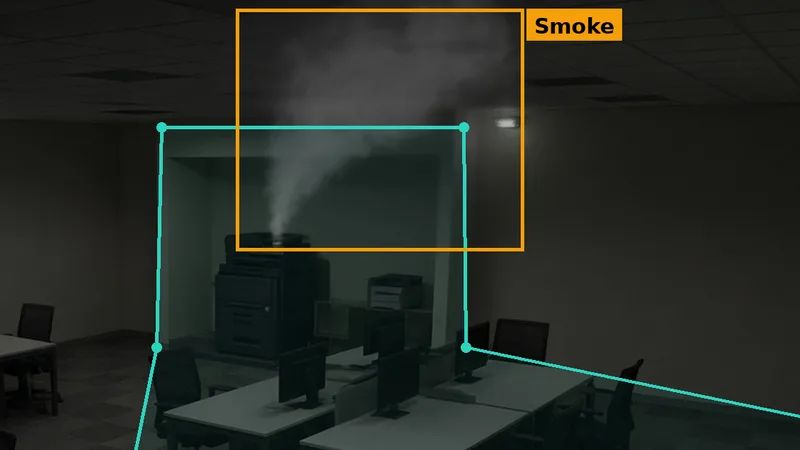
Here is how this might look for the fictional three-storey office shown at the top of this page. It is an example, not a real business. The office has a fire risk assessment, a fire alarm, two trained wardens on each floor every working day with named deputies, a drill twice a year and a warden point by each stair. After a conversation with its fire risk assessor and insurer, the business adds smoke and flame detection to an existing camera on the first floor, with a zone over the office floor and the copier alcove, armed from 19:00 to 07:00.
One evening the wardens make their usual end-of-day walk round, and the last person leaves at 18:30. The zone arms at 19:00. At 01:52, a plume of grey smoke starts to rise from the copier alcove. The camera zone sees it, and within a minute the alert reaches the keyholder with the clip and an AI description. They can see smoke on the office floor, call 999, tell the fire service exactly where it is and how to get in, and say that nobody is believed to be inside, based on the access log.
Crews deal with a fire at the copier. The following week, the business and its fire risk assessor review what happened: the copier is replaced, the alcove is cleared of the paper stored beside it, and the wardens add switching off non-essential equipment to their end-of-day walk round. The wardens were never needed that night, because nobody was there. The camera meant the fire was found at 01:52 by the keyholder, not at 07:30 by the first person in.
How Woodcock AI fits
Woodcock AI connects to existing IP cameras, and detection runs on an edge server on site or on a cloud server. It adds smoke and flame detection, and people and vehicle detection, to the cameras you already have. You draw polygon detection areas over the places that matter, choose when they are armed and who gets the alerts. Each alert has a snapshot, a short clip and an AI description of what the camera saw. Our smoke and fire detection page and how it works page show more.
Woodcock AI is self-learning, so it gets better over time at knowing what is normal on each camera. It is the result of years of development and is now in use on real sites in the UK. It works alongside your fire wardens, fire alarm, fire risk assessment and emergency plan rather than replacing them. Ask your cameras (Coming soon, early 2027) will let you ask questions about what your cameras have seen in plain words.
Ways to start
Book a site assessment. We look at what your cameras see by day and after dark, and show where zones would help, such as break-out areas, copier alcoves, archive rooms and comms rooms. Or ask for a live test on your cameras: we connect two or three of your existing cameras for about a fortnight, so you can see the alerts for yourself. We are also happy to arrange an on-site demo.
Sources
- Regulatory Reform (Fire Safety) Order 2005, articles 11, 13, 15, 18, 19 and 21; GOV.UK, workplace fire safety: your responsibilities.
- Home Office, A guide for persons with duties under the Fire Safety Order and the Fire Safety (England) Regulations 2022 (September 2023), from the fire safety legislation guidance collection.
- HM Government, Fire safety risk assessment: offices and shops (PDF, Part 1 Step 4 and Part 2 section 7) and Fire safety risk assessment: factories and warehouses.
- Fire Safety (England) Regulations 2022, regulation 9.
- London Fire Brigade, fire safety in the workplace; Scottish Government, practical fire safety guidance for existing non-residential premises; Fire (Scotland) Act 2005, Part 3; Fire Safety (Scotland) Regulations 2006; Fire and Rescue Services (Northern Ireland) Order 2006; Fire Safety Regulations (Northern Ireland) 2010; NIFRS, business fire safety.
- 2026 reports: East Sussex FRS, Brighton; West Yorkshire FRS, Leeds; Fire Protection Association, reporting Devon and Somerset FRS, Taunton.
We have summarised these sources in our own words and checked them on 3 November 2026. This guide is general information, not fire safety advice for your premises. Details of the 2026 cases are as stated in the reports at the time; we name places and courts, not people or businesses. The Fire Safety Order applies in England and Wales, the 2022 regulations in England only, and Scotland and Northern Ireland have their own laws. Your fire risk assessor, your insurer and your local fire and rescue service can advise on your building.
Your wardens go home. Who sees the smoke at 2am?
Book a site assessment and we will look at what your cameras see by day and after dark, and show where smoke and flame zones would help over break-out areas, copier alcoves, archive rooms and comms rooms, or ask for a live test on your cameras.
Related pages
Frequently asked questions
Is it a legal requirement to have a fire warden?
The law does not use the words fire warden or fire marshal. The Fire Safety Order requires the responsible person to nominate a sufficient number of competent persons to implement evacuation procedures, and to train them. Home Office guidance says that, other than in small premises, this will usually involve appointing fire wardens. In a very small business, the owner or manager may fill the role.
How many fire wardens do I need?
There is no fixed ratio in law. You need enough competent people to put your evacuation procedures into effect on every day and shift when people are in the building, allowing for holidays, sickness and hybrid working. The number depends on the size and layout of the building, the fire risks, and who is there. Your fire risk assessment should decide it and your fire drills should test it.
What is the difference between a fire warden and a fire marshal?
None in law. They are two names for the same role. The government guide to fire safety in offices and shops describes staff expected to undertake the role of fire marshals as often called fire wardens. Some organisations use one title for floor sweeps and another for the assembly point, so it is worth using one name consistently in your plan.
How often does fire warden training need refreshing?
The law does not set a fixed interval. Training must be given when people start and when risks change, repeated periodically where appropriate, and take place during working hours. Many courses suggest a refresher every one to three years, but the right interval depends on your fire risk assessment, changes to your building and team, and what your drills show.
Should fire wardens use fire extinguishers?
Only if it is part of their role, they have been trained, the fire is small, the alarm has been raised and they have a clear way out. Government guidance says people with no training should not be expected to attempt to extinguish a fire. A warden’s first job is to help people get out, and nobody should put themselves at risk.
Can AI on CCTV replace a fire warden or a fire alarm?
No. AI video detection cannot sweep a floor, guide people out, take a roll call or prove a building is empty, and it is not a fire alarm. It watches for visible smoke and flame in zones on your existing cameras, mostly out of hours when no wardens are there, and sends an alert with a clip so someone can call 999. Woodcock AI runs on an edge server on site or on a cloud server.
Last reviewed 3 November 2026