

Tool theft prevention: protecting tools in vans, depots, site stores and workshops
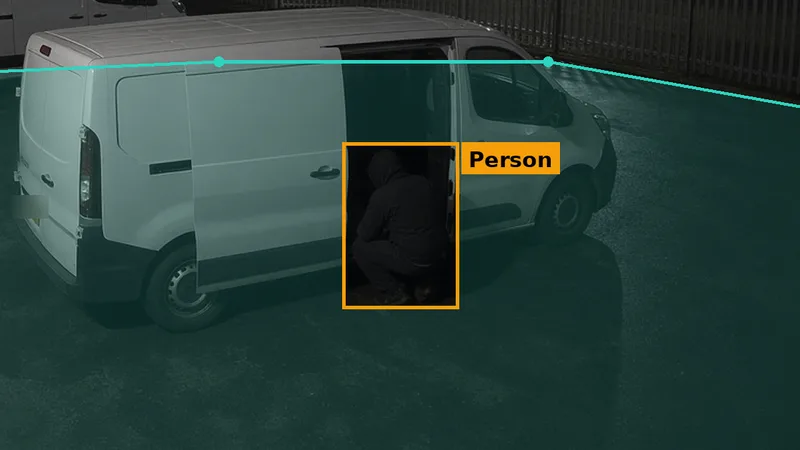
To prevent tool theft from a business, keep as few tools as possible where they sit unwatched overnight, and make the rest hard to reach, slow to take and quick to notice. Empty vans or park them with their doors against a wall in a lit, fenced compound; keep site tools in a steel store with its doors facing a camera; set the workshop alarm nightly; mark, photograph and register every tool; and sign kit out to named people. Then make sure someone finds out in minutes, not the next morning: AI detection on the cameras you already have can alert you when a person walks in among the vans, stands at a store door or crosses the back fence at night, and can watch battery chargers for smoke around the clock.

Last updated 2 November 2026. For most trades, the tools are the business. An electrician without a set of testers, drills and drivers cannot sign off a job. A groundworks crew without its saws, breakers and laser levels stands on site with nothing to do. A plumber whose van was emptied overnight spends the next morning ringing round customers to cancel, then buying the same kit again at the merchant, in a hurry. The tools may be insured. The lost days, the missed jobs, the disappointed customers and the knock to a small firm’s cash flow usually are not.
Tool theft is not a new problem, and much of the advice is familiar: empty the van, mark the tools, buy a better lock. What has changed is how organised and quick the thieves have become, how easy it is to sell tools on, and how many business tools now sit in places nobody watches for twelve or fourteen hours a night: vans in a depot compound or outside a worker’s home, steel containers on a site that closed at five, workshops on quiet estates, battery chargers on a bench in an empty unit.
This guide is for owners and managers of UK businesses that rely on tools and keep them in vans, depots, site stores, workshops and yards: building and maintenance contractors, electrical, plumbing and heating firms, groundworks, landscaping and grounds maintenance, fit-out and joinery, facilities management, fleet operators, plant and tool hire, and the managers of industrial units where tools are kept. It covers how big the problem is, where and when tools are stolen, what happened in a run of reported thefts in 2026, how to protect tools in vans and where vans are parked, compounds, boundaries, containers and site stores, workshops and units, marking and registering tools, tool control, CCTV and AI detection, the fire risk from charging tool batteries, what to do after a theft, insurance, and what the law says now and what is coming.
It does not cover theft of large plant and machinery, such as excavators and dumpers, which has its own guide, or the security of garden sheds at home. Where we use figures, they come from the Office for National Statistics, the Home Office, Parliament and police appeals, with links at the end. Where we give advice, it is general guidance, not a security survey of your site.
How big is tool theft in the UK?
There is no single official count of tool thefts. Police record crimes by type, such as theft from a vehicle, burglary of a business, or other theft, not by what was taken, so a van emptied of tools is counted as a vehicle crime and a workshop broken into is counted as non-residential burglary. To understand the size of the problem, you have to piece it together from several sources.
The broadest picture comes from the Office for National Statistics. In the year ending June 2026, police in England and Wales recorded 1.6 million theft offences, down 5% on the year before. Vehicle offences, which include theft from vehicles as well as theft of them, fell by 7% to 312,231. Burglary of all kinds fell by 6% to 222,304, and non-residential burglary, which covers business premises, sheds and outbuildings that are not part of a home, fell by 8.4% to 69,075.
Those falls are welcome, but they come from a very high level, and they only count crimes that were reported and recorded. Many small tool thefts never reach the police at all, either because the owner does not think anything will be done, or because they simply replace the tools and get back to work.
The Home Office Commercial Victimisation Survey gives a better view of how crime affects businesses rather than individuals. Its 2023 survey of business premises in England and Wales found that 26% of premises had been a victim of crime in the previous year, about 409,000 premises in all. The survey counts crime against vehicles used by the premises for their business, which is where van thefts sit. It found that vehicle-related theft was the type of crime most often experienced only once in the year, by 81% of its victims, which fits the pattern of a van emptied overnight and the owner changing what they do afterwards. And 69% of the businesses that had suffered theft said the financial impact on them was moderate or severe.
The same survey found that IT and electrical equipment made up 9% of the items stolen in thefts, burglaries and robberies against businesses. Power tools, testers and battery packs fall into that broad group, alongside laptops and phones. They are valuable, light, easy to carry, hard to trace when unmarked, and easy to sell on through online marketplaces, car boot sales and informal buyers. That combination is what makes tools such an attractive target.
The real cost is more than the tools
When a van is emptied, the visible loss is the tools. The bigger loss is often the time. A firm with three vans that loses one van’s worth of kit may lose a third of its capacity for days, while tools are replaced and the van door or lock is repaired. Jobs are cancelled or put back, and customers who were waiting for a boiler or an electrical certificate go elsewhere. The insurance excess has to be paid, and premiums or conditions may change at renewal. Staff who find their van broken into at six in the morning feel it too, especially when the tools are their own.
That is why the most useful question is not only how to stop a theft, but how to make sure that, if someone does try, you find out in time to do something about it. A theft discovered at seven in the morning is a crime report and an insurance claim. A person seen at a van door at two in the morning, with an alert on a phone and a clip to show the police, is a chance to keep the tools.
Where are business tools stolen from?
Most business tool thefts happen in four kinds of place. Each has its own weak points, and most firms have tools in more than one of them.
Vans. The largest group. Vans are parked overnight at a depot, outside staff homes, at a customer’s site or in the street, often with a full set of working tools inside. They are easy to spot, easy to target, and the tools are already packed for a quick exit. A van parked in the same place every night, with a trade name on the side, tells anyone watching exactly where the tools are.
Site stores and containers. On construction and maintenance sites, tools are kept in steel shipping containers, welfare cabins and lock-ups. Once work stops for the day, the site is usually empty, and a container in a quiet corner can be attacked for hours without anyone noticing.
Workshops and units. Joinery shops, fabrication units, garages, maintenance depots and tool hire branches keep large amounts of kit indoors. Doors, roller shutters, windows, roof lights and even walls can be the way in, often on industrial estates that are deserted overnight.
Yards and open storage. Tools, cable, fittings and small plant left in cages, sheds or open yards, often behind a fence that has not been checked for years.
How tool thieves usually work
We will not describe methods in a way that helps anyone, but in broad terms, reported tool thefts tend to follow a few patterns. Van doors and locks are forced or damaged, often at the side load door or the rear doors, where the tools are. Fences are cut, climbed or lifted, and tools are passed over or carried out through a gap. Weak walls and roofs are broken through, especially on older units, which is why a building with good doors and a good alarm can still be entered from the side. And some tools simply go missing over time, without a break-in at all, because nobody is counting them.
Thieves often watch a site or a street first. They notice which vans come back loaded, which containers are opened every morning, which units have no lights on at night and no sign of an alarm, and which yards have nobody about after six. They tend to come back to places that worked before. And they are quick: many reported thefts take minutes, not hours, which is why an alert that comes in the morning is too late.
Tool thefts reported in 2026
Police appeals published in 2026 show how widespread and how similar tool thefts are, from the Scottish Borders to Kent. These are a few that were reported publicly, with only the details the police chose to release. We have left out names, makes and values.
- Galashiels, Scottish Borders, January. Two vans were broken into overnight between 26 and 27 January, and tools were taken, according to Police Scotland.
- Kilmarnock, East Ayrshire. Police Scotland appealed after a series of thefts from vehicles across the town over a single week, with work vehicles particularly targeted and tools among the items taken. Officers asked residents and businesses to check their doorbell and CCTV footage.
- Catherington Business Park, near Horndean, Hampshire, August. Business premises and storage containers were targeted overnight between 9 and 10 August, between about 22:00 and 02:00. Hampshire Police said those responsible left through the fencing.
- Bridgnorth, Shropshire, September. A storage container on a construction site on Wenlock Road was broken into overnight between 3 and 4 September, West Mercia Police said, and tools were taken.
- Wootton, near Eccleshall, Staffordshire, September. Strimmers, chainsaws and other tools were stolen from a yard on Newport Road between midnight and 03:00 on 14 September, according to Staffordshire Police.
- Wainfleet, Lincolnshire, September. An industrial unit was broken into overnight between 24 and 25 September, and a power tool was among the items stolen, Lincolnshire Police said.
- East Peckham, Kent, September. Kent Police said that between 03:08 and 03:20 on 29 September, a hole was made through a brick wall of a unit on the Branbridges Industrial Estate, and more than 100 spindle tools were taken. Twelve minutes, from first entry to gone.
- Monkton, South Ayrshire, October. A vehicle was broken into at about 02:30 on 17 October, and electric tools and climbing equipment were stolen. Police Scotland linked it to a series of plant and tool thefts across Ayrshire over four nights.
Three things stand out. First, every kind of place is represented: vans, containers, yards and units. Second, rural and small-town sites are hit as much as cities, often on business parks and estates that are completely empty overnight. Third, the thieves are often organised, using vehicles to move tools away and working across several sites in a night or a week, which is why police appeals so often ask for doorbell, dash-cam and CCTV footage.
When tool thefts happen
Of the 2026 cases where police gave a time, every one was overnight. Horndean was between about 22:00 and 02:00. Eccleshall was between midnight and 03:00. Monkton was at about 02:30. East Peckham was between 03:08 and 03:20. The others were described simply as overnight. That matches what most firms already know: tools are taken when sites are closed, vans are parked up and nobody is looking.
Weekends, bank holidays and the Christmas shutdown are a particular risk, because sites are left for days rather than hours, and a theft on a Friday night may not be found until Monday. So are dark winter evenings, when sites empty in darkness at the end of the working day. And so is the first night on a new site, before fencing, lighting and routines have settled down.
The timing matters for prevention. If almost all the risk sits between the end of the working day and the start of the next, then the protection that matters most is the protection that works at night, when there is nobody on site: physical security that slows people down, lighting that removes the cover of darkness, and something that notices a person where there should be nobody and tells someone straight away.
Protecting tools in vans
The single most effective step is also the simplest: do not leave tools in vans overnight. Secured by Design, the police crime prevention initiative, puts it plainly in its advice on vans and tool theft, and police forces repeat it in almost every appeal. A van that is visibly empty, with a sign saying no tools are left in it overnight, is far less attractive than one that might be full.
For many firms, emptying every van every night is not practical. Kit is heavy, staff go home from the last job of the day, and there may be nowhere secure to put the tools at home. So the advice moves to making the van harder to get into and the tools harder to take:
- Park with the doors protected. Secured by Design advises parking with the rear or side doors against a wall or sturdy railings, so they cannot be opened far. In a depot, vans can be parked nose to tail or side door to side door, so each van protects the next.
- Park where you can be seen. Choose well-lit areas, ideally with CCTV in sight, and at home, park under a street light rather than in a dark corner.
- Use a van vault. A strong steel box bolted to the floor of the load area slows a thief down even once the doors are open.
- Add better locks and alarms. Extra locks on the load doors, and an alarm that covers the load area, make forcing the doors slower and noisier. In a written answer to Parliament in June 2025, the Home Office said Thatcham Research would add locks and alarms on the back of vans, and a motion sensor for the load area, to its vehicle security standard by February 2027.
- Advertise the security. Stickers saying the tools are marked, or that no tools are left in the van overnight, tell a thief that this van is not worth the risk.
None of these steps stops a determined thief on its own. A door against a wall can still be reached from the other side; a lock can still be beaten with enough time. What they do is add minutes, noise and risk, and make your vans a worse target than the next one along. That is also what gives an alert time to matter.
Parking a fleet so the doors cannot be reached
On a depot with several vans, the way they are parked at night is one of the cheapest security measures there is. Park the vans in a single row with their side load doors facing the depot wall, close enough that the doors cannot be slid open. Close the rear doors up to the next van or to a post. Put the row where a camera at one end can look straight along the doors, rather than across the roofs, and where a light falls on the doors rather than into the lens.
The same thinking applies to a single van at a home or customer site. Reverse up to a wall, a garage door or a fence, or park with the side door against a hedge or another vehicle. Avoid dark side streets and the far corner of a customer’s car park. If a van must be left somewhere that cannot be watched, take the most valuable tools out, even if the rest stay in.
Where do your vans stay overnight?
Most firms have vans in several places at night. Some come back to the depot compound, some go home with staff, and some stay on a customer’s site during a long job. Each needs its own rule, written down and explained to staff, about which tools stay in the van and which come out.
A fenced, lit depot compound that you control and can watch is the safest place for vans and for the tools in them. Vans outside staff homes are spread out, hard to watch and often parked on the street; for many firms, the best rule is that the most valuable tools come out every night, or that vans with expensive kit return to the depot. Vans on a customer site are behind someone else’s fence and rules, so it is worth asking what their security covers, rather than assuming. And vans on the street are the hardest to protect of all.
Some firms move to depot parking for the most loaded vans after their first theft, even though it means a longer drive at each end of the day, because the cost of one emptied van is so much higher than the cost of the extra miles. Others keep vans at home but bring them back to the depot over weekends and holidays, when the risk is highest.
Securing the depot, yard and van compound
A depot compound protects the vans and the tools inside them only if four things are in place. The fence has to be sound all the way round, without gaps behind bushes, sections that have been lifted, or pallets and skips stacked against it that make climbing easy. The gate has to be locked, lit and watched, and closed every evening, not left open for the last van back. Light has to fall on the vans and the routes to them, without shining into the cameras. And cameras have to look along the rows and across the gate, where people actually go.
Of those four, the camera is the one most often taken for granted. Many compounds have cameras that record around the clock, but nobody watches them at night, so the first anyone knows of a theft is when the footage is pulled the next morning. Footage after the event helps police and insurers. It does not keep the tools.
Where are your tools kept overnight?
Park vans with their doors against a wall or close to each other, light the rows, and put a camera at the end of each row looking along the doors. A people zone over the van park, armed when the depot is closed, flags anyone walking in among the vans, and a line on the gate flags anyone coming through.
Depots, fleet yards and van rows
Put the container where it can be seen from the road or the camera, with its doors facing the camera and a light on them. A people zone on the ground in front of the doors, armed out of hours, alerts as soon as someone stands there, long before a lock has been beaten.
Containers, cabins and lock-ups on site
Keep tools out of sight of windows, set the alarm every night, and charge batteries on a non-combustible bench in view of a camera, away from exits. Smoke detection on that camera runs around the clock, and a people zone inside the unit can be armed when it is locked.
Units, benches and battery chargers
Each place gets the detection that suits it: people zones round the vans and stores, lines on gates and fences, and smoke detection over the chargers.
The back fence and other quiet edges
Tool thefts often leave by a different route from the one they came in by, and many go out over or through a back fence rather than through the gate. In Horndean in August 2026, police said those responsible left through the fencing. Tools can be passed over a fence to someone waiting outside, carried through a cut section, or dropped over into scrubland and collected later.

The quiet edges of a site, the back fence, the side passage, the corner behind the workshop, are the places nobody walks past at night. They need the same care as the front gate: a sound fence with nothing stacked against it, a light, and a camera that looks along the fence rather than across it, so a person stays in view for as long as possible.
A line drawn along the foot of the fence, armed only when the site is closed, means anyone who reaches the fence from inside the yard, or comes over it from outside, sends an alert. Because it is armed at night only, daytime deliveries and staff working along the fence do not set it off.
Site stores, containers and cabins
On construction, maintenance and utility sites, tools usually live in a steel container or a cabin. Containers are strong, but they are often placed wherever there was space on day one, at the back of the site, facing away from the road and out of sight of everyone. That is exactly where a thief wants them.
Turn the container so its doors face the site entrance or a camera, and put a light on them. Use a shielded lock box or a container lock designed to resist cutting, rather than a padlock hanging in the open. Keep only the tools the job needs on site, and take the most valuable kit back to the depot or a secure store at night, especially before a weekend or a holiday. And make the evening close-down a routine: tools counted back in, doors locked, keys returned, and the site checked before the last person leaves.
Site stores are one of the clearest cases for detection rather than recording. In Bridgnorth in September 2026, a container on a construction site was broken into overnight. A camera facing the container doors, with a people zone on the ground in front of them armed from the end of the working day, would flag the first person who stood at the doors, while the lock was still on.
Workshops, units and depots
Tools kept indoors are safer than tools in a van or a container, but only if the building is as strong all the way round as it is at the front door. East Peckham in September 2026 is a good example: police said the way in was a hole made through a brick wall, and the whole theft took twelve minutes.
- Doors and shutters. Roller shutters, fire exits and personnel doors are the usual targets. Check that each one is in good repair, properly locked every night, and in view of a camera.
- Walls, windows and roofs. Older units with thin cladding, brick panels, windows and roof lights can be entered without touching a door. An intruder alarm with internal detectors covers these routes in a way that door contacts alone do not.
- The alarm. Set it every night, without exception, and make sure the alert reaches someone who will act on it.
- Out of sight. Keep tools away from windows and open doors, so nobody walking past can see what is inside.
Industrial estates are often completely empty at night, and neighbouring units may have their own cameras that see your doors. It is worth knowing your neighbours, sharing information about suspicious vehicles, and agreeing who to call if one of you sees something at another unit.
Marking, recording and registering tools
Marking does not stop a theft, but it makes tools harder to sell, easier for police to identify and more likely to come back. Secured by Design advises forensic marking and registering tools on approved tool and asset databases, and police forces regularly recover tools they cannot return because nobody can prove whose they are.
- Mark. Use a forensic marking product, an engraved postcode or company mark, or both, in a visible place and a hidden one.
- Record. Keep a list of every tool with its make, model and serial number, and a photograph, ideally showing the mark.
- Register. Register tools on an approved database, so that police and buyers checking a serial number can see they belong to you.
- Say so. Put stickers on vans, containers and doors saying that tools are marked and registered.
A tool register also pays off after a theft. Police need serial numbers to circulate stolen property, and insurers need them to settle a claim. A register kept in a spreadsheet or tool tracking app, updated when tools are bought, takes minutes to keep and saves hours when it matters.
Tool control: knowing what you have
Not every tool loss is a break-in. In many businesses, tools go missing gradually, left on a site, borrowed and not returned, or taken by someone leaving the firm. Without a register and a routine, nobody notices until a job needs a tool that is not there.
Simple tool control helps. Sign kit out to a named person or van. Do a short count against the register each week, or at the end of each job. Log van, store and container keys and keep spare keys secure, because a stolen key is the quietest way in. And collect tools and keys from leavers before their last day. None of this is about distrusting staff; it is about knowing what you have, so that a theft is spotted quickly and reported with the right details.
Signs your site or vans are being watched
Many tool thefts are planned. Before a theft, someone may have walked or driven past several times, parked up near the depot at the end of the day, watched which vans came back loaded, or tried a gate to see if it was locked. Some thieves follow vans home from a site to see where they are parked at night. Police forces regularly ask businesses to report anything that seems out of place, even if nothing has been taken yet.
Signs to look for include vehicles parked up for long periods near the site or near staff homes, especially if they come back on several days; people asking unusual questions about what kit you have, when the site is empty, or who has the keys; gates, locks, shutters or fences that have been tried or damaged; and small things moved, such as a pallet pushed against a fence, a light turned or a camera knocked.
If you notice any of these, write down the time, date and any vehicle details, save any footage, and report it to the police. Tell your staff, your neighbours and, on an industrial estate, the estate management. It is also a good moment to review your own security: check the fence, change any locks where keys may have been copied, and make sure detection is armed on the views that would see someone coming back.
This is one of the areas where an alert-based system is useful even when nothing is stolen. A people zone that sends an alert at 01:40 because someone walked round the van park and left again tells you something important: your site is being looked at. The clip, with the time, is exactly what police and your neighbours need to know.
A simple written policy for vans and tools
In many firms, what happens to tools at night depends on each driver. One empties the van every evening, another leaves everything in, and a third parks in a different street each night. A one-page written policy, explained to every driver and every new starter, removes the guesswork and is often what an insurer asks to see after a claim.
The policy only needs to cover four things. Which tools may stay in vans overnight, and which must come out or go back to the depot, usually the most valuable and the easiest to carry. Where vans may be parked overnight, such as the depot compound, a driveway or a specific street, and what to do when that is not possible. Who holds the keys to vans, stores and containers, and who receives alerts at night. And how and when to report a theft, an attempted theft or anything suspicious, including what details to record.
Review the policy after any theft or near miss, when the business grows, and when vans or depots change. A policy that nobody follows is worse than none, so keep it short and practical, and make it easy for staff to follow, for example by providing a secure store at the depot for tools that must come out of vans.
Weekends, holidays and shutdowns
The longest gaps are the most dangerous. A site that closes on a Friday afternoon may not be checked until Monday, and over the Christmas and New Year shutdown it may be empty for two weeks. Thieves know this, and a theft discovered at the end of a shutdown may have happened ten days earlier, with any footage overwritten and the tools long gone.
Before a long shutdown, move tools back from sites and vans to the most secure store you have, and bring vans into the compound rather than leaving them at homes or on customers’ sites. Check the fence, the gate, the locks and the lights. Arm people zones and lines all day, every day, for the shutdown, because nobody should be on site at all. Set up a rota of who receives alerts on each day, so that someone is always responsible, and make sure they know what to do. Our out-of-hours site security checklist covers the rest of the site.
It is also worth checking the cameras before the shutdown, not after. Walk round with a phone and confirm that each view still shows what it should, that nothing has been stacked in front of a camera, and that the lights come on at dusk. A camera that has been knocked out of line in October will not show anything useful in January.
Buying used tools without feeding theft
Stolen tools only pay when someone buys them. In its written answer in June 2025, the Home Office said work was under way on the markets where stolen tools are sold, and police forces regularly appeal to tradespeople not to buy tools without checking where they came from. Many businesses buy used tools, and most sellers are honest, but a few simple checks help keep stolen kit off your vans.
Ask for the serial number and check it against stolen property registers before you pay. Ask for a receipt or other proof of where the tool came from, especially for expensive items. Be wary of a price that is far below the usual second-hand value, of sellers with large numbers of the same tool, and of sales that have to happen quickly, in a car park or at night. And walk away from any tool whose marks or serial number have been ground off or covered, because that is a strong sign it was stolen.
If you are offered tools you think may be stolen, do not confront the seller. Note what you can, such as descriptions, vehicle details and where the tools were offered, and pass it to the police. If your own tools are stolen, check local marketplaces and second-hand listings, and give any leads to the police rather than trying to buy them back.
Working with your staff
Tool security works best when staff see it as protecting them, not policing them. Many tradespeople own some of their own tools, and a theft hits them directly, in lost earnings as well as lost kit. Explain why the policy exists, ask staff where they think the weak points are, and act on what they say. They often know which gate does not close properly, which corner of the yard is dark, or which street outside a worker’s home has had vans broken into.
When detection is added to the cameras, tell staff what it covers and when it is armed, and agree what happens if someone needs to come back to the depot out of hours, so they know they will be seen and nobody calls the police on a colleague. Clear signs that cameras and detection are in use protect staff too, because they tell a thief that this is not an easy target.
CCTV for tool theft: what it can and cannot do
Most firms that lose tools already have cameras, or put them in afterwards. The trouble is that a camera on its own is a recorder. It can show what happened, help police identify a vehicle, and support an insurance claim, but it does not stop the theft, because nobody is watching at two in the morning. Police appeals in 2026 asked again and again for doorbell and CCTV footage after the event.
Good camera placement still matters, because AI detection needs the same good views a person reviewing footage needs. For tool theft, the four positions that matter most are along the van rows, looking along the doors; inside each gate, looking across it; on the doors of each store, container and cabin; and along the back fence and quiet edges. Mount cameras high enough to be out of reach, keep lights behind them rather than in the view, and check every view at night. Our CCTV camera placement guide covers this in detail.
How AI detection on your cameras helps
AI detection turns the cameras you already have from recorders into something that notices. Software watches each camera’s view and recognises people, vehicles, smoke and flame, and sends an alert with a snapshot and short clip when something happens in a place, and at a time, where it should not. For tool theft, there are four useful tools:
- People zones. A shape drawn over part of the view, such as the van park, the ground in front of a container, or the yard behind the workshop. When a person walks into the zone while it is armed, an alert is sent. Woodcock AI uses polygon detection zones, so the shape can follow the exact outline of the van rows or the store, rather than a rough rectangle that takes in the road.
- Lines. A line drawn across a gate or along a fence, which alerts when someone crosses it, in the direction you choose.
- Vehicles. Vehicle detection can alert when a vehicle arrives in the yard or compound out of hours, which matters when thieves bring a van or pick-up to load.
- Smoke and flame. Watching battery chargers, waste and stores around the clock, as covered below.
The difference is timing. A van door forced at 02:14 is no longer something discovered at 07:00; it is an alert on the phone of a manager, a keyholder or a monitoring centre while the door is still being worked on. The clip shows whether it is a stranger or a member of staff collecting something, so the person who receives it can decide in seconds whether to call the police. And because the alert comes with a clip, the police know they are responding to a crime in progress, not a vague alarm.
Schedules: armed when the site is closed
Detection that alerts on every person, every day, quickly becomes noise. The answer is a schedule. People zones and lines are armed only when the site is closed, so staff and visitors during the day are not flagged, and smoke and flame detection stays on all the time.
A typical depot might arm the van park and tool store zones from 18:00 until 07:00, the gate and back fence lines from 19:00 until 06:30, and vehicle detection out of hours, with everything armed all day at weekends and over bank holidays. Woodcock AI is also self-learning, so over time it learns what is normal on each camera, such as trees moving in the wind or headlights sweeping across a wall, and alerts on what is not.
From alert to action
An alert is only useful if someone acts on it. Decide in advance who receives alerts at night, and what they do: call the police if it is clearly a crime in progress, call a keyholder to attend if it is unclear, or pass the alert to a monitoring centre. Make sure more than one person receives alerts, in case one is asleep or away. And check the system regularly, so you trust it when it matters.
Never go to a site alone to confront intruders. Thieves who steal tools are often organised and some are violent. The value of an early alert is that it lets the police respond while the thieves are still there, and lets you gather evidence, not that it puts you or your staff in danger.
Battery charging: the fire risk in the tool store
Cordless tools have brought a second risk into vans, workshops and stores: lithium-ion battery packs. Most charge safely for years, but a damaged, faulty or badly charged pack can overheat and catch fire, and a fire in a workshop or container at night can destroy far more than any thief would take. Fire and rescue services regularly warn about lithium-ion batteries in workplaces as well as homes.
Charge tool batteries on a non-combustible bench, away from exits and escape routes, using the matching charger. Take damaged packs out of use. Avoid charging large numbers of packs unattended overnight where you can, and keep the charging area clear of cardboard, rags and fuel. Include battery charging in your fire risk assessment. And put the charging bench in view of a camera, so smoke detection can watch it around the clock. Our lithium-ion battery storage guide covers this in more detail.
What to do if your tools are stolen
If a theft is happening now, call 999. Do not confront anyone, and do not go to the site alone. If you find a theft later, report it to the police, either through the non-emergency number or online, and get a crime reference number. Give the police the serial numbers, photographs and marks of the stolen tools, the times from your footage, and a description of any vehicle seen. Save the footage straight away, before the recorder overwrites it, and keep a copy somewhere safe.
Then tell your insurer, check whether the tools are listed on any registers as stolen, and check online marketplaces in your area for your tools, passing any leads to the police rather than trying to recover them yourself. Finally, look at how the thieves got in, and fix it before they come back. Repeat thefts are common, because a site that worked once is likely to work again.
Insurance and tool theft
Many business policies cover tools, but the conditions vary widely, and it is the conditions that decide whether a claim is paid. Some policies have particular conditions about tools left in vans overnight, the type of locks or alarms fitted, or where the van is parked. Read the wording, or ask your broker, before you need to claim, not after.
Keep proof of ownership: receipts, photographs and serial numbers, stored somewhere other than the van. Record the security you have, such as locks, alarms, cameras and detection, because insurers may ask for it. And tell your insurer when the risk changes, such as a new depot or more vans parked at staff homes.
Tool theft and the law
The Equipment Theft (Prevention) Act 2023 gives the government powers to require immobilisers and forensic marking on some equipment sold in England and Wales, and to require registration. It was aimed mainly at quad bikes and similar machines. After a call for evidence, the government said it would not include tools in the secondary legislation, and that it would be considering alternative ways to help prevent and tackle the theft of power tools.
In April 2025, Amanda Martin MP introduced the Theft of Tools of Trade (Sentencing) Bill as a Ten Minute Rule bill, seeking tougher sentences for tool theft. It has not become law. In a written answer in June 2025, the Home Office said it was working with the National Business Crime Centre on tool theft, pointed to the Secured by Design vans and tool theft advice, and said Thatcham Research would add locks and alarms on the back of vans, and a load-area motion sensor, to its vehicle security standard by February 2027. It also said work was under way on the markets where stolen tools are sold.
For businesses, the practical message is that new law will not protect your tools any time soon. Prevention, detection and good records are down to you.
Cameras and data protection
Business CCTV is covered by UK data protection law. The Information Commissioner’s Office expects you to have a clear purpose, such as protecting the site and the vans, to put signs up so people know cameras are in use before they enter the view, to keep views on your own site rather than neighbours’ homes and gardens, and to keep footage only as long as you need it. AI detection uses the same cameras and the same footage, so the same rules apply. Our guide to AI CCTV and GDPR has more detail.
A tool theft prevention checklist
Every site is different, but most of the steps in this guide fit into a short table. Use it to check each place your business keeps tools.
| Where tools are | Main risk | First steps | What cameras and AI add |
|---|---|---|---|
| Vans at the depot | Doors forced overnight | Doors to a wall, lit rows, van vault, empty where you can | A people zone over the van park out of hours; a line on the gate |
| Vans at staff homes | Spread out, out of sight | Empty overnight, park under a light, doors to a wall | Bring vans or tools back to a watched depot where you can |
| Site container or cabin | Locks attacked at night | Steel store, shielded lock, doors facing the camera, less stock | A people zone in front of the doors from close of work |
| Workshop or unit | Doors, shutters, walls or roof | Alarm set nightly, tools out of sight, weak panels fixed | Zones round doors and the yard; inside zones when locked |
| Open yard and boundary | Fences cut or climbed | Sound fence, nothing stacked against it, lighting | A line along the back fence, armed at night |
| Charging bench | Battery fire, not theft | Non-combustible bench, away from exits, in view | Smoke and flame detection on the camera, always on |
| Every tool | Easy to sell on | Mark, photograph, record serials, register | Clips that help police and insurers if theft happens |
Then make it routine. A five-minute close-down at the end of each day, by the last person to leave, closes most of the gaps that thieves look for.
Our out-of-hours site security checklist has a fuller list for the whole site, and our guides to plant and machinery theft, metal theft, fuel theft and perimeter intrusion detection cover related risks.
How Woodcock AI helps protect tools
Woodcock AI adds people, vehicle, smoke and flame detection to the IP cameras you already have, over RTSP or ONVIF, so there is usually no need to replace cameras. Detection runs on an edge server on site or a cloud server. You draw polygon zones that fit the van rows, store doors and yards exactly, add lines across gates and along fences, and set schedules so they are armed only when the site is closed. When something happens, an alert with a snapshot and short clip goes to the phones of the people you choose, and an AI description says what the camera saw.
Woodcock AI is self-learning, so it gets better at telling the normal from the unusual on each camera over time. It is the result of years of development and is now in use on real sites in the UK. For how the same approach fits other sites, see our pages on vehicle yards, construction site security and industrial estate security. Ask your cameras, a way to ask the system questions about what it has seen, is Coming soon, early 2027.
Ways to start
Start with a site assessment. We look at where your tools are kept, how your vans are parked, which cameras you have and what each one sees by day and at night, and show where people zones, lines, vehicle detection and smoke detection would help. Or ask for a live test on your cameras: we connect two or three of your existing cameras for about a fortnight, so you can see the alerts for yourself before deciding.
Sources
- Office for National Statistics, Crime in England and Wales: year ending June 2026, and the police force area data tables for the same period (October 2026).
- Home Office, Crime against businesses: findings from the 2023 Commercial Victimisation Survey.
- Secured by Design, Vans and tool theft crime prevention advice.
- legislation.gov.uk, Equipment Theft (Prevention) Act 2023.
- GOV.UK, Equipment Theft (Prevention) Act: summary of call for evidence responses and conclusion.
- UK Parliament, Theft of Tools of Trade (Sentencing) Bill.
- UK Parliament, Written question on tool theft, UIN 59229, answered 19 June 2025.
- Information Commissioner’s Office, Guidance on video surveillance, including CCTV.
- Police appeals published in 2026 by Police Scotland, Hampshire and Isle of Wight Constabulary, West Mercia Police, Staffordshire Police, Lincolnshire Police and Kent Police, as reported in local news.
We have summarised these sources in our own words. Always read the current versions in full. This page is general guidance, not legal, insurance or security advice; your installer, your insurer, your local police and a solicitor can advise on your own business.
Would you know if someone was at your vans tonight?
Book a site assessment and we will look at where your tools are kept, how your vans are parked and what your cameras see at night, and show where people zones, lines, vehicle detection and smoke detection would help, or ask for a live test on your cameras.
Related pages
Frequently asked questions
How can a business stop tools being stolen from vans?
The most effective step is not to leave tools in vans overnight. Where that is not practical, park with the side and rear doors against a wall or another vehicle, in a lit, fenced depot compound with cameras in sight, use a van vault bolted to the floor and extra locks on the load doors, and put stickers on the van saying tools are marked or removed overnight. AI detection on the depot cameras can alert you when someone walks in among the vans at night.
When are tools most likely to be stolen?
Overnight, when sites are closed and vans are parked up. Every 2026 police appeal we found that gave a time put the theft between about 22:00 and 03:20. Weekends, bank holidays, the Christmas shutdown and dark winter evenings are particular risks, because sites are left empty for longer.
Is it worth marking and registering tools?
Yes. Marking does not stop a theft, but it makes tools harder to sell and easier for police to identify and return. Secured by Design advises forensic marking and registering tools on approved tool and asset databases. Keep a register of serial numbers and photographs too, because police and insurers will ask for them.
Is there a law against selling stolen tools?
Handling stolen goods is already a crime. The Equipment Theft (Prevention) Act 2023 allows rules on marking and immobilisers for some equipment, but the government decided not to include tools. The Theft of Tools of Trade (Sentencing) Bill, introduced in April 2025, would toughen sentences but has not become law.
Can CCTV stop tool theft?
Cameras that only record help after a theft, by showing what happened and supporting police and insurers. To stop a theft, someone has to know about it while it is happening. AI detection on existing cameras sends an alert with a clip when a person enters a zone or crosses a line at night, so a manager, keyholder or monitoring centre can call the police in minutes.
Does Woodcock AI work with the cameras we already have?
Woodcock AI connects to existing IP cameras over RTSP or ONVIF and runs on an edge server on site or on a cloud server. It adds people, vehicle, smoke and flame detection with polygon zones, lines and schedules. A site assessment or a live test on two or three of your cameras shows how it works on your own site.
Last reviewed 2 November 2026