

Church fire safety: the law, risk assessment and checklist
Church fire safety means the precautions that protect worshippers, volunteers, visitors and hirers, and the building itself, from fire: a responsible person who knows their duties (in a Church of England parish the PCC acting together, and elsewhere usually the trustees or the body that manages the building), a current written fire risk assessment by a competent person, a suitable way of raising the alarm tested every week, exits unbolted and routes clear whenever people are inside, emergency lighting, signs and extinguishers that are checked and recorded, controlled use of candles and heaters, serviced heating and inspected electrics, a written emergency plan with stewards and drills at least annually, plans for anyone who needs help to get out, and measures against arson when the church is locked and empty. In England and Wales, the main law is the Regulatory Reform (Fire Safety) Order 2005.

What church fire safety means
Church fire safety is about stopping a fire from starting in or around a church, finding any fire quickly if one does start, and making sure that everyone inside, whether it is a congregation of three hundred at Christmas or one volunteer arranging flowers on a Thursday morning, can get out safely. It also means protecting a building that may have stood for centuries, along with its roof, its fittings and everything it holds, from a fire that could destroy in an hour what took generations to build.
Fire safety in a church rests on a few things working together. There is the law, which puts the duty on a responsible person, usually the body that runs the church. There is a written fire risk assessment, which looks at what could start a fire, who could be harmed and whether the precautions in place are good enough. There are the physical precautions: a way of raising the alarm, clear exits, emergency lighting where it is needed, signs and fire extinguishers. And there are the people: stewards and volunteers who know what to do, a plan for anyone who needs help to get out, and someone who checks that all of this still works from week to week.
This guide explains how fire safety works for churches, chapels and other places of worship across the UK, and for the church halls that sit beside many of them. It covers the law and who the responsible person is, the fire risk assessment, alarms, exits, emergency lighting and extinguishers, the balance between fire safety and a listed building, the everyday risks of candles, heating, electrics and kitchens, building works and hot work, evacuation, stewards and hirers, and the risks when the church is locked and empty: arson, bins and rubbish against the walls, and long quiet days. At the end, it explains where AI on existing CCTV can help by watching the outside of the church at night, and where it cannot.
Who this guide is for
This guide is written for the people who look after church buildings: members of parochial church councils, churchwardens and fabric committees in the Church of England and the Church in Wales; trustees, elders, deacons and property stewards in Methodist, Baptist, United Reformed, Catholic, independent and other churches; ministers and clergy; vergers, caretakers and the volunteers who open and lock up; and the people who manage church halls and book them out to community groups. It is written about churches, but most of it applies equally to chapels, meeting houses, mosques, gurdwaras, temples, synagogues and other places of worship, which have the same core duties.
Most of the detail is about England and Wales, where the same main fire safety law applies. Scotland and Northern Ireland have their own laws, which work in a similar way, and the guide says where they differ. It is general information, not legal advice for your church. Your fire risk assessor, your local fire and rescue service, your diocese, district or denomination, your insurer and your own advisers can tell you exactly what applies to your building.
Why churches are different
Churches are unlike most other public buildings in four ways. The first is the building itself. Many churches are old and listed, with timber roofs, hidden roof spaces, wooden pews and panelling, heavy doors, narrow stairs to towers and galleries, and only one or two ways out. Many were built long before fire safety rules existed, and changing them is difficult, slow and sometimes not allowed. A fire in a roof space or a tower can spread unseen and be very hard to fight.
The second is the use of flames and heat. Candles are part of worship in many traditions, and churches are often heated by old boilers, oil tanks and, in some places, portable heaters brought out on cold mornings. The government's fire safety guide for small and medium places of assembly, which names churches and other places of worship among the buildings it covers, lists naked flames such as candles, heaters, boilers and arson among the common sources of ignition.
The third is the pattern of use. A church may be full for an hour or two on a Sunday, busy with a toddler group, a choir practice or a concert during the week, and then locked and empty for long stretches, sometimes for days at a time. A fire that starts when nobody is there can grow for a long time before anyone notices. The fourth is the people. Most churches are run largely by volunteers, rotas change, and the person locking up on Wednesday may not be the one who knows where the fire extinguishers are. A good fire safety plan for a church has to work during a packed carol service and on an empty Tuesday night in February.
Church fire safety law: who is responsible?
In England and Wales, the main law is the Regulatory Reform (Fire Safety) Order 2005, usually called the Fire Safety Order. It applies to almost every building other than private homes, and that includes churches, chapels, other places of worship and church halls. It does not matter that a church is a charity, that it has no paid staff or that it is open only a few hours a week. Historic England's guide to fire safety for traditional church buildings says the same: the Order applies to churches, and someone has to take responsibility for meeting it.
The Order puts the duties on a responsible person. Under article 3, in a workplace, this is the employer, if the workplace is to any extent under their control. In any other case, it is the person who has control of the premises in connection with carrying on a trade, business or other undertaking, and the article says this applies whether that undertaking is for profit or not. If nobody fits that description, it is the owner. For most churches, that means the body that runs the church and controls the building, rather than any one person.
In the Church of England
In a Church of England parish, the Church of England's guidance on health and safety for PCCs says that the parochial church council is collectively responsible for health and safety, as the charity trustees of the parish. That includes fire safety: the guidance says PCCs should carry out regular fire risk assessments, keep exit routes clear, display appropriate signage, and keep fire extinguishers serviced, with electrical wiring and gas installations checked regularly by competent professionals. Churchwardens look after the building day to day, and many PCCs ask a churchwarden, a fabric officer or a health and safety officer to lead on fire safety, but the duty stays with the PCC as a body.
The Church of England's guidance on buildings and land explains that the PCC is responsible for the care and maintenance of the church and that changes to the building usually need permission through the faculty system. The archdeacon's annual Articles of Enquiry ask about the state of the building, and this is a useful prompt to check that the fire risk assessment is up to date. If the parish has a church hall, the PCC is often the managing trustee of the hall, and the same duties apply there. Installing fire alarms or security alarms, and CCTV for security purposes, is listed in List B of Schedule 1 to the Faculty Jurisdiction Rules 2015: the work can go ahead once the archdeacon has been consulted and has given written notice, unless the archdeacon decides a faculty is needed.
In other churches and places of worship
Other churches and faith groups organise themselves in different ways, but the same rule applies: the responsible person is whoever controls the building. Historic England's guide notes that in some nonconformist churches this will be a board of trustees. In a Methodist church it may be the church council, acting as managing trustees; in a Baptist or independent church, often the trustees; in a Catholic parish, often the diocesan trust, with the parish priest and parish team looking after the building day to day. In a mosque, gurdwara, temple or synagogue, it is usually the management committee or the trustees of the charity that owns or runs it.
If you are not sure who the responsible person is for your building, check your governing document, your trust deed or your denomination's guidance, and ask. It matters, because if a fire happens, the fire and rescue authority will want to know who was responsible for the assessment and the precautions. It also helps to name a single person, such as a churchwarden, a property steward or a hall manager, who takes the lead on fire safety for the trustees and reports back to them.
What the responsible person must do
The Fire Safety Order sets out what the responsible person must do. They must make a suitable and sufficient assessment of the fire risks (article 9), and put in place general fire precautions to protect people, based on that assessment (article 8 and article 11). They must make sure the premises have suitable means of detecting a fire and giving warning, and fire-fighting equipment where needed (article 13). They must make sure routes to emergency exits and the exits themselves are kept clear, so that everyone can leave quickly and safely, with emergency lighting and signs where needed (article 14). They must have procedures for serious and imminent danger, including evacuation (article 15), and keep the precautions and equipment maintained and in good working order (article 17).
The Order also requires the responsible person to appoint one or more competent persons to help them with the preventive and protective measures (article 18). A competent person is someone with enough training, experience or knowledge to do the job, and the article allows the responsible person to take on that role themselves if they are competent. Historic England's guide suggests that, in a church, this might be people such as churchwardens, vergers or stewards who are regularly there and know the building. Where a church employs staff, such as a verger, a caretaker, an administrator or a youth worker, they must also be given adequate fire safety training (article 21).
Who the law protects
The duties protect relevant persons, which means anyone who is lawfully on the premises or in the immediate area and could be harmed by a fire there. In a church, that includes the congregation and visitors, children and young people at Sunday school and youth groups, volunteers on the cleaning, flower and coffee rotas, choir members and bell ringers, people attending weddings, funerals and concerts, hirers and their guests in the hall, and contractors working on the building. Many will be unfamiliar with the building, some will be elderly or have a disability, and some will be young children. Your fire risk assessment needs to think about all of them.
Hirers, contractors and shared buildings
Churches rarely have just one user. Halls are hired out for parties, clubs, classes and meetings; contractors carry out repairs and building works; some buildings are shared by two congregations; and some have a nursery, a café or a food bank running alongside. Under article 5, anyone else who has some control of the premises can have duties too, to the extent of that control. Under article 22, where two or more responsible persons share or have duties for the same premises, they must co-operate, co-ordinate their fire safety measures and tell each other about the risks.
In practice, this means hirers should know what to do if there is a fire, where the exits and the assembly point are and how many people the hall can safely hold. A shared building needs one agreed fire plan, not two plans that contradict each other. Contractors should be told about the fire risks in the church before they start, and should tell you about any risks their work brings, especially if it involves heat, flames or sparks.
Writing down the assessment
In England, since 1 October 2023, every responsible person must record the findings of their fire risk assessment in full, whatever the size of the organisation, after changes made by section 156 of the Building Safety Act 2022 to article 9 of the Fire Safety Order. Before that, a written record was required only where there were five or more employees or certain other conditions applied. The record must include the significant findings, the measures taken or to be taken, and any group of people especially at risk. Wales has its own rules on this, so check the Welsh Government's guidance, but in practice every church should keep a written fire risk assessment wherever it is.
Who enforces the law
The law is enforced by the local fire and rescue authority. Fire safety officers can visit, inspect, ask to see the fire risk assessment and records, and give advice. Where something is wrong, they can issue an alterations notice, an enforcement notice requiring improvements by a set date, or a prohibition notice restricting or stopping the use of the premises if there is a serious risk to life. Serious failures can lead to prosecution. Most fire and rescue services would much rather help a church get things right than take action, and many welcome a call asking for advice.
Where a church employs anyone, the Health and Safety at Work etc. Act 1974 also applies, and the Church of England's health and safety guidance reminds PCCs of this. Your insurer will usually have its own requirements and guidance on fire safety too, and may ask to see the fire risk assessment, so it is worth reading your policy and the guidance that comes with it.
Scotland and Northern Ireland
In Scotland, the main law is Part 3 of the Fire (Scotland) Act 2005 and the Fire Safety (Scotland) Regulations 2006. Instead of a responsible person, the law refers to duty holders, and the duty to carry out a fire safety risk assessment and take fire safety measures is very similar. The Scottish Government's practical fire safety guidance for existing non-residential premises covers places of worship. The Church of Scotland's General Trustees' fire safety guidance explains that the congregation's charity trustees are the duty holders for their buildings. In Northern Ireland, the Fire Safety Regulations (Northern Ireland) 2010, made under the Fire and Rescue Services (Northern Ireland) Order 2006, set out similar duties, including a fire risk assessment, fire safety arrangements and maintenance.
The church fire risk assessment
The fire risk assessment is the foundation of church fire safety. It is a careful look at the church and the way it is used, to find out what could start a fire, what could burn, who could be harmed and what needs to be done to keep people safe. Everything else in this guide, from the alarm to the stewards' rota, should follow from it. The government publishes a series of guides for responsible persons under the Fire Safety Order, and the guide for small and medium places of assembly names churches and other places of religious worship among the premises it is written for. It describes a fire risk assessment in five steps.
Step one is to identify fire hazards: the sources of ignition, the sources of fuel and the sources of oxygen. Step two is to identify the people at risk, in and around the building, and especially those who are most at risk. Step three is to evaluate the risk, and then remove or reduce it, and protect people from what remains, by checking that the alarm, the escape routes, the lighting, the signs and the fire-fighting equipment are good enough. Step four is to record the findings, plan for an emergency, and inform, instruct and train people. Step five is to keep the assessment under review and revise it when needed.
Small, medium or large?
The government's small and medium guide is written for premises that hold up to 60 people (small) or up to 300 people (medium), and it lists village halls, community centres, churches and other places of worship among them. For premises that hold more than 300 people, there is a separate guide for large places of assembly, which may suit a large town church, a minster or a cathedral, or any church that hosts big concerts. Base the choice on the busiest the church gets, such as the midnight service at Christmas or a well-known choir's concert, rather than an ordinary Sunday. Church halls usually fall into the small or medium group. The guides are long, but they are free, clear and well worth reading, even if you pay a professional to do the assessment.
Step one: what could start a fire?
A fire needs three things: a source of ignition, fuel and oxygen. Take away any one, and a fire cannot start. In a church, the sources of ignition are usually familiar ones. The government's guide lists among them naked flames such as candles, central heating boilers, heaters, faulty or misused electrical equipment, light fittings, hot surfaces, cooking, and arson. In a church that might mean the candles on the altar and the prayer stand, tea lights at a carol service, the boiler in the boiler house, an oil-fired or gas heater, old wiring in the roof, a floodlight left close to a curtain, a toaster in the hall kitchen, a contractor's blowtorch during roof repairs, or someone setting fire to rubbish against a wall.
The guide suggests looking for signs of near misses, such as scorch marks, discoloured or charred plugs and sockets, and burns on fittings. Walk round with the people who use the building most, the vergers, cleaners and flower teams, because they will know where the extension leads are, which heater gets dragged into the vestry and where the candles are lit. Do not forget the rooms people rarely visit: the tower, the organ loft, the roof spaces, the boiler house and the vestry cupboards.
Then look at what would burn. Many churches have large amounts of timber in their roofs, pews, panelling, screens and floors. Add hangings, banners, kneelers, vestments and robes, hymn books and service sheets, displays, flowers and dried foliage, stacked chairs, Christmas decorations, and cleaning materials and paints stored in cupboards. The guide notes that storage areas are often neglected and allowed to become dumping grounds for unused material, and that a ready supply of combustible material makes an arson attack more serious. It even gives the example of a church that stored a petrol-driven lawnmower under the stairs inside the church, where the public could reach it, and says it should have been kept in a properly ventilated, fire-resisting store away from the church.
Step two: who is at risk?
Next, think about everyone who could be in or around the church, at every time it is used, and who would be most at risk if there were a fire. The government's guide says to pay particular attention to people at special risk, such as disabled people, people with special needs and children. It lists people working alone or in isolated areas, such as cleaners, unaccompanied children, people unfamiliar with the premises, such as visitors, and people managing the premises who do not know it well, such as organisers hiring the venue.
In a church, that is likely to include older members of the congregation, people with mobility, sight or hearing difficulties, babies and toddlers at a parent and toddler group, children in the Sunday school room or the choir vestry, visitors and tourists who do not know where the exits are, guests at weddings, baptisms and funerals, audiences at concerts, hirers and their guests in the hall, bell ringers up the tower, the organist in the loft, and the volunteer who comes in alone on a weekday to clean, arrange flowers or wind the clock. Think about the times when the building is used at night, such as a winter night shelter, an evening concert or a midnight service.
Step three: evaluate, reduce and protect
Step three is where you decide whether what is in place is good enough. First, remove or reduce the hazards you found: replace naked flame and radiant heaters with fixed heating where you can, keep candles under control, clear out the cupboards, store flammable liquids safely, and move bins away from the walls. Then check that people would be warned of a fire in time, that they could get out quickly and safely, that they could find their way in the dark or in smoke, and that there is suitable fire-fighting equipment, and that all of this is maintained.
Escape is often the hardest part in an old church. Many have just one or two doors, usually the same doors people use every day, and they may be heavy, narrow, up or down steps, or bolted and locked for security. The government's guide includes daily checks, or checks before an event, which start with removing bolts, padlocks and security devices from fire exits, making sure that doors on escape routes swing freely and close fully, and checking that escape routes are clear. Think about where people might be cut off: in a tower, a gallery, an organ loft, a crypt or a basement hall, and in the rooms off the main body of the church. The guide says there should normally be at least two escape routes from all parts of the premises, although a single route may be acceptable in some circumstances, for example where fewer than 60 people are present or travel distances are limited.
Step four: record, plan and train
Write down what you found and what you are going to do about it, with dates and names. In England, the whole assessment must now be recorded. The record should include the significant findings, the actions taken or planned, and anyone especially at risk. It should feed into an emergency plan: how the alarm is raised, how people get out, where they meet, who calls the fire and rescue service, who checks the building is clear, and how disabled people and children will be helped. Then tell people: the clergy, the churchwardens, the stewards and sidespeople, the regular volunteers, the hirers and the contractors. A short, clear briefing is worth more than a long document nobody reads.
Who should carry out the assessment?
The law does not say who must carry out the assessment, only that the responsible person must make sure it is suitable and sufficient, and must appoint competent people to help (article 18). The government's guidance on fire safety in the workplace says you can carry out the assessment yourself with the help of the official guides, but if you do not have the expertise or time, you should appoint a competent person to help, such as a professional risk assessor. For a small, simple chapel, a careful, well-informed volunteer using the government's guide and the denomination's templates may be enough. For a large, listed or complicated church, with towers, galleries, a crypt, a hall and regular large events, a professional assessor with experience of historic buildings is likely to be the better choice.
If you appoint a professional, check their experience and their membership of a recognised professional body or register, ask whether they have assessed churches before, and make sure they visit the building, including the parts the public do not see. Your diocese, district or denomination, your insurer and your local fire and rescue service may be able to suggest where to start. Whoever carries out the assessment, the responsible person, usually the PCC or the trustees, remains responsible for it and for acting on what it finds.
Step five: keep it under review
A fire risk assessment is not a one-off. Article 9(3) of the Fire Safety Order requires the responsible person to review it regularly to keep it up to date, and in particular if there is reason to suspect it is no longer valid or there has been a significant change in the premises or the way they are used. In a church, that might be building works, a reordering that moves pews or creates a new kitchen or toilet, a new use such as a café, a night shelter or regular concerts, a change in the people who use the building, a fire or a near miss, or a fire safety officer's visit. Many churches review their assessment each year, so that it can go to the PCC or trustees with the annual report, and the archdeacon's Articles of Enquiry in the Church of England are a useful reminder.
Alarms, exits, lighting and equipment
Once the fire risk assessment has identified the risks, the next job is to make sure the building has the right precautions, and that they work. For most churches, that means a way of raising the alarm, escape routes that people can use quickly and safely, emergency lighting where it is needed, clear signs, and suitable fire-fighting equipment. The right level depends on the church: a small chapel used by a handful of people in daylight needs much less than a large town church with a hall, a café, evening concerts and a winter night shelter.
Raising the alarm
Everyone in the building needs to be warned of a fire in time to get out. The government's guide explains that in some premises a fire will be obvious to everyone as soon as it starts, such as a simple open-plan village hall, and where the exits and travel distances are adequate, a shout of "fire" or a simple manual device such as a gong, whistle or air horn may be enough. Many small churches used only while people are in the main body of the church may fall into this group. But the guide also says that where there are unoccupied areas in which a fire could grow to the point of affecting escape routes before it is discovered, an automatic fire detection system may be needed.
That matters in churches, where the vestry, the hall, the kitchen, the boiler house, the tower and the roof spaces may be out of sight of the people in the nave. And it matters even more when the building is empty, because a fire alarm that only sounds inside a locked church may not be heard by anyone. Some churches fit automatic detection linked to an alarm receiving centre or to key holders' phones, especially in roof spaces, towers and other places where a fire could grow unseen. Your fire risk assessment, your insurer and a competent fire alarm engineer can help you decide what is right. In the Church of England, installing a fire alarm is a List B matter under the faculty rules, so talk to the archdeacon early.
Testing and maintenance
Fire safety equipment is only useful if it works on the day. Article 17 of the Fire Safety Order requires the responsible person to keep the premises and the equipment maintained in an efficient state, in efficient working order and in good repair. The government's guide gives examples of a testing timetable, while noting that other regimes may be appropriate. Daily, or before an event, it suggests removing bolts, padlocks and security devices from fire exits, checking that doors swing freely and close fully, and checking that escape routes are clear.
Weekly, it suggests testing the fire detection and warning system and any manual warning devices, following the manufacturer's or installer's instructions, and checking that fire extinguishers are in place and in apparent working order. Monthly, it suggests testing all emergency lighting systems and torches. Every six months, a competent person should test and maintain the fire detection and warning system. And each year, the emergency lighting and all fire-fighting equipment, fire alarms and other installed systems should be tested and maintained by a competent person. In a church open only on Sundays, the weekly test is often done before or after the main service, with someone ready to explain the noise. Keep a simple log of each test, who did it and anything found.
Emergency lighting and signs
If a fire cuts the power, or a service or concert happens after dark, people need to be able to see their way out. The fire risk assessment should consider whether emergency lighting is needed on escape routes, at exits, on stairs and in areas without natural light, such as a crypt, a basement hall or toilets with no windows. In a small church used only in daylight, the assessment may decide that torches kept by the door are enough, but evening and winter use usually needs more. Exit signs help people who do not know the building, and fire action notices tell them what to do. In a listed church, signs and lights can often be placed sensitively, and your DAC or heritage adviser can help.
Fire extinguishers and fire blankets
The government's guide explains that portable fire extinguishers allow suitably trained people to tackle a fire in its early stages, if it is safe to do so, and that a church will usually need extinguishers suited to the materials inside it: water or foam for wood, paper and textiles, carbon dioxide for electrical equipment, and a fire blanket or wet chemical extinguisher in a kitchen where oil is used. Extinguishers should be in clear, consistent places, usually near exits and on escape routes, and people should know not to put themselves at risk. The guide suggests a brief check, monthly in normal conditions, that extinguishers remain serviceable, and annual maintenance by a competent person. The Church of England's PCC guidance mentions keeping extinguishers serviced as a basic duty.
Fire safety in a listed or historic church
Many churches are listed buildings, and changing doors, panelling or escape routes, or running new cables through medieval walls, can harm the very thing you are trying to protect. The government's guide has an appendix on historic buildings. It says that the fire risk assessment will need to strike a balance between enough fire safety measures for people's safety and avoiding extensive alterations, so as to keep the character of the building. It recommends that the advice or consent of building control or other relevant heritage bodies should form part of any assessment that affects the character of the building, and that the ideal solution is reversible, so the historic elements can be reinstated.
It also suggests that a fire safety adviser can propose alternatives to conventional precautions, such as a fire engineering solution, sympathetic upgrading of existing doors and partitions, or specialist detection or suppression systems. And where the design of the building rules out conventional fire safety features, the guide says the building must be managed in a way that limits the number of people inside, limits activities, and provides adequate supervision. For a Church of England church, changes will usually need the DAC's advice and faculty permission or List B notice. Historic England's guide covers fire safety for traditional church buildings in more detail and is worth reading alongside the government's guide.
Working with the fire and rescue service
The historic buildings appendix also says the responsible person needs to make sure there is effective liaison with the fire and rescue service, so crews can fight a fire. It lists the kind of information to share: water supplies such as ponds, lakes and underground tanks; difficult access for fire engines; particular hazards in the building, including asbestos; combustible insulation under floors; underground vaults, ducts and voids where fire may spread unchecked; worn stone stairs; and cast iron columns and wrought iron beams. A church might add the position of the oil tank and the gas meter, the keys and how to get them, the route to the tower and the roof, and any spaces where people might be at night.
Many fire and rescue services are happy to visit important or historic buildings, and some may keep information about them to use on the way to a fire. A short pack by the main door, or with the key holders, with a plan of the building, the location of services and hazards, and the contact numbers of key holders, can save precious minutes. The guide also says, plainly, that for a place of assembly the fire and rescue service should be called to every fire.
People first, then the treasures
Churches often hold precious things: registers and silver, paintings, screens and monuments, organs and bells. The guide recognises that protecting valuable artefacts is an important consideration for owners and trustees, but it is clear that the efficient evacuation of everyone must come before any attempt to limit damage to property. Salvage should be limited to parts of the building not directly affected by the fire, and anyone asked to help with salvage should have formal training, proper protection and a full briefing on the risks. A salvage plan, agreed with the fire and rescue service, can help crews know what matters most and where it is, but no one should go back into a burning church to rescue an object.
Everyday fire risks in a church
Most fires in buildings start in ordinary ways: a candle too near something that burns, a heater left on, a faulty plug, a pan left on the cooker, or rubbish piled against a wall. Churches are no different. Many of these risks can be reduced with simple, cheap habits that volunteers can pick up quickly, as long as somebody explains them and checks they are followed. This part looks at the common risks one by one.
Candles and naked flames
Candles have a special place in worship, and nobody is suggesting they should go. But they are naked flames in a building full of timber, textiles and paper, sometimes held by children or by people in a crowd. The government's guide says to restrict and control the use of naked flames such as candles, and to make sure sources of heat are kept away from things that could burn. In a church, that means using stable, non-combustible holders with a wide base, keeping candles well away from banners, hangings, curtains, flowers and service sheets, never leaving candles burning when nobody is there, and checking that every candle, votive light and tea light is out before the church is locked. Votive candle stands should be placed where they can be seen, and emptied of spent candles and wax regularly.
Candlelit services, such as Christingle, carol and Advent services and the Easter vigil, bring the greatest risk, because they combine many flames, crowds and children. Simple measures help: drip guards or card collars on hand-held candles, stewards briefed to watch the aisles, battery candles for very young children, keeping hair and loose clothing in mind, and having a fire blanket and an extinguisher close to hand. Christmas also brings decorations, trees, greenery and lights, which the government's guide says the fire risk assessment should consider. Keep them off escape routes, away from heaters and candles, and use lights that are in good condition and switched off when nobody is there.
Heating, boilers and oil tanks
Heating is one of the biggest fire risks in many churches. The government's guide suggests replacing naked flame and radiant heaters with fixed convector heaters or central heating where possible, fire-guarding naked flames, and restricting the movement of portable heaters. It says portable heaters, gas cylinders and similar items should not be placed on corridors, stairways or circulation spaces used as escape routes, and that all gas heating appliances should be used only in line with the manufacturer's instructions and serviced annually by a competent person. Under the Gas Safety (Installation and Use) Regulations 1998, work on gas fittings must be done by a competent person registered with the approved body, Gas Safe Register.
Many rural churches are heated by oil, with a tank in the churchyard and a boiler in a boiler house or a basement. Keep the boiler serviced by a competent engineer, keep the boiler house clear of stored chairs, paper and rubbish, check the tank and its bund for damage or leaks, and keep the area around the tank free of vegetation and rubbish. The guide also warns against piling combustible material against heaters, even if they are turned off for the summer.
Electrics, lighting and organs
Electrical faults are a common cause of fire in old buildings, especially where wiring has been added to over many years, cables run through roof spaces, or floodlights and spotlights sit close to timber and fabric. The Church of England's PCC guidance says electrical wiring should be checked regularly by competent professionals. Fixed wiring should be inspected and tested periodically by a competent electrician, at intervals they recommend for the building, and in the Church of England the quinquennial inspection is a useful moment to ask about the state of the wiring. Where a church employs people, the Electricity at Work Regulations 1989 require electrical systems to be maintained so as to prevent danger, so far as reasonably practicable.
For portable appliances, the HSE's portable appliance testing FAQs explain that the law requires electrical equipment to be maintained to prevent danger, but does not say how often it must be tested; the frequency should depend on the type of equipment and how it is used, and simple visual checks find many faults. In a church, think about the kettles, urns and toasters in the hall, heaters, the sound system, the organ blower, vacuum cleaners and extension leads. Avoid daisy-chained extension leads and overloaded sockets, keep cables where they cannot be damaged, and switch off and unplug equipment that is not needed when the church is locked.
Kitchens and church halls
Church halls and kitchens bring their own risks: cooking, urns and toasters, hirers who do not know the building, parties with decorations and balloons, and more people than usual. Cooking should never be left unattended, a fire blanket should be close to the cooker, and the government's guide says that larger catering facilities, particularly those with deep fat fryers, should ideally be in separate buildings or separated from the rest of the building by fire-resisting construction. If you hire out the hall, the guide makes the point that the person who lets the premises keeps overall responsibility, but that some checks should be passed to the hirer under the hiring agreement, to be carried out on the day they use the building. Make the conditions of hire clear: maximum numbers, no candles or fireworks without permission, no blocking of exits, how to raise the alarm and where to go.
Housekeeping, storage and flammable liquids
Good housekeeping is one of the simplest ways to reduce fire risk. Churches collect things: old hymn books, chairs, staging, display boards, decorations, jumble, food bank stock, paint tins and cleaning products. The government's guide says the build-up of combustible materials should be monitored carefully, that nothing should be stored on escape routes, and that flammable liquids and similar materials should be kept to a minimum and stored safely. It also says to keep storage areas from becoming dumping grounds and to secure them. A yearly clear-out, with someone checking the tower, the vestry, the roof spaces and the boiler house, is a good habit. Petrol for the mower, paints and solvents should be kept in a suitable store outside the church, away from the building where possible, as in the government's own church example mentioned earlier.
Building works and hot work
Churches are always being repaired, and building works bring extra fire risks: heat from torches and cutting tools, temporary electrics, flammable materials, rubbish and scaffolding that can make it easier for intruders to reach the roof. The government's guide says to strictly control hot work by operating permit to work schemes, and to check all areas where hot work has been carried out to make sure no ignition has taken place and no smouldering or hot materials remain that could cause a fire later. For roof work and work near old timber, it is sensible to ask whether there is a method that avoids heat altogether, to finish hot work well before the end of the day, and to agree with the contractor how long the area will be watched afterwards.
Before works start, the responsible person and the contractor should agree how fire risks will be managed: where materials and waste will be kept, which areas are closed, how escape routes are kept open while the church is in use, how the fire alarm is protected from dust or isolated safely, and who checks the site at the end of each day. Remember that the duty to co-operate and share information under article 22 applies here too. Our guide to hot works fire risk explains permits and checks in more detail.
Concerts, festivals and special events
Concerts, flower festivals, exhibitions, plays and big weddings or funerals can bring more people, more equipment and more risks than an ordinary service. Check the expected numbers against the safe capacity in your fire risk assessment, keep aisles and exits clear of extra seating, staging and cables, think about extra lighting and sound equipment, and make sure the organisers know the fire plan and who is in charge. If more than 300 people are expected, read the government's guide for large places of assembly. Brief extra stewards for the event, and make sure they know how to raise the alarm, where the exits are and where people should gather.
People: plans, stewards, drills and training
Buildings do not evacuate themselves. When a fire starts in a church, what matters most is that someone notices quickly, raises the alarm, and that everyone knows how to get out and where to go. In most churches, that depends on volunteers: stewards and sidespeople, welcomers, vergers, choir leaders, children's group leaders and hall bookers. This part covers the emergency plan, stewards, drills, help for disabled people, training, lock-up and records.
The emergency plan
The Fire Safety Order requires procedures for serious and imminent danger (article 15), and the government's guide says the emergency plan should be based on the fire risk assessment, be easy to understand and be tested by fire drills. For a church, a good plan answers a few simple questions. How will people discover a fire and raise the alarm? Which exits will they use, and who opens them? Who calls 999, and what will they say? Where is the assembly point, and who checks that everyone is out? Who meets the fire and rescue service, with the keys and the building plan? Who helps children, older people and disabled people? And who decides when people can go back in?
Keep the plan short, put a fire action notice by each exit, and make sure the people leading each service, group or event know it. The assembly point should be far enough from the building to be safe from smoke, falling glass and slates, and from fire engines arriving, and should not block the route the crews will use. For services, it often helps for the person leading worship to know that they may need to ask people to leave calmly by a particular door. Our guide to fire evacuation plans explains how to write one.
Stewards, sidespeople and fire wardens
For every service, event or group meeting, someone should be in charge of fire safety. In many churches, that is one of the stewards, sidespeople or welcomers on duty, and for the hall it is the group leader or the hirer. Before people arrive, they unbolt the fire exits and check that aisles and routes are clear. During the service or event, they know roughly how many people are in, where the children are, and who might need help. If there is a fire, they raise the alarm, guide people to the exits, check rooms such as the vestry and toilets on the way if it is safe, and report to the person in charge at the assembly point. Larger churches may appoint and train fire wardens; our guide to fire warden duties explains the role.
Fire drills
The government's guide says a fire drill should be carried out at least annually or as determined by your fire risk assessment, and more often if people change often. Fire drills can feel awkward in a church, and few churches would stage one in the middle of a service. But a drill at a weekday group, a choir practice, a parent and toddler session or a stewards' training evening tests the plan and the alarm, shows how long it really takes to clear the building and finds problems, such as a door that sticks or an exit that nobody knew about. Warn people beforehand, think about anyone who might find a drill distressing, and talk afterwards about what went well and what needs to change.
Helping disabled people and others get out
Your plan must work for everyone. The government's guide says the fire risk assessment should consider the needs of all relevant people, including disabled people, and that where disabled people regularly use a building, their needs should, so far as practicable, be discussed with them. It suggests individual personal emergency evacuation plans, often called PEEPs, for disabled people who use the building often. The Equality Act 2010 also expects churches, as service providers, to make reasonable adjustments for disabled people. In practice, that might mean making sure a ramped exit is always unlocked, naming a helper on the rota for a regular member who uses a wheelchair, considering how people with hearing loss will know the alarm has sounded, and thinking about people in galleries, towers and lower rooms.
Fire safety training for volunteers and staff
The Fire Safety Order requires adequate fire safety training for employees (article 21), and the government's guide suggests training for anyone with a role in a fire. For volunteers, short and practical works best: a ten-minute briefing at a stewards' meeting, a walk round to see the exits and the alarm panel, and a reminder each autumn before the dark evenings and the Christmas services. Everyone who opens or locks the church, leads a group or hires the hall should know how to raise the alarm, where the exits and the assembly point are, how to call 999 and give the church's address, and what not to do, such as going back in. Those who might use an extinguisher need to know which type to use and when not to try. Our guide to fire safety training covers what to include.
Opening up and locking up
The moment of locking up is one of the most important in church fire safety, because a fire that starts afterwards may go unnoticed for hours. A short lock-up check, on a card by the door, helps volunteers who do not lock up often: every candle and votive light out, heaters off, the cooker, urn and toaster off, appliances unplugged, rubbish taken out and bins put away from the building, doors and windows shut and locked, and the alarm set. Opening up has its own checks: unbolt the fire exits before people arrive, and look and smell for anything unusual. Lone volunteers who open up or clean should tell someone when they arrive and when they leave, and know what to do if they find a fire.
Keeping records
Good records show that fire safety is being managed, help new volunteers pick up the job, and are the first thing a fire safety officer or insurer will ask to see. Keep the current fire risk assessment and action plan, the emergency plan, records of alarm tests and servicing, emergency lighting tests, extinguisher checks and servicing, electrical and gas inspections, drills and training, and any fires or near misses. A simple binder or a shared folder is fine. Our guide to the fire safety log book explains what to record and how.
Arson and the empty church
Churches are often empty, often open to the public during the day, set back from the road and surrounded by churchyards with places to hide. That makes them vulnerable to deliberate fires, whether the work of bored young people, burglars covering their tracks or someone with a grudge. The government's guide lists arson among the common sources of ignition, says to take precautions against it, and gives as an example an arson attack in which external rubbish bins placed too close to the building are set alight. It also says to look critically at your premises for any situation that may give an arsonist an opportunity.
The basics are the same for every church. Keep the building locked when it is not supervised, or, if it is open in the day, make sure someone looks in regularly and nothing that burns easily is left lying around. Keep bins locked and well away from the walls, doors, windows and eaves. Do not let garden waste, hedge cuttings, old timber, pallets or flattened cardboard pile up against the church, the hall or a lean-to store. Lock stores and sheds, and keep fuel for the mower somewhere secure away from the church. Light the doors and the dark corners, and trim back vegetation that hides them. Report fires and damage, however small, to the police and keep a note: a small fire in a bin or a porch is often a warning of something bigger. Our guides to arson prevention and church security go into more detail.
Bins, garden waste and stores
The commonest fuel for a deliberate or careless fire outside a church is whatever has been left against the walls. Churchyard working parties leave heaps of cuttings and branches; repairs leave old timber; the hall leaves flattened boxes and recycling; and lean-to stores fill with chairs, gardening tools and paint. Keep wheeled bins in a lockable enclosure, or at least chained well away from the building, and ask for lockable lids. Take garden waste away promptly, or compost it well away from the church in a place agreed with the churchwardens, and never burn it next to the building. If you need a skip for works, keep it as far from the church as the site allows. Check the outside of the building on the lock-up round, not just the inside.
When the church is empty for days
Many churches, especially in villages and multi-church benefices, are used once a week or less. A fire that starts on a Monday night may not be found until somebody smells smoke, sees it from the road or arrives for the next service. That is why the outside of the church, the stores, the porches and the oil tank matter so much: a fire that starts outside can spread into the roof or through a door before anyone knows. Walk round the outside regularly, ask neighbours to keep an eye on the church and give them a number to call, keep a key holder list up to date, and decide in advance who will respond to an alarm or an alert at night. The Home Office's protective security schemes for places of worship are worth checking for current eligibility if security improvements are needed.
Where cameras help with church fire safety
Many churches already have CCTV, usually fitted for security after thefts of lead or break-ins, and often covering the porches, the outside walls, the car park, the hall and the paths. Those cameras cannot do the job of a fire alarm, but they already look at some of the places where fires start outside the building: the stores, the bins, the porches and the boiler house. With AI detection added, the same cameras can watch those areas for visible smoke and flame, and for people, at the times the church is locked, and send an alert to the people who look after the building.

A fire alarm inside a church detects smoke or heat inside the building. It does not look at the heap by the vestry store, the bins by the hall or the oil tank in the churchyard, and in a locked church nobody may hear it until the fire is well established. That gap is where camera detection can help.
The way it works is simple. On a camera you already have, you draw a polygon zone over the area you care about, such as the store and the heap beside it. You set a schedule, so the zone is armed when the church is locked, and choose who gets the alerts. If the camera sees visible smoke or flame, or a person, in the zone during that time, an alert goes to the right phones with a snapshot, a short clip and an AI description of what it saw, so the person receiving it can check quickly and decide what to do.
Which areas to watch
The best places for zones are the outside areas where a fire is most likely to start, where it could do most harm, and where a camera already has a clear view. For most churches, that means the outside walls with stores, bins and heaps, the porches, the oil tank and the boiler house, and the link between the church and the hall. Pick an area below to see what a zone there would watch for.
Which area of the church?
Porches are sheltered, often unlit and sometimes left open, and they collect leaflets, papers and rubbish. A deliberate fire in a porch can reach the main door quickly. A zone over the porch can alert a key holder to visible smoke or flame, and to people in the porch, at hours when the church is locked.
Door, benches, notice board
Many rural churches keep heating oil in the churchyard and a boiler in a separate room or basement, out of sight of the road. A zone over the tank and the boiler house steps can see smoke or flame, and people by the tank, when nobody is there. It adds eyes; it does not replace servicing or the boiler's own safety controls.
Tank, bund, boiler house
The link between a church and its hall often has bins or recycling cages by the doors and is used by many different groups. A zone over the cage and the link doors can see smoke from cardboard set alight, and people by the doors late at night. It does not replace the lock-up check; it adds eyes between visits.
Ramp, doors, recycling
Each area needs its own zone and schedule.
Each zone gets its own schedule. A porch zone might be armed from the time the church is locked in the evening until it is opened in the morning. An oil tank zone might be armed all night, every night. A hall link zone might be armed after the last booking of the day ends. People detection can run alongside smoke and flame detection in the same zone, so a key holder knows if someone is in the porch at midnight.
Privacy: cameras at churches
Worshippers, visitors and hirers are entitled to privacy, and a church is a place where people pray, grieve and seek help. The Church of England's ChurchCare guidance on CCTV makes the point clearly: any interior cameras covering areas of public worship should be turned off during services, areas used for private devotion, confession or healing ministry should not be filmed, and cameras should be sited only to cover the areas they are needed for. Cameras outside the building can continue to operate during services. Use clear signs, explain the cameras in a privacy notice, decide how long recordings are kept and who can see them, and follow the ICO guidance on video surveillance. For a Church of England church, CCTV is a List B matter under the Faculty Jurisdiction Rules 2015, so consult the archdeacon first.
AI detection on cameras you already have does not have to change what the cameras see. For fire, the zones described here are all outside, and they are armed when the church is locked. Our guide to AI CCTV and UK GDPR explains the data protection points to consider before you start.
What AI on cameras cannot do
Be clear about the limits. Camera-based detection sees only what is in the camera's view and only what is visible: smoke, flame, people and vehicles. It does not measure heat, so it will not find a cable overheating in a roof void or a fire starting in a locked tower. It does not warn the people in the building, which is the job of the fire alarm. It cannot check that an exit is unbolted or a candle is out, which needs a person. It needs a working camera, a clear lens and enough light, or a camera with good night vision. It is an extra layer for the outside of the church, not a replacement for any of the precautions described in this guide.
Keeping camera false alerts down
Churchyards have plenty of things that can look like smoke on a camera: mist rising from the grass on an autumn night, vapour from the boiler flue on a frosty evening, smoke from a neighbour's bonfire or wood burner drifting across, headlights sweeping over the walls, and trees moving in the wind. A good setup keeps false alerts down by drawing tight zones over the real risk only, arming them at the times nobody should be there, keeping lenses clean and lighting steady, and letting the system learn what is normal on each camera. Self-learning means each camera gets better at telling everyday movement from a real event. After the first week, look back at every alert, and adjust the zones and schedules.
A worked example: the heap by the vestry store
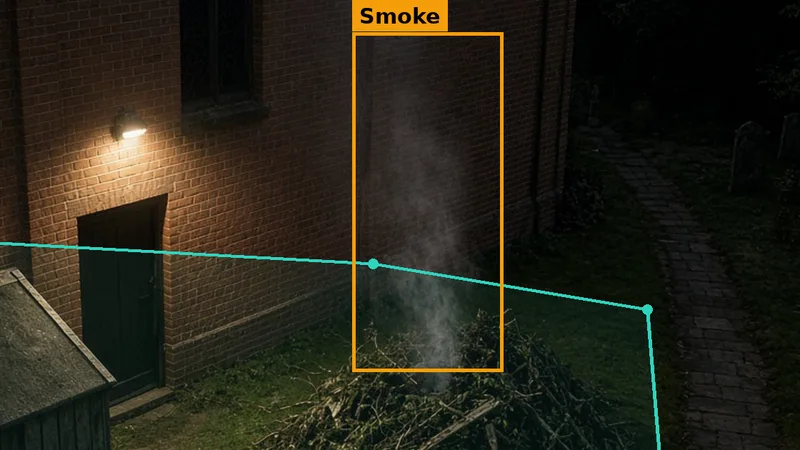
Here is a fictional example. A Victorian red-brick church in a market town has a timber lean-to store against the vestry wall. After a Saturday churchyard working party, a heap of hedge cuttings and old timber is left beside the store, waiting to be taken away. The church is used on Sundays and for a Wednesday morning group, and is otherwise locked. A camera fitted after a break-in already looks along the vestry side. A zone over the store and the heap is armed from 18:00 to 08:00. On Tuesday at 22:50, thin grey smoke starts to rise from the heap.
The camera sees it. The churchwarden gets an alert on their phone: smoke by the vestry store, with a snapshot and a short clip. They look at the clip, see smoke rising beside a timber store against the church wall on a dark, empty evening, call 999 and give the church's address and the gate to use, and call the key holder who lives opposite to meet the fire service with the keys. Nobody else would have known until the smoke was seen from the street. The next day, the PCC agrees that garden waste is taken away on the day of every working party, the store is cleared and locked, and the lock-up card now includes a walk round the outside.
Where Woodcock AI fits
Woodcock AI adds smoke and flame detection, and people and vehicle detection, to the cameras a church already has. You draw polygon zones over exactly the areas to watch, such as the vestry store, the porch, the oil tank or the hall link, set when each zone is armed, and choose who gets the alerts. The system is self-learning, getting better on each camera over time. Detection runs on an edge server on site or on a cloud server, so there is no need to replace cameras. It has been developed over years and is in use on real sites today.
Ways to start
The easiest first step is a site assessment: we look at what your existing cameras see, by day and after dark, and show where zones would help. You can also ask for a live test on your cameras, connecting two or three of them for about a fortnight, so your churchwardens see real alerts from your own church. Or book an on-site demo, for a single church or for a group of churches in a benefice, circuit or diocese. There is no commitment to look.
Common fire safety mistakes in churches
Fire safety officers and assessors see the same problems again and again in churches. Most of them can be found on a walk round and fixed quickly.
- Exits bolted during services. Side and vestry doors left locked while people are inside.
- Candles left burning. Votive lights and candles not checked at lock-up.
- Portable heaters. Brought out on cold mornings, placed near hangings or on escape routes.
- Cupboards and towers full. Old hymn books, chairs, decorations and paint built up over years.
- Extension leads everywhere. Daisy chains for heaters, urns and sound systems.
- An old assessment. Not reviewed after a reordering, works or a new use, or with actions never done.
- Nobody in charge. No named person for fire safety at services, events or hall bookings.
- Hirers not briefed. No fire procedures in the conditions of hire.
- Rubbish against the walls. Bins, cuttings and timber heaped against the church or a store.
- Hot work without a permit. Roof repairs with heat and no check afterwards.
Church fire safety checklist
Use this checklist to review your own church. It follows the guidance described above, but your fire risk assessment and your enforcing authority decide what applies to your building.
Responsibility and assessment
- Responsible person known: PCC, trustees or managing body.
- Fire risk assessment current, recorded, assessor competent and named.
- Review date set, and reviewed after works or a new use.
- Action plan worked through, with dates recorded.
Protection
- Alarm or warning method suitable, tested weekly and serviced.
- Exits unbolted whenever people are inside, routes clear.
- Emergency lighting, extinguishers and signs checked and recorded.
- Heating, gas, oil and electrics serviced and inspected.
People
- Emergency plan written, known and on fire action notices.
- Someone in charge of fire safety at every service and event.
- Drills at least annually, or as the assessment decides.
- Personal plans for people who need help; hirers briefed.
Out of hours and outside
- Candles out, heaters off and appliances unplugged at lock-up.
- Bins locked away from walls; cuttings and rubbish removed.
- Stores, porches and the oil tank secure and checked.
- Key holder list, neighbours and alert responders in place.
Sources
- Regulatory Reform (Fire Safety) Order 2005, including articles 3, 5, 9, 13, 14, 15, 17, 18, 21 and 22.
- HM Government, Fire safety risk assessment: small and medium places of assembly and large places of assembly. GOV.UK, fire safety in the workplace.
- Church of England, health and safety: PCC responsibilities; buildings and land: PCC responsibilities; ChurchCare, CCTV. Faculty Jurisdiction Rules 2015, Schedule 1.
- Historic England, fire safety for traditional church buildings. Church of Scotland General Trustees, fire safety.
- Gas Safety (Installation and Use) Regulations 1998; Electricity at Work Regulations 1989; HSE, portable appliance testing FAQs; Equality Act 2010.
- Scotland: Fire (Scotland) Act 2005, Part 3; Fire Safety (Scotland) Regulations 2006; Scottish Government, practical fire safety guidance for existing non-residential premises.
- Northern Ireland: Fire Safety Regulations (Northern Ireland) 2010; Fire and Rescue Services (Northern Ireland) Order 2006. ICO, guidance on video surveillance. Home Office, protective security for faith communities.
We have summarised these sources in our own words and checked them on 6 November 2026. This guide is general information, not legal or fire safety advice for your church. Fire safety law differs between England, Wales, Scotland and Northern Ireland, and denominations have their own rules and guidance. Your fire risk assessor, your local fire and rescue service, your diocese, district or denomination, your insurer and your own advisers can advise on your building.
The fire alarm covers the inside. Who watches the outside walls at night?
Book a site assessment and we will look at what your cameras see by day and after dark, and show where smoke, flame and people zones would help over the stores and bins by the walls, the porches, the oil tank and the hall link, or ask for a live test on your cameras.
Related pages
Frequently asked questions
Do churches need a fire risk assessment?
Yes. In England and Wales, the Regulatory Reform (Fire Safety) Order 2005 applies to churches, chapels, other places of worship and church halls, whether or not they have staff and whether or not they are run for profit. The responsible person must carry out a suitable and sufficient fire risk assessment and keep it under review. In England, since 1 October 2023, the whole assessment must be recorded in writing. Scotland and Northern Ireland have similar duties under their own laws.
Who is responsible for fire safety in a church?
The responsible person, usually the body that controls the building. In a Church of England parish, the PCC is collectively responsible, with the churchwardens looking after the building day to day. In other churches and places of worship, it is usually the trustees, the church council or the management committee. Others with some control, such as hirers and contractors, can have duties too, and must co-operate.
Do churches have to have a fire alarm?
Not always a full automatic system. The government guide for places of assembly says that in a small, simple building where a fire would be obvious to everyone, a shout or a manual device such as a gong may be enough, but where there are unoccupied areas in which a fire could grow unseen, automatic detection may be needed. Your fire risk assessment decides. In the Church of England, installing a fire alarm is a List B matter under the faculty rules.
Are candles allowed in church?
Yes. The government guide says to restrict and control naked flames such as candles, not to ban them. Use stable, non-combustible holders, keep candles away from fabrics, flowers and paper, never leave them burning when nobody is there, take extra care at candlelit services with crowds and children, and check every candle is out at lock-up.
How often should a church have a fire drill?
The government guide for small and medium places of assembly says at least annually, or as determined by the fire risk assessment. Many churches hold drills at a weekday group, choir practice or stewards’ training evening rather than during a service, and talk afterwards about what to improve.
Can AI on CCTV take the place of a church fire alarm?
No. The fire alarm, clear exits, the emergency plan and trained stewards are what protect people in the building. AI video detection on existing cameras covering the outside walls, stores, bins, porches, the oil tank and the hall link can watch for visible smoke and flame, and for people, when the church is locked, and send an alert with a clip to a churchwarden or key holder. It is an extra layer only, and interior cameras over worship areas should be off during services.
Last reviewed 6 November 2026