

Fire safety log book: what to record, UK guide
A fire safety log book is the written record that shows your fire precautions are being checked, tested and maintained. UK law does not require a book by name, but it does require you to record your fire risk assessment and fire safety arrangements in most workplaces and to keep fire safety systems maintained, and inspectors can ask to see records. A good log book records weekly alarm tests, false alarms, emergency lighting and extinguisher checks, fire door and escape route checks, services, training, drills, incidents and repairs. Paper or digital is fine. AI on existing CCTV can add early visual warning of smoke out of hours, but camera alerts are never log book entries.

What is a fire safety log book?
A fire safety log book is the written record of how the fire precautions in a building are looked after. It is where the responsible person, or the people they appoint, write down the weekly fire alarm test, the monthly check of the emergency lighting, the annual service of the fire extinguishers, the date of the last fire drill and how long it took, the training each member of staff has had, every false alarm, every fault that was found and what was done about it. It usually sits alongside the fire risk assessment, the emergency plan and the certificates left by contractors. In a small shop it may be a slim folder kept under the counter. In a large office block, a hospital or a factory it may be a set of registers, a shared spreadsheet or a dedicated app, with sections for each system and each contractor.
Whatever form it takes, the log book does one job: it shows that the fire precautions you rely on are being checked, tested and maintained, and that problems are being fixed. A fire alarm that nobody has tested for six months, emergency lights with flat batteries, a fire door with a broken closer and an extinguisher that has been discharged and hung back on its bracket can all look perfectly fine to a passer-by. The log book is how you, your staff, your fire risk assessor, your insurer and an inspecting fire safety officer can tell the difference.
The phrase "fire safety log book" does not appear in the Fire Safety Order. What the law requires, as we explain below, is that the responsible person records the fire risk assessment and the fire safety arrangements, keeps fire safety equipment and facilities maintained in efficient working order and good repair, and can produce records to an inspector. The government guides for employers then recommend that you keep a log book of all maintenance and testing, and ask, in their own checklist, whether you keep a log book to record tests and maintenance. So the log book is not a legal form with a fixed layout. It is the practical, widely used way of meeting several legal duties at once and being able to show that you have.
The government guidance is clear that there is no one correct format. In a small shop, it says, the record might be a few sheets of paper in a health and safety folder. In larger or more complex premises, a dedicated record of everything to do with fire safety is the best approach. Many trade associations sell printed log books with pre-ruled pages, and the guidance notes that some local enforcing authorities may also provide them. Many businesses now keep the same information in a spreadsheet, a facilities management system or a compliance app. All of these can work, as long as the record is complete, kept up to date and available when someone needs to see it.
This guide is for business owners, shop and office managers, landlords and managing agents, facilities and health and safety managers, and anyone who is the responsible person, or helps the responsible person, for a non-domestic building or the common parts of a block of flats in the UK. It explains what the law in each nation says about fire safety records, what to record for each fire safety system, a daily to annual schedule, how to write a good entry, who should keep the log book, paper versus digital, how long to keep records, what inspectors look for, how records work in shared buildings and when a building changes hands, the most common mistakes, and a checklist. It finishes with the hours when the building is empty and nobody is there to write anything down, which is where AI on existing CCTV can help.
One point before we start. This guide is about the records themselves. Each fire safety system has its own guide on this site that goes into the testing in depth: our guides to commercial fire alarm systems, emergency lighting regulations, fire extinguisher types, fire door regulations and commercial sprinkler systems. Where those topics come up here, we keep it to what goes in the book and point you to the guide that goes further.
Why keep a fire safety log book?
The first reason is that most of what keeps people safe in a fire is invisible until it is needed. Batteries in emergency lights slowly lose capacity. Smoke detectors gather dust. Door closers weaken. Escape routes slowly fill with boxes. A routine of regular checks, written down, is how these things are caught before the day they matter. Writing the check down is what turns a good intention into a habit: the empty line for this week is a reminder that the test has not been done yet.
The second reason is evidence. Under article 27 of the Fire Safety Order, an inspector can require the production of any records that the Order requires you to keep, or that are needed to carry out the inspection, and can take copies. When a fire safety officer from your local fire and rescue service visits, the log book is one of the first things they will usually ask to see. A complete, honest log book is the quickest way to show that the fire precautions in your fire risk assessment are actually being maintained. A blank or patchy one tells its own story.
The third reason is continuity. People change jobs, managers go on holiday, contractors change and buildings are sold. A log book means the next person can pick up where the last one left off: when the emergency lights were last discharge tested, which call point is next in the weekly rotation, which fire door was waiting for a new closer, and which contractor services the sprinklers. Since 1 October 2023, England and Wales have also required an outgoing responsible person to pass the relevant fire safety information to the incoming one, which is far easier if it is already written down in one place.
The fourth reason is learning. Patterns show up in a log book that nobody would notice day to day. The same detector causing false alarms every few weeks, the same final exit found locked on a Monday morning, the same extinguisher missing from its bracket after every weekend event, the same fire door that keeps getting wedged open. The government guides say that records of testing, maintenance and training help when you review your fire risk assessment, and that you should review it after a fire or a near miss. A good log book feeds straight into that review.
Is a fire safety log book a legal requirement?
Not in name, but the records that go into it largely are. In England and Wales, the Fire Safety Order requires every responsible person to record the fire risk assessment, including all of its findings, and to record their fire safety arrangements. These duties were widened by section 156 of the Building Safety Act 2022 from 1 October 2023. Before that date, the duty to record applied only where five or more people were employed, the premises were licensed, or an alterations notice was in force. Now it applies to every responsible person. The Order also requires fire safety equipment and facilities to be maintained in efficient working order and good repair, and requires you to be able to produce records to an inspector. The simplest way to meet all of these, and to prove that you have, is a log book.
The Fire Safety Order guidance on enforcement gives two examples of what changed in 2023: a shopkeeper who works as a sole trader or employs at least one part-time assistant, and the responsible person for the common parts of a block of flats where there are no employees at all. Both must now record their fire risk assessment, and the GOV.UK guidance on section 156 says the fire safety arrangements must now be recorded in all circumstances too. If you were relying on being too small to need written records, that exemption has gone in England and Wales.
Scotland and Northern Ireland have their own laws, which still contain a version of the old threshold for recording the risk assessment, but which have the same maintenance duty. We set out each nation in the next section. Across the whole UK, the HM Government guidance recommends keeping a log book of tests and maintenance whatever the size of your premises. Some other rules, such as the fire door checks in tall blocks of flats in England, contain their own express duty to keep a record. And your insurer may make a log book, or particular entries in it, a condition of your policy.
It is worth saying plainly what a log book is not. It is not the fire risk assessment, though it records the assessment and its actions. It is not a certificate from a contractor, though it should refer to them. And it is not a substitute for actually doing the checks. Under article 32 of the Fire Safety Order, it is an offence to make an entry in any register, book or other document required to be kept under the Order that you know to be false in a material particular. A log book filled in from memory at the end of the month, or ticked without the test being done, is worse than no log book at all.
What the law says about fire safety records
This section sets out the rules in each part of the UK. It is a summary in our own words, checked against the legislation on 3 November 2026, not legal advice. If you are unsure whether you are the responsible person, or which rules apply to your building, ask your fire risk assessor, a solicitor or your local fire and rescue service.
England and Wales: the Fire Safety Order
In England and Wales, fire safety in almost all non-domestic premises, and in the common parts of blocks of flats, is governed by the Regulatory Reform (Fire Safety) Order 2005. The person with the duties is called the responsible person. Under article 3, in a workplace that is the employer, so far as the workplace is under their control. In other premises it is the person who has control of the premises in connection with carrying on a trade, business or other undertaking, or the owner. Under article 5, other people who have some control of the premises, such as a managing agent or a contractor responsible for maintaining a system, can have duties too, so far as matters within their control are concerned.
The record duties in the Order were widened by section 156 of the Building Safety Act 2022, from 1 October 2023. The GOV.UK guidance on fire safety responsibilities under section 156 explains what changed. These are the main record duties in the Order now.
The fire risk assessment. Under article 9(6), as soon as practicable after the assessment is made or reviewed, the responsible person must make a record of the assessment or review. Under article 9(7) the record must in particular include the findings of the assessment, including the measures which have been or will be taken, and any group of people identified as especially at risk. Before October 2023, only the significant findings had to be recorded, and only in some premises. The word significant has been removed, and the duty applies to everyone. The section 156 guidance says the assessment must now be recorded in full, including all the findings.
The assessor. The same guidance says that if you engage a fire risk assessor to help you, you should record their name and, where applicable, their organisation, so there is a clear record for enforcing authorities of who completed the assessment.
Fire safety arrangements. Article 11 requires the responsible person to make arrangements for the effective planning, organisation, control, monitoring and review of the preventive and protective measures, and article 11(2) requires those arrangements to be recorded. Again, the old threshold was removed in October 2023. Your arrangements describe how fire safety is managed in your building: who is responsible for what, how often things are checked, who services which system, how contractors are controlled and how you review what you do. The log book is where the monitoring part of those arrangements shows up.
Maintenance. Article 17 requires the responsible person to ensure that the premises and any facilities, equipment and devices provided for the safety of relevant persons, or for the use of firefighters, are subject to a suitable system of maintenance and are maintained in an efficient state, in efficient working order and in good repair. Article 38 does the same for facilities provided for firefighters, such as firefighting lifts and dry rising mains. The Order does not say in so many words that maintenance must be written down. But it is very hard to show that a suitable system of maintenance exists, or that it is being followed, without a record. That is why the government guidance says records of maintenance will help to demonstrate compliance.
Shared premises. Under article 22, where two or more responsible persons share premises, each must take reasonably practicable steps to find out whether there are others, tell the others their name and a UK address for notices, tell them which part of the premises they consider themselves responsible for and keep a record of that information, and co-operate and co-ordinate with them. We come back to shared buildings later.
Handing over. Under article 22A, when a responsible person is replaced, the outgoing person must give the new responsible person any relevant fire safety information they hold, and every responsible person must keep records of relevant fire safety information. The relevant information includes the records of the risk assessment and reviews, the identity of anyone appointed to help with the assessment, the name and UK address of any other responsible person, and any fire safety information handed over under regulation 38 of the Building Regulations 2010 after building work.
Inspections. Under article 27, an inspector has powers to inspect premises and to require the production of records which the Order requires you to keep, or which are needed for the inspection, including extracts from computerised records, and to take copies.
False entries. Under article 32, it is an offence to fail to comply with the fire safety duties where that failure places people at risk of death or serious injury in case of fire. It is a separate offence to make, in any register, book, notice or other document required to be kept under the Order, an entry which you know to be false in a material particular.
Building work and blocks of flats in England
Two other sets of rules feed into the log book in England. First, under regulation 38 of the Building Regulations 2010, when building work is done to a building to which the Fire Safety Order applies, the person carrying out the work must give fire safety information to the responsible person, no later than the date of completion or the date of occupation, whichever is earlier. That information covers the design and construction of the building and the fire safety services, equipment and other provisions, so it should go in the log book or alongside it, and it forms part of the relevant information to pass on under article 22A.
Second, the Fire Safety (England) Regulations 2022 add duties for blocks of flats. Under regulation 10, in a building with two or more sets of flats that is above 11 metres in height, the responsible person must use best endeavours to check the entrance doors to individual flats at least every 12 months, and must check fire doors in the communal areas at least every 3 months. The responsible person must keep a record of the steps taken to check the flat entrance doors, including, where access was not granted during any 12 month period, the steps taken to try to gain access. If you manage a block like this, those checks belong in the log book.
Scotland
In Scotland, the duties come from Part 3 of the Fire (Scotland) Act 2005, including section 53 on the duty to carry out a fire safety risk assessment, and the Fire Safety (Scotland) Regulations 2006. Under regulation 8, as soon as practicable after an assessment is carried out or reviewed, the person with duties must record the specified information where they employ five or more employees, a licence or registration is required for the premises, or an alterations notice requiring it is in force. Under regulation 9, the specified information is the significant findings, including the measures taken or to be taken, and any person or group identified as especially at risk. Regulation 16 requires premises, facilities, equipment and devices to be subject to a suitable system of maintenance and kept in an efficient state, in efficient working order and in good repair. So in Scotland, a very small business may not be legally required to write down its risk assessment, but it is still required to maintain its fire safety equipment, and keeping a log book remains the best way to show that it does.
Northern Ireland
In Northern Ireland, the Fire Safety Regulations (Northern Ireland) 2010 follow the same pattern. Under regulation 8, the significant findings must be recorded where five or more people are employed, a licence or registration is required, or an alterations notice requiring it is in force, and regulation 9 sets out the information to record. Regulation 16 contains the same maintenance duty.
Two cautions apply to everything in this section. First, the HM Government guides that most people use as their starting point, such as Fire safety risk assessment: offices and shops, were written before October 2023, so where they mention the five employee threshold for recording, that is now out of date in England and Wales. Their advice on what to check, how often and what to record is still widely used. Second, other laws can require records too. For example, the Electricity at Work Regulations 1989 require electrical systems to be maintained so far as is necessary to prevent danger, and the Management of Health and Safety at Work Regulations 1999, under regulation 3, require employers with five or more employees to record the significant findings of their general risk assessment. Many businesses keep the fire records alongside these.
What happens if records are missing
GOV.UK explains that your local fire and rescue authority visits premises to check that the fire risk assessment and fire prevention measures are appropriate, and that fire safety officers should help you understand the rules and comply with them. If they think your measures are not adequate, they might issue an informal notice suggesting safety measures, or a formal fire safety notice: an alterations notice where premises have high safety risks or will have them if the use changes, an enforcement notice where a serious risk is not being managed, saying what improvements are needed by when, or a prohibition notice, which takes effect immediately and prohibits or restricts access. You can appeal to your local magistrates court within 21 days of receiving a notice. GOV.UK says you could be fined or go to prison if you do not follow fire safety regulations, and that major penalties can have unlimited fines and up to 2 years in prison. See enforcement, appeals and penalties on GOV.UK for the current details. This GOV.UK guidance is written for England and Wales.
In practice, inspecting officers tend to start with the fire risk assessment and the log book because they are the fastest way to understand how a building is managed. A missing record of the assessment is a breach in itself in England and Wales. Gaps in the testing record, such as no alarm tests for months or no record of an emergency lighting discharge test for years, are usually a strong sign that the maintenance duty in article 17 is not being met. And if a fire happens, the log book is one of the first documents investigators, insurers and lawyers will ask for.
What to record in a fire safety log book
Section 7.1 of the HM Government guide Fire safety risk assessment: offices and shops (the factories and warehouses guide has the same list) sets out what fire safety records should include. Your records should be kept in a specified place on the premises, for example in the management office, and should include details of the significant findings of the fire risk assessment and any action taken; testing and checking of escape routes, including final exit locking mechanisms such as panic devices, emergency exit devices and any electromagnetic devices; testing of fire warning systems, including weekly alarm tests and periodic maintenance by a competent person; recording of false alarms; testing and maintenance of emergency lighting; testing and maintenance of fire extinguishers, hose reels and fire blankets; where appropriate, testing and maintenance of other fire safety equipment such as fire suppression and smoke control systems; training of relevant people and fire evacuation drills; planning, organising, policy and implementation, monitoring, audit and review; maintenance and audit of systems provided to help the fire and rescue service; the arrangements in a large multi-occupied building for a co-ordinated emergency plan; and all alterations, tests, repairs and maintenance of fire safety systems, including passive systems such as fire doors.
The same section lists other things you may wish to record: the competence, qualifications and status of the people who carry out inspections and tests; the results of periodic safety audits, reviews, inspections and tests, and any remedial action taken; all incidents and circumstances which had the potential to cause accidents, and the remedial action that followed; and a record of the building use, the fire prevention and protection measures in place and the high-risk areas. It also says, in a line worth remembering, that the quality of records may be regarded as a good indicator of the overall quality of the safety management structure.
That is a long list, and not every item applies to every building. A small office with a simple alarm, a few emergency lights, two extinguishers and three fire doors needs a much shorter log book than a hotel, a shopping centre or a care home. The way to decide what goes in yours is to start from your fire risk assessment. Every fire precaution the assessment relies on, from the alarm system to the self-closing devices on the stair doors, should have a line in the log book saying how it is checked, how often, and by whom. The rest of this section goes through the usual sections one at a time.
The fire risk assessment and its actions
The front of most log books holds the management records: the current fire risk assessment, or a note of where it is kept, and a summary of its findings and actions. For each review, record the date, who carried it out and, if you used an assessor, their name and organisation, which the section 156 guidance on GOV.UK says you should now record. Record the findings and, for each action, who owns it, the target date and the date it was closed. An action plan where every line has a closing date is one of the clearest signs of a well-managed building. An action plan copied from one assessment to the next with the same items still open is one of the clearest signs of the opposite.
Also record any group of people the assessment identified as especially at risk, such as people working alone, young workers, people with disabilities or people who sleep on the premises, and the arrangements made for them. Note the planned date for the next review, and record any event that should trigger an earlier review, such as building work, a change of use, a fire or a near miss, new equipment or a significant change in the number of people in the building. Our fire risk assessment guide covers the assessment itself.
Your fire safety arrangements and named people
Your fire safety arrangements must be recorded in England and Wales. In practice this is often a short written fire safety policy at the front of the log book. It says who the responsible person is, who has been appointed to help them, who the fire wardens or marshals are, who carries out the routine checks, which contractors service which systems, and how often each check happens. It can also record the contact details of those contractors, the alarm receiving centre if the alarm is monitored, and the keyholders who respond out of hours. Keep it up to date: a policy naming a manager who left two years ago is a common finding in inspections.
If you share the building with other responsible persons, this is also where you record their name and the UK address they gave you for notices, and the part of the building each of you is responsible for, as article 22 now requires.
Fire alarm and detection
The fire alarm usually generates more entries than anything else. Part 2 of the HM Government guides says the system should be supervised by a named responsible person, given enough authority and training to manage the routine testing. The control and indicating equipment should be checked at least every 24 hours to ensure there are no faults. All types of fire warning system should be tested once a week, and for electrical systems a manual call point should be operated, using a different call point for each successive test, usually with a test key. Manual call points may be numbered so they can be tested in sequence. Six-monthly servicing and preventive maintenance should be carried out by a competent person with specialist knowledge of fire warning and automatic detection systems, normally under a service contract. Where the system is connected to a monitoring centre, arrangements should be made before testing to avoid unwanted false alarms. The guide says it is good practice to record all tests, false alarms and any maintenance carried out.
So the alarm section of your log book should record the date and time of each weekly test, the call point used, who did it, whether the alarm sounded throughout the building, and any faults. The example checklist in Appendix A.1 of the guide also asks whether staff and others heard the alarm, and whether linked systems operated correctly, such as magnetic door holders releasing and smoke curtains dropping. Record each six-monthly service, with the engineer and company, what was found and the certificate or report reference. And record every false alarm: the date and time, the zone or device, the cause if known and what was done. Our commercial fire alarm systems guide covers the systems themselves.
Emergency lighting
The guides say that, typically, testing of emergency lighting would include a daily visual check of any central controls, a monthly function test by operating the test facility for long enough to make sure each emergency lamp lights, and an annual full discharge test. Part 1 adds that the monthly tests should be done at a time when, following the test, the lights will not be immediately needed, and Part 2 warns that batteries typically take 24 hours to recharge after a full discharge test, so the premises should not be reoccupied until the system is working fully unless other arrangements are made. The example checklist in Appendix A.1 also includes a six-monthly item asking whether luminaires operate on test for one third of their rated value, and an annual check that they operate for their full rated duration.
Record each monthly test with the date, who did it, which fittings or circuits were tested and any that failed. Record the annual test, the engineer and the result, and the repairs that followed. Our emergency lighting regulations guide goes further, including the current British Standard.
Fire extinguishers, hose reels and fire blankets
The guides say that in normal conditions a monthly brief check of portable extinguishers should be enough to make sure they remain serviceable, with maintenance by a competent person annually. Part 1 also includes a weekly check that extinguishers and hose reels are correctly located and in apparent working order. Hose reels need regular visual checks for leaks and damage, with more formal maintenance at least annually by a competent person. Record the monthly checks, the annual service, any extinguisher that was missing, damaged, discharged or moved, and when it was replaced. Any extinguisher that has been used, even briefly, needs recharging or replacing, and that should be in the book too. Our fire extinguisher types guide covers choosing and siting them.
Escape routes, final exits and fire doors
Part 1 of the guides suggests daily checks that bolts, padlocks and security devices have been removed from fire exits, that doors on escape routes swing freely and close fully, that escape routes are clear of obstructions and combustible materials, that the fire alarm panel shows the system is active, that emergency lighting units look to be in good repair and that safety signs are legible. The example checklist marks daily checks as not normally recorded, so many premises simply record that the daily walk-round was done, or record only what was found and put right.
Weekly, the checklist asks whether all emergency fastening devices on fire exits, such as push bars and pads, work correctly, and whether external routes are clear. Monthly, the guides suggest checking that fire doors are in good working order, closing correctly, with frames and seals intact, and that electronic release mechanisms and automatic doors on escape routes fail safe in the open position. Annually, all structural fire protection and compartmentation should be inspected, and the checklist asks whether all self-closing fire doors fit correctly. In tall blocks of flats in England, the three-monthly and annual fire door checks under the 2022 Regulations described above go here, with the record of steps taken to get access to flats. Our fire door regulations guide covers doors in depth.
Sprinklers, smoke control and firefighter facilities
If your building has other installed systems, they need sections too. The example checklist includes six-monthly checks that any sprinkler system, any firefighting or evacuation lift and the release and closing mechanisms of fire-resisting compartment doors and shutters have been tested by a competent person, and annual checks that any dry or wet rising main and any smoke and heat ventilation system have been tested by a competent person, that external access for the fire service is still available, and that any firefighters switches have been tested. Part 1 says fire pumps and standby diesel engines should be tested for 30 minutes each week, and the checklist asks whether emergency generators have been tested, normally by running them for an hour each month. Article 38 of the Fire Safety Order requires facilities provided for firefighters to be maintained in efficient working order and good repair. Our commercial sprinkler systems guide covers sprinklers in more detail.
Training
Every employee must be given adequate fire safety training when they start and when they are exposed to new or increased risks, repeated periodically where appropriate, under article 21 of the Fire Safety Order. The HM Government guides say that whatever training you decide is necessary, it should be verifiable. In practice that means writing it down. The training section of the log book should show who was trained, what kind of training it was (induction, refresher, fire warden or marshal, use of extinguishers, evacuation chair, duty manager), the date, who delivered it and when the next refresher is due. If you use an online course, keep the completion record, but also record the in-person walk-round of your own building, because an online course cannot show someone your exits and assembly point. Our fire safety training guide covers what training should include.
Fire drills
GOV.UK says you should carry out at least one fire drill per year and record the results, and that you must keep the results as part of your fire safety and evacuation plan. The HM Government guides say a drill should be carried out at least annually or as determined by your fire risk assessment, more often if you have a high staff turnover, and that at the end, if the alarm is monitored, you should tell the alarm receiving centre that the drill is over and record the outcomes. Any conclusions and remedial actions should be recorded and implemented.
A useful drill record includes the date and time, who planned it and what it was meant to test, which call point or scenario was used, whether the alarm was heard everywhere, how long it took to clear the building and to complete the roll call, which routes and exits were used, any doors left open or wedged, anyone who did not leave or went back in, any problems with people who needed help, and what will change as a result, with an owner and a date for each action. Our fire evacuation plan guide covers drills in more detail, and our fire warden duties guide covers the people who sweep the building.
Contractors, building work and hot work
The HM Government guides note that fires are more frequent when buildings are being refurbished or altered. Before any building work starts, you should review your fire risk assessment and consider the additional dangers, such as hot work, temporary electrical equipment, extra combustible materials and waste, and changes to escape routes. Hot work, such as welding, flame cutting, the use of blow lamps or portable grinding equipment, should be strictly controlled near flammable materials, which can be done with a written permit to work, and areas where hot work has been done should be checked to make sure no ignition has taken place and no smouldering materials remain. Record the review, the permits issued, the checks after hot work and the contractors on site. If an alterations notice is in force, you must notify the fire and rescue service about alterations.
When the work is finished, file the fire safety information given to you under regulation 38 of the Building Regulations 2010 and record what changed: new detectors, new doors, a moved exit, a new partition. Your log book and your fire risk assessment both need to reflect the building as it is now, not as it was before the builders arrived.
Fires, near misses and faults
Record every fire, however small, and every near miss: a bin that started to smoulder, a charger that overheated, a scorch mark found behind a heater, a toaster that set off the detector. The HM Government guides list incidents and circumstances which had the potential to cause accidents among the things you may wish to record, along with the remedial action, and say a fire or near miss may indicate that your assessment needs reviewing. GOV.UK says you must carry out regular checks to make sure, among other things, that you record any faults in systems and equipment. Each fault entry should be closed off, with the date it was put right and who did it.
How often: a daily to annual schedule
Most log books are organised around a schedule. The one below follows Part 1 step 3.4.6 and the example maintenance checklist in Appendix A.1 of the HM Government guides. The guides stress that their examples are not intended to be prescriptive and that other regimes may be appropriate, so your own schedule should also follow the instructions from the manufacturers and installers of your systems, the recommendations of your fire risk assessment and any conditions set by your insurer. In larger and more complex premises you may need a competent person to carry out some of the checks.
| How often | What to check or test | Who | What to record |
|---|---|---|---|
| Daily | Fire exits unlocked and opening easily, escape routes clear, fire alarm panel showing normal, emergency lighting units look in good repair, signs legible | Trained member of staff | Not normally recorded line by line; record that the walk-round was done and anything found and put right |
| Weekly | Fire alarm test from a different call point each time; push bars and pads on exits; extinguishers and hose reels in place; safety torches; fire pumps and standby diesel engines run for 30 minutes | Named person | Date, time, call point used, result, faults and actions |
| Monthly | Emergency lighting function test; fire doors closing correctly with seals intact; electronic door releases fail safe; brief extinguisher check; emergency generators run, normally for one hour | Named person | Date, fittings or doors checked, failures, repairs |
| Three-monthly | Emergency water tanks at normal level; hydrants and fire service access not blocked; in tall blocks of flats in England, communal fire doors | Named person | Date, findings, actions |
| Six-monthly | Fire alarm service; sprinklers, firefighting lifts and compartment door and shutter mechanisms tested by a competent person | Competent person | Engineer, company, report or certificate reference, faults |
| Annual | Emergency lighting full duration test; all firefighting equipment and installed systems serviced; compartmentation and fire doors inspected; rising mains and smoke ventilation tested; at least one fire drill; in tall blocks of flats in England, flat entrance doors (best endeavours) | Competent person, responsible person | Reports, certificates, drill results, remedial actions |
| On each event | False alarms, fires, near misses, faults, training, contractor and hot work permits, building work, change of responsible person | Whoever deals with it | Date, what happened, action, date closed |
How to write a good log book entry
The best test of a log book entry is whether someone who was not there could understand it a year later. "Alarm OK" with a squiggle tells a fire safety officer very little. "Weekly alarm test, call point 3 (rear stairs, first floor), 10:05, sounders heard in all areas except the store room where the sounder was weak, engineer booked, job reference noted, initials" tells them a great deal, and the follow-up line two days later saying the sounder was replaced and retested closes the loop.
Every entry should show the date, and the time where it matters, such as alarm tests and drills; what was checked or tested, precisely enough to identify it, such as the call point number, the zone, the door or the fitting; who did it; the result, including anything that was not right; and the action taken, with the date the fault was put right. If you use a contractor, record their name, the company and the reference of the report or certificate they left, and keep the report itself in the back of the log book or in a linked folder. Never write an entry in advance, never fill in a block of weeks at once and never correct an entry by overwriting it. Cross it through with a single line, initial it and write the correction beside it, or in a digital system, make sure the history of changes is kept.
The example checklist in Appendix A.1 of the government guides uses yes, no and not applicable columns with a comments column, and says that any ticks in the grey boxes, the answers that show something is wrong, should result in further investigation and appropriate action. That is the right spirit for the whole log book: an entry that shows a problem is not a failure, as long as the next entry shows it was dealt with. A log book in which every single line is a tick is more likely to make an experienced officer suspicious than reassured.
Keeping the log book
Who should keep the fire safety log book?
The responsible person is responsible for the log book, in the same way they are responsible for the fire risk assessment and the fire precautions it records. In a small business that is usually the owner or the manager on site. In a larger organisation the responsible person is the employer or the person in control of the premises, and they appoint people to carry out the day-to-day work: a facilities manager, a site manager, a caretaker, a building manager or a member of staff given the job of the weekly alarm test. Under article 13 of the Fire Safety Order, the responsible person must, where necessary, nominate competent persons to implement firefighting measures and make sure their number, training and equipment are adequate for the premises.
It is good practice to name one person as the keeper of the log book, with a deputy for holidays and sickness, and to make sure the people who carry out checks know how to record them and what to do if they find a fault. The responsible person, or someone senior on their behalf, should look at the log book regularly, at least as part of each review of the fire risk assessment, and check that faults are being closed and that nothing has quietly stopped happening. If you appoint a managing agent or a facilities contractor to keep the log book for you, the legal duty stays with you, so make sure you can see it whenever you need to.
Some of the work belongs to specialists. The HM Government guides say you, or a person you have nominated, can carry out certain checks and routine maintenance, but further maintenance may need a competent service engineer, and that where contractors are used, third party certification is one way to get reasonable assurance of quality and competence. The guides list the competence, qualifications and status of the people who carry out inspections and tests among the things you may wish to record, so it is worth noting in the log book who each contractor is and why you consider them competent.
Paper or digital?
Either can work. The HM Government guides say there is no one correct format, and article 27 of the Fire Safety Order lets inspectors require records to be produced or, where they are kept in computerised form, extracts from them to be provided. A pre-printed paper log book is simple, cheap to replace, needs no login and is easy for any member of staff to fill in by the alarm panel. Its weaknesses are that it can be lost, damaged or filled in carelessly, it is hard to see trends, and it is only in one place. A spreadsheet is easy to search but easy to overwrite, and often ends up in several versions on different computers. A dedicated app or facilities system can send reminders, attach photos and certificates, keep an audit trail of who entered what and when, and show several buildings at once, but it depends on staff using it and on you keeping access to the data if you change provider.
Whatever format you choose, the records must be complete, kept up to date, accurate, and available on request. Many businesses use both: a paper book by the alarm panel for the weekly test and the monthly checks, and a digital folder for contractor reports, certificates and the fire risk assessment. If you do that, make the paper book say where the digital records are, and keep both up to date.
Where to keep it
The HM Government guides say your records should be kept in a specified place on the premises, for example in the management office, and should be available for inspection by the enforcing authority. Pick one place, tell your staff and your contractors where it is, and keep it there. Common choices are the back office, the reception desk or a document box next to the fire alarm panel, so that the person testing the alarm and the service engineer can fill it in on the spot.
Think about what happens if the building burns. A paper log book that sits in the office where the fire starts may be lost exactly when it is needed most, by your insurer, the fire investigators or your own lawyers. Photograph or scan the pages regularly, or keep copies of the key records off site, and keep digital records backed up.
How long should you keep fire safety records?
We have not found a fixed retention period for fire safety test and maintenance records in the Fire Safety Order or in the Scottish and Northern Ireland regulations. The duties are framed around recording the assessment and arrangements, handing relevant fire safety information to a new responsible person under article 22A, and being able to produce records an inspector asks for. In practice, that means you should keep records long enough to show the history of your fire precautions: at the very least, back to the last full review of your fire risk assessment and the last annual service of each system, and usually much longer for the fire risk assessment itself, building work information under regulation 38, fire door and compartmentation surveys, and anything to do with a fire, a near miss or an enforcement notice. Ask your fire risk assessor, insurer and legal adviser what period suits your premises, and write the answer into your arrangements so everyone follows the same rule. When a log book is full, start a new one but keep the old one.
What an inspector looks for
When a fire safety officer visits, they will usually want to see the recorded fire risk assessment, evidence that its actions are being dealt with, your recorded fire safety arrangements, and evidence that the fire precautions are being maintained, which means the log book. They are likely to look for regular weekly alarm tests rather than occasional ones, monthly emergency lighting checks, a recent annual discharge test, current service reports for the alarm, extinguishers and any other systems, fire door checks, records of training and of at least one recent fire drill, a record of false alarms, and evidence that faults found are being fixed. They may compare the log book with what they see on a walk round: a log book showing weekly checks of a fire exit that turns out to be padlocked raises obvious questions.
Be honest. An entry that says the test was not done because the keyholder was ill, with the date it was done instead, is far better than a neat column of ticks that does not match reality. As explained above, knowingly making a false entry in a book required to be kept under the Order is a separate offence under article 32.
Shared buildings, landlords and tenants
In a building with more than one business, or a block of flats with commercial units, there is often more than one responsible person. The landlord or managing agent is usually responsible for the common parts, such as shared stairs, corridors, entrance halls, the shared fire alarm and the emergency lighting in the common areas, while each tenant is responsible for their own unit. Leases often say who maintains which systems, but the Fire Safety Order duties apply whatever the lease says.
Under article 22, each responsible person must co-operate and co-ordinate with the others, tell them about the risks their business creates, and, since October 2023, tell the others their name, a UK address for notices and the part of the premises they consider themselves responsible for, and keep a record of that information. For the log book, that usually means the landlord keeps the record of tests on the shared systems and shares the results, while each tenant keeps a log book for their own unit. A tenant whose staff rely on a landlord fire alarm needs to know that it is being tested and serviced, so ask for copies of the relevant pages or reports, and record in your own log book that you have seen them. Agree who carries out the drills and how faults found by one party are reported to the other. Our fire risk assessment guide covers shared premises further.
When the responsible person changes
When a business is sold, a lease is assigned, a managing agent is replaced or a new tenant moves in, the log book should move with the responsibility. Under article 22A of the Fire Safety Order, added in October 2023, an outgoing responsible person must give the new responsible person any relevant fire safety information they hold. That includes the records of the fire risk assessment and its reviews, the identity of anyone appointed to help make or review it, the name and UK address of any other responsible person where known, and fire safety information given under regulation 38 of the Building Regulations 2010. The log book is not named in article 22A, but handing it over with these records is the obvious way to give the new responsible person the history of the building. If you are taking over premises and nobody hands you a log book, ask for it, and record that you asked.
Common log book mistakes
The same problems come up again and again in fire safety audits and inspections. Most come down to the log book being treated as a form to fill in rather than a record of what actually happened.
- Ticks without detail. A column of ticks shows that someone held a pen. Record the call point, the zone, the fittings and the result.
- Gaps. Weekly tests that stop during holidays, staff changes or busy periods. Name a deputy and add the test to someone's calendar.
- Faults that are never closed. An entry saying a door closer is broken, followed by months of ticks for that door. Every fault needs a closing entry.
- Same call point every week. Testing the call point nearest the office every time means the others are never tested. Rotate them, by number.
- False alarms not recorded. Unwanted alarms show a pattern that can point to a faulty detector, poor siting or a process that needs to change.
- Contractor visits with no paperwork. A note that the engineer came is not enough. Keep the report and record the faults it lists.
- No record of drills or training. If it is not written down, it is very hard to show that it happened.
- Entries written in advance or in batches. Pages filled in the same pen in one sitting are easy to spot and can amount to a false entry.
- One copy, kept in the wrong place. A log book that nobody can find, or that is lost in a fire, helps no one.
- Out of date names. A responsible person, warden or contractor who left long ago is still listed.
Fire safety log book checklist
Use this checklist to review your own log book. It follows the records suggested in the HM Government guides and the legal duties described above, but your fire risk assessment decides what applies to your premises.
Management
- Current fire risk assessment recorded, with significant findings and the assessor named.
- Every action has an owner, a target date and a closing date.
- Fire safety arrangements written down, with named people.
- In shared buildings, other responsible persons and the parts they cover recorded.
Systems
- Weekly alarm tests with call points rotated, and every false alarm recorded.
- Monthly emergency lighting tests and an annual full duration test.
- Extinguishers checked monthly and serviced annually.
- Six-monthly alarm service and other system services, with reports kept.
Building
- Escape routes, exits and exit hardware checked.
- Fire doors checked, with faults closed off.
- Building work, hot work permits and regulation 38 information recorded.
- Compartmentation inspected.
People and history
- Training recorded for every member of staff, with refreshers due.
- At least one fire drill a year, or as your assessment says, with results and actions.
- Fires, near misses and faults recorded and closed.
- Log book kept in a specified place, backed up, with old books kept.
After the last entry of the day: where AI on existing CCTV fits
A fire safety log book shows that your precautions are checked and maintained: that the alarm sounds, the emergency lights come on, the extinguishers are in place and the fire doors close. All of that depends on people. Your alarm warns the people inside, and your staff know what to do because they are trained. But many workplace fires start when nobody is there at all: overnight, at weekends and on bank holidays, in shops, salons, clinics and offices that are locked up and dark. If the fire alarm is not monitored, nobody may know until the fire is seen from outside. Many of those spaces already have a camera pointing at them.

AI video detection watches for visible smoke and flame inside areas you choose, at the times you choose, and sends an alert with a snapshot and a short clip so a person can decide what to do. It can spot smoke rising at the back of a salon, among the donation bags in a charity shop or by the presses in a dry cleaner, in the area a camera can see.
We want to be clear about what this is and is not. Video smoke and flame detection does not carry out any of the checks in your log book, and camera alerts are not log book entries. The weekly alarm test, the monthly emergency lighting test, the extinguisher checks and the fire door checks still have to be done by people and written down. It does not replace your fire alarm, fire risk assessment, emergency plan, training, drills or any other precaution your assessor, insurer or the law requires. It does not sound your fire alarm or call the fire service. It is an extra layer of early visual warning, most useful in the hours when nobody is on site.
If a camera system does send an alert that turns out to be a real fire or a near miss, that event belongs in your log book like any other incident, written up by the person who dealt with it, with the action taken. Camera equipment you rely on should also be maintained, and your installer can tell you how. If your fire alarm is monitored, keep those arrangements in place; camera alerts sit alongside them. If you are considering camera detection, talk to your fire risk assessor and insurer first. Our guides to video smoke detection on existing CCTV and commercial fire alarm systems explain how the two fit together.
Where it can help
The places where camera detection adds most are those that are empty and dark for long periods, or that hold a lot of fuel. Choose a type of premises below to see how a zone might be set up. Each image is a camera view with a zone drawn over the area to watch.
Which premises?
Small clinics keep a log book of alarm tests, emergency lighting and extinguisher checks like any other workplace. Overnight the rooms are empty, with sterilisers, chargers and equipment on standby. Where a camera already covers a surgery or the decontamination room, a zone armed overnight can alert a keyholder if visible smoke or flame appears.
Smoke and flame, overnight
Charity shops handle large amounts of donated clothing, paper and furniture, often stored in a back room with electrical items waiting to be checked. After closing, nobody is there. A zone over the sorting area can add a visual check for smoke or flame while the shop is shut.
Smoke and flame, overnight
Dry cleaners and laundries run presses, dryers and boilers all day, and warm textiles are a known fire risk. Once the shop is closed, a camera covering the pressing area can watch a zone and alert someone if smoke appears. It does not replace any detection the premises already has, and it never replaces a single log book check.
Smoke and flame, out of hours
Each area needs its own zone and schedule.
Other places worth considering include stockrooms, bin stores, battery charging areas and service yards where packaging builds up. Our guides to electrical fire safety and spontaneous combustion cover related ground.
The limits of camera detection
Every detection method has limits. A camera can only see what is in its view, and many fires start out of sight: inside a machine, in a ceiling void, behind a cupboard or in a store room. Smoke will not be seen until it comes into view, which may be some time after the fire started. Cameras need enough light, or infrared, to see at night, and thin smoke in the dark is harder to see. A camera cannot see heat. A camera that has no power sees nothing, so ask your installer what keeps the cameras, recorder and network running in a power cut.
What about false alerts?
Steam from presses and dryers, dust, headlights, reflections and insects near the lens can all look like smoke to a camera. Good set-up keeps false alerts down. Tight polygon zones cover the risk, not the whole view. Schedules arm zones only when the area should be empty, so a pressing area zone is not armed while the presses are in use. Clean lenses and steady lighting help, and a self-learning system gets better over time at knowing what is normal for each camera. Looking back at alerts after the first week or two, and adjusting zones, makes a big difference.
A worked example
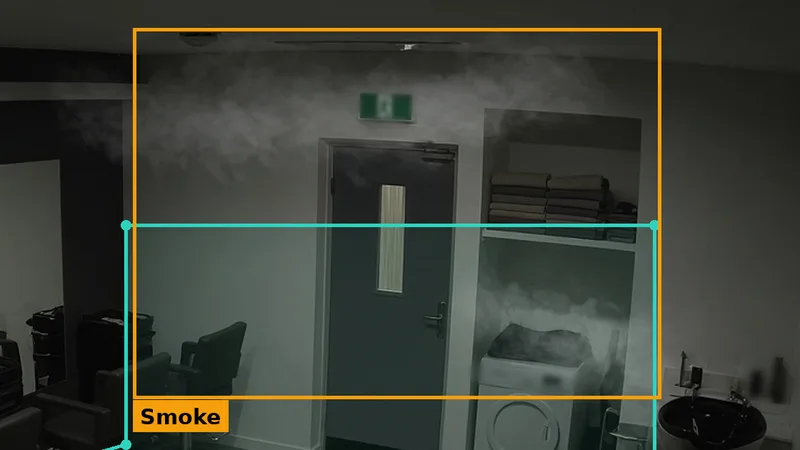
Here is how this might look for the fictional hair salon shown at the top of this page. It is an example, not a real business. The salon has a fire risk assessment, a fire alarm, emergency lighting, two extinguishers and a log book kept in the back office, with weekly alarm tests, monthly lighting checks and a record of staff training and the yearly drill. After a conversation with its fire risk assessor and insurer, the owner adds smoke and flame detection to an existing camera that looks across the salon floor, with a zone over the floor and the back area armed from 20:00 to 07:00.
One night the last stylist switches off the towel dryer at 19:55 and the owner walks round and locks up. The zone arms at 20:00. At 03:10, grey smoke starts to drift from the back of the salon. The camera zone sees it, and the alert reaches the owner, who is the keyholder, with the clip and an AI description. They have been briefed on what to do. They can see smoke at the back, call 999, tell the fire service exactly where it is and how to get in, and say that nobody is inside.
Crews deal with the fire. The next day, the owner records the incident in the log book: the time, what was found, what the fire service did, the damage and the actions, including having the dryer and the electrics inspected, reviewing the fire risk assessment, and retesting the alarm and emergency lighting before the salon reopens, all with their own entries. The log book showed the salon was looking after its fire precautions; the camera meant the fire was found at 03:10 by the keyholder, not at 08:30 by the first stylist in.
How Woodcock AI fits
Woodcock AI connects to existing IP cameras, and detection runs on an edge server on site or on a cloud server. It adds smoke and flame detection, and people and vehicle detection, to the cameras you already have. You draw polygon detection areas over the places that matter, choose when they are armed and who gets the alerts. Each alert has a snapshot, a short clip and an AI description of what the camera saw. Our smoke and fire detection page and how it works page show more.
Woodcock AI is self-learning, so it gets better over time at knowing what is normal on each camera. It is the result of years of development and is now in use on real sites in the UK. It works alongside your log book, fire alarm, fire risk assessment, training and emergency plan rather than replacing them. Ask your cameras (Coming soon, early 2027) will let you ask questions about what your cameras have seen in everyday words.
Ways to start
Book a site assessment. We look at what your cameras see by day and after dark, and show where zones would help, such as salons, clinics, shops and back rooms. Or ask for a live test on your cameras: we connect two or three of your existing cameras for about a fortnight, so you can see the alerts for yourself. We are also happy to arrange an on-site demo.
Sources
- Regulatory Reform (Fire Safety) Order 2005, articles 3, 5, 9, 11, 13, 17, 21, 22, 22A, 27, 32, 37 and 38, and Schedule 1.
- Building Safety Act 2022, section 156, and GOV.UK, fire safety responsibilities under section 156.
- GOV.UK, Fire Safety Order: supplement to the enforcement guidance note.
- Building Regulations 2010, regulation 38; Fire Safety (England) Regulations 2022, regulation 10.
- Management of Health and Safety at Work Regulations 1999, regulation 3; Electricity at Work Regulations 1989, regulation 4.
- GOV.UK, workplace fire safety: your responsibilities, including fire risk assessments, fire safety equipment, drills and training and enforcement, appeals and penalties.
- HM Government, Fire safety risk assessment: offices and shops (PDF) and factories and warehouses (PDF), Part 1 step 3.4.6, Part 2 sections 1.7, 2.5 and 7.1, and Appendix A.1.
- Scotland and Northern Ireland: Fire (Scotland) Act 2005, section 53; Fire Safety (Scotland) Regulations 2006, regulations 8, 9 and 16; Fire Safety Regulations (Northern Ireland) 2010, regulations 8, 9 and 16.
We have summarised these sources in our own words and checked them on 3 November 2026. This guide is general information, not fire safety advice for your premises. The Fire Safety Order applies in England and Wales, and Scotland and Northern Ireland have their own fire safety laws. Your fire risk assessor, the installers and maintainers of your systems, your insurer and your local fire and rescue service can advise on what your log book should contain.
Your log book shows the checks are done. Who sees the smoke at 3am?
Book a site assessment and we will look at what your cameras see by day and after dark, and show where smoke and flame zones would help over salons, clinics, shops and back rooms, or ask for a live test on your cameras.
Related pages
Frequently asked questions
Is a fire safety log book a legal requirement?
Not by that name. The Fire Safety Order does not mention a log book. But in England and Wales you must record your fire risk assessment and fire safety arrangements in most workplaces, keep fire safety systems and equipment maintained in efficient working order, and be able to produce records when an inspector asks. GOV.UK says you must record any faults found in regular checks, and record fire drill results. A log book is the usual way to do all of this. Scotland and Northern Ireland have similar duties.
What should be recorded in a fire safety log book?
The HM Government guides list the fire risk assessment findings and actions, tests of escape routes and final exit locks, weekly fire alarm tests and services, false alarms, emergency lighting tests, extinguisher, hose reel and fire blanket maintenance, other systems such as sprinklers and smoke control, training and drills, facilities for the fire service, and all alterations, tests, repairs and maintenance, including fire doors. Each entry should show the date, what was checked, who did it, the result and any action.
How often should the fire alarm be tested and recorded?
The HM Government guides say the system should be tested weekly by operating a manual call point, using a different call point for each test, and serviced every six months by a competent person. The control panel should be checked at least every 24 hours for faults. It is good practice to record all tests, false alarms and maintenance. If the alarm is monitored, tell the monitoring centre before testing.
Can a fire safety log book be digital?
Yes. The government guides say there is no one correct format, and the Fire Safety Order lets inspectors ask for extracts from records kept in computerised form. Paper, a spreadsheet or an app can all work, as long as the records are complete, up to date, accurate and can be produced when asked. Many businesses keep a paper book by the alarm panel and digital copies of reports and certificates, with the paper book saying where the rest is kept.
How long should fire safety records be kept?
We have not found a fixed retention period for fire safety test and maintenance records in the Fire Safety Order or the Scottish and Northern Ireland regulations. Keep enough history to show your precautions have been maintained, at least back to the last full assessment review and the last annual service of each system, and keep records of fires, near misses, enforcement and building work for longer. Agree a period with your fire risk assessor and insurer, and when a book is full, keep it.
Do camera smoke alerts count as log book entries?
No. AI video detection on existing cameras watches zones for visible smoke and flame, mostly out of hours, and sends an alert with a clip so a person can decide what to do. It does not carry out any of the checks in your log book, and its alerts are not log book entries. If an alert leads to a real fire or near miss, record that incident in the log book like any other. Woodcock AI runs on an edge server on site or on a cloud server.
Last reviewed 3 November 2026