

Fire safety training: a UK guide for employers
Fire safety training teaches people at work what to do to prevent a fire and what to do if one starts. In the UK it is a legal requirement: employers must give staff adequate fire safety training when they start, when risks change and periodically after that, in working hours. Training should cover discovering a fire, raising the alarm, calling 999, escape routes and exits, the assembly point, fire doors, equipment and good housekeeping, and be tailored to your premises and tested by fire drills. Wardens and others with a role need more. Training prepares people at work; out of hours, AI on existing CCTV can add early visual warning of smoke, but it never replaces training.

What is fire safety training?
Fire safety training is the instruction and practice that make sure the people who work in a building know how to prevent a fire, what to do if one starts, and how to get themselves and everyone else out safely. In a small shop it may be little more than showing a new starter the fire exits, the fire alarm call points and the assembly point, and explaining what to do if they discover a fire or hear the alarm. In a large store with hundreds of staff on many shift patterns, a care setting, a factory or a busy venue, it is a planned programme, with induction training on the first day, refresher sessions, extra training for people with particular roles, and fire drills that test whether it has all worked.
In the UK, fire safety training is not optional. In England and Wales, article 21 of the Regulatory Reform (Fire Safety) Order 2005, usually called the Fire Safety Order, requires the responsible person to make sure employees are given adequate safety training when they start and when they are exposed to new or increased risks, and says that training must be repeated periodically where appropriate, adapted to new or changed risks, provided in a way that fits the risks in the fire risk assessment, and given during working hours. Scotland and Northern Ireland have almost identical rules. The GOV.UK guide for businesses puts it simply: you need to train new staff when they start work and tell all employees about any new fire risks.
Training sits alongside information and instruction. The law treats them as related but separate duties. Information means telling people what the risks are, what measures are in place and who has been named to help in an emergency. Instruction means telling people what to do. Training means making sure they can actually do it, which usually means showing them, walking the routes with them, letting them practise and checking that they have understood. A fire action notice by a call point is information and instruction. Walking a new starter along the escape route from their workstation to the assembly point, and showing them how the exit door at the end opens, is training. A fire drill tests both.
This guide is for business owners, managers, HR and training leads, health and safety and facilities managers, and anyone who is the responsible person for fire safety in non-domestic premises in the UK. It explains what the law requires in each nation, what fire safety training should cover, who needs which level of training, how often it should happen, how to run fire drills that teach people something, what records to keep and how to fit training into your fire risk assessment. It finishes with the hours when your trained staff have all gone home, which is where AI on existing CCTV can help with a different problem: spotting smoke and flame when nobody is there to see it.
One point before we start. This guide is about general fire safety training for staff, the kind every employer needs. Fire wardens and fire marshals need more than this, and our fire warden duties guide covers that role and its training in depth. Our fire evacuation plan guide covers the plan that your training teaches people to follow. Where those topics come up here, we keep it short and point you to the guide that goes further.
Why fire safety training matters
Fires in workplaces are often found by the people working there. Someone smells burning, sees a wisp of smoke from behind a machine or notices that a bin is smouldering. What happens in the next minute depends almost entirely on what that person has been taught. A trained member of staff knows to raise the alarm at once, at the nearest call point, rather than going to look for a manager. They know not to open a door with smoke behind it. They know which exit to use, how to open it, where to go once they are outside and who to report to. They know they should not stop to collect their coat or finish what they were doing, and they know not to use the lift.
The HM Government guides for employers put it plainly: the actions of staff if there is a fire are likely to be crucial to their safety and that of other people in the premises. In shops, hotels, leisure venues, offices with visitors and any building open to the public, staff are also the people the public will look to. Customers usually try to leave the way they came in. A trained member of staff who calmly points them to the nearest exit, holds a door, checks a toilet or helps someone with a pushchair down the stairs can make a real difference to how quickly a building empties.
Training also prevents fires. Many workplace fires start with something a member of staff did or did not do: a heater left on under a desk, a charger left plugged in with a damaged lead, rubbish allowed to build up by a back door, a fire door wedged open, flammable liquids stored next to a heat source, smoking outside the permitted area, or hot work done without the right checks. Training that explains why these things matter, in the context of your building, is one of the cheapest and most effective fire precautions there is.
Finally, training is what makes the rest of your fire precautions work. A fire alarm only helps if people react to it straight away instead of waiting to see if it is a false alarm. Fire doors only hold back smoke if people keep them closed. Escape routes only work if people know where they are and keep them clear. Fire extinguishers are only useful in the hands of someone who knows which one to use, how to use it and, most importantly, when not to. An emergency plan that nobody has been taught is just a document in a file.
Who needs fire safety training?
The short answer is every employee. The duty in article 21 applies to all of the responsible person's employees, full time or part time, permanent or temporary, on days or on nights. It is not just for fire wardens, managers or people who work in higher-risk areas. A new cleaner on an early shift, a weekend sales assistant, an apprentice in a workshop and a manager who has just transferred from another site all need to know what to do in a fire in this building.
People who work in your building but are not your employees need to be covered too, though the route is slightly different. Article 20 of the Fire Safety Order requires the responsible person to give the employer of any outside workers, such as agency staff, cleaners, security officers and maintenance contractors, clear information about the risks and the measures in place, and enough information to identify the people who will help with an evacuation. Anyone working in your undertaking who is not your employee must get appropriate instructions and information about the risks. In practice, most employers simply include agency and contract staff in their induction briefing and make sure contractors are shown the escape routes, which the HM Government guides recommend.
Some people need more than the basic level. The HM Government guides say that staff with a supervisory role in a fire, such as heads of department, fire marshals or wardens, and fire teams in larger premises, should be given details of the fire risk assessment and receive additional training. People who may take on the role of duty manager, people expected to help disabled people to escape, and people who are expected to use fire-fighting equipment also need training for that role. We cover these levels in detail later in this guide.
Visitors, customers and members of the public do not need training, but they do need clear information and, often, help. That is what fire action notices, signs, announcements and trained staff are for. In a hotel, a hospital, a school or a care setting, the training your staff receive has to take account of the fact that many of the people they may need to help will not know the building at all, may be asleep, may not speak English or may not be able to get out without assistance.
If you are self-employed and work alone, the training duty in article 21 does not apply to you in the same way, because you have no employees. You still need to know what to do in a fire, and if you share premises with others, you need to co-operate with their arrangements. If you employ even one person, the duty applies in full.
The law on fire safety training
Fire safety training is required by law in every part of the UK. The rules are set out in fire safety law, which applies to almost all non-domestic premises, and backed up by general health and safety law, which applies to all employers. This section sets out what each says, in our own words, with links to the text. It is general information, not legal advice. If you are unsure how the law applies to your premises, ask a competent fire risk assessor, your local fire and rescue service or a solicitor.
England and Wales: the Fire Safety Order, article 21
The main duty is article 21 of the Regulatory Reform (Fire Safety) Order 2005. It applies to the responsible person, which in a workplace is the employer, and it has two parts. The first part says when training must be given. The text of article 21 requires the responsible person to make sure that employees are provided with adequate safety training at the time when they are first employed, and on their being exposed to new or increased risks because of any of four kinds of change: being transferred or given a change of responsibilities; new work equipment, or a change to work equipment already in use; new technology; or a new system of work, or a change to an existing one.
The second part says what the training must be like. It must include suitable and sufficient instruction and training on the appropriate precautions and actions the employee should take to safeguard themselves and other relevant persons on the premises. It must be repeated periodically where appropriate. It must be adapted to take account of any new or changed risks to the safety of the employees concerned. It must be provided in a manner appropriate to the risk identified by the risk assessment. And it must take place during working hours.
Several things follow from that wording. Training is not a single event; it must be repeated where appropriate, which in practice means refresher training at intervals that suit the risk. It is not one-size-fits-all; it must fit the risks your fire risk assessment has found, which means generic training on its own is unlikely to be enough. It must keep up with change, so a move to a new building, a new production line, a new storage arrangement or a new shift pattern should prompt fresh training. And it must happen in working hours, so asking staff to complete it unpaid at home in the evening does not meet the duty.
"Relevant persons" is defined in article 2 of the Fire Safety Order. It means anyone who is or may be lawfully on the premises, and anyone in the immediate vicinity who is at risk from a fire there, apart from firefighters carrying out their duties. So training must cover not just how employees keep themselves safe, but how they help keep safe the customers, visitors, contractors, patients, pupils, residents and anyone else who may be there.
Other duties in the Fire Safety Order that link to training
Article 21 does not stand alone. Several other articles of the Fire Safety Order depend on people being trained, and a good training programme covers them too.
Article 13 deals with fire-fighting and fire detection. Where necessary, the responsible person must nominate competent persons to implement fire-fighting measures and make sure that the number of those people, their training and the equipment available to them are adequate for the size and hazards of the premises. A person is competent for this purpose if they have sufficient training and experience or knowledge and other qualities to do the job properly.
Article 15 covers procedures for serious and imminent danger. The responsible person must establish, and where necessary give effect to, appropriate procedures, including safety drills, to be followed in an emergency, and nominate a sufficient number of competent persons to implement those procedures as far as they relate to evacuation. These are the people often called fire wardens or fire marshals. Article 15 also says that nobody should have access to an area where access must be restricted for safety unless they have received adequate safety instruction.
Article 18 requires the responsible person to appoint one or more competent persons to help them carry out the preventive and protective measures, again defining competence in terms of sufficient training and experience or knowledge. Where there is a competent person in your own employment, they must be appointed in preference to someone from outside.
Article 19 requires the responsible person to give employees comprehensible and relevant information on the risks identified by the risk assessment, the preventive and protective measures, the emergency procedures and the identities of the people nominated to help with fire-fighting and evacuation. Where a dangerous substance is present, employees must also get details of the substance and the significant findings of the risk assessment. Before employing a child, the responsible person must give a parent comprehensible and relevant information about the risks and the measures in place. Article 20 extends similar duties to the employers of outside workers and to anyone working in your undertaking who is not your employee.
Article 23 places duties on employees themselves. While at work, every employee must take reasonable care for their own safety and that of others who may be affected by what they do or do not do, co-operate with their employer so that fire safety duties can be met, and tell their employer about any work situation that a person with their training and instruction would reasonably consider a serious and immediate danger, and about any shortcoming in the protection arrangements. Training is what gives employees the knowledge to do this.
Who is responsible for training?
Under article 3, the responsible person is the employer, if the workplace is to any extent under their control. In other premises it may be the person in control of the premises in connection with a business, or the owner. GOV.UK lists employers, owners, landlords, occupiers and anyone else with control of the premises, such as a facilities manager, building manager or managing agent, as people who may be responsible for fire safety. In a building shared by several businesses there will often be more than one responsible person, and each employer is responsible for training its own employees.
The responsible person can delegate the work of arranging and delivering training, to a training manager, a fire safety adviser or an external provider, but they cannot delegate the legal responsibility. If training is not given, or is inadequate, the responsible person is the one who answers for it. Where several responsible persons share a building, article 22 requires them to co-operate and co-ordinate their fire safety measures, which in practice often means joint fire drills, shared fire action notices and an agreed approach to evacuation.
Health and safety law: the Management Regulations
The Management of Health and Safety at Work Regulations 1999, regulation 13, sets a general training duty for all employers in Great Britain. It is worded very like article 21: employers must make sure employees are given adequate health and safety training when they are recruited and when they are exposed to new or increased risks because of a transfer or change of responsibilities, new or changed work equipment, new technology or a new or changed system of work. The training must be repeated periodically where appropriate, adapted to new or changed risks, and take place during working hours. Regulation 13 also says that, when giving employees tasks, employers must take into account their capabilities as regards health and safety.
For most employers this simply means that fire safety training is part of a wider health and safety induction and training programme. Doing them together makes sense. Starting a new job is a lot to take in, and fire safety is often lost among IT logins, uniforms and payroll forms. Make sure the fire part is given proper time, ideally on the first day and in person, rather than squeezed into a pile of forms to sign.
Scotland
In Scotland, fire safety duties are set out in Part 3 of the Fire (Scotland) Act 2005 and the Fire Safety (Scotland) Regulations 2006. Regulation 20 deals with training and follows the same pattern as article 21: an employer with duties under section 53 of the Act must make sure employees are given adequate fire safety training when they are first employed and when they are exposed to new or increased risks through a transfer or change of responsibilities, new or changed work equipment, new technology or a new or changed system of work. The training must include sufficient instruction and training on the precautions and actions to take, be repeated periodically when appropriate, be adapted to new or changed risks, fit the risks identified by the fire safety assessment and take place during working hours.
Northern Ireland
In Northern Ireland, fire safety duties are set out in the Fire and Rescue Services (Northern Ireland) Order 2006 and the Fire Safety Regulations (Northern Ireland) 2010. Regulation 20 again requires an employer to give employees adequate fire safety training when they start and when they face new or increased risks, with the same four kinds of change. The training must include sufficient instruction on the precautions and actions to take, be repeated periodically when appropriate, be adapted to new or changed risks, fit the risks identified by the assessment and take place during working hours. Regulation 20 also says that employers, when giving employees tasks, must take into account their capabilities as regards health and safety, so far as they relate to fire.
How the law is enforced
Fire safety law in non-domestic premises is mostly enforced by the local fire and rescue authority. GOV.UK explains that your local fire and rescue authority visits premises to check that the fire risk assessment and fire prevention measures are appropriate, and that fire safety officers should help you understand the rules and comply with them. Training is one of the things they routinely look at. They may ask to see your training records, the dates and results of your fire drills and your emergency plan, and they may ask members of staff what they would do if the fire alarm went off or if they found a fire. A member of staff who does not know where the assembly point is, or who says they would go and find the manager before raising the alarm, tells an inspector a great deal.
The HM Government guides say that enforcing authorities may want to examine records as evidence that adequate training has been given, and that whatever training you decide is necessary should be verifiable. If fire safety officers think your measures are not adequate, they might issue an informal notice suggesting safety measures, or a formal fire safety notice. An enforcement notice says what improvements are needed and by when. A prohibition notice takes effect immediately where the risk is so great that access to the premises needs to be prohibited or restricted. GOV.UK also warns that you could be fined or go to prison if you do not follow fire safety regulations. GOV.UK explains the enforcement, appeals and penalties process in its guide to workplace fire safety.
What fire safety training should cover
The law does not give a fixed syllabus for fire safety training. It says the training must be suitable and sufficient, and must fit the risks identified in your fire risk assessment. The HM Government guides for employers, such as the guide for offices and shops (PDF) and the guide for factories and warehouses (PDF), are more specific. They say training should be based on the particular features of your premises, take account of the findings of the fire risk assessment, explain your emergency procedures, take account of the work activity and explain the duties and responsibilities of staff, take place during normal working hours and be repeated periodically where appropriate, be easily understandable by your staff and other people who may be present, and be tested by fire drills.
The same guides list what staff training should include. In our own words, and grouped together, the list covers the following.
Discovering a fire and raising the alarm
The first thing every member of staff needs to know is what to do if they discover a fire. In most premises the answer is simple: raise the alarm at once by operating the nearest fire alarm call point, leave the area, closing doors behind you if you can, and make sure the fire and rescue service is called. Training should show people where the call points are, especially the one nearest their usual place of work, and explain that operating one is never wrong if they genuinely think there is a fire. Some people hesitate because they worry about causing a false alarm or getting into trouble. Make it clear that nobody will be criticised for raising the alarm in good faith.
Explain what happens after the alarm is raised. Does the alarm sound throughout the building, or only in one area at first? Is it monitored by an alarm receiving centre, which then calls the fire service, or does someone on site need to dial 999? Who does that, and what do they say? If your premises use a staged alarm, or a different sound for an alert and an evacuation, staff need to know the difference. If your building has a voice alarm, they need to recognise the messages. All of this comes from your emergency plan, and it is different in every building.
Teach people to raise the alarm before they do anything else, including tackling the fire, phoning a manager or going to see how big it is. A fire can spread quickly, and the sooner the alarm sounds, the more time everyone else has to get out.
What to do when the alarm sounds
Every member of staff needs to know what to do on hearing the fire alarm. In most workplaces with a simultaneous evacuation strategy, that means stopping work, making machines and processes safe only if they have been trained to and it is quick and safe to do so, leaving by the nearest safe exit without stopping to collect belongings, closing doors on the way out and going straight to the assembly point. In buildings with phased evacuation, staged alarms or a stay put strategy, the right action depends on where people are and what the alarm sounds like, and training must make that clear.
Staff also need to know their role in alerting members of the public and visitors and, where appropriate, directing them to exits. In shops, hotels, restaurants, leisure venues and public buildings, this may be the most important part of the training. Customers are unlikely to know any route except the one they came in by. Staff who confidently point people to the nearest exit, and do not let them head back to the main entrance through a smoke-filled area, help a building empty quickly and safely.
Explain the reason for not using lifts in a fire, unless a lift has been specifically installed or nominated for evacuating disabled people following a suitable fire risk assessment. People are used to taking the lift, and under stress they fall back on habit, so it needs to be said more than once.
Escape routes, exit doors, fire doors and the assembly point
Training should cover the location of escape routes, especially those not in regular use, how to open all emergency exit doors, and the importance of keeping fire doors closed to stop the spread of fire, heat and smoke. The HM Government guides go further and say staff should be trained on exit routes and the operation of exit devices, including physically walking these routes. This matters. A route that someone has walked is one they will remember in an emergency. A push bar that someone has pushed is one they will not hesitate over.
Show people the assembly point, explain why they must go there and report rather than going home or back to their car, and explain how the roll call or sweep report works. The guides list the importance of reporting to the assembly area as one of the minimum training topics. If someone is missing, the fire service needs to know as soon as they arrive. If someone has left without reporting, crews may put themselves at risk searching for a person who is safe at home.
Our guides to fire door regulations, fire safety signs and emergency lighting cover the equipment that keeps escape routes usable. Training is what makes sure people do not undermine it, by wedging fire doors open, stacking stock in front of exits or hanging coats over signs.
Fire-fighting equipment
Staff should know where the fire-fighting equipment is. Whether they should use it is a different question, and your fire risk assessment and emergency plan should answer it. The HM Government guides say that people with no training should not be expected to attempt to extinguish a fire, and that where staff are expected to take a more active role, they should be given more comprehensive training. Article 13 of the Fire Safety Order requires the responsible person, where necessary, to nominate competent people to implement fire-fighting measures and to make sure their number, training and equipment are adequate.
Where staff are trained to use extinguishers or fire blankets, training should cover which type to use on which kind of fire, how to use it, and when not to try: if the fire is spreading, if the room is filling with smoke, if the way out is behind the fire, or if the person does not feel able to. Hands-on practice with a real or training extinguisher helps far more than watching a video. Whatever the training, the message must always be that getting out comes first. Our guide to fire extinguisher types explains the different types and what each is for.
Fire prevention and housekeeping
Training should cover the importance of general fire safety, including good housekeeping, and, where relevant, the safe use of and risks from storing or working with highly flammable and explosive substances. The guides also mention general matters such as permitted smoking areas and restrictions on cooking other than in designated areas. In practice this is where training does most to stop fires starting. Teach people to keep escape routes, stairways and areas around electrical equipment clear; not to let waste and packaging build up, especially near buildings and heat sources; to report damaged leads, overheating equipment and faulty lights; to switch off and unplug equipment that should not be left running; and to follow the rules for heaters, chargers and cooking.
Where staff work with dangerous substances, the training must go further. Article 19 requires employees to be given details of the substance, the risk it presents, access to the safety data sheet and the significant findings of the risk assessment. Our flammable storage fire safety guide and electrical fire safety guide cover the detail.
Other topics to include
The HM Government guides add several more topics in their further guidance on training. As a minimum, they say, all staff should receive training about the items listed in your emergency plan; the importance of fire doors and other basic fire-prevention measures; where relevant, the appropriate use of fire-fighting equipment; the importance of reporting to the assembly area; exit routes and the operation of exit devices, including physically walking them; general matters such as smoking and cooking; and assisting disabled persons where necessary. They also mention, where relevant, an understanding of the purpose of any fixed fire-fighting equipment such as sprinklers or gas flooding systems, and the reporting of faults, incidents and near misses.
Where it applies, training should also cover how to stop machines and processes and isolate power supplies in a fire. In a factory, a commercial kitchen, a laboratory or a plant room, a process left running can make a fire much worse. But shut-down tasks should only be given to people who have been trained for them, and only where they can be done quickly and safely on the way out.
Make it fit your building
The single biggest weakness in fire safety training is that it is too generic. An online course or a video can explain how fire spreads, why fire doors matter and what the colours of extinguishers mean. It cannot show someone where the call point nearest their desk is, how the exit door at the back of your stockroom opens, or where your assembly point is. Article 21 says training must be provided in a manner appropriate to the risk identified by the risk assessment, and the HM Government guides say it should be based on the particular features of your premises.
So whatever general training you use, add a part that is specific to your building and your people. Walk the routes. Point out the call points, the extinguishers and the assembly point. Explain your alarm and your plan. Cover the particular hazards of the work: the fryers in the kitchen, the dust in the workshop, the battery chargers in the store, the flammable liquids in the plant room. Make sure it is easily understandable by everyone, which may mean translated materials, an interpreter, pictures rather than words or extra time for people who need it.
Who needs which kind of fire safety training
Not everyone needs the same training. Everyone who works in your premises needs basic fire safety training, in the form of an induction when they start and refreshers after that. People who take on extra responsibilities in a fire need more. The HM Government guides say that all the staff identified in your emergency plan as having a supervisory role if there is a fire, such as heads of department, fire marshals or wardens and, in larger premises, fire teams, should be given details of your fire risk assessment and receive additional training.
The guides also list the times when training is necessary. As well as when staff start or are transferred into the premises, and when the plan or the risks change, they add: to make sure staff know what they have to do to safeguard themselves and others on the premises; where staff are expected to assist disabled persons; and if a member of staff may take on the role of duty manager. Thinking about training in levels helps you make sure the right people get the right training.
Fire safety induction for new starters
Article 21 says employees must be given adequate safety training when they are first employed. In practice, the fire safety part of an induction should happen on the first day, before the new starter is left to work alone or out of sight of someone who knows what to do. The HM Government guide for offices and shops says that in small premises this may be no more than showing new staff the fire exits and giving basic training on what to do if there is a fire. In larger premises, such as a supermarket with high staff turnover and many shift patterns, the organisation of training will need to be planned.
A good fire safety induction is short, practical and specific to the building. Walk the new starter along their escape routes from where they will work, including the routes they would not normally use. Show them the nearest call points, the fire exits and how they open, the extinguishers and the assembly point. Explain the alarm, what to do on discovering a fire and on hearing the alarm, and who the wardens are. Point out the fire hazards in their area. Then record that it was done.
Induction applies to people transferred into the premises, too. Someone who has worked for you for years on another site does not know the routes, alarm or assembly point of the one they have just moved to. The same applies when a team moves floors or a business moves building.
Fire wardens and fire marshals
Fire wardens, also called fire marshals, need more comprehensive training than other staff. The HM Government guides say their role may include helping people on the premises to leave; checking the premises to make sure everyone has left; using fire-fighting equipment if it is safe to do so; liaising with the fire and rescue service on arrival; shutting down vital or dangerous equipment; and performing a supervisory or managing role in any fire situation. Their training may include detailed knowledge of the fire safety strategy of the premises, awareness of human behaviour in fires, how to encourage others to use the most appropriate escape route, how to search safely and recognise areas that are unsafe to enter, the difficulties some people may have in escaping and any special evacuation arrangements, and additional training in the use of fire-fighting equipment.
Warden training is often delivered as a dedicated course, by your own competent person or an external provider, followed by a site-specific briefing on your own building and plan. The external course gives the general knowledge. The briefing tells wardens which area they sweep, where they report, who they report to and what to do if someone refuses to leave. Our fire warden duties guide covers how many wardens you need, what they do day to day and in an emergency, and how to cover every shift.
Staff nominated to use fire-fighting equipment
Article 13 requires the responsible person, where necessary, to nominate competent persons to implement fire-fighting measures and to make sure the number of such persons, their training and the equipment available to them are adequate, taking into account the size of and specific hazards in the premises. A person is regarded as competent where they have sufficient training and experience or knowledge and other qualities to enable them properly to implement those measures. If your plan expects anyone to tackle a fire, even a small one in a bin, they need practical training in using the right extinguisher, and the judgement to know when to leave it and get out.
Duty managers and people in charge out of hours
The person in charge on a shift may be a duty manager, a shift supervisor, a security officer or a team leader. If they may be the person who decides whether to evacuate, calls the fire service, takes the roll call or meets the crews, they need training for that. The HM Government guides list the role of duty manager as a reason for training in its own right. Make sure every shift has someone trained to take charge, including nights, weekends and bank holidays, when the usual managers are not there.
Staff who assist disabled people
Where staff are expected to help disabled people evacuate, they need training for it. That may mean knowing their part in each personal emergency evacuation plan, how to use any evacuation chair or other equipment provided, where refuges are and how the refuge communication system works, and how to help someone with a visual or hearing impairment who may not be aware of the alarm. The help must be available on every shift, so train enough people. Our fire evacuation plan guide explains PEEPs, refuges and evacuation strategies.
Agency workers, contractors and lone workers
Article 21 applies to employees, but the Fire Safety Order reaches further. Article 20 requires the responsible person to make sure that anyone working in the undertaking who is not their employee is given appropriate instructions and comprehensible and relevant information about the risks, and that the employers of people from outside undertakings working on the premises are given information on the risks and the precautions, and on who is nominated to run the evacuation. In practice, anyone who works in your premises needs to know what to do in a fire, whoever employs them. Agency workers and temporary staff often start at short notice, and should get the same day-one basics as anyone else. Contractors need to know the alarm, escape routes, assembly point and any rules for hot work and isolating systems. Cleaners, security staff and other people who work alone or in isolated areas need training that reflects being on their own.
Night shift and weekend staff are easily missed, because group training sessions tend to run in the daytime on weekdays. Fewer people may be on site, so each person may have more to do in an emergency. Plan training to reach them, too.
How to deliver fire safety training
The law does not say how training must be delivered. It must be adequate, appropriate to the risk, repeated periodically where appropriate, and take place during working hours. Most employers use a mix of methods. In-person training, by your own competent person or an external provider, is best for anything specific to your building and for practical skills such as using an extinguisher. Online courses are useful for general knowledge, for refreshers and for reaching people on different shifts, and they usually include a test that gives you a record. Short toolbox talks keep fire safety in people's minds between formal sessions, and a walk-round of routes, exits and call points makes the training real.
Is online fire safety training enough?
Online fire awareness training can be a useful part of your training, but on its own it is unlikely to be enough. It cannot show staff the escape routes, exits, call points and assembly point in your building, explain your particular plan, or give hands-on practice with equipment. The HM Government guides say training should be based on the particular features of your premises, and that staff should physically walk the exit routes. So if you use online training, add a site-specific part, in person, that covers your building and your plan, and test it with a fire drill.
Whatever method you choose, make sure people actually understand it. Clicking through slides is not the same as knowing what to do. Ask questions, watch what people do in drills, and give extra help to anyone who needs it, including people whose first language is not English.
How often is fire safety training required?
There is no single legal interval for fire safety training. Article 21 says training must be repeated periodically where appropriate, and the right interval depends on your premises, your people and the findings of your fire risk assessment. What the law does say clearly is when training must happen: when people are first employed, and when they are exposed to new or increased risks because of a transfer or a change of responsibilities, the introduction of new or changed work equipment, the introduction of new technology, or a new system of work or a change to an existing one.
The HM Government guides add further times when training is necessary: when changes have been made to the emergency plan and the preventive and protective measures; where working practices and processes or people's responsibilities change; to take account of any changed risks to staff or other relevant persons; and where staff are expected to assist disabled people or may act as duty manager. They say training should be repeated as often as necessary and should take place during working hours.
Refresher training
Many employers give all staff a fire safety refresher once a year, and that is a sensible starting point for most workplaces. Some refresh more often, for example in higher-risk premises, where staff turnover is high, where many people are on shifts and may miss sessions, where sleeping risk is involved, as in hotels and care homes, or where staff have an active role in evacuating the public. Some lower-risk workplaces with a stable team and a simple building refresh less often for general staff, backed by regular drills and toolbox talks. Whatever interval you choose, your fire risk assessment should explain why it is right, and you should be able to show that it is being followed.
Refresher training does not need to repeat the whole induction. It should remind people of the key actions, cover anything that has changed since last time, address any problems seen in drills or near misses, and check that people still know their routes, call points and assembly point. Fire wardens, nominated equipment users and duty managers need their own role-specific refreshers, too.
Do not wait for the annual refresher
The most useful training is often the training that happens because something changed. If a corridor is blocked for building work and people need to use a different route, tell them, and walk it with them. If the alarm system is replaced, explain what the new one sounds like. If an extinguisher type is changed, show people the new one. If there has been a fire, a near miss or a false alarm that showed people did not know what to do, deal with it straight away. Article 21 makes these changes legal triggers for training, and the HM Government guides list changes to the emergency plan and the preventive and protective measures as a reason for training.
Fire drills test the training
The HM Government guides say that once the emergency plan has been developed and training given, you will need to evaluate its effectiveness, and that the best way to do this is to perform a fire drill. They say this should be carried out at least annually or as determined by your fire risk assessment, and that if you have a high staff turnover, you may need to carry them out more often. A drill tests whether the training worked: whether people heard the alarm, went the right way, closed doors, went to the assembly point and could be accounted for.
The guides suggest that, for premises with more than one escape route, the drill should assume one exit or stairway is unavailable because of the fire, simulated by a designated person at a point on the route. Changing which route is blocked at each drill encourages people to use routes they do not normally use. They also suggest asking a member of staff at random to set off the alarm with the test key at the nearest call point, which shows whether people know where it is. They note that surprise drills may not be beneficial, as the health and safety risks introduced may outweigh the benefits, and that you should inform the alarm receiving centre if the alarm is monitored.
During and after the drill, the responsible person and observers should look at how well things went. On-the-spot debriefs are useful, and the guides say any conclusions and remedial actions should be recorded and implemented. Each problem found is a training need. Our fire evacuation plan guide covers drills, roll calls and debriefs in more detail.
Fire safety training records
Article 21 does not use the word records, but you need to be able to show that training was given. The HM Government guides say that whatever training you decide is necessary to support your fire safety strategy and emergency plan, it should be verifiable, and that enforcing authorities may want to examine records as evidence that adequate training has been given. Their checklists ask whether you are maintaining a record of training sessions, and they recommend that the fire safety records for your premises include details of training and fire drills.
A good training record is simple. For each person, it should show what training they had, when, how it was delivered, who delivered it and how their understanding was checked, for example by a test, a sign-off or observation in a drill. For group sessions and drills, record the date, who attended, what was covered and any problems or actions. Keep the records somewhere they can be found quickly, whether that is a fire safety log book, a training spreadsheet or a learning management system. If you are required to record the significant findings of your fire risk assessment, the arrangements for training should be recorded too.
Records also help you manage training, not just prove it. A list of who is due a refresher, who has not yet done the warden course, and which night shift workers missed the last session shows you where the gaps are before an inspector or a fire does.
Training in shared and multi-occupied buildings
In shared buildings, such as office blocks, shopping centres, business parks and mixed-use buildings, there may be several responsible persons. Article 22 requires them to co-operate, to co-ordinate their fire safety measures and to inform each other of the risks. For training, that means your staff need to know the arrangements for the whole building, not just for your part of it: the alarm, the escape routes through common parts, the assembly point and who is in charge in an evacuation. Ask the building owner or managing agent for the building's emergency plan, and make sure your own training matches it. Where you can, take part in building-wide drills.
How to build a fire safety training programme
A fire safety training programme does not need to be complicated. Start with your fire risk assessment and your emergency plan: they tell you the risks, the evacuation strategy, the roles people play and the equipment they may use. Then map who needs which level of training: everyone, wardens, nominated equipment users, duty managers, people who assist disabled people, and the contractors and agency workers who come and go. Decide how each level will be delivered, how often it will be refreshed and how it will be recorded. Plan drills, and use what they show to improve the training. Review the programme whenever something significant changes, and at least whenever you review your fire risk assessment.
Our fire risk assessment guide explains how the assessment works, and the HM Government guides include templates and checklists for the training and drill parts.
Common fire safety training mistakes
The same problems come up again and again. Training is too generic, so people know what a fire triangle is but not where the call point nearest their desk is. Some people are missed, especially night shift workers, weekend staff, agency workers, cleaners and security officers. Training happens, but nobody can prove it, because there is no record. Training is never tested, or drills happen but nobody writes down or acts on what went wrong. Fire wardens are named, but have left, changed shifts or never had role training. And training does not keep up with change: a new layout, a new alarm or a new process, with nobody told.
Fire safety training checklist
Use this checklist to check your own training. It is based on the Fire Safety Order and the HM Government guides, and it is not exhaustive.
Everyone
- Fire safety induction on the first day, before working alone.
- Walked their escape routes, including routes not normally used.
- Shown call points, exits and how they open, equipment and the assembly point.
- Knows what to do on discovering a fire and on hearing the alarm.
- Knows the fire hazards in their area and how to report faults.
Roles
- Enough trained wardens to cover every shift.
- Nominated equipment users have practical training.
- Every shift has someone trained to take charge.
- Helpers trained for each personal emergency evacuation plan.
Others on site
- Agency workers and temporary staff get the day-one basics.
- Contractors are told the plan, routes and hot work rules.
- Lone workers, cleaners and security staff are included.
- Shared building arrangements are explained.
Keep it up
- Refresher interval set by the fire risk assessment, and kept.
- Extra training after changes, fires and near misses.
- Drills at least yearly, or as your assessment says, with a debrief.
- Records of every session, drill and action.
When the trained people have gone home: where AI on existing CCTV fits
Fire safety training prepares people for a fire while they are at work. It assumes someone is in the building to notice smoke, raise the alarm and get everyone out. But many workplace fires start when nobody is there at all: overnight, at weekends and on bank holidays, in shops, kitchens, factories and offices that are locked up and dark. The trained staff have gone home. Nobody is there to smell burning or see smoke. If the fire alarm is not monitored, nobody may know until the fire is seen from outside. Many of those spaces already have a camera pointing at them.

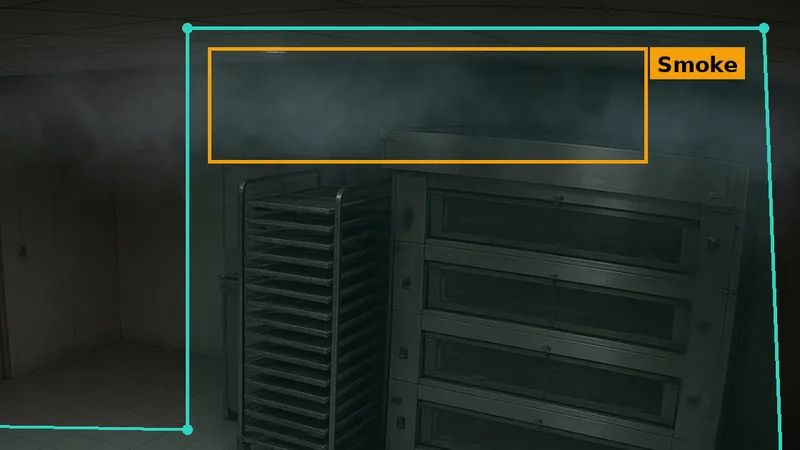
AI video detection watches for visible smoke and flame inside areas you choose, at the times you choose, and sends an alert with a snapshot and a short clip so a person can decide what to do. It can spot smoke rising at the ovens in a bakery, among the rails in a shop or along a production line out of hours, in the area a camera can see.
We want to be clear about what this is and is not. Video smoke and flame detection is not fire safety training, and it does not reduce the training your staff need. It does not replace your fire alarm, fire risk assessment, emergency plan, drills or any other precaution your assessor, insurer or the law requires. It does not sound your fire alarm or call the fire service. It is an extra layer of early visual warning, most useful in the hours when nobody is on site.
Out of hours, if a clip shows smoke or flame, the person who receives it can call 999 and say what they can see and where. That person needs training too: what to do with an alert, who to call, what to tell the fire service and when not to go in. Add it to your keyholder briefing. If your fire alarm is monitored, keep those arrangements in place; camera alerts sit alongside them. If you are considering camera detection, talk to your fire risk assessor and insurer first. Our guides to video smoke detection on existing CCTV and commercial fire alarm systems explain how the two fit together.
Where it can help
The places where camera detection adds most are those that are empty and dark for long periods, or that hold a lot of fuel. Choose a type of workplace below to see how a zone might be set up. Each image is a camera view with a zone drawn over the area to watch.
Which area?
Shops train staff to clear customers quickly and to keep exits and routes clear of stock. Overnight, nobody is there. A camera that already covers the shop floor can watch a zone over the rails and displays and send an alert with a clip if visible smoke or flame appears, so a keyholder can check and call 999.
Smoke and flame, overnight
Food factories train staff in shut-down, hot work and housekeeping, because ovens, fryers, dust and packaging are real fire risks. Between shifts and at weekends the halls may be empty. A zone over the line can add a visual check for smoke or flame while nobody is there.
Smoke and flame, between shifts
Offices rely on trained staff, wardens and drills during the day. Overnight, chargers, heaters and electrical equipment can be left on in an empty building. Where a camera covers the floor, a zone armed overnight can alert someone if smoke appears. It does not replace any detection the building already has.
Smoke and flame, overnight
Each area needs its own zone and schedule.
Other places worth considering include stockrooms, bin stores, battery charging areas and service yards where packaging builds up. Our guides to warehouse fire safety and electrical fire safety cover related ground.
The limits of camera detection
Every detection method has limits. A camera can only see what is in its view, and many fires start out of sight: inside an oven, in a ceiling void, behind a display or in a cupboard. Smoke will not be seen until it comes into view, which may be some time after the fire started. Cameras need enough light, or infrared, to see at night, and thin smoke in the dark is harder to see. A camera cannot see heat. A camera that has no power sees nothing, so ask your installer what keeps the cameras, recorder and network running in a power cut.
What about false alerts?
Steam from ovens and fryers, dust, headlights, reflections and insects near the lens can all look like smoke to a camera. Good set-up keeps false alerts down. Tight polygon zones cover the risk, not the whole view. Schedules arm zones only when the area should be empty, so the bakery zone is not armed while the ovens are in use. Clean lenses and steady lighting help, and a self-learning system gets better over time at knowing what is normal for each camera. Looking back at alerts after the first week or two, and adjusting zones, makes a big difference.
A worked example
Here is how this might look for the fictional supermarket in-store bakery shown at the top of this page. It is an example, not a real business. The store has a fire risk assessment, a fire alarm, an emergency plan, trained fire wardens on every shift, a training record for every member of staff and a closing routine run by the duty manager. After a conversation with its fire risk assessor and insurer, the store adds smoke and flame detection to an existing camera that looks across the bakery, with a zone over the ovens and proving cabinets armed from 23:00 to 05:00, when the bakery is closed.
One night the bakery team switch off the ovens at 22:45 and the duty manager walks round and locks up. The zone arms at 23:00. At 02:40, grey smoke starts to rise from behind one of the ovens. The camera zone sees it, and the alert reaches the keyholder with the clip and an AI description. They have been briefed on what to do. They can see smoke at the ovens, call 999, tell the fire service exactly where it is and how to get in, and say that nobody is believed to be inside, based on the alarm set and the access log.
Crews deal with the fire. The following week, the store has the oven and the damaged area repaired. Before the bakery reopens, the duty manager briefs the bakery team on what happened and on the shut-down checks at close, the store adds the incident to its training record and fire risk assessment review, and it runs a drill to check that everyone still knows the routes past the closed area. The training was ready for people who were not there; the camera meant the fire was found at 02:40 by the keyholder, not at 05:00 by the first baker in.
How Woodcock AI fits
Woodcock AI connects to existing IP cameras, and detection runs on an edge server on site or on a cloud server. It adds smoke and flame detection, and people and vehicle detection, to the cameras you already have. You draw polygon detection areas over the places that matter, choose when they are armed and who gets the alerts. Each alert has a snapshot, a short clip and an AI description of what the camera saw. Our smoke and fire detection page and how it works page show more.
Woodcock AI is self-learning, so it gets better over time at knowing what is normal on each camera. It is the result of years of development and is now in use on real sites in the UK. It works alongside your fire safety training, fire alarm, fire risk assessment and emergency plan rather than replacing them. Ask your cameras (Coming soon, early 2027) will let you ask questions about what your cameras have seen in everyday words.
Ways to start
Book a site assessment. We look at what your cameras see by day and after dark, and show where zones would help, such as shop floors, kitchens and bakeries, production lines and offices. Or ask for a live test on your cameras: we connect two or three of your existing cameras for about a fortnight, so you can see the alerts for yourself. We are also happy to arrange an on-site demo.
Sources
- Regulatory Reform (Fire Safety) Order 2005, articles 2, 3, 13, 15, 18, 19, 20, 21, 22 and 23.
- Management of Health and Safety at Work Regulations 1999, regulation 13.
- GOV.UK, workplace fire safety: your responsibilities, including fire safety equipment, drills and training and enforcement, appeals and penalties.
- HM Government, Fire safety risk assessment: offices and shops (PDF) and factories and warehouses (PDF), Part 1 step 4.4 and Part 2 sections 7.1 and 7.4.
- Scotland and Northern Ireland: Fire (Scotland) Act 2005, Part 3; Fire Safety (Scotland) Regulations 2006, regulation 20; Fire and Rescue Services (Northern Ireland) Order 2006; Fire Safety Regulations (Northern Ireland) 2010, regulation 20.
We have summarised these sources in our own words and checked them on 3 November 2026. This guide is general information, not fire safety advice for your premises. The Fire Safety Order applies in England and Wales, and Scotland and Northern Ireland have their own fire safety laws. Your fire risk assessor, a competent fire safety trainer, your insurer and your local fire and rescue service can advise on the training your premises need.
Your staff know what to do. Who sees the smoke when they have gone home?
Book a site assessment and we will look at what your cameras see by day and after dark, and show where smoke and flame zones would help over shop floors, kitchens and bakeries, production lines and offices, or ask for a live test on your cameras.
Related pages
Frequently asked questions
Is fire safety training a legal requirement?
Yes. In England and Wales, article 21 of the Fire Safety Order requires employers to give employees adequate safety training when they are first employed and when they are exposed to new or increased risks, repeated periodically where appropriate and in working hours. The Management of Health and Safety at Work Regulations 1999 contain a similar general duty. Scotland and Northern Ireland have matching duties in regulation 20 of their fire safety regulations. The law does not set a syllabus or require a particular certificate; the training must fit the risks in your fire risk assessment.
How often should fire safety training be done?
The law says training must be repeated periodically where appropriate, and must happen when people start and when risks change, for example a new role, new equipment or a new way of working. It does not set a fixed interval. Many employers refresh all staff once a year, and more often in higher-risk premises or where staff turnover is high. Your fire risk assessment should set the interval. Fire drills, at least once a year or as your assessment says, test that the training worked.
What should fire safety training include?
The HM Government guides say staff training should include what to do on discovering a fire, how to raise the alarm, what to do on hearing it, alerting visitors and directing them to exits, calling the fire service, evacuation to the assembly point, escape routes and exit doors, keeping fire doors closed, the location and, where appropriate, use of fire-fighting equipment, stopping machines where relevant, not using lifts, flammable substances and good housekeeping. It should be based on your premises and tested by drills.
Is online fire safety training enough?
Usually not on its own. Online courses are useful for general knowledge and refreshers, and give you a record. But they cannot show staff the routes, exits, call points and assembly point in your building, or explain your own plan. The government guides say training should be based on the particular features of your premises, and that staff should physically walk the exit routes. Add a short site-specific session and test it with a drill.
Do agency workers and contractors need fire safety training?
They need to know what to do in a fire. Article 20 of the Fire Safety Order requires the responsible person to give anyone working in the undertaking who is not an employee appropriate instructions and information about the risks, and to give the employers of outside workers information on the risks, the precautions and who runs the evacuation. In practice, give agency staff the same day-one basics as anyone else, and brief contractors on the alarm, routes, assembly point and any hot work rules.
Can AI on CCTV replace fire safety training?
No. Training prepares people at work to prevent fires and get out safely, and nothing replaces it, your fire alarm, your fire risk assessment or your drills. AI video detection on existing cameras does a different job: it watches zones for visible smoke and flame, mostly out of hours when the trained staff have gone home, and sends an alert with a clip so someone can call 999. Woodcock AI runs on an edge server on site or on a cloud server.
Last reviewed 3 November 2026
Training should be verifiable, which means recorded. For the training and drill pages of your records, see our fire safety log book guide.