

Fire safety in schools: the law, drills and checklist
Fire safety in schools means the precautions that protect pupils, staff and visitors from fire: a responsible person who knows their duties (usually the employer: the local authority, the governing body, the academy trust or the proprietor, depending on the type of school), a current written fire risk assessment by a competent person, a fire alarm tested every week, fire doors that close and are never wedged open, emergency lighting, signs and equipment that are checked and recorded, a written emergency plan with drills at least once a year and preferably once a term, personal plans for anyone who needs help to get out, control of higher-risk rooms such as labs, workshops and kitchens, and measures against arson when the school is empty. In England and Wales, the main law is the Regulatory Reform (Fire Safety) Order 2005.

What fire safety in schools means
Fire safety in schools is about making sure that a fire never starts if it can be helped, that if one does start it is found quickly and kept small, and that every child, member of staff and visitor gets out safely. A school is a workplace, a public building and a place full of children at the same time. On a normal day, hundreds of pupils, many of them too young to look after themselves in an emergency, are spread across classrooms, halls, laboratories, workshops, kitchens and playgrounds. The building and the people in charge of it have to be ready for a fire at any moment.
Fire safety in a school rests on a few things working together. There is the law, which puts the duty on a named responsible person. There is a written fire risk assessment, which looks at what could start a fire, who is at risk and what is in place to protect them. There are the physical precautions in the building: fire alarms, fire doors, emergency lighting, signs, extinguishers and, in some schools, sprinklers. And there are the people: staff who know what to do, pupils who have practised it, plans for anyone who needs help, and someone who checks that all of this still works.
This guide explains how fire safety works in schools across the UK. It covers the law and who is responsible in each type of school, the fire risk assessment, building design and sprinklers, the equipment and how often it should be tested, evacuation, drills and plans for pupils who need help, the special risks in laboratories, workshops and kitchens, and the risks when the school is empty: arson, holidays, building works and lettings. At the end, it explains where AI on existing CCTV can help by watching the outside of the site at night, and where it cannot.
Who this guide is for
This guide is written for the people who keep schools safe: head teachers and senior leaders, school business managers, site managers and caretakers, governors, academy trust estates teams and trustees, and local authority officers responsible for maintained schools. It covers primary and secondary schools, special schools, pupil referral units and alternative provision, academies and free schools, and independent schools. Much of it also applies to nurseries, sixth form colleges and further education colleges, which have the same core duties.
Most of the detail is about England, where the Department for Education publishes most of the school-specific guidance. Wales shares the same main fire safety law, and Scotland and Northern Ireland have their own laws, which work in a similar way. Where the rules differ, the guide says so. It is general information, not legal advice for your school. Your fire risk assessor, your local fire and rescue service, your local authority or trust, and your own advisers can tell you exactly what applies to you.
Why schools are different
Three things set schools apart from most other workplaces. The first is the people. Young children cannot be expected to find their own way out in smoke, and some pupils have physical, sensory or learning needs that mean they need help. Staff have to lead classes out, check registers and keep groups together, often while dealing with frightened children. The second is the buildings. Many school sites are a mix of buildings from different decades, with an old main block, later extensions, modular classrooms added when numbers grew, a sports hall, and a kitchen and boiler house at the back. Each part may have been built to different rules.
The third is the pattern of use. A school is packed for six or seven hours a day, busy with clubs, cleaners and lettings for a few more, and then empty at night, at weekends and for weeks at a time in the holidays. The government's fire safety guide for educational premises says arson is a particular problem in schools, and a fire that starts when the site is empty can grow for a long time before anyone notices. A good fire safety plan for a school has to work during a lesson on a Tuesday morning and on an empty site at ten o'clock at night in August.
The law: who is responsible for fire safety in a school
In England and Wales, the main fire safety law for schools is the Regulatory Reform (Fire Safety) Order 2005, often called the Fire Safety Order. It applies to almost all buildings other than private homes, including every kind of school. It puts the legal duties on the "responsible person". Under article 3, where the premises are a workplace, that is the employer, to the extent the workplace is under their control. Where there is no employer in control, it is the person who has control of the premises, such as an owner or occupier.
Who the employer is depends on the type of school. The Department for Education's guidance on health and safety for schools and the Health and Safety Executive set this out. For community and community special schools, voluntary-controlled schools, maintained nursery schools and pupil referral units, the local authority is the employer. For foundation, foundation special and voluntary-aided schools, it is the governing body. For academies and free schools, it is the academy trust, and for other independent schools, it is the proprietor. In practice, the employer delegates much of the day-to-day work to the head teacher, the business manager and the site team, but it cannot hand over the legal responsibility itself.
What the responsible person has to do
The Fire Safety Order sets out a list of duties, which together are called general fire precautions. The responsible person must carry out a suitable and sufficient fire risk assessment under article 9 and act on what it finds. They must take reasonable steps to reduce the risk of fire starting and spreading, and provide suitable fire detection and warning, firefighting equipment, escape routes and exits, emergency lighting and signs. They must have procedures for serious and imminent danger, under article 15, including enough competent people to help with an evacuation, and practise them.
They must also keep all of these precautions maintained and in good working order, give staff clear information about the risks and the procedures, and train them when they start and when anything changes, under article 21. Training has to be repeated from time to time and take place in working hours. Children are not employees, but the responsible person must protect them as relevant persons, and the duties to give information extend to the parents of any child employed on the premises. The government's guide for educational premises was issued under the Fire Safety Order to help responsible persons do all of this, and it is the best single starting point.
When more than one person is in control
Schools are rarely used by the school alone. Community groups, sports clubs, churches and holiday clubs hire the hall and the sports hall in the evenings and the holidays. Contractors carry out maintenance and building works. Some sites share buildings with a nursery, a children's centre or a community library, and some schools built under managed contracts have a facilities management company that runs the building. Under article 22, where two or more responsible persons share duties in the same premises, they must cooperate, coordinate their fire precautions and tell each other about the risks.
In practice, that means a written letting agreement that says who is in charge during the hire, how hirers will be told about the fire procedures, escape routes and assembly point, and who checks that exits are unlocked. It means a clear handover with contractors, covering hot work, fire alarm isolations and escape routes that may be blocked by the works. And it means sharing the fire risk assessment and procedures with any other organisation on the site. Gaps between organisations are where things get missed.
How the law is enforced
The Fire Safety Order is enforced by the local fire and rescue authority. Fire safety inspectors visit premises to audit them, and schools are among the buildings they look at. Most problems are dealt with by advice and an agreed plan of action. Where there is a serious risk, the fire service can issue an enforcement notice requiring the responsible person to put things right by a set date, or a prohibition notice that stops or restricts the use of all or part of the building straight away. Failing to comply with the law can lead to prosecution.
The fire service is also a source of help. Many fire and rescue services offer advice to schools, talks to pupils and joint work on arson prevention, especially before the summer holidays. If you are unsure whether something in your school is safe, ask them. It is far better to ask than to wait for an audit or, worse, a fire.
Health and safety law alongside
Fire safety sits within a school's wider health and safety duties. Under the Health and Safety at Work etc Act 1974, employers must ensure, so far as reasonably practicable, the health and safety of their staff and must not expose pupils, visitors and others to risk. The Department for Education's advice on responsibilities and duties for schools explains that the employer, or the proprietor, is accountable, that a competent person should be appointed to help, and that schools should have emergency procedures, including for fire. The emergency planning guidance for education settings covers planning for wider emergencies.
The Health and Safety Executive regulates health and safety in schools, while the fire and rescue authority enforces fire safety law. For a school, the practical result is the same: risk assessments that are written down, reviewed and acted on, a competent person to help, staff who are trained, and records that show the work has been done. Many schools keep their fire safety records in a single fire safety log book. Our fire safety log book guide explains what to keep.
Scotland, Wales and Northern Ireland
Wales shares the Fire Safety Order with England, so the duties of the responsible person are the same. School building projects in Wales have their own design standards and funding conditions set by the Welsh Government, so check them with your local authority or the Welsh Government for any new building. In Scotland, the duties are set by Part 3 of the Fire (Scotland) Act 2005 and the Fire Safety (Scotland) Regulations 2006. They work in a very similar way, with a duty holder who must carry out a fire safety risk assessment and put precautions in place. The Scottish Government's practical fire safety guidance for existing non-residential premises covers schools.
In Northern Ireland, the duties are set by the Fire and Rescue Services (Northern Ireland) Order 2006 and the Fire Safety Regulations (Northern Ireland) 2010, again with a duty to assess the risk and take precautions. Wherever your school is, the basic job is the same: assess the risk, protect the building and the people in it, plan what happens in a fire, train staff, practise, and keep records.
The school fire risk assessment
The fire risk assessment is the foundation of fire safety in any school. It is a careful look at the whole site to find out what could start a fire, what could help it spread, who would be at risk and whether the precautions in place are good enough. It then sets out what needs to be done, by whom and by when. The Department for Education's health and safety guidance is clear: "You must have an appropriate and up-to-date fire risk assessment." Where five or more people are employed, which covers almost every school, the significant findings must be recorded, along with the measures taken.
A good school assessment is specific. It names the buildings, blocks and rooms, describes the escape routes from each part, and deals with the things that are particular to that site: the science laboratories, the design and technology workshops, the kitchen, the boiler room, the modular classrooms, the lettings, and the parts of the site that are hidden from view at night. A generic template filled in with a few ticks is not enough. Our fire risk assessment guide explains the general method in more depth.
Who should carry it out
The responsible person must make sure the assessment is done by someone competent. In a small, simple school, a trained member of staff may be able to do it, but most schools, local authorities and academy trusts use a professional fire risk assessor, especially for large, older or complex sites. The Department for Education's guidance says assessors should be appropriately qualified or experienced, and points to the National Fire Chiefs Council's guidance on how to choose a competent fire risk assessor.
When you appoint an assessor, ask about their training, their experience of school buildings, and whether they are on a register run by a recognised professional body or certification scheme. Ask what the assessment will include and how long they will spend on site. Make sure they can see every part of the building, including roof spaces, plant rooms, the kitchen and the outbuildings. And remember that even a good assessor can only report what they find. The responsible person still has to act on it.
How often to review it
A fire risk assessment is not a one-off document. It must be reviewed regularly and whenever there is reason to think it may no longer be valid. The Department for Education's guidance says schools of any height should consider reviewing their assessment annually, or at least every three years. It should also be reviewed after any significant change: a new building or extension, a new modular classroom, building works, a change in the use of rooms, new lettings or holiday clubs, a change in the number or needs of pupils, or after a fire or a near miss.
Reviewing does not always mean starting again. Often it means walking the site with the last assessment in hand, checking that the actions have been done, noting what has changed and updating the record. What matters is that the assessment describes the school as it is now, not as it was when the assessor last visited.
Common fire hazards in schools
The government's guide for educational premises lists the hazards that are most common in schools. Inside, they include science laboratories with gas and chemicals, design and technology workshops with machines, dust and heat, kitchens with cooking oil and gas, art rooms with kilns, drama and music spaces with lighting and electrical equipment, and the electrical equipment found all over a modern school, from laptops and their chargers to heaters and kettles. Large amounts of paper, from displays on walls to stored exam papers and stationery, add to the fuel.
Outside, the guide points to rubbish, bins and skips placed against buildings, stored materials, and the ease with which someone can get onto a school site out of hours. Deliberate fire setting is a hazard in its own right, inside the school during the day and outside at night. The assessment should look at each of these and say what is being done about it.
People at particular risk
The assessment must think about everyone who may be on the site, and who would be at particular risk in a fire. In a school, that starts with the pupils. Very young children in nursery and reception classes cannot be expected to evacuate themselves and need to be led out. Pupils with mobility, sight, hearing or learning needs may need help, and may need a personal plan. The government's guide also points to people who are unfamiliar with the building, such as visitors, supply staff, contractors and people attending lettings, and to people working alone or out of hours, such as cleaners and site staff.
For each group, the assessment should say how they will be warned of a fire, how they will get out, and who will help them if they need it. This links directly to the emergency plan and to personal evacuation plans, which are covered later in this guide.
School buildings, design and sprinklers
How a school building is designed has a big effect on how safe it is in a fire. New school buildings, extensions and major alterations in England and Wales must meet the Building Regulations, which deal with fire safety in Approved Document B. The Department for Education has long published Building Bulletin 100, a design guide for fire safety in schools, and its guidance on fire safety in new and existing school buildings brings the main documents together. The Department's estate management guidance still points to Building Bulletin 100 for fire safety in school building design.
Once a building is in use, the design is only part of the picture. The fire risk assessment checks that the building still works as it was designed to: that fire doors still close, that walls and ceilings have not been breached by new cables and pipes, that escape routes have not been blocked, and that any changes since the building opened have not undermined it.
Sprinklers in schools
Sprinklers are often discussed in school fire safety. In England, there is no general law that every school must have sprinklers. For building projects funded by the Department for Education, its Technical Manual, updated in January 2026, sets the specification. It says that the use of Building Bulletin 100 (2007 version) is no longer required for those projects, and asks for an automatic fire suppression system, such as sprinklers, in new buildings and major refurbishments that are four storeys or more, or more than 11 metres high, that include residential accommodation such as boarding, or that are any special school, special college or alternative provision. There are exceptions, such as some small two-storey teaching buildings and temporary accommodation. The Manual also asks for sprinkler tanks and pumps to be protected from vandalism.
The Technical Manual is a design specification for those projects, not a law that applies to all schools. Schools built with other funding, and existing schools, are covered by the Building Regulations and their fire risk assessment. Where a school already has sprinklers, they must be maintained and inspected at least once a year by a competent person, as the Department's guidance says. Our commercial sprinkler systems guide explains how sprinklers work and how they are maintained.
In Scotland, building standard 2.15 requires an automatic fire suppression system in a range of buildings, including a school building. It does not apply to a building that forms part of an existing school, or an extension to a school building, where it is not reasonably practicable. In Wales, school building projects have their own Welsh Government design standards and funding conditions, so check the current conditions with the Welsh Government and your local authority before any new school building or major refurbishment. In Northern Ireland, ask the Education Authority or your own building advisers.
Older buildings, system builds and modular classrooms
Many schools are in buildings that are decades old. Some were put up using system building methods, such as CLASP and SCOLA, in the 1950s to 1970s. The government's guide for educational premises warns that buildings of this kind may have hidden cavities in walls, floors and roofs through which fire and smoke can spread unseen, and that cavity barriers may be needed. If your school has buildings of this type, make sure your fire risk assessor knows and checks them.
Modular and temporary classrooms bring their own risks. Many stand on supports with a gap underneath, where leaves, litter and wind-blown rubbish collect, and which can be hard to see into. Some are sited close to the main building, so that a fire in one could spread to the other. Keep the gap underneath clear, ask your fire risk assessor whether it should be closed off with fire-resisting skirting, keep the space between buildings free of stored materials and bins, and make sure each modular unit is covered by the fire alarm and the fire risk assessment. The same care is needed where an old building joins a new extension, and in roof voids and plant rooms that are rarely visited.
Compartments, fire stopping and escape routes
Most school buildings are divided into compartments by fire-resisting walls and floors, so that a fire is held in one part of the building for long enough for everyone to get out and for firefighters to arrive. Corridors and stairs used as escape routes are often protected in the same way. Fire doors are the weak points in these walls, and they only work if they are closed when a fire starts. The fire stopping around pipes, cables and ducts that pass through fire-resisting walls is just as important, and is easily damaged when new cables are run for computers, projectors or cameras.
Escape routes must be kept clear, final exit doors must open easily from the inside without a key, and the route from each exit to the assembly point must be safe and free of obstruction. Every time work is done in the building, check that it has not left a hole in a fire-resisting wall or put something in an escape route.
Fire alarms, doors and equipment
The precautions in a school building only protect people if they work when they are needed. The Department for Education's health and safety guidance sets out the checks it expects schools to make, and the fire risk assessment should confirm that they are being done. Most of the routine checks can be done by a trained site manager or caretaker. The rest need a competent contractor. Every check, fault and repair should be recorded, usually in the fire safety log book.
The fire alarm
Every school needs a way of warning everyone in the building of a fire. In most schools, that is an electrical fire alarm system with manual call points, sounders and automatic detectors in some or all areas. The Department's guidance says the alarm should be tested every week, using a different call point each time, so that over a period every call point is checked. The system should be inspected and serviced by a competent person at regular intervals through the year, all work should be recorded, and the records should be available to the fire service. A zone plan should be displayed next to the fire alarm panel, so that anyone responding can see quickly where the alarm came from.
Make sure the alarm can be heard everywhere, including in the sports hall, the music rooms, workshops with noisy machines, the kitchen, the playground and any outbuildings and modular classrooms. Think about pupils and staff who are deaf or hard of hearing, and whether visual alarms or vibrating pagers are needed. Our commercial fire alarm systems guide explains the different types of system and how they are maintained.
Fire doors
Fire doors hold back fire and smoke and protect escape routes, but only if they are closed and in good condition. The Department for Education's guidance lists what to check. The door closer should work, and the door should close fully onto its latch from any angle. Any hold-open devices should release when the alarm sounds. The glazing should be intact, and the door should have the right sign, such as "fire door keep closed" or "automatic fire door keep clear". The door should open and close freely, without sticking or catching, and should not be warped. Intumescent strips and smoke seals should be in place and undamaged, and hinges and locks should be kept working.
The guidance also says fire doors should not be propped open by staff or pupils. In a busy school, that is one of the most common problems: doors wedged open with a chair, a fire extinguisher or a door wedge to make life easier between lessons. If a door needs to be open for good reasons, a hold-open device linked to the fire alarm can be fitted. The site team should walk the building regularly, check the doors, and report and fix faults quickly.
Extinguishers, blankets, hose reels and sprinklers
Fire extinguishers should be provided where the fire risk assessment says they are needed, and inspected by a competent person at least once a year, with quick visual checks by the site team in between to make sure they are in place, undamaged and not discharged. Fire blankets, often found in kitchens, food technology rooms and laboratories, should also be checked at least once a year. Staff should only use firefighting equipment if they are trained and it is safe to do so. Getting everyone out comes first.
Some older schools have hose reels. The Department's guidance says these are intended for the fire service, that school staff are not normally trained to use them, and that they should be inspected yearly and included in the school's Legionella risk assessment. Sprinkler systems and other fixed firefighting systems should be inspected at least once a year. Facilities for the fire service, such as dry risers, firefighting lifts, emergency switches, vehicle access and premises information, should be maintained and tested at least once a year too.
Emergency lighting
Emergency lighting comes on when the normal lighting fails, so that people can find their way out. It is needed on escape routes, in rooms without enough natural light, in stairs and corridors, and wherever the fire risk assessment says it is needed. That includes areas used in the evening, such as halls and sports halls used for lettings, and the routes from them to the outside. The Department's guidance encourages schools to carry out and record a monthly flash test, and says it is good practice to carry out a condition test every six months, including a three-hour battery test by a competent person.
Our emergency lighting regulations guide explains the standards, the tests and the records in more detail.
Signs, notices and the log book
Fire safety signs show people the way out, mark fire doors and equipment, and tell people what to do. Exit signs should be clear and consistent and lead all the way to a final exit. Fire action notices should be displayed by call points and in each room, in language that pupils, visitors and supply staff will understand. Our fire safety signs guide explains the different types.
All of this work produces records: alarm tests, fire door checks, extinguisher inspections, emergency lighting tests, drills, training and the fire risk assessment itself. A single fire safety log book, on paper or online, keeps them in one place, shows inspectors what has been done and helps the next site manager pick up where the last one left off. If something fails a check, record what was done about it and when.
Evacuation, drills and people who need help
A school's emergency plan sets out exactly what happens when the fire alarm sounds. The government's guide for educational premises and the Department for Education's emergency planning guidance both expect schools to have a written plan, to make sure everyone knows it, and to practise it. A good plan says how the alarm is raised, who calls the fire service, how each class leaves the building and by which route, where everyone assembles, how registers are taken for pupils, staff and visitors, who checks toilets and other rooms, who meets the fire service, and what happens next if the weather is bad or the building cannot be re-entered.
Keep the plan simple enough to follow under stress. Staff should not need to look anything up. Plans on the wall of each classroom should show the routes out and the assembly point, and supply staff should be told about them on their first day. Our fire evacuation plan guide covers the general principles.
Fire drills
The government's guide for educational premises says fire drills should take place at least once a year, and preferably once a term. The Scottish Government's guidance says the same: the minimum is once a year, and in schools drills should take place preferably once a term. Termly drills mean that new pupils and staff practise early in the year, and that everyone stays familiar with the routes.
Vary the drills. Hold some at break time or lunchtime, when pupils are spread around the site and not with their teacher. Block a route to see whether people find another way. Include breakfast and after-school clubs and, with the hirer, lettings. Time each drill, note what went wrong, such as doors left open, classes using the wrong exit or registers that did not match, and record what was learned and what will change. Tell parents that drills are being held so that children can talk about them at home.
Plans for pupils and staff who need help
Some pupils and staff need help to get out of a building in a fire. They may use a wheelchair or walking aids, have a sight or hearing impairment, have learning or sensory needs that make a sudden alarm and a crowded corridor very hard to cope with, or have a temporary injury. A personal emergency evacuation plan, often called a PEEP, sets out how each person will be warned, who will help them, which route they will use and what equipment, such as an evacuation chair, is needed. Named helpers need a back-up for when they are absent, and the plan should be practised in drills.
The Equality Act 2010 requires schools to make reasonable adjustments for disabled pupils, staff and visitors, and the Department's guidance points to this for fire safety. Very young children in nursery and reception classes need a plan too: how many adults are needed to lead them out, how babies and toddlers who cannot walk are carried, and how they are kept together and warm outside. Special schools, where many pupils may need help, need detailed plans and enough trained staff at all times.
Clubs, lettings and the school day's edges
The fire plan has to work outside lessons as well. Breakfast clubs and after-school clubs often run with a small number of staff, in rooms different from the usual classrooms, and sometimes with pupils from several year groups. Lettings bring in people who do not know the building at all, and hirers are in charge of their own groups. Holiday schemes may use only part of the site, with other parts locked or under works. For each of these, the plan should say who is responsible, how registers are kept, which routes and exits are open, and who meets the fire service.
Make sure every hirer has a short fire briefing, knows where the exits and the assembly point are, and agrees in writing to keep exits clear and unlocked during the hire. Make sure staff who lock up check that nobody is left in the building and that nothing has been left switched on or burning.
Training staff and fire wardens
Under the Fire Safety Order, staff must be trained when they start, when their duties or the risks change, and from time to time after that. Every member of staff should know how to raise the alarm, how to get their class out, where the assembly point is and what their role is. Many schools appoint fire wardens, or fire marshals, to check their area is clear and report to the person in charge at the assembly point. Teachers lead their class, the office collects the visitor book and calls 999, and the site manager meets the fire service with keys and information about the building.
Every role needs a named deputy, because people are off sick, on trips or in meetings. Our guides to fire safety training and fire warden duties explain these roles in more detail. Keep the fire evacuation procedure separate from any lockdown procedure, and make sure the two alarms sound different, so that nobody mixes them up.
Higher-risk rooms and activities
Some rooms in a school carry a much higher fire risk than an ordinary classroom, and the government's guide for educational premises covers each of them. Science laboratories have gas taps, Bunsen burners and stores of flammable and oxidising chemicals. Gas supplies should have an emergency shut-off, chemical stores should be well managed and secure, and the amounts kept should be as small as practical. Design and technology workshops have machines that produce heat, sparks and fine dust, and soldering and brazing equipment. Keep them clean, extract dust, and switch off equipment at the end of each session.
School kitchens use cooking oil, gas and electric equipment, and grease builds up in extract ducts and filters, which need regular cleaning. Art rooms may have kilns, which should be sited and used safely and switched off before staff leave. Drama studios and halls have stage lighting, curtains and sets, which should be fire-retardant where possible. Store rooms collect paper, old furniture and equipment, and should be kept tidy, locked and free of anything that could easily catch fire.
Displays and escape routes
Pupils' work on the walls is part of school life, but large amounts of paper and fabric in corridors can help a fire spread along an escape route. The government's guide advises avoiding displays in corridors and foyers where possible, keeping them to separate areas, and not putting them on stairways that are escape routes or in dead-end corridors. It also advises using display materials that are fire-retardant, and keeping combustible displays in circulation spaces to a minimum. Classrooms are usually a better place for large displays.
The same thinking applies to anything stored in a corridor: coats, bags, boxes, furniture, laptop charging trolleys and recycling bins. Corridors and stairs are escape routes first. Charging trolleys and other electrical equipment should be placed where the fire risk assessment says, and checked and maintained like any other electrical equipment.
Building works, contractors and hot work
Much school building work happens in the summer holidays, when the site is empty. Works bring new risks: hot work such as welding, cutting and roofing, alarm detectors covered or isolated to stop false alarms, escape routes blocked, holes made in fire-resisting walls, and skips, pallets and materials stored close to buildings. The government's guide says hot work by contractors should be controlled by a permit-to-work system. Agree with contractors before they start how they will keep the site safe, check the area after each session of hot work, and make sure alarms and fire stopping are restored before the building is handed back.
Skips and stored materials are a particular risk on an empty site, because they are easy to set alight and can be close to the building. The government's guide advises not placing skips next to the building. Agree with contractors where materials and skips will go, and make sure the works compound is secure.
Arson and the empty school
The government's guide for educational premises says that arson is a particular problem in schools, and sets out the main ways to reduce it. Limit the number of entrances to the site and keep the boundary secure. Light the outside areas at night. Reduce places where someone could hide, such as overgrown planting and recesses in buildings. Remove rubbish and anything that could be used as fuel. Do not put skips next to the building. Keep bins in a locked compound away from the building, and keep storerooms locked. And be suspicious of small fires that look accidental, because they may be a sign that someone is testing the site.
Deliberate fires at schools can start outside, in bins, skips, rubbish and stored materials, and spread to the building. Others may be started inside after a break-in. Good security, good housekeeping and good relations with neighbours, who can report people on the site at night, all help. Our guides to arson prevention and CCTV and school security CCTV cover the security side in more depth.
Bins, skips and stored materials
Wheelie bins and large waste bins are the easiest thing on a school site to set alight. Keep them in a locked compound, away from walls, windows, doors and overhanging eaves, and ask the waste contractor for lockable lids. Keep pallets, crates, cardboard and old furniture locked away or removed from site. Do not leave recycling bags or cardboard outside the kitchen overnight. During building works, agree with the contractor where skips will go, well away from the building, and make sure they are emptied or covered regularly.
Look at the site through the eyes of someone who wants to cause trouble. Where could they get in, where could they stay out of sight, and what could they set alight? Then deal with each of those things, starting with the ones closest to the buildings.
Holidays, weekends and nights
A school is empty for more than half the year once nights, weekends and holidays are counted. In the long summer holiday, many sites are empty for weeks, apart from contractors, holiday clubs and the site team. That is when a fire can start and grow unseen. Before each holiday, walk the whole site, clear rubbish and anything that could burn, lock bins and stores, brief contractors and hirers, and set up a key holder rota, so that someone can always respond out of hours. Make sure the fire alarm and any intruder alarm are monitored, and that the monitoring company has up-to-date contact details.
Holidays are also when building works happen, and when modular classrooms, sports halls and outbuildings may sit unused and unchecked. Check them before the holiday and at intervals during it, and make sure that any alarm isolations made for the works are reinstated each evening.
Out of hours, outside: where AI on existing CCTV fits
A school at night is quiet, but it is not free of risk. The fire alarm protects the inside of the buildings, and where it is monitored, it will call for help if it detects a fire. But the outside of the site, the playgrounds, the gaps under modular classrooms, the kitchen yard, the bin compound, the works compound and the exit paths, is not usually covered by fire detection at all. These are the places where rubbish collects, materials are stored and deliberate fires are set. Many schools already have cameras covering exactly these areas, recording for security, with nobody watching.

AI video detection can turn those existing cameras into an extra pair of eyes. Software watches the camera feeds for visible smoke and flame, and for people and vehicles, inside zones you draw on each view. When something is seen in an armed zone, it sends an alert with a snapshot, a short clip and a plain description of what the camera saw to the site manager, the key holder or an out-of-hours monitoring service. A person then looks and decides what to do, following the school's fire safety arrangements.
That gives the site team early sight of things the fire alarm cannot see, outside, where a small fire can grow for a long time unnoticed. For a school whose biggest worry is a fire in the bin compound or a skip spreading to the building in the middle of the night, that can be useful.
Where cameras help most at a school
Choose the outside areas where a fire could start or be started out of hours, where nobody is around, and where a camera already has a clear view. For most schools, that means the kitchen service yard and bin compound, any works compound in the holidays, the playground edges and modular classrooms, and the fire exits and paths at the back of the buildings. Pick an area below to see what a zone there would watch for.
Which area of the school?
The kitchen service yard collects bins, crates, cardboard and the gas cylinder store, often tucked away at the back of the school, out of sight of the road. A zone over the bin compound and the crates can alert the site manager to visible smoke or flame, and to people in the yard, at hours when nobody should be there.
Bins, gas store, crates
Summer works bring skips, pallets and stored materials onto an empty site, close to the buildings. A zone over the skip and the materials can see smoke or flame, and people inside the fence, after the contractors have left for the day. It adds eyes to the contractor's own site security; it does not replace it.
Skips, pallets, site cabin
Fire exits and the paths from them must stay clear so people can get away from the building. A zone over the exit doors and the path can see smoke from rubbish dumped or set alight by the door, and people at the back of the hall at night. It does not replace checks that the exit is clear; it adds eyes between checks.
Outside the hall
Each area needs its own zone and schedule.
Each zone gets its own schedule. A kitchen yard zone might be armed from the evening, once the kitchen staff and cleaners have left, until the site manager arrives in the morning. A works compound zone might run every night of the summer holiday. A playground zone might be armed only out of hours and in the holidays, so that it is never active while pupils are on the playground. People detection can run alongside smoke and flame detection in the same zone, so the site manager knows if someone is in the kitchen yard at midnight.
Privacy: cameras at schools
Pupils, staff, parents and visitors are entitled to privacy, and schools must take particular care with images of children. Cameras for fire and security at a school should cover outside areas, such as yards, playgrounds, entrances, car parks and exit paths. They must never be placed in classrooms, toilets or changing rooms. Use clear signs, explain the cameras in the school's privacy notice, decide how long recordings are kept and who can see them, and follow the ICO guidance on video surveillance. A data protection impact assessment is a sensible step before adding or changing cameras.
AI detection on cameras you already have does not have to change what the cameras see. It looks for smoke, flame, people and vehicles in the zones you draw, and the zones for fire can be armed only out of hours, when pupils are not on site. Our guide to AI CCTV and UK GDPR explains the data protection points to consider before you start.
What AI on cameras cannot do
Be clear about the limits. Camera-based detection sees only what is in the camera's view and only what is visible: smoke, flame, people and vehicles. It does not measure heat, so it will not find a cable overheating inside a wall or a fire in a locked store room. It does not warn the people in the building, which is the job of the fire alarm. It cannot check that a fire door closes or that an exit is unlocked, which needs a person. It needs a working camera, a clear lens and enough light, or a camera with good night vision. It is an extra layer for the outside of the site, not a replacement for any of the precautions described in this guide.
Keeping camera false alerts down
Schools have plenty of things that can look like smoke on a camera: steam from kitchen extracts on a cold evening, vapour from boiler flues, mist and rain, headlights in the car park and leaves blowing across the playground. A good setup keeps false alerts down by drawing tight zones over the real risk only, arming them at the times nobody should be there, keeping lenses clean and lighting steady, and letting the system learn what is normal on each camera. Self-learning means each camera gets better at telling everyday movement from a real event. After the first week, look back at every alert, and adjust the zones and schedules.
A worked example: the modular classroom in August
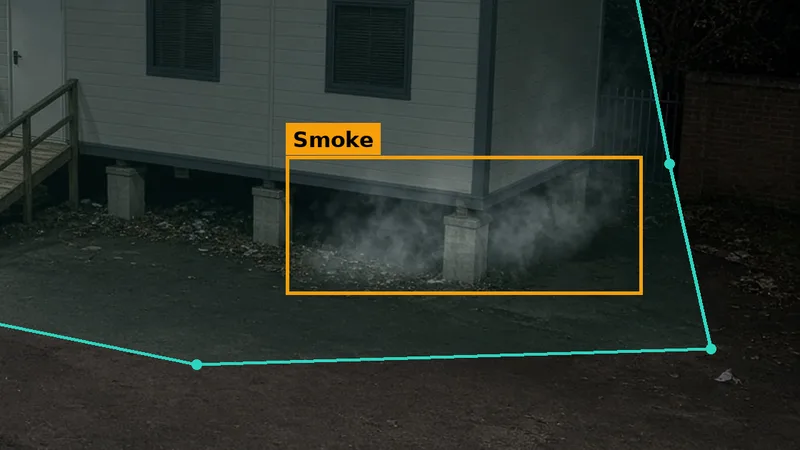
Here is a fictional example. A primary school on the edge of a town has a single-storey modular classroom at the side of the back playground, standing on short supports with a gap underneath where leaves and litter collect. It is the summer holiday, and the site is empty in the evenings. A camera on the main building already looks across the playground. A zone over the modular classroom and the ground around it is armed from 20:00 to 07:00 through the holiday. At 21:40, thin grey smoke starts to drift out from under one end of the classroom.
The camera sees it. The site manager gets an alert on their phone: smoke by the modular classroom, with a snapshot and a short clip. They look at the clip, see smoke coming from under the classroom on an empty site, call 999 and give the school's address and the entrance to use, and call the key holder on the rota, who lives nearby, to meet the fire service at the gate with the keys. Nobody else would have known until the smoke was seen from the road. The next day, the school asks its fire risk assessor about closing off the gap under the classroom, adds a check of the gap to the site team's weekly walk round, and reminds the holiday rota who responds to alerts.
Where Woodcock AI fits
Woodcock AI adds smoke and flame detection, and people and vehicle detection, to the cameras a school already has. You draw polygon zones over exactly the areas to watch, such as the kitchen yard, the works compound, the modular classrooms or the fire exits, set when each zone is armed, and choose who gets the alerts. The system is self-learning, getting better on each camera over time. Detection runs on an edge server on site or on a cloud server, so there is no need to replace cameras. It has been developed over years and is in use on real sites today.
Ways to start
The easiest first step is a site assessment: we look at what your existing cameras see, by day and after dark, and show where zones would help. You can also ask for a live test on your cameras, connecting two or three of them for about a fortnight, so your site team sees real alerts from your own school. Or book an on-site demo, for a single school or for a group of schools in a trust. There is no commitment to look.
Common fire safety mistakes in schools
Fire inspectors and assessors see the same problems again and again in schools. Most of them can be found on a walk round and fixed quickly.
- Fire doors wedged open. Propped with chairs or wedges between lessons, closers broken, seals damaged.
- Displays on escape routes. Large paper displays in corridors, foyers and on escape stairs.
- Corridors used as storage. Furniture, boxes, charging trolleys and recycling on the escape route.
- Holes in fire-resisting walls. Left by cabling or plumbing works and never sealed.
- An old assessment. Not reviewed after a new building, works or a change of use, or with actions never done.
- Drills only in lesson time. Never at break, lunch, clubs or lettings, so gaps are never found.
- No personal plans. Pupils or staff who need help to get out, with no plan or no named helper.
- Bins against the building. Unlocked bins under windows, by doors or under the eaves.
- Skips by the building. Works skips and materials left next to buildings over the holidays.
- Unclear responsibility. Nobody sure whether the school, the trust, the council or a contractor does what.
Fire safety in schools checklist
Use this checklist to review your own school. It follows the guidance described above, but your fire risk assessment and your enforcing authority decide what applies to your school.
Responsibility and assessment
- Responsible person known, and who does what agreed in writing.
- Fire risk assessment current, recorded, assessor competent and named.
- Review date set, and reviewed after changes.
- Action plan worked through, with dates recorded.
Protection
- Fire alarm tested weekly at a different call point, and serviced.
- Fire doors close and seal, and are never wedged open.
- Emergency lighting, extinguishers and signs checked and recorded.
- Fire-resisting walls intact, new holes sealed.
People
- Emergency plan written, known and on classroom walls.
- Drills at least once a year, preferably once a term, and varied.
- Personal plans for pupils and staff who need help.
- Staff trained, wardens and deputies named, hirers briefed.
Out of hours and outside
- Bins locked away from buildings, skips placed well away.
- Boundary, lighting and stores secure, rubbish removed.
- Holiday plan and key holder rota in place.
- Works, lettings and contractors covered by the fire plan.
Sources
- Regulatory Reform (Fire Safety) Order 2005, including articles 3, 9, 15, 21 and 22.
- HM Government, Fire safety risk assessment: educational premises.
- Department for Education, Good estate management for schools: health and safety; health and safety advice for schools: responsibilities and duties; emergency planning and response for education settings.
- Department for Education, fire safety in new and existing school buildings; Building Bulletin 100; design standards and Technical Manual (January 2026 update).
- Health and Safety Executive, education FAQs. Equality Act 2010.
- Scotland: Fire (Scotland) Act 2005, Part 3; Fire Safety (Scotland) Regulations 2006; Scottish Government, practical fire safety guidance for existing non-residential premises; building standard 2.15.
- Northern Ireland: Fire Safety Regulations (Northern Ireland) 2010. ICO, guidance on video surveillance.
We have summarised these sources in our own words and checked them on 4 November 2026. This guide is general information, not legal or fire safety advice for your school. Fire safety law differs between England, Wales, Scotland and Northern Ireland. Your fire risk assessor, your local fire and rescue service, your local authority or trust, and your own advisers can advise on your school.
The fire alarm covers the buildings. Who watches the yard at night?
Book a site assessment and we will look at what your cameras see by day and after dark, and show where smoke, flame and people zones would help over the kitchen yard, the bin compound, works compounds, modular classrooms and the fire exits, or ask for a live test on your cameras.
Related pages
Frequently asked questions
What are the fire safety regulations for schools in the UK?
In England and Wales, the main law is the Regulatory Reform (Fire Safety) Order 2005, which requires the responsible person to carry out a fire risk assessment and put precautions in place. Health and safety law applies alongside it. In Scotland, the Fire (Scotland) Act 2005 and the Fire Safety (Scotland) Regulations 2006 apply, and in Northern Ireland, the Fire Safety Regulations (Northern Ireland) 2010. New buildings must also meet building regulations.
Who is responsible for fire safety in a school?
The responsible person, usually the employer. In England, that is the local authority for community, voluntary-controlled and maintained nursery schools and pupil referral units, the governing body for foundation and voluntary-aided schools, the academy trust for academies and free schools, and the proprietor for other independent schools. Day-to-day tasks are often delegated to the head teacher and site team, but the legal duty stays with the employer.
How often should schools have fire drills?
The government guide for educational premises says at least once a year and preferably once a term, and the Scottish Government guidance says the same. Vary the drills, including break times, lunchtimes, clubs and a blocked route, and record what was learned.
How often should a school fire risk assessment be reviewed?
Department for Education guidance says schools should consider reviewing the assessment annually, or at least every three years, and whenever it may no longer be valid, such as after building works, a new building, a change of use or a fire.
Do schools have to have sprinklers?
Not all of them. In England, the Department for Education Technical Manual asks for sprinklers or another automatic fire suppression system in DfE-funded new buildings and major refurbishments that are four storeys or more, or over 11 metres, that include boarding, or that are special schools or alternative provision, with some exceptions. In Scotland, building standards require them in new school buildings, with exceptions. Existing sprinklers must be inspected at least once a year.
Can AI on CCTV take the place of a school fire alarm?
No. The fire alarm, fire doors, the emergency plan and trained staff are what protect people in the building. AI video detection on existing cameras covering kitchen yards, bin compounds, works compounds, modular classrooms and exit paths can watch for visible smoke and flame, and for people, out of hours, and send an alert with a clip to the site manager. It is an extra layer only, and cameras should never be placed in classrooms, toilets or changing rooms.
Last reviewed 4 November 2026