

Fire safety signs: a UK guide
Fire safety signs show people the way out, where fire-fighting equipment is and what to do in a fire. In the UK, fire safety law requires emergency routes and exits to be indicated by signs, and the Health and Safety (Safety Signs and Signals) Regulations 1996 set the shapes and colours: green for escape, red for fire equipment, blue for instructions such as “Fire door keep shut”, and yellow or red for warnings and bans. Exit signs must use a pictogram, not text alone, and must be lit, maintained and kept visible. Your fire risk assessment decides which signs you need. Signs guide people in the building; out of hours, AI on existing CCTV can add early visual warning of smoke, but it never replaces signs.

What are fire safety signs?
Fire safety signs are the signs and signals that help people get out of a building safely in a fire, find the fire-fighting equipment, and know what to do. The obvious ones are the green fire exit signs above doors and along corridors, with a white running figure and an arrow. Then there are the red signs that mark fire extinguishers, fire hose reels and fire alarm call points, the blue "Fire door keep shut" signs on fire doors, the fire action notices by call points that tell staff and visitors what to do, and the no smoking and flammable material signs in places where a fire is more likely to start.
In the law of Great Britain, a fire safety sign has a precise meaning. The Health and Safety (Safety Signs and Signals) Regulations 1996 define it as a sign, including an illuminated sign or an acoustic signal, that provides information on escape routes and emergency exits in case of fire, provides information on the identification or location of fire-fighting equipment, or gives warning in case of fire. That means a fire alarm sounder is a fire safety sign too, in the legal sense, and so is an illuminated exit sign. In everyday use, most people mean the signboards on walls and doors, and that is what most of this guide is about.
Fire safety signs are a small part of fire safety, and they cost little compared with fire doors, alarms or sprinklers. But they are one of the first things a fire officer, a fire risk assessor or an insurer will look at, because they show quickly whether the people running a building have thought about how everyone gets out. A missing exit sign over a back door, an arrow pointing the wrong way after a refit, a fire door sign painted over or a fire action notice that still names a manager who left two years ago all tell the same story. They are also some of the easiest things to put right.
This guide is for business owners, facilities and site managers, landlords of commercial buildings, health and safety leads and anyone who is the responsible person for fire safety in non-domestic premises in the UK. It explains what the law requires in England and Wales, Scotland and Northern Ireland, the different kinds of fire safety sign and what each colour and shape means, where signs should go and how high, how they should be lit, how to check and maintain them, and how signs fit into your fire risk assessment. It finishes with the hours when nobody is on site, which is where AI on existing CCTV can help with a different problem: spotting smoke and flame when the building is empty.
The main kinds of fire safety sign
Safety signs in the UK follow a simple code of shape and colour, set out in Schedule 1 to the Safety Signs and Signals Regulations and in the international standard for registered safety signs, BS EN ISO 7010. Once you know the code, you can read a sign at a glance, before you take in the picture or any words.
Emergency escape signs are rectangular or square, with a white pictogram on a green background. They show emergency exits and escape routes, usually with a running figure, a door and an arrow. Green means safety: the way out, a first aid point, an emergency facility. Fire-fighting equipment signs are rectangular or square, with a white pictogram on a red background. They show where fire extinguishers, fire hose reels, fire alarm call points and emergency fire telephones are. Red, in this context, means fire equipment.
Mandatory signs are round, with a white pictogram on a blue background. They tell you to do something. "Fire door keep shut" is the fire safety sign most people meet in this form. Prohibition signs are round, with a black pictogram on white, a red border and a red diagonal bar. They tell you not to do something, such as smoke, use a naked flame or put water on a particular kind of fire. Warning signs are triangular, with a black pictogram on yellow and a black border. They warn of a hazard, such as flammable material, an explosive atmosphere or danger from electricity.
Alongside the signs there are notices, which carry words: fire action notices, "Push bar to open" above panic bars, "Fire escape keep clear" on the outside of exit doors, and information for the fire and rescue service, such as where to find a sprinkler valve or an electrical cut-off. We go through each of these later in this guide, with what the law and the government guidance say about them.
Why fire safety signs matter
The people who most need signs are the people who do not know the building. HSE's guidance on the Regulations makes a simple point: people usually leave premises by the same way they came in, or by routes they already know. In a fire, that route may be full of smoke or blocked by the fire itself. Emergency exits and exits that are not in normal use need to be clearly marked, so people know there are other ways out. HSE adds that well-signposted exits in full view give people a feeling of security in an emergency.
Think about who is in your building on a typical day. Staff may know every corridor, but customers, guests, patients, pupils' parents, delivery drivers, cleaners and contractors often do not. A new member of staff on their first week may know the way to the canteen and nothing else. People who are unfamiliar with a building, or who are frightened, tired, distracted or affected by smoke, need a sign they can see from where they are standing, and then another, and then another, until they are outside. The same signs help firefighters coming in, and the notices for the fire and rescue service help them find valves, switches and risers quickly.
Signs also help people find the equipment they might need. A fire extinguisher behind a door or in a cabinet is no use if nobody knows it is there. And signs remind people of the rules that stop fires starting and spreading: keep this fire door shut, do not smoke here, flammable materials are stored here. None of this replaces the other fire precautions. A sign does not make an escape route safe, and HSE is clear that safety signs are not a substitute for other ways of controlling risk. But without signs, many of those other precautions are harder to use. Our guides to fire risk assessment and fire evacuation plans show how signs fit into the bigger picture.
Fire safety signs and the law
Two sets of rules work together. Fire safety law, such as the Regulatory Reform (Fire Safety) Order 2005 in England and Wales, says that emergency routes and exits must be shown by signs, and that fire-fighting equipment must be easy to find. The Health and Safety (Safety Signs and Signals) Regulations 1996 then say what a safety sign should look like and how it should be kept. HSE's guidance on the Regulations, known as L64, puts it this way: the duty to provide fire safety signs mostly comes from the Fire Safety Order, and in Scotland from the Fire (Scotland) Act 2005, while the Signs Regulations describe the types of sign that should be used.
The Fire Safety Order: routes and exits indicated by signs
Under the Regulatory Reform (Fire Safety) Order 2005, the responsible person for non-domestic premises in England and Wales must carry out a fire risk assessment (article 9) and put in place the general fire precautions it shows are needed. Article 14 covers emergency routes and exits. Among its requirements, paragraph (2)(g) is short and clear: "emergency routes and exits must be indicated by signs". The same article says that routes and exits needing illumination must have emergency lighting of adequate intensity, which is why exit signs and emergency lighting so often go together.
Article 17 requires the premises and any facilities, equipment and devices provided under the Order to be subject to a suitable system of maintenance, and maintained in an efficient state, in efficient working order and in good repair. That includes the signs on your escape routes. Article 21 requires adequate safety training for employees, which in practice includes what the signs mean and where they lead. The responsible person is normally the employer, or the person who has control of the premises, such as the owner, landlord or managing agent.
Government guidance for the Order expects signs in almost every workplace. The HM Government guide Fire safety risk assessment: offices and shops, and its sister guide for factories and warehouses, say signs must be used, where necessary, to help people identify escape routes and find fire-fighting equipment and emergency fire telephones. They add that a fire risk assessment deciding that no escape signs are needed, for example because trained staff will always be on hand to help visitors, is unlikely to be acceptable to an enforcing authority, other than in the smallest and simplest premises where the exits are in regular use and familiar to staff and visitors.
The guides also say when signs are not needed: where the locations of escape routes and fire-fighting equipment are readily apparent, and the equipment is visible at all times. A single-room shop with one front door and an extinguisher by the till may need very little. In all other situations, the guides say, your fire risk assessment is likely to show that signs are needed.
The Safety Signs and Signals Regulations 1996
The Health and Safety (Safety Signs and Signals) Regulations 1996 apply to workplaces in Great Britain. They require employers to provide and maintain safety signs where there is a significant risk to health and safety that has not been removed or controlled by other methods, such as engineering controls or safe systems of work. Where the risk is not significant, the Regulations do not require a sign, but HSE points out that certain fire safety signs may still have to be displayed under separate law. Regulation 2 defines a fire safety sign, as set out at the top of this guide, and a signboard, which is a sign that gives information or instructions by a combination of shape, colour and a symbol or pictogram, made visible by lighting of enough intensity.
Regulation 4 sets out the employer's duty to provide and maintain safety signs that comply with Schedule 1. For fire safety signs, regulation 4(3) makes those duties apply where signs are required by other law, which in practice means the Fire Safety Order and its equivalents. Regulation 5 requires employers to give employees comprehensible and relevant information on the measures taken in connection with safety signs, and suitable and sufficient instruction and training in the meaning of safety signs and what to do in connection with them.
Schedule 1 is where the detail sits. It sets the shapes and colours for each kind of sign, the minimum share of the sign that should be the safety colour, and the example pictograms. It also contains some practical rules that are easy to overlook. Too many signs placed too close together should be avoided. Poor design, too few signs, poor positioning or poor repair make signs less effective. Signs need to be cleaned, maintained, checked, repaired and replaced where necessary, so they keep their intrinsic and functional qualities. The number and position of signs depend on the extent of the hazard and the area to be covered. Signs that need a power source must have a guaranteed emergency supply in case the power fails, unless the hazard goes away with the power. Illuminated signs and acoustic signals must be checked before they are put into service and then at sufficiently frequent intervals. And where workers have impaired sight or hearing, which can include people wearing hearing protection, signs and signals should be supplemented or replaced.
Schedule 1 also says signboards should be placed at a suitable height and in a position appropriate to the line of sight, taking account of any obstacles, either at the access point to an area of general risk or close to a specific hazard. They should be in a well-lit and easily accessible position, and where natural light is poor, phosphorescent colours, reflective materials or artificial lighting should be used. A sign should be removed when the situation that justified it no longer exists, which matters after a refit or a change of use. The pictograms should be as simple as possible, with unnecessary detail left out, and they may be slightly different from the examples in the schedule, as long as they convey the same meaning.
Scotland and Northern Ireland
In Scotland, Part 3 of the Fire (Scotland) Act 2005 and the Fire Safety (Scotland) Regulations 2006 do the job of the Fire Safety Order. Regulation 13 of the Scottish regulations covers emergency routes and exits, and paragraph (2)(g) uses the same words: emergency routes and exits must be indicated by signs. The Safety Signs and Signals Regulations 1996 apply in Scotland, as they do across Great Britain.
In Northern Ireland, the Fire and Rescue Services (Northern Ireland) Order 2006 and the Fire Safety Regulations (Northern Ireland) 2010 apply. Regulation 13(2)(g) again says emergency routes and exits must be indicated by signs. The Great Britain signs regulations do not extend to Northern Ireland, which has its own Health and Safety (Safety Signs and Signals) Regulations (Northern Ireland) 1996, built on the same European directive and with the same structure, including the duty to provide and maintain signs in line with Schedule 1.
Building regulations: Approved Document B
When a building is built, extended or significantly altered in England, the Building Regulations apply, and Approved Document B gives the government's guidance on meeting the fire safety requirements. Volume 2, for buildings other than dwellings, says in paragraph 5.28 that every doorway or other exit giving access to a means of escape, other than exits in ordinary use such as main entrances, should be distinctively and conspicuously marked by an exit sign following BS ISO 3864-1 and BS 5499-4. It refers to HSE guidance on the Safety Signs Regulations, and notes that some buildings may need additional signs under other legislation.
Appendix C of the same volume deals with fire doors. Paragraph C11 says fire doorsets should be marked with the appropriate fire safety sign following BS 5499-5, depending on whether the door is to be kept closed when not in use ("Fire door keep shut"), kept locked when not in use ("Fire door keep locked shut") or held open by an automatic release mechanism or free swing device ("Automatic fire door keep clear"). The signs go on both sides of the door, except for fire doors to cupboards and service ducts, which are marked on the outside only. Paragraph C12 lists doors that do not need these signs, including doors to and within flats and dwellinghouses, bedroom doors in some residential premises, and lift entrance and landing doors. Our fire door regulations guide covers fire doors in more depth.
Approved Document B describes what is expected in new work. For a building already in use, it is the fire risk assessment under the Fire Safety Order that decides what signs are needed today. In practice, the two usually point the same way, and assessors often use the building regulations guidance as a benchmark.
Wayfinding signs in high-rise residential buildings
Since 23 January 2023, regulation 8 of the Fire Safety (England) Regulations 2022 has required the responsible person for a high-rise residential building in England to make sure the building has clear markings of floor identification and identification of flats. A high-rise residential building is one at least 18 metres high or at least 7 storeys. The markings must follow Approved Document B volume 1 and be on each landing in the stairways and in the lift lobbies, visible in low lighting or when lit by a torch. The government's fact sheet on wayfinding signage explains that this came from a recommendation of the Grenfell Tower Inquiry Phase 1 report: the signs help firefighters know which floor they are on and find the right flat in smoke and darkness.
No smoking signs
No smoking signs have their own law too. In England, the Smoke-free (Signs) Regulations 2012 require at least one legible no-smoking sign to be displayed in smoke-free premises and smoke-free vehicles. The rules on the sign itself are deliberately light. Wales, Scotland and Northern Ireland have their own smoking laws with their own sign rules, so check the version for your nation. Separately, where smoking is a fire risk, for example near flammable liquids or combustible stock, your fire risk assessment may call for prohibition signs in particular places, such as a "No smoking and no naked flames" sign at the door of a flammable store. Our guide to flammable storage covers this in more detail.
Who is responsible for fire safety signs?
For most businesses, the employer or the person in control of the premises is responsible for signs, along with the rest of the fire precautions. In a building with several occupiers, such as a block of offices, a shopping parade with flats above or a business park unit, HSE says a common approach is sensible, so people are not confused about how to get out. It is normally the owner who is responsible for signs in common areas such as stairways, and each occupier for the signs in their own part of the building. If there is any doubt, check with the fire and rescue authority. Article 22 of the Fire Safety Order requires responsible persons who share premises to co-operate and co-ordinate, and signs are a good example of where that matters: an exit route that crosses from a tenant's unit into a common corridor needs signs that agree with each other.
Enforcement
The Fire Safety Order is enforced by the local fire and rescue authority. Fire safety officers inspect premises, and signs are part of almost every audit. In most cases a problem leads to advice or an informal letter. Where something is more serious, the authority can issue a formal notice requiring improvements by a set date, or restrict or prohibit the use of the premises if the risk is serious enough. GOV.UK warns that you could be fined or go to prison for not following fire safety regulations. HSE and local authorities enforce the Safety Signs Regulations for general workplace signs. Insurers, landlords and clients may also ask to see that signs are in place and checked as part of their own surveys and audits. See GOV.UK, workplace fire safety: your responsibilities.
Types of fire safety sign, and what each one means
Schedule 1 to the Safety Signs and Signals Regulations sets out the shapes and colours. BS EN ISO 7010, the standard for registered safety signs, gives the pictograms that most suppliers now use, and which BSI describes as standardising the appearance and meaning of safety signs. Together they mean a fire exit sign in Manchester looks much like one in Madrid, and a visitor who speaks no English can still find the way out. This section walks through each kind of sign you are likely to need.
Fire exit and escape route signs
Emergency escape signs are rectangular or square, with a white pictogram on a green background, and the green must cover at least half of the sign. The pictogram shows a person running towards a door, and the sign is usually paired with an arrow showing the direction of travel. The Regulations call these emergency escape or first-aid signs. BSI's summary of BS 5499-4 refers to the two registered exit signs in BS EN ISO 7010, coded E001 and E002, and covers how supplementary text and directional arrows are used with them.
HSE's guidance is specific on two points that catch people out. First, a fire safety sign that carries only text, typically the words "Fire Exit", is not acceptable. Text can be used alongside a pictogram, but not instead of one. Second, a directional arrow on its own is not acceptable. It has to be used with the pictogram to form the sign. The HM Government guidance repeats both points and adds that every escape route sign should, where necessary, include or be accompanied by a directional arrow, and that if the route to the nearest exit is not obvious it should be shown by signs.
You will see two broad styles of exit sign in UK buildings. The government guidance calls them the BS-type sign, which has a pictogram and supplementary text such as "Fire exit", and the Euro sign, which has a pictogram and arrow but no text. Either can be used, but different types should not be mixed. HSE adds that signs to the older BS 5499 style are still acceptable under the Regulations, provided they continue to fulfil their purpose effectively. So a building does not have to tear out every older sign that still works, but when you replace signs or add new ones, keep to one consistent scheme throughout, so that people are not left comparing two different styles in a corridor full of smoke.
The government guidance also warns against relying on a few outsized signs. A very large sign over one exit can draw people towards it when another exit would be closer or safer. The aim is a steady chain of signs, each one leading to the next, across the whole building, so that every person can reach the nearest suitable exit.
Fire-fighting equipment signs
Fire-fighting equipment signs are rectangular or square, with a white pictogram on a red background, and the red must cover at least half of the sign. The examples in the Regulations include a fire hose, a ladder, a fire extinguisher and an emergency fire telephone, along with a red directional arrow. In practice you will also see signs for fire alarm call points and fire blankets, and sometimes signs explaining which type of extinguisher to use on which kind of fire.
Schedule 1 says fire-fighting equipment should be identified by a red colour and by a location signboard, or both. HSE explains that the location will normally be shown by a signboard or by colouring the background behind the equipment red, and where the equipment itself is mostly red there may be no need to colour the background as well. The sign must be large enough for the location to be easily found. If equipment is placed out of direct view, for example in a cabinet or around a corner, its location should be shown with directional arrows together with the equipment sign. HSE adds an important caution: these arrows must not contradict the escape route direction. Red arrows pointing one way and green arrows pointing the other is exactly the confusion you want to avoid.
The Regulations do not cover the colour coding of fire extinguishers themselves. HSE points to BS 7863, which sets out the coloured band or panel on an extinguisher that shows what is inside it. Our guide to fire extinguisher types explains the colours and which extinguisher suits which fire. The government guidance says that signs should show non-automatic fire safety equipment if there is any doubt about its location, for example extinguishers kept in cabinets or recesses.
Fire door signs
Fire door signs are mandatory signs: round, white text or symbol on blue. They tell people to do something, and they matter because a fire door only works if it is closed when a fire starts. Approved Document B volume 2 sets out three versions. "Fire door keep shut" goes on self-closing fire doors that should be closed when not in use, on both sides. "Fire door keep locked shut" goes on fire doors that are kept locked when not in use, such as doors to cupboards, stores and service ducts, and these are marked on the outside only. "Automatic fire door keep clear" goes on fire doors held open by an automatic release mechanism or free swing device, which close when the fire alarm operates, and the sign reminds people not to put anything in the way.
The government guidance for existing premises says the same: fire doors fitted with self-closing devices should be labelled "Fire door keep shut" on both sides, and fire-resisting doors to cupboards, stores and service ducts that are not self-closing because they are routinely kept locked should be labelled "Fire door keep locked" on the outside. Approved Document B lists some doors that do not need these signs, including doors to and within flats and dwellinghouses, bedroom doors in some residential premises, and lift entrance and landing doors.
A fire door sign is not a substitute for a fire door that works. If a "Fire door keep shut" door is always wedged open, the sign is telling you something about how the building is used. The answer may be a hold-open device linked to the fire alarm, which would then need the automatic fire door sign, or a change to how people use that route. That is a question for your fire risk assessment, and our fire door regulations guide covers it in detail.
Prohibition and warning signs
Prohibition signs are round, with a black pictogram on a white background, a red edge and a red diagonal line, and the red must cover at least 35% of the sign. The examples in the Regulations include "No smoking", "Smoking and naked flames forbidden" and "Do not extinguish with water". The last of these is used where water would make a fire worse, for example near some electrical equipment or certain chemicals, and it should sit with clear information about what to use instead. "Do not use lift in the event of fire" signs are also common near lifts that are not designed for evacuation.
Warning signs are triangular, with a black pictogram on a yellow or amber background and a black edge, and the yellow must cover at least half of the sign. Examples in the Regulations relevant to fire include "Flammable material or high temperature", "Explosive material", "Danger: electricity" and "Oxidant". You will find them on flammable liquid stores, gas cylinder cages, electrical intake rooms and plant rooms. Our guides to flammable storage and electrical fire safety cover these areas.
Schedule 1 warns against too many signs placed too close together. A door covered in six different stickers is harder to read than a door with one clear sign. Put prohibition and warning signs where your fire risk assessment shows a real hazard, at the access point to the area or close to the specific hazard, and take them down when the hazard goes.
Fire action notices and other notices
Notices carry words and give instructions, and the government guidance says they must be used, where necessary, to provide instructions on how to use any fire safety equipment, the actions to be taken in the event of a fire, and help for the fire and rescue service, such as the location of sprinkler valves or electrical cut-off switches. All signs and notices should be positioned so they can be easily seen and understood.
The guidance lists several notices that apply to many workplaces. A notice with the words "Push bar to open" should be permanently displayed immediately above the push bar on all doors fitted with a panic bolt or panic latch. A notice with the words "Fire escape keep clear" should be permanently displayed at about eye level on the outside of doors provided as a means of escape which, because they are not normally used, may become obstructed. HSE gives examples: a final exit door that opens into a car park or storage yard, or a seldom-used door between rooms. Fire doors need their keep shut or keep locked notices, as above.
A fire action notice, sometimes called a fire instruction notice, tells staff and visitors what to do if they discover a fire or hear the alarm. The government guidance says to put them on escape routes beside fire alarm call points, and also where staff frequently gather, such as canteens and locker rooms. In small, simple premises, the guidance notes that the emergency plan may be no more than a fire action notice. A typical notice covers how to raise the alarm, how to call the fire and rescue service, leaving by the nearest exit without stopping for belongings, where the assembly point is, and not going back in until told it is safe. The best notices are short, specific to the building and up to date.
If your premises routinely have people whose first language is not English, the guidance suggests you may need to give instructions in more than one language, and the translation should always convey an identical message. Pictogram signs help here too, which is one reason the law requires them for escape routes and equipment rather than words alone.
Where to put fire safety signs
Most sign problems are not about the sign itself but about where it is. A perfectly compliant exit sign is useless if it is hidden behind a hanging banner, mounted on a door that is always propped open, or placed where nobody standing in the route can see it. The HM Government guidance for existing premises gives practical rules, and BS 5499-4, the code of practice for escape route signing, covers the selection of signs, their location, mounting positions, lighting and maintenance in more detail.
Exits and escape routes
HSE says to display the fire exit sign immediately above the exit opening or, if that is not possible, in a position where it can be clearly seen and is least likely to be obstructed or obscured by smoke. The government guidance adds that escape signs should be fixed above the door in the direction of escape and not fixed to doors, because they will not be visible if the door is open. Where an exit cannot be seen, or a person escaping may be in doubt about where it is, HSE says fire exit signs with a directional arrow are appropriate at suitable points along the route. Its example is a warehouse where goods in transit and other obstructions may block a clear view of the exit doors.
The guidance sets one test that every route should pass: signs should be positioned so that a person escaping will always have the next escape route sign in sight. In simple premises, a few signs showing the alternative exits might be all that is needed. In larger and more complex premises, you may need a series of signs leading people along the escape routes to the final exit. The best way to check is to walk every route yourself, from the furthest corner of each room, and look for the next sign at every turn, door and junction.
Remember the exits people do not normally use. HSE notes that people usually leave by the way they came in. The signs over side doors, rear exits, stair doors and exits from function rooms or back-of-house areas are the ones that tell people there is another way out. Approved Document B's rule for new buildings, that every exit other than those in ordinary use should be marked with an exit sign, is a useful benchmark for existing ones.
Mounting heights
The government guidance for existing premises gives typical heights. Signs mounted above doors should be between 2.0 m and 2.5 m above the floor. Signs on walls should be between 1.7 m and 2.0 m above the floor. Heights greater than 2.5 m may be used for hanging signs, for example in large open spaces or for operational reasons, but they need to be conspicuous and legible, and larger signs may be needed. Signs should be sited at the same height throughout the escape route, so far as is reasonably practicable, so people's eyes can follow them.
There is a balance to strike. Smoke rises and collects under the ceiling first, which is why HSE talks about choosing a position least likely to be obscured by smoke. A sign that is too high may disappear early in a fire. A sign that is too low may be blocked by people, trolleys, stock or furniture. Low-mounted way guidance, such as photoluminescent strips near floor level, is a separate system covered by BS ISO 16069, and BSI notes that BS 5499-4 does not cover it.
Sight lines, clutter and smoke
The government guidance warns that other signs in shops, such as advertising and customer information, or shop dressing, can distract attention from or hide escape signs, and that escape signs must not be overwhelmed. This matters in retail, hospitality and leisure, where displays, banners and seasonal decorations change often. Warehouses and stockrooms have the same problem with racking and stacked goods. A sign that was clear on the day of the fire risk assessment can be hidden a month later by a new display or a taller stack of pallets.
Build sight lines into the way you work. Ask shopfitters and visual merchandisers to keep exit signs clear. Add sign checks to the routine after deliveries, stock moves and refits. And when you walk the routes, look from where people will actually be standing, not from the doorway.

Size and legibility
The government guidance says the legibility of escape signs depends on the size of the sign, how well it is lit and the distance over which it is viewed. HSE says signs should be sufficiently large to be clearly seen, and points to BS 5499-4 and BS 5499-10 for information on application, size and siting. Sign suppliers usually quote a maximum viewing distance for each size, and the distance for an internally lit sign is often greater than for an unlit one of the same size. Measure the longest distance from which each sign needs to be read, especially in open-plan offices, sports halls, warehouses and large shops, and choose the size from that.
People with impaired sight or hearing
Schedule 1 says that where workers have impaired sight or hearing, signs and signals should be supplemented or replaced. The government guidance notes that many people with poor vision keep some sight and can use changing or contrasting colour as clues when moving around a building. It may be enough to paint columns and walls in a contrasting colour, and to highlight changes in level, for example by making the nosings of steps and stairs a contrasting colour. For people with no sight, it suggests a well-managed buddy system, continuous handrails, a sound localisation system that helps people move towards an alert sound, or more tactile aids.
The factories and warehouses guidance adds that where people have difficulty seeing conventional signs, a way-guidance system may need to be considered. People who cannot hear the alarm, or who wear hearing protection in noisy areas, may need visual alarm devices such as beacons, which are fire safety signs in the legal sense too. A personal emergency evacuation plan for anyone who needs one should cover how they will know there is a fire and how they will find their way out.
Lighting fire safety signs
A sign that cannot be seen in the dark is no use when the lights go out. Schedule 1 says signboards should be in a well-lit position, and where natural light is poor, phosphorescent colours, reflective materials or artificial lighting should be used. HSE adds that if natural light is poor, adequate illumination, which includes emergency lighting, will be required. The government guidance says all signs and notices will need illumination to make sure they are conspicuous and legible, and lists external illumination and internal illumination as options.
Schedule 1 also says that signs needing some form of power must have a guaranteed emergency supply in case the power fails, unless the hazard goes away with the power. In practice, internally lit exit signs are usually part of the emergency lighting system, either self-contained with their own battery or fed from a central battery system, and they stay lit in a power cut. Escape route signs are a key part of emergency lighting design, and our emergency lighting regulations guide explains the testing and the standards in full.
Photoluminescent signs
Photoluminescent signs glow in the dark after they have been charged by light. They are widely used and can help in poor light, and HSE says signs using photoluminescent materials may have a role in poor light conditions. But the government guidance is firm that photoluminescent signs and notices need a period of exposure to light before they become visible in darkness, get fainter over time, and are not a substitute for appropriate emergency lighting. They should only be used where other forms of illumination are present. BS 5266-6 gives guidance on using photoluminescent fire safety signs and notices.
In practice, that means a photoluminescent sign in a windowless corridor that is dark all night will not have been charged when it is needed, and a photoluminescent sign under emergency lighting may be a useful extra. Ask your emergency lighting contractor or fire risk assessor before relying on them.
Checking and maintaining fire safety signs
Schedule 1 says signboards should be cleaned, maintained, checked, repaired and replaced where necessary, so that they keep their intrinsic and functional qualities, and that illuminated signs and acoustic signals should be checked before they are put into service and then at sufficiently frequent intervals. HSE says all signs should be properly maintained, fixed securely and large enough to be clearly seen. Under article 17 of the Fire Safety Order, the facilities provided for fire safety must be kept in efficient working order and good repair.
The government guidance suggests a daily check that all safety signs and notices are legible, as part of the routine walk round the premises. That does not need to take long: a quick look along each route as you open up is often enough to spot a sign that has fallen, been covered or been knocked askew. Lit exit signs are normally checked as part of the monthly emergency lighting function tests and the annual full-duration test, and any failed sign should be repaired promptly.
Common faults include faded signs, especially in sunlight; signs with peeling vinyl or broken diffusers; signs left behind after a layout change that now point into a dead end or a wall; arrows pointing the wrong way after a door was moved; fire door signs painted over by decorators; fire action notices with the wrong assembly point or out-of-date names; and missing signs on doors added during a refit. Schedule 1 says a sign should be removed when the situation that justified it no longer exists, so taking down old signs is as important as putting up new ones. Keep a note of sign checks and repairs with your other fire safety records.
Signs and your fire risk assessment
Your fire risk assessment is where you decide what signs your premises need. Under article 9 of the Fire Safety Order, and the equivalent rules in Scotland and Northern Ireland, the responsible person must assess the fire risks and the precautions needed. The government guides include signs and notices in the list of things to consider, alongside escape routes, emergency lighting, fire detection and warning, fire-fighting equipment and training. Many businesses use a professional fire risk assessor, especially for larger or more complex buildings, but the responsible person stays responsible for the result.
The simplest way to assess signs is to walk the building as someone who has never been there before. Start in the furthest corner of each room and follow the signs to a final exit, then to the assembly point. At every turn, door and junction, ask whether the next sign is in sight. Then do it again from a different start point, and again with the main route blocked, to check the alternative exits are signed. Look for every fire extinguisher, hose reel and call point and ask whether a stranger would find it. Check every fire door for the right sign on the right side. Read every fire action notice and check it matches your current emergency plan.
The government guides include checklists for signs and notices. Adapted, they ask: where necessary, are escape routes, exits, fire-fighting equipment and emergency fire telephones shown by appropriate signs? Have you provided notices for the actions to take if there is a fire, and instructions on using fire safety equipment? Are signs and notices positioned so they can be easily seen and understood? Are they visible in all lighting conditions, including in a power cut? And are they in a consistent style that matches the rest of the building? Record what you find and what you will do about it, especially if you have five or more employees, a licence, or an alterations notice, when recording significant findings is required.
Training: what staff need to know
Regulation 5 of the Safety Signs Regulations requires employers to give employees information on safety signs and suitable and sufficient instruction and training on what they mean and what to do. HSE explains that employees should be aware of and understand the meaning of safety signs and signals they see or hear during their work. Most signs are self-explanatory, but HSE notes that some people, particularly new starters, may be unfamiliar with the less commonly used ones. Article 21 of the Fire Safety Order requires adequate fire safety training for employees, including on first starting work and when risks change.
For signs, that training can be short and practical. Explain the colour code. Walk new starters along both ways out of their work area, so they know the alternative route as well as the one they use every day. Show them where the nearest extinguisher and call point are. Explain what the fire door signs mean and why doors must not be wedged. And tell them how to report a damaged, hidden or missing sign. Fire wardens and marshals, who sweep areas in an evacuation, need a deeper knowledge of routes and exits; our fire warden duties guide covers their role.
Common mistakes
Most of the sign problems found on inspections are simple and repeat from building to building. Text-only "Fire Exit" signs, which HSE says are not acceptable. Arrows on their own, without the running figure pictogram. Exit signs fixed on doors, which disappear when the door is open. A mix of old BS-type signs and new Euro-type signs in the same corridor. Arrows left over from an old layout that now point at a wall, a store cupboard or a door that has been locked. Signs hidden behind stacked stock, racking, displays, banners or seasonal decorations. Fire door signs on doors that are not fire doors, or missing from doors that are. Red arrows to equipment that point the opposite way to green escape arrows. And fire action notices with the wrong assembly point, a phone extension that no longer exists or the name of someone who left long ago.
There is also the opposite problem. Schedule 1 warns against too many signs close together, and a building plastered in signs can be harder to navigate than one with a few clear ones. Over-signing often happens when signs are added piecemeal over years without anyone removing the old ones. A periodic review, with a plan of where every sign is, helps keep the scheme clean.
Building work, refits and temporary changes
Refits, extensions, shopfits and maintenance work are the moments when signs most often go wrong. Exits are closed off, routes are diverted, doors are moved and walls go up. Plan the escape routes for each stage of the work before it starts, put up temporary signs that match the temporary routes, cover or remove signs that would send people towards a closed exit, and walk the routes again when the work moves on. When the work is finished, check every route against the new layout, update the fire risk assessment and fire action notices, and make sure the contractor has not left a mix of old and new signs.
Signs in different types of premises
The rules are the same in every workplace, but each kind of building has its own pressure points. Here are the ones we see most often.
Offices and shared buildings. In a multi-occupied office building, the owner or managing agent is normally responsible for signs in the common parts, such as the stairs, landings and entrance hall, and each tenant for signs inside their own space. The two need to agree. When a tenant fits out a floor, check that the signs inside the tenancy lead to the building's escape stairs, and that the stair signs still make sense. In buildings with lifts, signs near the lifts may tell people not to use them in a fire unless they are designed for evacuation.
Shops. Retail is where signs most often compete with displays, banners and promotional material. The government guidance specifically warns that advertising and shop dressing can distract attention from, or hide, escape signs. Rear exits through stockrooms need signs that stay visible when the stockroom is full, and the outside of the rear exit door often needs a "Fire escape keep clear" notice, especially if it opens onto a yard or service road. Our guide to fire risk assessment covers shops and offices.
Warehouses and factories. HSE's own example of where directional signs are needed is a warehouse where goods in transit and other obstructions may block the view of exit doors. Long aisles, high racking and changing stock levels mean signs at the ends of aisles, along main routes and over every exit, at heights that will not be hidden by stock. Hanging signs in high-bay buildings need to be larger to be legible. Our guide to warehouse fire safety covers these buildings in depth.
Hospitality, leisure and venues. Cinemas, theatres, bars, function rooms and bowling alleys are often dark by design, crowded at peak times and full of visitors who do not know the building. Exit signs need to be lit and visible above the crowd, and staff need to know how to guide people out. Licensing conditions and the venue's own fire strategy may add requirements. These premises are also often left empty for long hours after closing.
Residential buildings. In blocks of flats, the common parts are covered by the Fire Safety Order, and in high-rise residential buildings in England the wayfinding sign rule in the Fire Safety (England) Regulations 2022 applies. Approved Document B volume 2 does not require the fire door signs on doors to and within flats, but fire doors in the common parts, such as stair and corridor doors, still need them. Houses in multiple occupation and other residential premises have their own guidance, and your local fire and rescue service or housing authority can advise.
Quick reference
Every building is different, and your fire risk assessment decides the detail, but the same handful of signs and notices appear in almost every workplace. Use this as a starting list when you walk your premises, and check each against the guidance above.
As a rough guide: exit signs above every exit that is not in ordinary use, and above the main exits too where the route is not obvious; escape route signs with arrows at every turn, junction and door where the way out is not obvious, so the next sign is always in sight; signs at stairs and landings; fire-fighting equipment signs where equipment is not readily visible, with arrows if it is out of view; "Fire door keep shut", "Fire door keep locked" or "Automatic fire door keep clear" on fire doors as appropriate; "Push bar to open" above panic bars; "Fire escape keep clear" on the outside of exit doors that could be blocked; fire action notices beside call points and where staff gather; information for the fire and rescue service where valves, switches or risers are not obvious; no smoking signs where the law or your assessment requires them; and warning signs at flammable stores and electrical rooms.
Signs are not a once-and-done job. They need a fresh look whenever something changes, and a routine look even when nothing seems to have.
What fire safety signs cannot do
Signs are designed for people who are in the building when a fire starts. They tell people where to go and where the equipment is, and they remind people of the rules. They do not detect a fire, raise the alarm or call anyone. They depend on people being there to see them. And like any one precaution, they do not stand alone: the escape routes must be wide enough and kept clear, the doors must open, the fire alarm must work, the emergency lighting must come on and people must be trained.
There is one situation signs cannot help with at all: a fire in a building with nobody in it. Overnight, at weekends and over holidays, many shops, warehouses, venues, offices and yards are locked and empty. The exit signs stay lit, as they should, but there is nobody to follow them, and nobody to see the smoke. If the fire alarm is not monitored, a fire may only be noticed when it is seen from outside or when the first person arrives in the morning. That is a different problem, and it is where cameras that are already on site can help.
When nobody is there: where AI on existing CCTV fits
Fire safety signs are designed for the moment people need to get out. They assume someone is in the building. But many fires start when nobody is there at all: overnight, at weekends and on bank holidays, in shops, stores, venues and yards that are locked up and dark. The exit signs glow over empty aisles. Nobody is there to smell burning or see smoke. If the fire alarm is not monitored, nobody may know until the fire is seen from outside. Many of those spaces already have a camera pointing at them.
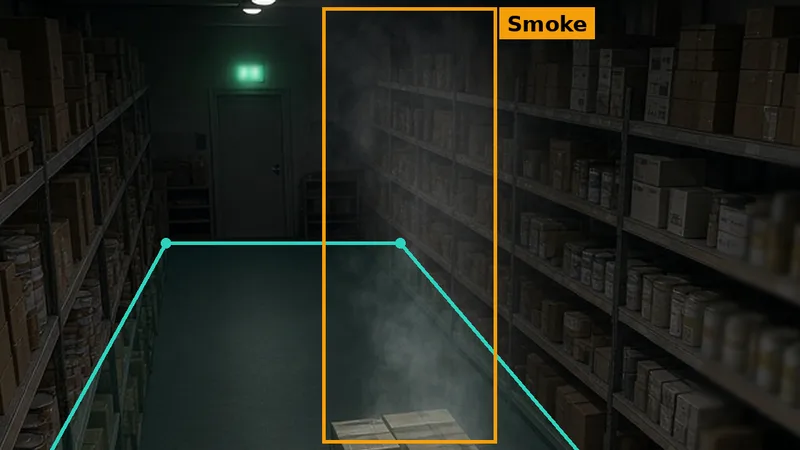
AI video detection watches for visible smoke and flame inside areas you choose, at the times you choose, and sends an alert with a snapshot and a short clip so a person can decide what to do. It can spot smoke rising from stock in an aisle, across a cinema screen or among soft play frames out of hours, in the area a camera can see.
We want to be clear about what this is and is not. Video smoke and flame detection is not a fire safety sign, and it does not check your signs. A camera cannot tell you whether an exit sign is in the right place, whether an arrow points the right way or whether a fire action notice is up to date; only walking the routes can. It does not replace your signs, emergency lighting, fire alarm, fire risk assessment or any other precaution your assessor, insurer or the law requires. It does not sound your fire alarm or call the fire service. It is an extra layer of early visual warning, most useful in the hours when nobody is on site.
Out of hours, if a clip shows smoke or flame, the person who receives it can call 999 and say what they can see and where. If your fire alarm is monitored, keep those arrangements in place; camera alerts sit alongside them. If you are considering camera detection, talk to your fire risk assessor and insurer first. Our guides to video smoke detection on existing CCTV and commercial fire alarm systems explain how the two fit together.
Where it can help
The places where camera detection adds most are those that are empty and dark for long periods, or that hold a lot of fuel. Choose an area below to see how a zone might be set up. Each image is a camera view with a zone drawn over the area to watch.
Which area?
Cinemas and theatres are dark by design, full of upholstered seats and busy for a few hours, then empty. Exit signs and emergency lighting do their job while the audience is in. Overnight, a camera that already covers the screen or the auditorium can watch a zone over the seating and send an alert with a clip if visible smoke or flame appears, so a keyholder can check and call 999.
Smoke and flame, overnight
Soft play centres are full of foam, plastics and fabric, and in the day they are busy with families who do not know the building, so clear exit signs matter. Overnight they are empty. Out of hours, a zone over the play frames can add a visual check for smoke or flame.
Smoke and flame, out of hours
Leisure venues mix machinery, catering, arcade machines and soft furnishings, and they are often empty for long hours after a late close. Walk round at close and check the exits and signs. Where a camera covers the lanes or the floor, a zone armed overnight can alert someone if smoke appears. It does not replace any detection the building already has.
Smoke and flame, overnight
Each area needs its own zone and schedule.
Other places worth considering include stockrooms behind shops, storage cages, bin stores and service yards where packaging builds up. Our guides to warehouse fire safety and flammable storage cover related ground.
The limits of camera detection
Every detection method has limits. A camera can only see what is in its view, and many fires start out of sight: inside a cabinet, in a ceiling void, behind a display or in a cupboard. Smoke will not be seen until it comes into view, which may be some time after the fire started. Cameras need enough light, or infrared, to see at night, and thin smoke in the dark is harder to see. A camera cannot see heat. A camera that has no power sees nothing, so ask your installer what keeps the cameras, recorder and network running in a power cut.
What about false alerts?
Steam, dust, headlights, reflections and insects near the lens can all look like smoke to a camera. Good set-up keeps false alerts down. Tight polygon zones cover the risk, not the whole view. Schedules arm zones only when the area should be empty. Clean lenses and steady lighting help, and a self-learning system gets better over time at knowing what is normal for each camera. Looking back at alerts after the first week or two, and adjusting zones, makes a big difference.
A worked example
Here is how this might look for the fictional DIY store shown at the top of this page. It is an example, not a real business. The store has a fire risk assessment, a fire alarm, internally lit exit signs on its emergency lighting, fire action notices by each call point and a closing routine run by the duty manager. After a conversation with its fire risk assessor and insurer, the store adds smoke and flame detection to existing cameras that look down its main aisles, with zones over the aisle floors armed from 22:00 to 06:30.
One evening the duty manager walks round at 21:40, checks that no stock is blocking the exits or hiding the signs, and locks up. The zones arm at 22:00. At 02:14, thin grey smoke starts to rise from a pallet of boxed stock standing in the middle of aisle 7. The camera zone sees it, and the alert reaches the keyholder with the clip and an AI description. They can see smoke in the aisle, call 999, tell the fire service exactly where it is and how to get in, and say that nobody is believed to be inside, based on the alarm set and the access log.
Crews deal with the fire. The following week, the store has the damaged area repaired. Before the public come back in, it replaces the smoke-stained exit signs in that part of the building, asks its contractor to test the emergency lighting there, walks every escape route to check the signs still make sense with the aisle temporarily closed, and updates its fire risk assessment and fire action notices. The signs were ready for people who were not there; the camera meant the fire was found at 02:14 by the keyholder, not at 07:00 by the first person in.
How Woodcock AI fits
Woodcock AI connects to existing IP cameras, and detection runs on an edge server on site or on a cloud server. It adds smoke and flame detection, and people and vehicle detection, to the cameras you already have. You draw polygon detection areas over the places that matter, choose when they are armed and who gets the alerts. Each alert has a snapshot, a short clip and an AI description of what the camera saw. Our smoke and fire detection page and how it works page show more.
Woodcock AI is self-learning, so it gets better over time at knowing what is normal on each camera. It is the result of years of development and is now in use on real sites in the UK. It works alongside your fire safety signs, emergency lighting, fire alarm, fire risk assessment and emergency plan rather than replacing them. Ask your cameras (Coming soon, early 2027) will let you ask questions about what your cameras have seen in everyday words.
Ways to start
Book a site assessment. We look at what your cameras see by day and after dark, and show where zones would help, such as shop aisles, stockrooms, cinema screens, soft play halls and leisure floors. Or ask for a live test on your cameras: we connect two or three of your existing cameras for about a fortnight, so you can see the alerts for yourself. We are also happy to arrange an on-site demo.
Sources
- Health and Safety (Safety Signs and Signals) Regulations 1996, regulations 2, 4 and 5 and schedule 1; HSE, L64 Safety signs and signals: guidance on regulations (PDF).
- Regulatory Reform (Fire Safety) Order 2005, articles 9, 14, 17, 21 and 22; GOV.UK, workplace fire safety: your responsibilities; HM Government, Fire safety risk assessment: offices and shops (PDF) and factories and warehouses (PDF).
- GOV.UK, Approved Document B (fire safety), volume 2, buildings other than dwellings; Fire Safety (England) Regulations 2022, regulation 8 and the wayfinding signage fact sheet; Smoke-free (Signs) Regulations 2012.
- BSI, BS EN ISO 7010 and BS 5499-4 product summaries.
- Scotland and Northern Ireland: Fire (Scotland) Act 2005, Part 3; Fire Safety (Scotland) Regulations 2006, regulation 13; Fire and Rescue Services (Northern Ireland) Order 2006; Fire Safety Regulations (Northern Ireland) 2010, regulation 13; Health and Safety (Safety Signs and Signals) Regulations (Northern Ireland) 1996.
We have summarised these sources in our own words and checked them on 3 November 2026. This guide is general information, not fire safety advice for your premises. British Standards are paid documents; we describe them from the summaries published by BSI and HSE, so check the standard itself or ask a competent person for the detail. The Fire Safety Order applies in England and Wales, and Scotland and Northern Ireland have their own fire safety laws. Your fire risk assessor, a competent sign or emergency lighting supplier, your insurer and your local fire and rescue service can advise on your building.
The signs are lit for people. Who sees the smoke when nobody is in?
Book a site assessment and we will look at what your cameras see by day and after dark, and show where smoke and flame zones would help over shop aisles, stockrooms, cinema screens, soft play halls and leisure floors, or ask for a live test on your cameras.
Related pages
Frequently asked questions
Are fire safety signs a legal requirement?
Yes, where they are needed. Fire safety law says emergency routes and exits must be indicated by signs: article 14 of the Fire Safety Order in England and Wales, regulation 13 of the Fire Safety (Scotland) Regulations 2006 and regulation 13 of the Fire Safety Regulations (Northern Ireland) 2010. The Safety Signs and Signals Regulations 1996 set what the signs look like. Your fire risk assessment decides where signs are needed. Only the smallest and simplest premises, where exits and equipment are obvious, are likely to need few or none.
What colour are fire exit signs?
Green. Emergency escape signs are rectangular or square, with a white pictogram, usually a running figure and a door, on a green background that covers at least half of the sign. Red signs mark fire-fighting equipment, blue round signs give instructions such as “Fire door keep shut”, yellow triangles warn of hazards, and round signs with a red border and diagonal bar show what is not allowed.
Is a sign that just says Fire Exit acceptable?
No. HSE guidance says a fire safety sign that bears only text, typically “Fire Exit”, will not be acceptable. The sign must include a pictogram. Text can be added to help understanding, but not used on its own. A directional arrow on its own is not acceptable either; it must be used with the pictogram.
How high should fire exit signs be?
The government guidance for existing premises suggests between 2.0 m and 2.5 m above the floor for signs above doors, and between 1.7 m and 2.0 m for signs on walls, at the same height along the route where practicable. Hanging signs in large spaces can be higher, but may need to be larger. Signs should be above the door, not on it, and placed where smoke is least likely to hide them.
Do fire exit signs need to be illuminated?
They need to be visible in all the conditions in which they must be read. The Regulations say signs should be well lit, and where natural light is poor, lit artificially or made with phosphorescent or reflective materials, and signs that need power must have a guaranteed emergency supply. In practice, exit signs are usually internally lit and part of the emergency lighting. Photoluminescent signs are not a substitute for emergency lighting.
Can CCTV check my fire safety signs?
No. A camera cannot tell you whether a sign is in the right place, points the right way or is up to date, and it does not replace any sign, your emergency lighting, your fire alarm or your fire risk assessment. AI video detection on existing cameras does a different job: it watches zones for visible smoke and flame, mostly out of hours, and sends an alert with a clip so someone can call 999. Woodcock AI runs on an edge server on site or on a cloud server.
Last reviewed 3 November 2026
Signs work best when staff have walked the routes they point to. For staff training, see our fire safety training guide.