

Fire door regulations: a UK guide for businesses
Fire door regulations in the UK come mainly from fire safety law, not one single rule. In England and Wales, the Fire Safety Order requires the responsible person to keep fire doors in efficient working order and good repair, and in England the Fire Safety (England) Regulations 2022 add quarterly checks of communal fire doors and annual best-endeavours checks of flat entrance doors in blocks over 11 metres. Most fire doors are rated FD30 or FD60, must self-close, and must not be wedged open.

Fire doors are among the most important and most neglected fire precautions in any building. A good fire door, kept shut, can hold back fire and smoke for half an hour or more, long enough for people to get out and for crews to arrive. The same door wedged open, with a broken closer or a missing seal, does almost nothing. This guide explains the fire door regulations that apply to UK businesses and building owners: who is responsible, what the Fire Safety Order and the Fire Safety (England) Regulations 2022 require, what FD30, FD60 and E30Sa mean, how fire doors are tested and certified, the parts that make a fire door work, how and how often to check them, what goes wrong, and how the rules differ in Scotland, Wales and Northern Ireland.
Two points before we start. First, the guidance here is general. What your premises need comes from your own fire risk assessment, and your fire risk assessor, your landlord or managing agent, your insurer and your local fire and rescue service can tell you what applies to you. Second, we do not name people or businesses involved in real fires or prosecutions, and we do not give prices. Where we say what the law or the official guidance asks, it comes from the sources listed at the end of this page, which we checked on 3 November 2026.
Fire door regulations: the short answer
There is no single "fire door law". In England and Wales, the Regulatory Reform (Fire Safety) Order 2005 requires the responsible person for almost any non-domestic premises, and for the common parts of blocks of flats, to provide suitable fire precautions, which usually include fire doors, and to keep them maintained in efficient working order and good repair. In England, the Fire Safety (England) Regulations 2022 add specific duties for buildings with two or more sets of domestic premises: tell residents about fire doors, and in buildings over 11 metres, check communal fire doors at least every three months and use best endeavours to check flat entrance doors at least every twelve months. Building regulations, explained in Approved Document B in England, set out how new fire doors should perform, typically as FD30 or FD60 doors with smoke seals and self-closers. Scotland, Wales and Northern Ireland have their own laws, with similar duties.
| Question | Short answer | Where to read more |
|---|---|---|
| Which law applies? | Fire Safety Order 2005 in England and Wales; own laws in Scotland and Northern Ireland | The law |
| Who is responsible? | The responsible person: employer, owner or person in control | Responsible person |
| How often to check? | Set by your risk assessment; fixed minimums for some blocks of flats in England | Checks |
| What rating is needed? | Usually FD30 or FD60, often with smoke seals (S or Sa) | Ratings |
| Must old doors be replaced? | Not just because standards have changed | Existing doors |
| Can they be held open? | Only by devices that release on the fire alarm | Hold-open devices |
| What goes wrong? | Wedges, broken closers, gaps, missing seals | Common failures |
| What if nobody is there? | Shut doors at night help; plan who would notice a fire | When nobody is there |
What a fire door is, and what it does
A fire door is not just a heavy door. It is a complete assembly, usually called a fire doorset or door assembly, made up of the door leaf, the frame, the hinges, the closer, the latch or lock, the intumescent strips and smoke seals, any glass and the way it is all fixed into the wall. It has been tested, as a whole, to show that it resists fire for a set time. Change one part for something untested, cut a hole for a letter box or a cat flap, or leave a large gap at the edges, and the door may no longer perform as it was tested. That is why most guidance treats the door and everything fitted to it as a single product.
Fire doors do several jobs. In escape routes, such as stairs and corridors, they keep fire and smoke out long enough for people to use the route. Between compartments, they hold a fire in one part of a building so it cannot spread through the rest. Around rooms with a higher risk, such as plant rooms, boiler rooms, kitchens and stores, they keep a fire in the room where it starts. In blocks of flats, the front door of each flat is a fire door too, because it protects the shared corridor and stairs from a fire inside the flat, which is what lets most residents stay put while the flat on fire is dealt with. All of these jobs depend on the door being closed when the fire starts.
The government's fire door guidance for blocks of flats, published under the Fire Safety (England) Regulations 2022, describes four kinds of fire door: flat entrance doors; doors that protect stairs and lobbies; doors that divide long corridors; and doors to plant rooms, service cupboards and risers. Workplaces use the same kinds of door, with different names: doors on escape stairs, cross-corridor doors, doors to plant and storage rooms, and doors in compartment walls.
The law: who must do what
In England and Wales, the main law is the Regulatory Reform (Fire Safety) Order 2005, often called the Fire Safety Order or the RRO. It applies to almost all non-domestic premises, including shops, offices, factories, warehouses, hotels and the common parts of blocks of flats. The Order does not set out a list of fire door rules. Instead, it puts general duties on the responsible person, and fire doors are one of the main ways of meeting them.
Article 8 requires the responsible person to take general fire precautions to keep relevant persons safe. Article 9 requires a suitable and sufficient fire risk assessment, which should identify which doors need to be fire doors and what they protect. Article 14 requires emergency routes and exits to be kept clear and usable, with emergency doors opening in the direction of escape and not locked so they cannot easily be opened. Article 17 is the maintenance duty: where necessary to keep people safe, the premises and any facilities, equipment and devices provided must be subject to a suitable system of maintenance and kept in an efficient state, in efficient working order and in good repair. A fire door with a broken closer is a device not in efficient working order. Article 38 makes a similar demand for anything provided to protect firefighters. Article 32 sets out the offences.
The responsible person
The responsible person is usually the employer, where the premises are a workplace under their control. Otherwise it is the person who has control of the premises in connection with a trade, business or other undertaking, or the owner. In a shared building there may be several responsible persons: a tenant for its own unit, and the landlord or managing agent for the common parts. The Order requires them to co-operate and share information. The Fire Safety Act 2021 confirmed that, in buildings with two or more sets of domestic premises, the Order covers the structure, the external walls and all doors between domestic premises and common parts, such as flat entrance doors.
The responsible person can, and often should, get help. Fire risk assessors, fire door inspectors and maintenance contractors all have a part to play. But the duty stays with the responsible person, who should keep records of what has been checked, what was found and what was done about it. GOV.UK's guidance on enforcement explains that fire and rescue authorities can serve alterations, enforcement and prohibition notices, and that an offence under the Order can lead to an unlimited fine and, in the most serious cases tried at the Crown Court, up to two years in prison. Several of the 2026 cases later in this guide involved fire doors.
Building regulations and fire safety law are different
Two sets of rules apply to fire doors, and they are often confused. Building regulations, explained in England in Approved Document B, apply when a building is built, extended or materially altered, and they set out how new fire doors should perform. Fire safety law, the Fire Safety Order and its regulations, applies every day a building is in use, and it is about keeping the precautions working. A door fitted in 1995 does not have to meet the 2026 version of Approved Document B. The government's fire door guidance says that existing doors which met the relevant standards when they were installed are generally adequate, and that the absence of intumescent strips or of certification does not, on its own, mean a door is not fit for purpose. What matters is whether it still does its job, which is what your fire risk assessment and inspections should establish.
The Fire Safety (England) Regulations 2022
The Fire Safety (England) Regulations 2022 came out of the Grenfell Tower Inquiry. Its Phase 1 report noted that fire doors play an essential role in preventing the spread of smoke and toxic gases and in preserving the compartmentation of buildings, and that the doors at Grenfell Tower, through damage or disrepair, did not act as they should. The Inquiry recommended urgent inspection of fire doors in residential buildings and regular checks, no less than every three months, that every fire door has an effective self-closing device in working order. The regulations were made on 18 May 2022 and came into force on 23 January 2023. They extend to England and Wales but apply in England only.
Regulation 10 is the fire door regulation. It applies to buildings in England that contain two or more sets of domestic premises and common parts through which residents would need to escape in a fire. In practice, that means most blocks of flats, and mixed-use buildings with flats above shops or offices. It does not apply to the inside of a house, and it does not apply to workplaces without flats, where the general duties of the Fire Safety Order apply instead.
The regulation has two parts. The first, which applies to every such building whatever its height, is about information: the responsible person must give residents information about the importance of fire doors to the building's fire safety. The second, which applies only where the top storey is more than 11 metres above ground level, typically a building of more than four storeys, is about routine checks.
How often fire doors must be checked
In a block of flats in England with a top storey more than 11 metres up, the responsible person must check all fire doors in the common parts, including their self-closing devices, at least every three months. They must also use best endeavours to check all flat entrance doors, including their self-closers, at least every twelve months, and keep a record of the steps taken, including where access was refused. The government's guidance treats doors to plant rooms, service cupboards and risers as communal doors that should also be checked at least every three months. The fact sheet notes that the landing doors of lifts are not included; lifts have their own inspection regime.
Below 11 metres there is no fixed interval in the regulations, but that does not mean no checks. The fact sheet is clear that the regulations do not replace the general duty in the Fire Safety Order, and that responsible persons for lower buildings must still make sure all fire doors, including flat entrance doors, are capable of providing adequate protection. The same is true of workplaces. The government's guides to fire safety risk assessment suggest, as an example schedule, a monthly check that all fire doors are in good working order and closing correctly and that frames and seals are intact. London Fire Brigade notes that one industry best practice guide suggests six-monthly inspections, and says that a risk-based approach is better, with six-monthly checks essential in premises such as hotels or where vulnerable people live.
Information for residents
In every building covered by regulation 10, residents must be told that fire doors should be kept shut when not in use, that they should not tamper with self-closing devices, and that they should report any fault or damage to fire doors straight away. The information must be given when a resident moves in and then at intervals of no more than twelve months. A short letter or leaflet, a notice in the common parts and a reminder in the annual newsletter are common ways of doing it. The aim, as the fact sheet puts it, is to deepen residents' understanding of their role in keeping the building safe, and to encourage them to let the responsible person in to check their front door.

The picture above shows why flat entrance doors matter so much. Only the nearest door on the left has a visible overhead closer; others may have closers concealed in the door or frame, or none at all, which is why each door needs a close look during checks. Each front door along a corridor like this one is part of the protection for everybody else. In a building designed for a stay-put strategy, residents in other flats rely on the door of the flat on fire holding back fire and smoke while crews deal with it. A door with a missing closer, a letterbox that no longer shuts, or a replacement front door that was never fire-resisting can let smoke into the corridor that the whole building uses to escape. The Luton fire described later in this guide shows the difference a closed, working door makes.
Best endeavours, and when residents refuse
Front doors belong, for most purposes, to the flat, so the responsible person needs the resident's co-operation to check them. The regulation asks for best endeavours. The fact sheet says it is for the responsible person to decide how best to engage with residents, for example by agreeing a date in advance. If access cannot be achieved, the responsible person should gather evidence of the steps taken, such as letters asking for access. The fire door guidance adds that, over every twelve-month period, a record must be kept of the steps taken to check flat entrance doors and of any cases where access was not granted, and that legal action may need to be considered if a resident persistently refuses.
Who can carry out the checks
The regulation 10 checks are meant to be simple. The guidance says that, with appropriate instruction, caretakers, managing agents, housing officers and maintenance staff should be able to do them, for example during other routine visits, because they are visual and do not involve tools. It is not envisaged that the person checking carries out a detailed technical examination of the door's fire resistance; that belongs in the fire risk assessment. Repairs and replacements are different: where an inspection finds that a door needs repair or replacement, the work must be done by a competent contractor. And the guidance warns that the simple checks are no substitute for periodic assessment of fire doors by specialists, for example by sampling during fire risk assessments.
Fire door checks in workplaces
For shops, offices, factories, warehouses, hotels and other workplaces, the Fire Safety Order sets no fixed interval. The responsible person decides, through the fire risk assessment, how often doors are checked and by whom, and keeps a record. A common pattern is a quick daily look as part of opening or locking up, a recorded monthly check, a check, each time the fire alarm is tested, that any alarm-linked hold-open devices release and the doors close, and a more detailed survey by a competent person, often once a year. Busy doors on main routes, doors in premises where people sleep, and doors in premises with vulnerable people need more frequent checks. Our guide to fire risk assessment covers how the assessment sets those intervals.
Fire door ratings: FD30, FD60 and the European classes
Fire doors are rated by how long the whole doorset kept fire from getting through in a standard furnace test. The British rating comes from BS 476-22 and is written FD followed by the number of minutes, so FD30 means thirty minutes' integrity and FD60 sixty. A suffix S is added where the door must also restrict cold smoke leakage, giving FD30S and FD60S. The European rating comes from testing to BS EN 1634-1 and classification to BS EN 13501-2. It is written E for integrity, followed by minutes, with Sa added for restricted smoke leakage at ambient temperature, so E30Sa is broadly the European counterpart of FD30S. The two systems are not automatically interchangeable: Approved Document B notes that national classifications do not necessarily equate to European ones, and a product can only claim a European class if it has been tested for it.
The Scottish guidance makes a point worth remembering: the door rating is an indication of test performance and is not necessarily how a door will perform in a real fire. A test is carried out on a correctly made, correctly fitted doorset. A door in daily use may have dropped on its hinges, had its closer adjusted, lost part of a smoke seal or been fitted with a new lock. That is why checking and maintenance matter as much as the original rating.
Which rating goes where
In England, Table C1 of Approved Document B sets out the minimum rating for doors in different positions. Some examples from volume 2, which covers buildings other than houses: a door from a flat to a space in common use, E30Sa or FD30S; doors in the enclosure of a protected stairway, E30Sa or FD30S; a door forming part of a protected lobby approach or protected corridor to a stairway, E30Sa or FD30S; any other protected corridor, E20Sa or FD20S; doors sub-dividing corridors that connect alternative exits, E20Sa or FD20S. A door in a compartment wall separating buildings must match the wall, with a minimum of 60 minutes, and a door in a compartment floor must match the floor. Where smoke control is needed and the building is not pressurised, the door must also meet a leakage limit: no more than 3 cubic metres per metre per hour, from the head and jambs, at 25 pascals, or meet the Sa classification when tested to BS EN 1634-3.
FD60 doors usually appear where the wall or floor around them is rated to 60 minutes or more, for example compartment walls in larger warehouses and factories, walls between a building and an adjoining one, or some plant and service areas. The fire risk assessment or the building's fire strategy should say what each door is meant to achieve. If nobody knows, that is a finding in itself. Approved Document B also notes that most fire doors give little insulation, so, unless a door provides insulation as well as integrity, no more than a quarter of the length of a compartment wall should consist of door openings.
How fire doors are tested
Approved Document B requires the test to be carried out from each side of the doorset separately, because fire can come from either side. Lift doors are the exception and are tested from the landing side only. Crucially, test evidence must apply to the complete installed assembly. The guidance warns that small differences in detail may significantly affect the rating. A leaf from one maker hung in a frame from another, with hinges, closers and seals chosen on cost, is not the same as the doorset that passed the test, even if every part was sold as fire-rated.
One detail is worth flagging for people planning long-life refurbishments. The current Approved Document B volume 2 accepts both BS 476-22 ratings and European classifications. The version of Appendix C that takes effect from 2 September 2029 no longer lists the BS 476-22 route in paragraph C1, and instead points to European classification or an assessment of performance. Doors already fitted are not affected by that change, but anyone specifying new doors for a project that will finish around or after that date should ask about European classification now.
Certification and labels
Third-party certification is how most buyers, installers and inspectors know that a door is what it claims to be. Under a certification scheme, an independent body checks the manufacturer's testing, production and, in some schemes, the installation, and the door carries a label or a coloured plug, usually on the top or hanging edge of the leaf. London Fire Brigade points building owners to the industry's door certification schemes for suppliers and specification advice. The Fire Door Safety Week five-step check starts here too: without a certification mark, you cannot be sure the door really is a fire door. A mirror or a phone camera helps to read a label on the top edge.
Two cautions apply. First, older fire doors in existing buildings often have no label at all. London Fire Brigade describes older 'notional' fire doors, often hung in frames with a 25mm door stop and without modern seals, which may be suitable to stay in place if they are not warped or gapped badly enough to need replacing. The government's revised fire door guidance is explicit that the absence of strips, seals or any form of certification does not imply that an existing door is unfit for purpose, and that a door which met the standards when it was fitted will usually continue to provide adequate protection provided it is undamaged and the gaps are not too large. Second, certification can be voided by later changes. Mid and West Wales Fire and Rescue Service warns that altering a door for glazing apertures or air transfer grilles will make the certification void. So can a new lock, a new letterbox or a spyhole drilled by someone who did not know the door was certified.
Fire door components, and what each one does
A fire door is a doorset: leaf, frame, seals, hinges, closer, latch or lock, any glazing and any signs, tested and fitted together. Each part has a job, and each part can fail.
Intumescent strips and smoke seals
Intumescent strips sit in a groove in the edge of the door or in the frame. In a fire they swell, sealing the gap between leaf and frame so that flames and hot gases cannot pass. Smoke seals, which look like draught seals and are often a brush or a flexible blade, stop cold smoke from leaking round the door in the early stages of a fire, before the strip has expanded. The two are normally combined in a single strip. The government's guidance asks checkers to make sure strips and seals, where present, are undamaged, make contact with the door edge or frame, and have not been painted over. The Scottish guidance notes that intumescent strips are fitted in the door or frame but not at the bottom of the door.
Missing seals on an older door are not automatically a breach. The government's guidance says that, if strips and seals were not originally present, this may be acceptable, subject to the findings of the fire risk assessment. On a door that was supplied with them, a missing or torn strip is a defect to put right.
Gaps around the door
Smoke and flame find the easiest path, and a large gap round a door is exactly that. The government's guidance gives the industry standard: the gap between the door and the frame should never be more than 4mm, except at the bottom, where it should be as small as practicable while making sure the door is unlikely to snag on the floor if it drops slightly on its hinges. Fire and rescue services commonly describe the target as a constant gap of around 3 to 4mm at the top and sides. The Fire Door Safety Week check says the gap under the door can be slightly larger, up to 8mm, depending on the door, and that ideally you should not see light under it. Simple gap tester cards make the check quick.
Self-closing devices
A fire door only works when it is shut. Approved Document B expects every fire doorset, including flat entrance doors, to have a self-closing device, except for cupboard doors, service duct doors that are normally locked shut, and doors inside flats and houses. The government's guide to fire safety risk assessment says closers should meet BS EN 1154 and that rising butt hinges are not suitable. The Scottish guidance adds that the closing force must be enough to overcome any latch, and that it is inappropriate to rely on staff to close fire doors.
The government's check is simple. Open the door fully and let it go; then open it to around 15 degrees and let it go. In both cases it should close fully into the frame, overcoming the latch and any friction with the floor. Mid and West Wales Fire and Rescue Service suggests checking that the closer shuts the door onto the latch from any position, including from 75mm. A closer that slams is a problem too: London Fire Brigade notes that doors which bang loudly encourage people to wedge them open.
Hinges, latches and hardware
The government's guide to fire safety risk assessment says fire-resisting doors need the correct number, size and quality of hinges, normally a minimum of three, following the manufacturer's instructions, with BS EN 1935 as the relevant standard. Approved Document B adds that, unless shown to be satisfactory when tested as part of the doorset, the essential parts of a hinge should be made from materials with a melting point of at least 800°C. Missing or loose hinge screws are one of the defects the government asks routine checkers to look for, and the Fire Door Safety Week check asks you to open the door and confirm that all hinges are firmly fixed, three or more of them, with no missing or broken screws.
Latches, locks, handles, letterboxes and spyholes all go through the door, so each one is a potential weak point. They should be compatible with the tested doorset. Where pairs of doors have rebated meeting edges, they must close in the right order or they will not seal; the government's guide says door coordinators to BS EN 1158 should be fitted and working in all such cases where the doors are self-closing, and the fire door guidance asks checkers to make sure any selector on a double door is operating correctly.
Glazing in fire doors
Fire doors can have vision panels, but the glass and its glazing system must be fire-resisting and must have been tested as part of the door. London Fire Brigade says glazing should not be retrofitted by cutting a door unless the work is done by a door specialist. The government's checklist asks checkers to look at the condition of the fire-resisting glass and glazing system in door panels and in any side or over panels that form part of the doorset. Approved Document B also limits where uninsulated glazing can be used. Cracked panes, missing glazing beads and ordinary glass fitted after a breakage are all defects that should be put right by a competent person.
Fire door signs
Approved Document B expects fire doors to carry a sign complying with BS 5499-5. There are three messages: 'Fire door keep shut' for doors kept closed when not in use; 'Fire door keep locked shut' for doors kept locked, such as cupboards and service ducts; and 'Automatic fire door keep clear' for doors held open by an automatic release mechanism or a free-swing device. Signs go on both sides, except cupboard and service duct doors, which are signed on the outside. Doors to and within flats, bedroom doors in hotels and similar premises, and lift landing doors do not need these signs.
Alterations that undermine a fire door
Many fire door failures start with a well-meant change. A tenant fits a new lock; a contractor trims the bottom of a door for new flooring; someone cuts in a vision panel, adds a cat flap or fits a ventilation grille; the decorators paint over the seals. The government's checklist covers most of these: a replacement front door that is not fire-resisting, a letterbox that does not close or was fitted later, a hole where a lock has been removed, damage to glazing, grilles and hinges, and seals painted over during decorating. Each change should go through someone who understands fire doors before it happens, not after.
Hold-open devices: keeping doors open safely
Some fire doors are on busy routes, used by people with trolleys, by staff carrying loads, or by people with impaired mobility who find a heavy closer hard to open. The answer is never a wedge. Approved Document B allows self-closing fire doors to be held open by a fusible link (not on escape routes, except in specific paired-door arrangements), by an automatic release mechanism triggered by an automatic fire detection and alarm system, or by a door closer delay device. In practice, most buildings use electromagnetic hold-open devices on the wall or floor, or free-swing closers, linked to the fire alarm.
The government's guide to fire safety risk assessment sets out the conditions. Hold-open devices on doors protecting escape routes should only be installed with an automatic fire detection and warning system that includes smoke detectors designed to protect those routes. The device should release the door so that it closes effectively within its frame when smoke is detected by an automatic detector, when the alarm is operated by hand, for example at a call point, on any failure of the fire alarm system, and on any electrical power failure. It must always be possible to close the door by hand, and a site-specific risk assessment should be carried out first. The Scottish guidance adds that these devices should not be used on a door to a room where the only automatic detection is a heat detector, because by the time heat is detected, smoke may already have passed through.
Hold-open devices need checking too. The government's fire door guidance advises using the test button, where there is one, to close the door rather than pulling it off its magnet, and many fire risk assessments ask for a check, each time the fire alarm is tested, that every device releases and every door shuts and latches. A device whose magnet has been taped or whose door has been propped with a chair in front of it is no better than a wedge. Self-contained hold-open devices that are not connected to the fire alarm exist, but the government's guide says they are unlikely to be suitable for doors protecting single stairways or other critical escape routes, and should be used only where a site-specific risk assessment shows they are appropriate.
Riser, cupboard and plant room doors
Doors to plant rooms, service cupboards and risers are easy to forget, because they are rarely opened. They matter because risers run through every floor, and a fire or smoke in a riser can bypass the compartments that protect the rest of the building. The government's fire door guidance says these doors should be checked at least every three months in blocks of flats over 11 metres, for damage, damaged grilles, damaged seals and large gaps. They may be either self-closing or kept locked shut, and if they are self-closing, the closer should be tested in the same way as any other. Approved Document B does not require a self-closer on cupboard doors or on service duct doors that are normally locked shut, which is why the 'Fire door keep locked shut' sign exists.
The guidance also notes that caution is needed when entering these areas, taking account of the health and safety risk assessment. Contractors leaving riser doors unlocked, or cable runs pushed through the door edge or the wall above, are common findings. The fire stopping behind the door matters as much as the door itself: a perfect door in a wall full of unsealed holes protects nothing.
A fire door checklist you can use
The government's fire door guidance gives the best plain-English checklist available, and it works for any building, not just flats. Each time doors are checked, it asks you to confirm that:
- a fire-resisting door has not been replaced with a door that is not fire-resisting;
- letterboxes close firmly and are not jammed open, and any letterbox added later is suitable for fire doors and was fitted by a specialist;
- there is no damage to the door, frame or surrounding wall that could affect its ability to resist fire or smoke, such as a split in a timber door, damaged glazing, warping, or a hole where a lock has been removed;
- fire-resisting glass and its glazing system, including side and over panels, are in good condition;
- there are no obvious defects in the hinges, such as missing or loose screws, or in other hardware such as ventilation grilles;
- intumescent strips and smoke seals, if present, are undamaged, touch the door or frame, and have not been painted over;
- the gap between door and frame is not too large: never more than 4mm, except at the bottom;
- there is an effective self-closing device that closes the door fully into its frame from fully open and from about 15 degrees.
For a quicker walk-round, or to give residents and staff something they can remember, the Fire Door Safety Week five-step check covers the essentials: look for a certification label or plug; check the gaps at the top and sides are consistently less than 4mm, with the bottom gap no more than about 8mm depending on the door; look for intumescent seals and check they are intact; check there are three or more firmly fixed hinges with no missing or broken screws; and open the door about halfway, let go, and check it closes firmly onto the latch without sticking. Warwickshire Fire and Rescue Service promoted the same five steps for Fire Door Safety Week 2026, asking anyone responsible for a building to walk through it, check that doors close fully into their frames, and report or repair any defects.
Whatever checklist you use, record it. A simple sheet per door, or a row per door in a spreadsheet, with the date, the person, the result and the action taken, is enough to show an inspector that checks happen. Number the doors on a floor plan so that defects can be found and fixed quickly. Photograph defects and photograph them again after repair.
The most common fire door failures
Fire and rescue services see the same faults again and again. The commonest is the simplest: fire doors wedged or propped open. Then come closers that have been removed, disconnected or adjusted until they no longer latch; gaps that have grown as doors drop on worn hinges; intumescent strips and smoke seals that are missing, torn or painted over; doors damaged by trolleys, bins and furniture; holes left by old locks; glazing cracked or replaced with ordinary glass; and fire-resisting doors swapped for ordinary ones during refurbishment or by residents. Every one of these turns up in the prosecutions summarised below.
Wedging deserves its own paragraph, because it is behaviour, not hardware. London Fire Brigade notes that doors which bang loudly encourage people to wedge them open. The Fire Door Safety Week survey for the 2026 'Check it, close it' campaign found that 38% of Gen Z respondents, aged 18 to 29, said they feel safe when a fire door is wedged open. People wedge doors because the closer is too strong, because the door slams, because deliveries are awkward, or because a room gets hot. Each of those has a better answer: adjust or replace the closer, fit a delayed-action closer, fit an alarm-linked hold-open device after a risk assessment, or deal with the heat. Then tell people why the door matters, and check it.
Repairs, replacement and competent people
Routine checks are for anyone with simple instruction. Repairs are not. The government's guidance says that where inspections identify the need for repair or replacement of a fire door, the work must be done by a competent person. Small adjustments, such as tightening hinge screws or adjusting the closing speed, may be within the skill of a trained maintenance person. Replacing seals, refitting glazing beads, repairing damaged edges or dealing with gaps needs someone who understands how the doorset was tested and certified, so that the repair does not change what was tested. If a door is badly warped, split, wrongly specified, or has been cut about, replacement is usually the right answer, and the new doorset should come with evidence of its performance and be installed as tested.
Replacement does not always mean the latest standard. The government's revised guidance is clear that there is no requirement to replace a fire door simply because it does not meet current standards for new buildings, if it remains in full working order from a fire safety point of view. What it must do is give adequate protection, as judged by the fire risk assessment. For new and replacement doors, however, aim for a certificated doorset fitted by a competent installer. The government's guide to fire safety risk assessment notes that the performance of correctly specified fire doors can be undermined by poor installation, and that accreditation schemes for fire door installers are available.
Fire doors in the news in 2026
These cases, all reported by fire and rescue services or the fire safety trade press during 2026, show how fire doors work when they are right and what happens when they are not. We name the places and courts but not the people or businesses involved; the sources list links to the original reports.
Luton, 15 February 2026. At 2.28am, crews were called to a kitchen fire on the ninth floor of a 15-storey residential building. Bedfordshire Fire and Rescue Service said the closed fire door to the flat was instrumental in containing both fire and smoke, significantly reducing the potential impact on other residents.
Windsor, 22 May 2026. Two managers of a property with commercial and residential units pleaded guilty at Reading Crown Court to eight offences under the Fire Safety Order. Royal Berkshire Fire Authority's investigation found no fire detection system, insufficient emergency lighting and inadequate fire doors that would have compromised the means of escape. Both received suspended 14-week custodial sentences.
Brighton, 20 July 2026. The person in control of a house in multiple occupation above a commercial unit, who had pleaded guilty in April, was sentenced at Brighton Magistrates' Court. The failings East Sussex Fire and Rescue Service had found included the removal of a fire-resisting door protecting the means of escape, and a kitchen door onto the escape route that failed to self-close fully.
Warwickshire, September 2026. Supporting Fire Door Safety Week 2026 as part of the national Fire Kills campaign, Warwickshire Fire and Rescue Service urged building managers, landlords and tenants to use the five-step check and report or repair defects, noting that many people do not realise that a fire door is not necessarily a fire exit door.
Preston Crown Court, 28 September 2026. An individual and a company were sentenced for breaches at a former chapel in Darwen and a hall in Bacup. Lancashire Fire and Rescue Service had found obstructed escape routes, damaged fire doors, missing fire-resisting glazing, inadequate detection and fire alarms that were switched off or without power. The individual received a suspended prison sentence.
Taunton Magistrates' Court, 19 October 2026. A company and a sole trader providing sleeping accommodation at a guest house pleaded guilty to seven offences. Devon and Somerset Fire and Rescue Service inspectors had found, among other failings, incomplete fire doors throughout the premises, and served a prohibition notice stopping its use for sleeping until remedial work was done.
Barrow-in-Furness, reported 2 November 2026. Following a 2023 fire in which a tenant suffered life-threatening injuries, a housing company was fined at South Cumbria Magistrates' Court. The court heard that the flat doors did not provide 30 minutes' fire resistance, lacked self-closing devices, intumescent strips and smoke seals, and had two hinges rather than three.
The pattern is consistent. Where a fire door was closed and working, the fire stayed in the flat. Where doors were missing, incomplete, damaged or without closers, courts treated it as a failure of the most basic duty in the Fire Safety Order.
Scotland, Wales and Northern Ireland
The principles of fire doors are the same across the UK, and the same doorsets, ratings and standards are used everywhere. The laws, the names of the duty holders and the building rules for new work differ.
Scotland
In Scotland, fire safety in non-domestic premises is governed by Part 3 of the Fire (Scotland) Act 2005 and the Fire Safety (Scotland) Regulations 2006. The person with duties is usually called the duty holder rather than the responsible person, and the Scottish Fire and Rescue Service enforces. The Scottish Government's practical fire safety guidance for existing non-residential premises explains fire doors in detail. It uses the same ratings (FD30, FD30S, E30Sa, FD60S and E60Sa), and makes the point that a door's rating is an indication of test performance, not necessarily how it will perform in a real fire. It says intumescent strips are fitted in the door or frame but not at the bottom of the door, that self-closing devices should comply with BS EN 1154 and be able to overcome any latch, and that relying on staff to close fire doors is inappropriate.
On hold-open devices, the Scottish guidance is specific: they are only appropriate where there is an automatic smoke detection system, and should not be used for a door to a room where the only automatic detection is a heat detector. Building standards for new work in Scotland are set by the Building (Scotland) Regulations and the Scottish Government's technical handbooks, not by Approved Document B.
Wales
The Fire Safety Order applies in Wales as it does in England, and the Fire Safety Act 2021 applies to both. The Welsh Government's guidance on the Act explains that it clarifies that, in buildings with two or more sets of domestic premises, the Order covers the structure, external walls and all doors between domestic premises and the common parts, including flat entrance doors. The Welsh Government has also published guidance for responsible persons on fire doors in blocks of flats, which describes fire doorsets as designed and tested to resist the spread of fire and smoke for at least 30 minutes, says self-closing devices should close the door securely into its frame, and advises discouraging residents from replacing flat entrance doors themselves.
The Fire Safety (England) Regulations 2022 do not apply in Wales. Instead, Wales has taken its own route. The Building Safety (Wales) Act 2026 introduces a new building safety regime for multi-occupied residential buildings of any size, divided into three categories by height and number of storeys. The Welsh Government says the Act's fire safety provisions also apply to houses in multiple occupation that are not let under a single joint tenancy. Responsible persons for flats in Wales should follow the Welsh Government's guidance as the new regime is brought in, and keep checking fire doors under the existing duty in the Fire Safety Order in the meantime.
Northern Ireland
In Northern Ireland, fire safety in non-domestic premises is governed by the Fire and Rescue Services (Northern Ireland) Order 2006 and the Fire Safety Regulations (Northern Ireland) 2010, enforced by the Northern Ireland Fire and Rescue Service. NIFRS says the Order applies to almost all buildings, places and structures that are not domestic premises, including houses in multiple occupation. As in the rest of the UK, the duty is to carry out a fire risk assessment and put suitable precautions in place, and fire doors, their closers and their condition are a normal part of that assessment. Building regulations for new work in Northern Ireland have their own technical guidance.
Fire doors in different types of premises
The rules are the same everywhere, but the doors that matter most, and the ways they fail, depend on the building.
Warehouses and distribution sites
In a large warehouse, the key fire doors are often in compartment walls: between the storage hall and the office block, around plant rooms and battery charging areas, and between separate parts of the building. Many will be FD60 or higher, matching the wall, and some openings will be protected by fire shutters rather than doors. The everyday threats are trolleys and pallet trucks hitting doors and frames, stock and racking stacked in front of shutters, and doors propped open for traffic. Our guide to warehouse fire safety covers the wider picture.
Factories and workshops
In factories, fire doors separate process areas from each other and from offices, protect stairs and escape corridors, and enclose plant rooms, compressor rooms and stores for flammable materials. Dust, heat and vibration wear doors and closers quickly, and production pressure is a constant reason to wedge doors. A monthly recorded check is a sensible minimum, with weekly attention in dusty or high-traffic areas. Our guide to factory fire safety has more on fire risks in manufacturing.
Hotels, care homes and other sleeping premises
Where people sleep, fire doors are critical, because occupants may be asleep, unfamiliar with the building, or unable to escape quickly. Bedroom doors and corridor doors in hotels are self-closing fire doors, corridor doors are often on alarm-linked hold-open devices, and night staff need to know how the doors work. London Fire Brigade says six-monthly checks are essential in hotels and in buildings where people who might not be able to respond quickly to a fire live. Two of the 2026 cases above, the guest house in the Devon and Somerset area and the flats in Barrow-in-Furness, involved sleeping accommodation. Our guide to hotel security covers other risks in hotels.
Offices, business centres and flats above shops
Multi-let offices and business centres rely on fire doors around stair cores and lobbies, and on corridor doors that sub-divide long routes. The common problems are tenants propping doors for convenience, cabling pushed through door heads, and nobody being sure which tenant or landlord is responsible for which door. Mixed-use buildings, with flats above shops, restaurants or takeaways, are where many prosecutions happen: the door between the commercial unit and the residential escape route is often the most important door in the building. The Windsor and Brighton cases above were both in buildings like this.
When nobody is there: where AI on existing CCTV fits
Fire doors do their work whether or not anyone is in the building. That is their great strength: a closed, well-maintained fire door contained the Luton fire in February 2026 without anybody touching it. But a door only holds back fire and smoke for a limited time, and out of hours there may be nobody to notice that a fire has started behind it. Many of the places where that matters, such as stair lobbies, corridors, riser cupboards and compartment walls, already have a camera pointing at them.
AI video detection watches for visible smoke and flame inside areas you choose, at the times you choose, and sends an alert with a snapshot and a short clip so a person can decide what to do. It can spot smoke drifting along a corridor ceiling or up a stairwell out of hours, in the area a camera can see.
We want to be clear about what this is and is not. Video smoke and flame detection does not check fire doors. It does not tell you whether a door is open, closed, wedged or damaged, and it is no substitute for the door checks described in this guide. It does not replace your fire alarm, your fire risk assessment or any other precaution your assessor, insurer or the law requires. It does not sound your fire alarm, release hold-open devices or call the fire service. It is an extra layer of early visual warning, most useful in the hours when nobody is on site.
Out of hours, if a clip shows smoke or flame, the person who receives it can call 999 and say what they can see and where. If your fire alarm is monitored, keep those arrangements in place; camera alerts sit alongside them. If you are considering camera detection, talk to your fire risk assessor and insurer first. Our guides to video smoke detection on existing CCTV and commercial fire alarm systems explain how the two fit together.
Where it can help
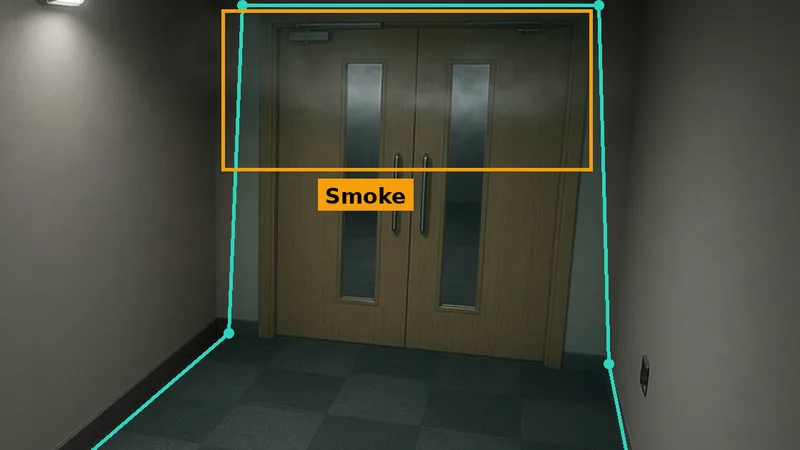
The places where camera detection adds most are those where a fire could start, or smoke could gather, while nobody is around, especially on the escape routes your fire doors protect. Choose an area below to see how a zone might be set up. Each image is a camera view with a zone drawn over the area to watch.
Which area?
Stair lobbies and corridors are the escape routes fire doors protect. Out of hours, a camera that already covers a lobby can watch a zone over it and send an alert with a clip if visible smoke or flame appears, so a keyholder can check and call 999. It does not check whether a door is open or closed, and it does not test hold-open devices.
Smoke and flame, out of hours
Riser and plant doors are rarely opened, and the corridors outside them are quiet at night. If a camera covers the corridor, a zone over the riser door and the corridor in front of it can alert someone if smoke appears around the door. The riser door still needs its own three-monthly or risk-based checks.
Smoke and flame, out of hours
A compartment wall and its fire doors are meant to stop a fire in one part of a warehouse spreading to the next. If a camera covers a compartment door and the racking near it, a zone over the door and the floor in front of it can send an alert with a clip if visible smoke or flame appears after the last shift. The alarm and sprinklers, where fitted, remain the primary systems.
Smoke and flame, after the last shift
Each area needs its own zone and schedule.
Other places worth considering include plant rooms, storerooms beside stairs, bin stores against the building and loading bays. Our guides to bin store fire safety and fire evacuation plans cover related ground.
The limits of camera detection
Every detection method has limits. A camera can only see what is in its view: smoke behind a closed fire door, inside a riser or in a room without a camera will not be seen until it comes into view. That is, of course, exactly what a good fire door is meant to achieve. Cameras need enough light, or infrared, to see at night, and thin smoke in the dark is harder to see. A camera cannot tell you that a building is empty, because people can be out of view. And a camera can only tell someone; it cannot close a door or get anyone out.
What about false alerts?
Steam, dust, headlights, reflections and insects near the lens can all look like smoke to a camera. Good set-up keeps false alerts down. Tight polygon zones cover the risk, not the whole view. Schedules arm zones only when the area should be empty. Clean lenses and steady lighting help, and a self-learning system gets better over time at knowing what is normal for each camera. Reviewing alerts after the first week or two, and adjusting zones, makes a big difference.
A worked example
Here is how this might look for the fictional two-storey business centre shown at the top of this page. It is an example, not a real business. The centre has a fire risk assessment, a fire alarm, self-closing fire doors on its stair cores and a pair of cross-corridor fire doors on each floor, checked every month by the site manager. After a conversation with its fire risk assessor and insurer, the owner adds smoke and flame detection to an existing camera in the ground-floor corridor, with a zone over the corridor and the cross-corridor doors at its end, armed from 20:00 to 07:00.
One night, the last tenant leaves at 19:40 and the zone arms at 20:00. At 02:14, faint grey smoke starts to show behind the vision panels and at the head of the closed doors, coming from a store room on the far side. The camera zone sees it, and within a minute the alert reaches the keyholder with the clip and an AI description. They can see smoke in the corridor, call 999, tell the fire service exactly where it is and how to get in, and say that nobody is believed to be inside.
Crews arrive and deal with a fire in the store room. The closed cross-corridor doors and the stair doors have held the smoke back from the rest of the building. The following week, the owner and the fire risk assessor review what happened: the door that kept the smoke out of the stair is checked and its seals replaced, the store room is cleared and refitted, and the door check record shows that all the doors on that corridor had passed their check a fortnight earlier. The fire doors did their job. The camera meant the fire was found at 02:14 by the keyholder, not at 08:00 by the first tenant in.
How Woodcock AI fits
Woodcock AI connects to existing IP cameras, and detection runs on an edge server on site or on a cloud server. It adds smoke and flame detection, and people and vehicle detection, to the cameras you already have. You draw polygon detection areas over the places that matter, choose when they are armed and who gets the alerts. Each alert has a snapshot, a short clip and an AI description of what the camera saw. Our smoke and fire detection page and how it works page show more, and our industrial and warehousing and logistics pages cover larger sites.
Woodcock AI is self-learning, so it gets better over time at knowing what is normal on each camera. It is the result of years of development and is now in use on real sites in the UK. It works alongside your fire doors, fire alarm, fire risk assessment and people rather than replacing them. Ask your cameras (Coming soon, early 2027) will let you ask questions about what your cameras have seen in plain words.
Ways to start
Book a site assessment. We look at what your cameras see by day and after dark, and show where zones would help, such as stair lobbies, corridors, riser cupboards and compartment walls. Or ask for a live test on your cameras: we connect two or three of your existing cameras for about a fortnight, so you can see the alerts for yourself. We are also happy to arrange an on-site demo.
Sources
- GOV.UK, Fire Safety (England) Regulations 2022: fire door guidance (revised 2025) and fire doors checklist; Home Office, Fact sheet: fire doors (regulation 10) and Fire Safety (England) Regulations 2022 collection.
- Fire Safety (England) Regulations 2022, regulation 10 and regulation 1; Fire Safety Act 2021.
- Regulatory Reform (Fire Safety) Order 2005, articles 8, 9, 14, 17, 32 and 38; GOV.UK, enforcement and sanctions for non-compliance and workplace fire safety: your responsibilities.
- HM Government, Approved Document B and volume 2, buildings other than dwellings (Appendix C and Table C1); Fire safety risk assessment: factories and warehouses (Part 2 and Appendix B).
- London Fire Brigade, fire doors, office environments and private rented sector landlords; Fire Door Safety Week, five-step fire door check and 2026 survey; Mid and West Wales Fire and Rescue Service, fire doors keep you safe; Dorset and Wiltshire Fire and Rescue Service, fire doors advice for landlords.
- Scottish Government, practical fire safety guidance for existing non-residential premises and building standards technical handbook; Fire (Scotland) Act 2005, Part 3; Fire Safety (Scotland) Regulations 2006.
- Welsh Government, fire doors in flats: guidance for building owners, Fire Safety Act 2021 guidance and building safety programme; Fire and Rescue Services (Northern Ireland) Order 2006; Fire Safety Regulations (Northern Ireland) 2010; NIFRS, business fire safety.
- 2026 reports: Bedfordshire FRS, Luton; Royal Berkshire FRS, Windsor; East Sussex FRS, Brighton; Warwickshire FRS, Fire Door Safety Week; Lancashire FRS, Darwen and Bacup; Devon and Somerset FRS, guest house; FSMatters, Barrow-in-Furness.
We have summarised these sources in our own words and checked them on 3 November 2026. This guide is general information, not fire safety advice for your premises. Details of the 2026 cases are as stated in the reports at the time; we name places and courts, not people or businesses. The Fire Safety Order applies in England and Wales, the 2022 regulations in England only, and Scotland and Northern Ireland have their own laws. Your fire risk assessor, a competent fire door specialist, your insurer and your local fire and rescue service can advise on your building.
Your fire doors hold back smoke. Who sees it at 2am?
Book a site assessment and we will look at what your cameras see by day and after dark, and show where smoke and flame zones would help over stair lobbies, corridors, riser cupboards and compartment walls, or ask for a live test on your cameras.
Related pages
Frequently asked questions
Are fire doors a legal requirement?
Fire safety law does not list every door that must be a fire door. The Fire Safety Order requires the responsible person to take general fire precautions, including protecting escape routes, and to keep them in efficient working order and good repair. Where the fire risk assessment or the building design relies on fire doors, they must be kept working. Building regulations set where fire doors are needed in new buildings and in building work.
How often should fire doors be checked?
In blocks of flats in England with a top storey over 11 metres, communal fire doors must be checked at least every three months and flat entrance doors at least every year on a best-endeavours basis. Elsewhere, the fire risk assessment sets the interval. Government guides suggest a monthly check in workplaces, and London Fire Brigade says six-monthly checks are essential in hotels and where vulnerable people live.
What is the maximum gap around a fire door?
The government’s fire door guidance gives the industry standard: the gap between door and frame should never be more than 4mm, except at the bottom, where it should be as small as practicable without the door snagging. Fire services often describe the target as a constant 3 to 4mm. The Fire Door Safety Week check says the bottom gap can be up to about 8mm, depending on the door.
What do FD30 and FD60 mean?
FD30 means the doorset kept fire from getting through for at least 30 minutes in a BS 476-22 test, and FD60 for 60 minutes. An S suffix, as in FD30S, means it also restricts cold smoke. The European equivalents, from BS EN 1634-1 tests, are written E30 and E60, with Sa for smoke control. The rating applies to the whole tested doorset, not just the leaf.
Can fire doors be held open?
Not with wedges. Approved Document B allows self-closing fire doors to be held open by an automatic release linked to the fire alarm, a fusible link in limited cases, or a door closer delay device. Government guidance says alarm-linked hold-open devices on escape routes need smoke detection, must release on alarm, fault or power loss, and must allow the door to be closed by hand.
Can AI on CCTV check fire doors or replace a fire alarm?
No. AI video detection does not check whether fire doors are open, closed or damaged, and it is not a fire alarm. It watches for visible smoke and flame in zones on your existing cameras, mostly out of hours, and sends an alert with a clip so someone can call 999. Woodcock AI runs on an edge server on site or on a cloud server.
Last reviewed 3 November 2026
Fire wardens are often the first to spot a wedged fire door. For their everyday checks and duties, see our fire warden duties guide.