

Office security: a UK guide to protecting office buildings out of hours
Office security means protecting an office building, its people, property and data, especially out of hours when it is empty. The basics are layered: a secure perimeter and car park, good doors and windows, access control and visitor management, a monitored intruder alarm, CCTV that covers every entrance, good lighting, sound keyholding, and a clear-desk policy, alongside a fire risk assessment that covers bin stores and e-bike charging. AI on existing CCTV can add early alerts, but never replaces alarms or guards.

Last updated 3 November 2026. Most offices are busy for about ten hours a day, five days a week, and empty for the rest. That is when the trouble usually comes. Laptops, phones and IT kit sit on desks overnight. Cars and vans stand in the car park. Bikes and e-bikes wait in a store by the back door. Wheelie bins full of paper sit against the wall. And during the day, the busiest time of all, a confident stranger can walk in behind someone with a pass and leave by the fire exit with a laptop under their arm.
This guide explains office security in the UK for the people who look after office buildings: owners and occupiers, office and facilities managers, landlords and managing agents of multi-let buildings, and estate teams on business parks. It covers what offices are up against, the ways intruders get in, the fire risks that grow when nobody is around, the layers of security that work together, who does what in a shared building, the law and guidance, and a checklist you can print. It is written for ordinary offices, from a single suite above a shop to a building on a business park.
We make AI detection for existing CCTV cameras: people, vehicles, smoke and flame. Near the end we explain where that fits and where it does not. Be clear from the start: AI on cameras is an addition to your intruder alarm, your locks, your fire alarm, your guards and your keyholders. It never replaces them. Most of this page applies to any office, with or without cameras.
If you want to go deeper on a single topic, we have separate guides on commercial burglary prevention, business alarm systems, security risk assessments, out-of-hours site security, car park security and bin store fire safety. This page looks at the office building as a whole and shows how those pieces fit together.
What does office security cover?
Office security is everything you do to protect the people, property, information and building of an office, in working hours and out of them. In practice that means keeping out people who should not be there, making it hard to take things if they do get in, spotting trouble early, and knowing who will respond. It also means fire safety, because many of the threats to an office at night are fires: a bin set alight against the wall, or a battery that fails on charge in the cycle store.
The details depend on what kind of office you run. In an owner-occupied building, one business controls everything from the car park barrier to the server cupboard, so one person can make decisions. In a multi-let building, the landlord or managing agent usually looks after the outside, the entrance, the reception, the lifts, the stairs and the car park, while each tenant looks after its own floor or suite. On a business park, an estate team may run the roads, gates, lighting and estate patrols, while each building has its own owner or tenants. In serviced offices, the operator runs the front door and the shared rooms, and each member company has a desk or a small room.
Those splits matter, because gaps open up where one person's responsibility ends and the next begins. The tenant assumes the landlord checks the fire exit at night. The landlord assumes the tenants keep their bikes out of the stairwell. The estate team assumes each building has its own alarm response. Nobody looks at the bin store. Later in this guide we look at the landlord and tenant split in more detail, and at the joint duties the law places on everyone with control of part of a building.
The other thing that shapes office security is time. A typical office is occupied for perhaps 50 hours a week. For the other 118 or so, it is empty or nearly empty, with a cleaner in the evening, perhaps a security officer on a large site, and otherwise nobody. Weekends, bank holidays and the long Christmas shutdown add more. Most of the measures in this guide are about those empty hours, and about making sure that when something does happen, someone finds out in minutes rather than the next morning.
That is not to say daytime does not matter. Two of the 2026 incidents later in this guide happened in office hours: one at lunchtime and one in the early evening as people were packing up. Daytime risks are mainly about who gets in, and that comes down to reception, access control, visitor management and a culture where people feel able to ask a stranger who they are there to see.
What are offices up against?
The best national picture of crime against businesses in England and Wales comes from the Home Office Commercial Victimisation Survey. Its most recent results are for 2023. The Home Office has since paused the survey while it reviews its methods, so there is no newer edition. The survey covers several sectors, not offices alone, so treat its figures as a guide to business premises in general.
In 2023, 26 per cent of business premises, about 409,000, had experienced at least one crime in the previous twelve months. Theft was the most common, at 14 per cent of premises. Burglary, including attempts, affected 8 per cent, as did vandalism. Assaults or threats affected 7 per cent. Just over half of the premises that had suffered a crime, 55 per cent, had reported at least one incident to the police, which means a lot of business crime never reaches the police at all.
The survey also asked about prevention. Across all the kinds of measure it asked about, the ones businesses mentioned most often were about monitoring the premises and stopping people getting in while they were closed. Only 11 per cent of premises belonged to a local crime prevention network, such as a business crime reduction partnership or a local watch group. For offices on a business park or in a town centre, joining one is a cheap way to find out what is happening nearby before it happens to you.
Police-recorded crime gives a second view. The Office for National Statistics reported 222,304 burglaries recorded by police in England and Wales in the year to June 2026, 6 per cent fewer than the year before. That figure covers homes and businesses together. Police also recorded 312,231 vehicle offences, down 7 per cent, a category that includes theft of and from vehicles, the kind of crime that happens in office car parks. Falling numbers are welcome, but they are national totals. They say little about the risk to your building, which depends on where it is, what is inside, and how easy it looks.
What makes an office attractive to a thief? Portable, valuable, easily sold kit, such as laptops, phones, monitors and docking stations. Cars and vans parked out of sight of the road overnight. Bikes and e-bikes in a store that is easy to reach. Cash is rarely the target in a modern office, but information can be: a laptop is worth more to some criminals for the data on it than for the hardware. And an empty building at night, with a car park, a service yard and a back door out of view, gives a burglar time to work.
What do 2026 office break-ins and thefts tell us?
News and police reports from 2026 show the same few patterns again and again. We have left out the names of the businesses and of anyone accused or convicted. The details come from the police appeals and news reports listed at the end of this page.
In June 2026, City of London Police reported that a prolific burglar had been jailed for three years and four months after a string of burglaries at business premises in the City between late December 2025 and early April 2026, in which laptops and phones were stolen. During one of the break-ins, on Saturday 28 March 2026, he was caught on CCTV stealing laptops and a mobile phone at premises on Dukes Place. He admitted seven burglaries and an attempted burglary. It is a good example of what CCTV does well after the event: it gives the police and the courts clear evidence of who did what.
At about 2am on 13 April 2026, according to the Manchester Evening News, two people got into the communal bike store of an apartment block on Great Ancoats Street in Manchester and took two pedal bikes. It was a residential building, not an office, but office bike stores share the same weakness: a room full of valuable, portable property, often by a back door, visited by nobody at night.
On Monday 7 September 2026, between 5.30pm and 5.40pm, three laptops were stolen during a burglary at a business in St Albans city centre, according to the Herts Advertiser, and police released CCTV of a man they wanted to speak to. Ten minutes, at the end of the working day, is all it took.
On 18 September 2026, between about 12.15pm and 12.52pm, a man walked into an office building on Railway Road at Stockport Exchange and asked if he could wait for his father, according to a Greater Manchester Police appeal reported by Stockport Nub News. Police say the receptionist let him through the turnstiles, and that he went up to the third floor, took a work laptop from one of the offices and left through a fire exit. Turnstiles, a reception desk and a busy lunchtime did not stop it. A plausible story did the work.
At about 11.20pm on 19 September 2026, two men were seen on CCTV climbing a fence at business premises on College Street in St Helens and stealing catalytic converters from two parked ambulances, according to the St Helens Star. The thefts were found at about 7am the next morning, nearly eight hours later, and the business behind the vehicles told the paper the thefts had taken two ambulances off the road. Any business that leaves vans, pool cars or other vehicles parked overnight behind a fence has the same exposure.
And between 9.15pm on 3 October and just after midnight on 4 October 2026, burglars broke into premises on a business park in Rishton, Lancashire, caused significant damage and left with a large quantity of items, according to the Lancashire Telegraph. Police were not told until 5.16am and asked people to look out for a white Luton box van and two off-road motorbikes seen in the area.
Several threads run through these reports. The targets were portable: laptops, phones, bikes and vehicle parts. The way in was often a soft edge, such as a reception desk, a fence or a fire exit, rather than a locked front door. Most happened when few people were around. And CCTV mattered, but mostly afterwards, as footage for a police appeal. In St Helens and Rishton, hours passed before anyone knew. That gap between something happening and someone finding out is one of the main themes of this guide.
How do intruders get into offices?
Rarely through the front door. The main entrance of most offices is well lit, faces the road, has good glass and good locks, and is often covered by a camera. Intruders look for the back and sides of the building instead: fire exits, service doors, plant rooms, ground-floor windows, rooflights, and walls or bins that make it easy to climb to a first-floor window. During the day, the easiest route of all is often straight through reception behind someone with a pass.
The police advice for businesses on police.uk covers the basics. Keep the outside of the building well maintained and free of rubbish. Work out which areas are vulnerable to forced entry. Keep service doors locked when they are not in use. Have a monitored intruder alarm that works. Make sure CCTV covers the vulnerable areas and records good-quality images. Store wheelie bins away from the building, because they can be used as climbing aids, especially to reach first-floor windows. Light the outside, especially loading areas. Cut back overgrown bushes and trees. Fit security-rated doors and windows. And do not leave keys on the premises: give them to named members of staff only and keep a list of keyholders.
Fire exits deserve special attention, because they have to open easily from the inside and so are hard to secure well from the outside. People prop them open for a cigarette, a delivery or a breath of air, and then forget. A fire exit propped open at 4pm is a way in at 2am. Fire exits should never be locked in a way that stops people getting out in an emergency, but they can be alarmed or monitored so that you know when one is opened or left open, and they should be checked as part of the locking-up routine at the end of each day.
Out-of-hours break-ins
Many office break-ins happen when the building is empty. A typical pattern starts with a look at the building by day or at dusk: where the cameras point, where the lights are, which doors face the car park and which face nothing at all. The intruders come back late at night, often with a van or a car parked out of sight, and go straight to a rear door or window. Inside, they take what is easy to carry and easy to sell, such as laptops, monitors, phones and tools, and they are often gone within minutes, long before anyone looks at the cameras.
Every step in that sequence is a chance to stop it. A tidy, well-lit building with visible cameras may never get the second visit. Good doors and locks slow the entry down. An intruder alarm, monitored by an alarm receiving centre, tells someone that a door or window has been opened. Cameras that alert on people or vehicles in the grounds at night can give warning before anyone reaches the building at all. Our guide to commercial burglary prevention goes into each of these in more depth.
Tailgating and blagging in office hours
Tailgating means following an authorised person through a controlled door. Blagging means talking your way in. Both are daytime crimes, and both exploit good manners. Most people will hold a door for the person behind them, and most receptionists want to be helpful. The Stockport case earlier in this guide shows how well it works: a plausible story at reception, a trip through the turnstiles, and an exit through a fire door with somebody else's laptop.
The ProtectUK guidance on access control, published by Counter Terrorism Policing, says staff should be trained to deal with tailgating and with doors being held open, and that they should feel safe to challenge someone or report a concern. It also points out that access control systems need maintaining, and that you need a plan for when they fail, such as securing a door or posting someone on it.
Secured by Design's Commercial Design Guide sets out what good looks like for an office entrance. It says the reception should give staff a clear view of the entrance doors, the approach to them and the waiting area. Where a business has large numbers of visitors, it says access beyond reception, including stairs and lifts, should be controlled by staff, barriers or proximity readers. It says automated access control is likely to be needed at the main entrance and may be needed on internal doors, and that such systems should keep a log. Where two or more businesses share a common entrance, it says the doors should have automated access control, with an electronic lock release and an audio link to each business.
Visitor management turns that into a routine. Visitors sign in, give the name of the person they are visiting, wear a visible badge and are met at reception and escorted, rather than told which floor to go to. Contractors are expected and booked. Couriers leave parcels at reception. Badges are handed back on the way out. None of this needs to feel unfriendly. A greeting of "Who are you here to see? I will let them know you are here" is polite, and it stops most blaggers.

Laptops, IT kit and information
Laptops were the target in three of the six 2026 incidents earlier in this guide. They are light, valuable, easy to sell and often left on desks. The cost of losing one is rarely just the hardware. It can mean lost work, a data breach, a report to the regulator and a long afternoon for whoever manages your IT.
Simple habits help most. Lock laptops away at night in lockers, drawers or a locked room. Keep a clear desk, so that papers, notes with passwords, keys and access cards are not left out. Keep an asset list with serial numbers, so that you know what has gone and can tell the police. The National Cyber Security Centre's Small organisations guide to cyber security covers the information side: backing up your data, protecting your devices and accounts, and spotting scams. If every laptop is encrypted, locked by a password or passkey, and backed up, a stolen laptop is a hardware problem rather than a data disaster.
Do not forget the rest of the IT kit. Server and network cupboards should be locked, with the keys controlled. Monitors, docking stations and phones are worth stealing too. Shredding bins and confidential waste should be locked and collected regularly, and never left out by the bins overnight.
Anti-social behaviour around entrances
Anti-social behaviour is not always a crime, but it can make an office feel unsafe and it is often a sign of more to come. The Commercial Victimisation Survey found that 8 per cent of business premises had experienced anti-social behaviour in the previous year. Of those premises, the most common types experienced were groups hanging about on the street, at 26 per cent, street drinking or alcohol-related behaviour, at 23 per cent, and intimidating, threatening or abusive behaviour, at 21 per cent. The most common impacts reported were general nuisance, upset or disruption for staff, and putting customers off.
For offices, the usual hotspots are covered entrances and doorways, smoking shelters, cycle stores, bin stores and quiet corners of the car park after dark. Good lighting, clear sight lines and keeping these areas tidy all help. So do small design choices: an entrance canopy that does not offer a dry place to sit, benches placed where they can be seen from reception, and a smoking area away from the main door. Record what happens, with dates and times, and report it to the police or the council. Our guide to anti-social behaviour prevention covers the law and the options in more detail.
Car parks and catalytic converters
An office car park is busy from eight until six and then, for most of the night, holds a few pool cars, a couple of company vans, perhaps a car left by someone who went home by train. To a thief, that is a quiet place to work. The risks are theft of vehicles and of parts such as catalytic converters, theft of whatever is left inside the cars, and damage. A car park that is dark and out of view of the road also gives cover to anyone heading for the back of the building.
The St Helens case earlier in this guide is typical: a fence climbed late in the evening, catalytic converters taken from two vehicles, nobody aware until the morning. Police-recorded vehicle offences fell by 7 per cent in the year to June 2026, according to the ONS, but there were still more than 312,000 of them.
The basics are the same as for any car park. Light it well, with even lighting that does not leave deep shadows between cars. Keep vegetation low and boundaries in good repair. Use a barrier or gate if the car park can be closed at night, and ask staff not to leave anything on view in their cars. Park company vans close together in the best-lit, most visible area. Cameras should cover the entrance and exit and the areas where vehicles stand overnight. Our car park security guide covers all of this in more detail, and if you are adding chargers for electric cars, see our guide to EV charging fire safety.
Cycle stores
Cycle stores are one of the most overlooked parts of office security. They are full of valuable, portable property, they are usually tucked at the back or side of the building, often by a door to the street, and in many offices nobody looks inside them from one morning to the next. Thieves know this, as the Manchester bike store case earlier in this guide shows. And now that many of the bikes are electric, a cycle store is also a fire risk.
Secured by Design's Commercial Design Guide has a whole section on internal cycle stores. It says the store's doorset should be rated for security and also for fire and smoke, specifically to address concerns about electric bikes. The store should be well lit, with walls running from floor to ceiling and no windows. There should be crash bars or similar emergency fittings on the inside so nobody can be locked in. Access should be part of the building's access control and monitoring. Cycle stands should be fixed and certified for security. And no single store should hold more than 70 bikes. It also says the responsible person, the fire and rescue service and building control should make sure fire suppression for charging and storing lithium-ion vehicles has been considered, and points readers to the National Fire Chiefs' Council's guidance on e-bikes and e-scooters.
External cycle shelters need the same thinking: in view of reception or the street, well lit, with good stands, and covered by a camera. Ask staff to use good locks and to lock the frame and both wheels. Keep a record of who uses the store. And check it, at least at the end of the day, so you notice the bike that has been left for a week, the battery that has been left on charge overnight, or the door that does not close.
What fire risks grow when the office is empty?
Security and fire safety meet at night. When an office is busy, a fire in a bin, a cupboard or a cycle store is usually noticed quickly. When it is empty, the same fire can grow for a long time before anyone sees it. The fire alarm will usually detect smoke inside the building, but fires that start outside, against the wall, in a bin store or in a detached cycle shelter may not be covered by it at all.
The government's guide to fire safety risk assessment for offices and shops lists arson as one of the main sources of fire, giving the example of an arson attack in which external rubbish bins placed too close to the building are set alight. It also notes that where parts of a building are unoccupied, or there are common corridors and circulation spaces in multi-occupied premises where a fire could grow unnoticed, an automatic fire detection system may be needed.
Bin stores against the building
The same guide gives clear advice about waste. If bins, especially wheeled bins, are used outside, it says they should be secured in a compound so they cannot be moved next to the building and set on fire. Skips should never be placed against a building and should normally be at least 6 metres from any part of it. Secured by Design's Commercial Design Guide goes further for new buildings. It says bins should be kept in a lockable, roofed store set apart from the main buildings, with lockable lids, and that combustible materials should generally not be stored within 10 metres of the building. And as the police advice points out, bins pushed against a wall are also a ladder for a burglar.
On the evening of 26 March 2026, Merseyside Fire and Rescue Service was called to an external industrial bin store on fire beside an 11-storey building on Old Hall Street in Liverpool city centre. The fire had affected the ground floor and damaged the external cladding. Four fire engines and an aerial appliance attended, crews put the fire out within minutes of arriving, and firefighters in breathing apparatus then cleared smoke from the basement. A fire in a bin store does not stay in the bin store when the store is built against the building.
Practical steps follow. Keep bins in a locked compound away from the building, or at least away from windows, doors, vents and cladding. Do not let waste overflow or pile up beside the bins, and arrange collections so that bins are emptied before long closures. Keep confidential waste locked. Light the bin store, and make sure it is in view of a camera. Our guide to bin store fire safety covers enclosures, distances and detection in more detail.
E-bike and e-scooter charging
More and more staff commute by e-bike or e-scooter, and many want to charge at work. That brings lithium-ion batteries into the building, often into a cycle store, a basement or a corner of the office. The London Assembly Research Unit's analysis of London Fire Brigade data found 521 fires involving lithium-ion batteries in London in 2025, up 28 per cent on the year before, injuring 109 people and killing three. E-bikes were the largest group, with 228 fires. In an incident report in October 2026, the London Fire Brigade said it had recorded 129 fires involving e-bikes and e-scooters in London from January to August 2026.
These fires can be destructive. At 4.38am on 12 July 2026, the London Fire Brigade sent eight fire engines and around 60 firefighters to a fire at an e-bike and e-scooter workshop on Camberwell Road in Walworth, south London. The workshop was destroyed and around 35 people were evacuated from nearby. The brigade said the fire was believed to have been caused by the catastrophic failure of an e-scooter's lithium-ion battery. It was a workshop, not an office, but it shows how fast a battery fire can take hold in a room full of bikes when nobody is there.
The Department for Transport's guidance E-cycle and e-scooter batteries: managing fire risk for premises, published in 2024, is written for exactly this situation. It says a fire risk assessment is a legal duty under the Fire Safety Order, and that bringing in a new fire hazard means the assessment needs to be reviewed. Fire services' early findings suggest the risk is highest while batteries are charging. E-cycles from established brands, bought from reputable sellers as a complete system and used as instructed, are understood to present a low risk. Damaged, bulging, smelly or leaking batteries are a much higher risk and should not be allowed on the premises.
The guidance suggests several options. You can provide separate, purpose-designed metal battery charging lockers, ideally outside, while bikes and scooters without their batteries use the normal cycle store. You can upgrade or move the cycle store for better fire safety. Or, particularly in non-residential premises like offices, you can restrict charging on the premises while still allowing bikes and scooters to be stored, since most e-bikes have enough range for a typical commute. Whatever you choose, it says charging should use enough sockets without extension leads, the area should not be used to store anything flammable, and batteries on charge should be at least 45 centimetres apart unless fire-resistant separators are used. E-bikes and e-scooters should be kept out of stairwells, common areas and escape routes.
The London Fire Brigade's guidance note GN103, which the government guidance refers to, has a section for offices under 18 metres. It says not every office will be suitable for storing or charging these vehicles. Where possible, they should be stored and charged in a dedicated external location; otherwise in a space separated by suitable fire resistance. A store should not open directly onto the only escape route, and it should be on the access level with direct access from outside, so firefighters can reach it. It recommends a means of raising the alarm in the room, including smoke detection, that gives early warning to people in the building, an external switch to isolate the power to the room, the right chargers only, and not charging removed batteries in general circulation spaces. It also warns that the gases from a battery fire are often mistaken for steam.
What does layered office security look like?
No single measure keeps an office safe. A good lock can be bypassed by a tailgater; an alarm is useless if nobody sets it; a camera that nobody watches records a crime rather than stopping it. The answer is layers. Secured by Design, the police's crime prevention initiative, builds its Commercial Design Guide around this idea, from the site boundary through the building shell to the inside of the building, and the police business crime advice follows the same pattern.
The aim of layers is simple. Each one should make the next step harder, slower or more visible, and between them they should buy time for someone to notice and respond. That is why detection and response matter as much as locks: the best physical security in the world only delays a determined intruder.
Perimeter and approach
Start at the edge. Where does your site begin, and can people walk, drive or climb into it at night without anyone noticing? Many offices have open frontages, which is fine, but the sides and rear of the building, service yards, car parks and cycle stores are often reachable from a back lane, a towpath or a neighbouring site. Fences and gates should be in good repair. Hedges and trees should be pruned so they do not hide doors and windows, and the exterior should be kept tidy and free of rubbish and graffiti, which the police advice says helps show the premises are cared for. If gates can be locked at night, lock them.
In a business park, the boundary is often shared. Talk to the landlord or the managing agent about the estate's own fencing, gates, lighting and patrols, and about what their cameras cover. Our guides to industrial estate security and perimeter intrusion detection go further on this.
Doors, windows and the building shell
Next, the building itself. Secured by Design recommends security-rated doorsets and windows, tested to recognised standards, and warns against deep door recesses, which give intruders somewhere to work out of sight. Ground-floor windows and those within easy reach of a flat roof, a wall or a bin store need particular attention. Roller shutters and grilles have their place, especially on rear and service doors, though they need to be balanced against the look of an office front.
The police advice is more basic and just as important: identify the places where someone could force their way in, keep service doors locked whenever they are not in use, and store wheelie bins away from the building, because they can be used as climbing aids, especially to first-floor windows. Walk round the outside of your office at dusk with that in mind. You will usually find a pallet, a ladder, a bin or a low roof that someone could use.
Access control and visitors
Access control is the layer that decides who can get in and when. In most offices it means a fob or card system on the main entrance and some internal doors, often linked to time schedules, so that a cleaner's fob works in the evening but not at three in the morning. Used well, it also leaves a record of who went where.
The weak points are human. Fobs that are not cancelled when someone leaves, codes that never change, doors propped open for deliveries, and tailgating, all covered earlier in this guide. Make removing access part of every leaver's process, review who has out-of-hours access every few months, and set door-held-open alerts where your system supports them. Make sure visitors are signed in, badged and escorted, and that contractors' access is limited to the times and areas they need.
Intruder alarms
An intruder alarm is the backbone of out-of-hours security in most offices. Secured by Design says intruder alarm systems should meet the relevant British and European standards, and that if an immediate police response is required, installers must meet the National Police Chiefs' Council's requirements for police response to security systems. The police business crime advice asks you to make sure a monitored alarm is fully operational and installed by an accredited company.
The practical points are simple. Make sure the alarm is set every night, with a clear routine for the last person out, and that zones cover the right areas, including back offices, server rooms and stores. Know what happens when it goes off: who is called, how fast they can get there, and what they do. Our guide to business alarm systems covers grades, monitoring and police response.
CCTV
CCTV does three jobs: it can deter, it can help you respond while something is happening, and it can help the police afterwards. Secured by Design puts it clearly: CCTV is not a solution to every security problem, but it can help deter criminals and identify offenders, and a monitored system allows a real-time reaction where a recording-only system is mainly a tool for investigation.
It recommends drawing up an operational requirement before buying or changing a system, setting out what the cameras are for. It says staff should be trained to operate the system and to make recordings available to the police on request, and that the system should be able to store images for at least 30 days. It notes that, ideally, a system would be monitored live around the clock so someone can react as things happen, but that most are designed for recording and investigation after the event. And it says that, while camera locations are site-specific, it would be normal for the system to cover all vehicle and pedestrian entrances as a minimum. And it says the system should be planned alongside the lighting and the landscaping, so that cameras are not blinded or blocked.
For an office, typical camera positions are the main entrance and reception, rear and service doors, fire exits, the car park entrance and exit, the bin store, the cycle store, and any loading bay. The ICO's checklist adds that cameras should be positioned to avoid capturing private land or homes where possible. Our guide to CCTV camera placement has more detail, and our CCTV maintenance checklist covers keeping images clear.
The weakness of most office CCTV is not the cameras but the watching. Footage is recorded and nobody looks at it until the morning, when the damage is done. Later in this guide, we look at how AI can watch existing cameras in real time.
Lighting
Good lighting helps people and cameras see. Outside, aim for even light over entrances, the car park, paths, the bin store and the cycle store, without deep shadows and without glare into cameras or neighbours' windows. The police advice singles out loading areas. Inside, Secured by Design points out that lights operated by presence detection save energy and, in a closed building, show the presence and progress of an intruder, so the controls for them should be kept secure.
Keys and keyholding
The police advice is that keys should not be left on the premises, should be held by designated staff only, and that you should keep a list of keyholders. Add to that: change codes when people leave, cancel lost fobs straight away, and make sure your alarm company and, where relevant, the landlord have up-to-date keyholder details. Decide who will attend if the alarm goes off at night, and make sure they know not to go in alone if there may be someone inside. Many businesses use a professional keyholding and response service rather than asking staff to get out of bed.
Clear desk, IT and information
Physical security and information security overlap in an office. A clear-desk policy means laptops are locked away, confidential papers are filed, and nothing tempting is visible from the windows. Lock server and comms rooms and include them in alarm zones. Back up your data, as the police advice says, so that a stolen machine is an inconvenience rather than a disaster. Secured by Design also asks that internet-connected devices, such as video doorbells and building management systems, carry recognised security accreditation. As a minimum, change default passwords on cameras and recorders and keep their software up to date. The NCSC's guidance for small organisations covers the IT side.
Who is responsible in a multi-let office?
In an owner-occupied office, the answer is easy: you are. In a multi-let building or a business park, it is more complicated. The landlord or managing agent usually looks after the shared entrance, the reception, the lifts and stairs, the car park and the estate, and often runs the main CCTV and access control. Each tenant looks after its own suite or floor, its own staff and visitors, and often its own alarm. Some things, like the fire risk in shared areas, belong to everyone.
The Fire Safety Order recognises this. Article 22 says that where two or more responsible persons share, or have duties in respect of, premises, each must tell the others their name and address and which part of the premises they consider themselves responsible for, cooperate so that everyone can meet their duties, and take reasonable steps to coordinate their measures. Each responsible person must also take reasonable steps to find out whether anyone else shares responsibility for the premises.
Data protection follows the same logic. The ICO's guidance says that where you decide with another organisation the purposes and operation of a surveillance system, you are joint controllers, and both remain responsible for complying with the law. If the landlord's cameras watch the shared entrance and your cameras watch your suite, agree who holds which footage, who can view it and who handles requests from the police or from people asking for copies of their own images.
In practice, the most useful thing a tenant can do is ask questions. What does the landlord's CCTV cover, and is anyone watching it at night? Who holds keys and who responds to alarms? Is the cycle store shared, and who is responsible for charging in it? Where do the bins go, and how often are they emptied? The answers are often less reassuring than people expect, and it is better to find that out before a break-in or fire.
What law and guidance apply to office security?
There is no single law on office security. Instead, a handful of laws and guidance documents shape what you should do. This section summarises them in our own words; it is not legal advice.
The Fire Safety Order
Under the Regulatory Reform (Fire Safety) Order 2005, the responsible person for an office in England and Wales must make a suitable and sufficient assessment of the fire risks and keep it under review, particularly if there is reason to suspect it is no longer valid or there has been a significant change. Arson, bins against the building, e-bike charging and areas that are unoccupied at night all belong in that assessment. The government's guide for offices and shops explains how to do it. Our guide to fire risk assessment covers the process in detail.
Data protection and CCTV
If your cameras capture identifiable people, you are processing personal data under the UK GDPR and the Data Protection Act 2018. The ICO's video surveillance guidance sets out what that means. Its checklist for limited CCTV systems asks small businesses to register with the ICO and pay the fee, name a person responsible for the system, define the problem the cameras address, record a lawful basis, make sure images are clear enough to give to the police, position cameras to avoid capturing private land or people not visiting the premises, put up visible signs, store images securely for a defined period, know how to handle requests, and regularly review whether the system is still necessary. The ICO notes this guidance is under review following the Data (Use and Access) Act.
The ICO also says a data protection impact assessment is needed for processing likely to result in a high risk, which includes monitoring individuals at a workplace, and that it applies in most cases of video surveillance. That matters for offices, where the same cameras that watch for intruders at night watch staff during the day. Be clear about the purpose, tell staff, and do not use security cameras for anything incompatible with it. Our guide to AI CCTV and UK GDPR covers adding analytics to cameras you already have.
The Surveillance Camera Code
The Surveillance Camera Code of Practice sets out 12 guiding principles for surveillance camera systems in public places, starting with the principle that use must always be for a specified purpose, in pursuit of a legitimate aim and necessary to meet a pressing need. Relevant authorities such as councils and the police must have regard to it; other operators are encouraged to adopt it voluntarily. Most private offices are not required to follow it, but its principles are a sensible framework, especially for cameras that look over a public street or a shared estate road.
Police and security guidance
Secured by Design's Commercial Design Guide, the police business crime advice on police.uk and ProtectUK's guidance on access control are not law, but they describe what the police regard as good practice, and they are what crime prevention officers, insurers and security assessors will usually have in mind. Our guide to security risk assessment shows how to use them to assess a site.
Office security checklist
Here is a checklist that draws the guide together. It is a starting point, not a substitute for your own fire and security risk assessments. Walk the site at dusk with it, ideally with the landlord or managing agent if you share the building, and review it whenever something changes.
Outside
- Boundary fences and gates in good repair, locked at night where possible
- Hedges and trees pruned; no rubbish or graffiti left
- Car park lit evenly; vans parked together in view
- Bins in a locked compound, away from walls, doors and windows
- No pallets, ladders or bins left as climbing aids
The building
- Rear, side and service doors locked when not in use
- Ground-floor and easy-reach windows secure
- Fobs cancelled and codes changed when people leave
- Out-of-hours access reviewed every few months
- Visitors signed in, badged and escorted
Alarm, CCTV and response
- Monitored alarm set every night; last-out routine agreed
- Cameras on every vehicle and pedestrian entrance
- Bin store, cycle store and fire exits in view
- Images clear enough to give to the police
- Keyholder list up to date; someone on call
Fire
- Fire risk assessment covers the hours nobody is in
- E-bike charging assessed, moved outside or restricted
- No bikes or batteries in escape routes or stairwells
- Smoke detection in cycle stores where charging happens
Paperwork and people
- ICO registration and fee up to date; named person responsible
- CCTV purpose, lawful basis and retention written down
- Landlord and tenants agree who does what
- Laptops locked away; data backed up
Where does ordinary office CCTV fall short?
Most offices already have CCTV, often a good deal of it. The trouble is that it is usually a record, not a warning. Cameras record all night and nobody looks until the morning, when someone notices a forced door or a missing bike and goes back through the footage. That helps the police, as the City of London case shows, but it does not stop the break-in, the theft or the fire.
An office can be empty for up to 14 hours on a weekday night and for the whole weekend. The areas most at risk, such as rear doors, the bin store, the cycle store and the car park, are the ones nobody can see from reception, and even where there is a security officer or a monitoring centre, they may be watching dozens of screens. A person at a fire exit at 1am, or smoke rising from a bin store, is easy to miss.
How can AI on existing CCTV help an office?
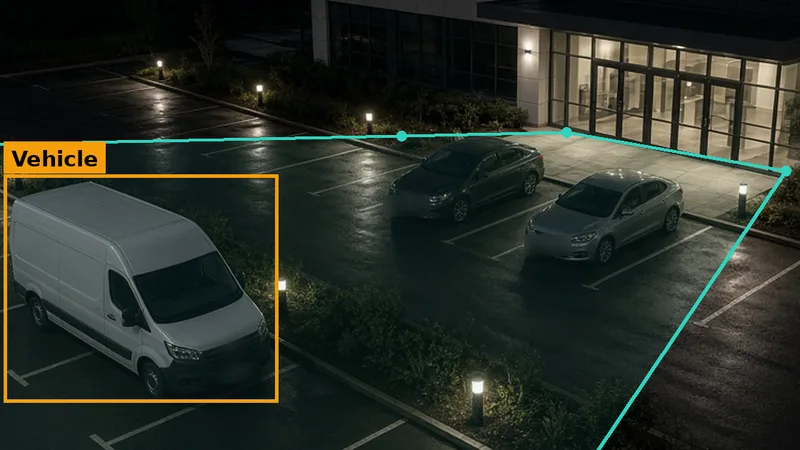
AI video detection changes what existing cameras can do. Software watches the camera views all the time and looks for the things you care about: a person or a vehicle in an area where nobody should be after hours, or visible smoke and flame. When it sees them in an area you have chosen, it sends an alert straight away, with a snapshot, a short clip and a description of what the camera saw, so a keyholder, a security officer or a response service can check what is happening, call the police or 999, and send someone. It also gives the police a clear picture of what happened.
With Woodcock AI, you draw polygon detection areas on each camera view, around exactly what you want to watch, such as a fire exit, the cycle store, the bin store or the car park, and leave out what you do not, such as the public footpath, the road or a neighbour's yard. You choose when each area is armed, for example from 19:00 to 07:00 on weekdays and all weekend, and who gets the alerts. Our pages on perimeter intrusion detection and AI smoke and fire detection explain more.
Three areas worth watching
Choose an area below to see what a camera view of it might look like and how a detection zone could be set up.
Which area?
Rear and side doors, out of sight of the road, are a common way in. Draw the zone over the door and the ground in front of it, not the public path beyond the fence. Arm it after the last person leaves, so a person at the door at night produces an alert with a clip, while staff using the door during the day do not.
Fire exits and service doors
A cycle store can carry two risks at once: theft and battery fire. A people zone over the store, armed after hours, watches for intruders; a smoke and flame zone over the charging area watches for a battery failing, as long as the camera has a clear view. Neither replaces smoke detection or the guidance on where charging should happen.
People, and smoke on charge
Bins against the building are a fire risk and a climbing aid. A zone over the bin store can watch for smoke and flame and, after hours, for people. Outside fires like this are often beyond the reach of the building's fire alarm, so early sight from a camera that already looks at the bins can make a difference.
Smoke, flame and climbing
Each area needs its own zone and schedule.
Where should cameras watch?
Start from your security and fire risk assessments. The best places for AI detection are usually where those assessments say an intruder or a fire is most likely and least likely to be seen: rear and side doors and fire exits, the car park after hours, the cycle store, the bin store, low roofs and the ladders or plant that lead to them, and boundary fences and gates on a business park. Cameras over the main entrance can watch for people after hours too, though cleaners and late workers mean schedules matter there.
Not every camera is suitable. Detection needs a clear, stable view, with enough light or good infrared at night. A camera mounted high to cover a whole car park may show a person at the far end as a few pixels. Our camera placement guide explains how to check whether a view is good enough.
What AI on your cameras cannot do
Be clear about the limits. Woodcock AI detects people, vehicles, smoke and flame in the areas you choose; it does not tell you who a person is or whose vehicle it is. It sees only what the camera sees, so it cannot help where there is no camera or the view is blocked. It cannot sense heat or gas, so it cannot see a battery failing inside before there is smoke or flame. And it is an addition to your intruder alarm, your fire alarm, your guards and your keyholders, never a replacement for them. What it adds is early sight, in the places your cameras already cover, at the times nobody else is looking.
What about false alerts?
Offices have people about at odd hours: cleaners, late workers, security patrols, delivery drivers, and foxes in the bin store. Good set-up keeps false alerts down. Tight polygon areas leave out footpaths and roads. Schedules arm zones after the last person leaves and disarm them before the first arrives, with separate schedules for areas cleaners use. Clean lenses, a steady aim and good lighting give the software the clearest picture. And because Woodcock AI is self-learning, it gets better over time at knowing what is normal on each camera. Our guide to reducing CCTV false alarms goes into more detail.
A worked example
Here is how this might look for a fictional two-storey office on a business park, with a front car park, a rear service yard, a cycle store and a bin enclosure. It is an example, not a real business. At 19:00, the car park zone is armed until 07:00. The last person leaves at 19:10 and sets the intruder alarm. At 01:52, a van with its lights off drives into the car park and stops across the bays nearest the camera, in view of the glass doors and two cars left overnight by the entrance. The camera over the car park sees it, and within a minute the alert, with the clip, reaches the keyholder. Watching the clip, the keyholder sees two people get out and crouch beside one of the cars, calls the police and asks the keyholding service the business uses to send a patrol. By the time the patrol arrives, the van has gone, but the police have the clip, the time and a description of the van.
The next morning, the office manager and the landlord review what happened. The car park barrier had been left up, and the lighting at the back of the car park was not working, so both are fixed. The camera did not stop the van coming in, and the alarm stayed in charge of the building. What the camera added was early sight of what was happening, and footage that the police could use.
How Woodcock AI fits
Woodcock AI connects to existing IP cameras and runs on an edge server on site or on a cloud server. It adds people and vehicle detection, and smoke and flame detection, to the cameras you already have. You draw polygon detection areas over the places that matter, choose when they are armed and who gets the alerts. Each alert has a snapshot, a short clip and an AI description of what the camera saw.
Woodcock AI is self-learning, so it gets better over time at knowing what is normal on each camera. It is the result of years of development and is now in use on real sites in the UK. It works alongside your alarm, your guards, your keyholders and your risk assessments rather than replacing them. Ask your cameras (Coming soon, early 2027) will let you ask questions about what your cameras have seen in plain words.
Ways to start
Book a site assessment. We look at what your cameras see by day and after dark, and show where zones would help, such as rear doors, the car park, the cycle store and the bin store. Or ask for a live test on your cameras: we connect two or three of your existing cameras for about a fortnight, so you can see the alerts for yourself. We are also happy to arrange an on-site demo.
Sources
- Home Office, Crime against businesses: findings from the 2023 Commercial Victimisation Survey, and the crime against businesses collection.
- Office for National Statistics, Crime in England and Wales: year ending June 2026.
- Police.uk, Keep burglars out of your business.
- Secured by Design, Commercial Design Guide 2025.
- ProtectUK, Access control.
- National Cyber Security Centre, Small Business Guide.
- GOV.UK, Fire safety risk assessment: offices and shops and Workplace fire safety: your responsibilities; the Regulatory Reform (Fire Safety) Order 2005, article 9 and article 22 (legislation.gov.uk).
- Department for Transport, E-cycle and e-scooter batteries: managing fire risk for premises (2024); London Fire Brigade, Guidance Note 103 on charging and storing electric powered personal vehicles.
- London Assembly Research Unit, London Fire Brigade research on lithium-ion battery fires in London in 2025.
- Information Commissioner's Office, video surveillance guidance and checklist for limited CCTV systems; Home Office, Surveillance Camera Code of Practice.
- Reports of 2026 incidents: City of London Police, City of London; Manchester Evening News, Manchester; Herts Advertiser, St Albans; Stockport Nub News, Stockport; St Helens Star, St Helens; Lancashire Telegraph, Rishton; Merseyside Fire and Rescue Service, Liverpool; London Fire Brigade, Walworth and Hackney (2026 figures).
We have summarised these sources in our own words. The Fire Safety Order applies in England and Wales; Scotland and Northern Ireland have their own fire safety law. Check the current law and guidance for your nation, your lease and any conditions in your insurance policy. This page is general guidance, not legal, security or insurance advice. In an emergency, always call 999.
Who sees your office at 2am?
Book a site assessment and we will look at what your cameras see by day and after dark, and show where zones would help at rear doors, the car park, the cycle store and the bin store, or ask for a live test on your cameras.
Related pages
Frequently asked questions
What are the most important office security measures?
Layers that work together: a secure perimeter and car park, good doors and windows with rear and service doors kept locked, access control and visitor management, a monitored intruder alarm set every night, CCTV covering every entrance, good lighting, sound keyholding and a clear-desk policy. Each layer buys time for someone to notice and respond.
How do burglars usually get into offices?
Police advice points to the weak spots: rear and side doors, service doors left unlocked, ground-floor and easy-reach windows, and climbing aids such as bins left against the building. During the working day, thieves also walk in behind staff or pose as visitors or contractors, often to take laptops.
Who is responsible for security in a multi-let office?
Usually the landlord or managing agent looks after shared entrances, common parts and the estate, and each tenant looks after its own space. Under the Fire Safety Order, responsible persons who share premises must cooperate and coordinate. Where landlord and tenant decide together how CCTV is used, they can be joint controllers under data protection law.
Can staff charge e-bikes and e-scooters at the office?
Only if your fire risk assessment allows it. Government guidance says the risk is highest while batteries are charging. Options include charging in purpose-designed metal lockers outside, a separated store with smoke detection, or restricting charging on site while still allowing bikes to be stored. Keep damaged batteries off the premises and bikes out of escape routes.
Does office CCTV need to follow data protection law?
Yes, if it captures identifiable people. The ICO expects you to register and pay the fee, name someone responsible, define the purpose, record a lawful basis, put up signs, keep footage securely for a set period, handle requests, and review the system regularly. Monitoring staff at work usually means a data protection impact assessment is needed.
Can AI on existing CCTV help protect an office?
Yes, as an addition to alarms and guards, not a replacement. Woodcock AI runs on an edge server on site or on a cloud server and watches polygon zones you draw, such as rear doors, the car park, the cycle store and the bin store. It alerts on people and vehicles after hours and on visible smoke and flame, with a snapshot, clip and description.
Last reviewed 3 November 2026