

HMO fire safety: regulations and landlord guide
HMO fire safety means the precautions a landlord or manager must have in a house in multiple occupation: a fire risk assessment for the common parts, a suitable mains-wired, interlinked fire alarm system, fire doors and a protected escape route kept clear, emergency lighting where needed, gas and electrical safety checks, records and information for tenants. In England the duties come from the Housing Act 2004, the HMO management regulations and the Fire Safety Order, with mandatory licences for larger HMOs. LACORS guidance sets out what councils usually expect. AI on existing CCTV can add an early visual warning to the landlord or agent, but never replaces the alarms.

What is HMO fire safety?
A house in multiple occupation, or HMO, is a home shared by people who are not one family. A group of students renting a terraced house, five young professionals sharing a kitchen, a big Victorian house let room by room as bedsits, an older house split into flats without meeting modern building rules: all of these can be HMOs. Fire safety in an HMO is about making sure that if a fire starts anywhere in the building, the people asleep in the other rooms are woken in time, the fire and smoke are held back long enough, and everyone can get out safely by a route that is not blocked by the fire.
HMOs carry a higher fire risk than ordinary family homes. The people who live in them do not always know each other, and one tenant may have little say over what another does. There are more cooking appliances, more electrical items, more chargers and more locked doors. Tenants may come and go at all hours. Many HMOs are older houses with a single staircase as the only way out, which means a fire in the hallway can trap everyone above it. That is why the law expects more of HMO landlords than of ordinary landlords, and why councils can inspect HMOs, license them and attach fire safety conditions to the licence.
The national guidance most councils in England use for existing HMOs, the LACORS housing fire safety guide, puts it simply: the aim is to detect a fire early, to contain it, and to make sure people can escape. In practice that means a suitable, interlinked fire alarm system, fire doors in the right places, a protected and unobstructed escape route, and, in larger or more complex houses, emergency lighting and simple firefighting equipment. On top of the physical precautions sits management: someone has to check that the alarms work, the fire doors close, the hallway is clear and the gas and electrics are safe, and keep a record that they have.
This guide is for HMO landlords, licence holders, managing and letting agents, and anyone responsible for a shared house, bedsits or converted flats in the UK. It explains what counts as an HMO in each nation, licensing, the laws that apply and who enforces them, the fire risk assessment, smoke and heat alarms, fire doors, escape routes, emergency lighting, extinguishers and fire blankets, the gas, electrical and alarm checks, what tenants must be told, keeping records, e-bikes and e-scooters, bins and rubbish, smoking and other common causes, the mistakes we see most often, and a checklist. It ends with where cameras on the communal areas and outside of an HMO can help, and where they must not be used.
A note before we start. Much of what follows is set by the law, and some is set by guidance that councils and fire services use when they decide whether a house is safe. Where we say "must", we point to the law. Where we say "should" or "usually", it comes from guidance and the right answer for your house depends on its size, layout and the people who live there. Your council's private sector housing team, your local fire and rescue service and a competent fire risk assessor can tell you what your house needs. Nothing on this page is legal advice.
What counts as an HMO?
In England and Wales, the definition is in section 254 of the Housing Act 2004. In broad terms, a building or a flat is an HMO if three or more people live there who form two or more households, they share a kitchen, bathroom or toilet, they live there as their only or main home, and at least one of them pays rent. A "household" means a single person, a couple, or members of the same family living together. So three friends sharing a house are an HMO; a couple and their two children are not. GOV.UK sums it up as a property rented out by at least three people who are not from one household but share facilities.
The Act has several tests. The standard test covers houses and flats where tenants share basic amenities. The self-contained flat test applies the same rules to a single flat. The converted building test covers buildings converted into a mix of flats and non-self-contained rooms. And section 257 covers buildings converted into self-contained flats where the conversion did not meet the 1991 Building Regulations and fewer than two thirds of the flats are owner-occupied. Section 257 buildings are often called "converted flats" and come up again below, because they have their own fire safety rules.
Scotland and Northern Ireland have their own definitions. In Scotland, section 125 of the Housing (Scotland) Act 2006 defines an HMO as living accommodation occupied by three or more people who are not all from the same family, or from one of two families, as their only or main residence, and who share a toilet, washing facilities or cooking facilities. In Northern Ireland, section 1 of the Houses in Multiple Occupation Act (Northern Ireland) 2016, in operation since 1 April 2019, covers living accommodation occupied as their only or main residence by three or more people who form more than two households, where rent or other payment is made. The detail of each definition matters, so if you are not sure whether your house is an HMO, ask your council.
For fire safety, the LACORS guide groups HMOs into a few practical kinds, because each needs a different level of protection. A shared house is one let as a whole to a group, such as students or friends, who share the kitchen and living room and often know each other. A bedsit HMO is let room by room, each tenant has their own lockable room, often with cooking in it, and tenants may not know each other at all. Converted flats are older buildings split into self-contained flats without meeting modern standards. And a flat in multiple occupation is a shared flat inside a larger building. The guide also notes that its advice does not apply to buildings built or converted to the 1991 Building Regulations or later, which should already have suitable protection.
HMO licensing
In England, a "large" HMO must be licensed by the council. Since 1 October 2018, under the Licensing of HMOs (Prescribed Description) (England) Order 2018, that means an HMO occupied by five or more people forming two or more separate households, whatever the number of storeys. GOV.UK describes it as a property rented to five or more people who form more than one household, where some or all tenants share the toilet, bathroom or kitchen, and at least one tenant pays rent. Purpose-built flats in a block of three or more flats are left out of the mandatory scheme. In Wales, mandatory licensing still uses the older test of three or more storeys, five or more people and two or more households.
On top of the mandatory scheme, councils can bring in "additional" licensing for smaller HMOs in all or part of their area. Many have. So a three-bedroom shared house may need a licence in one street and not in the next. Check your council's website before you let. A licence lasts for up to five years and you need a separate licence for each HMO. The council must be satisfied that the house is reasonably suitable for the number of people, that the facilities are good enough, and that the licence holder and manager are "fit and proper" people. GOV.UK warns that you could get an unlimited fine for renting out an unlicensed HMO.
Every HMO licence comes with conditions, and several of the mandatory ones are about fire. Schedule 4 to the Housing Act 2004 requires the licence holder to give the council a gas safety certificate every year if gas is supplied, to keep electrical appliances and furniture supplied by them in a safe condition, and, in England, to keep every electrical installation in proper working order and safe. They must make sure a smoke alarm is installed on each storey of the house on which there is a room used wholly or partly as living accommodation, and keep it in proper working order. In England, they must also make sure a carbon monoxide alarm is installed in any room used as living accommodation that contains a fixed combustion appliance other than a gas cooker. For each of these, the licence holder must give the council a declaration on demand. For the alarm conditions, a hall or landing counts as a room, and so do bathrooms and toilets.
Councils can, and usually do, add their own conditions. These often set out the type of fire alarm system, require fire doors to particular rooms, require emergency lighting, set a schedule of alarm testing and servicing, require a fire risk assessment, or require the licence holder to keep records. Licence conditions are legally binding, and breaching one is an offence. Read the conditions on your licence carefully, and if anything is unclear, ask the council before the inspection rather than after it. If you disagree with a condition, you can appeal to the First-tier Tribunal.
The laws that apply to HMO fire safety
There is no single HMO fire safety law. Instead, several overlapping laws apply at once, and which ones apply depends on the kind of HMO, whether it is licensed and which part of the building you are talking about. In England, the main ones are the Housing Act 2004, the Management of Houses in Multiple Occupation (England) Regulations 2006, the Regulatory Reform (Fire Safety) Order 2005, and a group of safety regulations covering alarms, gas and electrics. Wales has a similar mix, with its own management regulations and the Renting Homes (Wales) Act rules. Scotland and Northern Ireland have their own systems, covered below.
The Housing Health and Safety Rating System. Part 1 of the Housing Act 2004 gives councils the HHSRS, a way of assessing hazards in any home, rented or not. Fire is one of the hazards it covers. If a council inspector finds a serious fire hazard, the council can require the landlord to fix it, and in some cases can do the work itself and charge for it. The LACORS guide explains that the HHSRS is the main tool councils use to assess fire safety in existing housing, and that HMO licence conditions are set to reflect it. GOV.UK publishes an HHSRS guide for landlords and agents.
The HMO management regulations. The Management of Houses in Multiple Occupation (England) Regulations 2006 apply to every HMO in England, licensed or not. Regulation 4 is about safety. The manager must keep the means of escape from fire free from obstruction and in good order and repair, and keep any firefighting equipment and fire alarms in good working order. Notices showing the means of escape must be displayed where they are clearly visible to the occupiers, except in houses with four or fewer occupiers. The manager must also take all such measures as are reasonably required to protect the occupiers from injury, having regard to the design, the structural condition and the number of occupiers. Breaking these regulations is an offence.
The Fire Safety Order. The Regulatory Reform (Fire Safety) Order 2005 does not apply to people's own homes, but article 6 says that where a building contains two or more sets of domestic premises, it does apply to the structure and external walls of the building and to any common parts, including the doors between the homes and the common parts. Since the Fire Safety Act 2021 came into force, in England on 16 May 2022, that has been spelled out in the Order itself. In an HMO, the shared hallways, stairs and landings, and in many houses the shared kitchen too, are treated as common parts. The responsible person, usually the landlord or the managing agent, must carry out a fire risk assessment and put in place the precautions it identifies. LACORS notes that the Order does not apply to a true shared house where a single group has use of the whole house, although the Housing Act rules still do.
Who enforces? This overlap means two bodies can be involved. The council enforces the Housing Act, the HHSRS, licensing and the management regulations. The fire and rescue service enforces the Fire Safety Order in the common parts. The LACORS guide describes the dual regime and the joint protocols that councils and fire services agree so they do not trip over each other. In most HMOs, in practice, the council takes the lead and consults the fire service. For a single household, such as an ordinary family let, only the Housing Act applies.
Converted flats and blocks. If your HMO is a converted building with two or more flats, the Fire Safety (England) Regulations 2022 may also apply. They add duties for the responsible person, such as giving residents fire safety instructions and information about fire doors. Our guide to fire door regulations covers those duties, and GOV.UK publishes separate guidance on fire safety in purpose-built blocks of flats.
Wales, Scotland and Northern Ireland
Wales. The Housing Act 2004 and the Fire Safety Order apply in Wales much as in England, with Welsh versions of the licensing and management rules. Mandatory licensing in Wales covers HMOs of three or more storeys with five or more people in two or more households, and councils can add additional licensing. Under the Renting Homes (Fitness for Human Habitation) (Wales) Regulations 2022, every rented home in Wales, including HMOs, must have a working smoke alarm on each storey, connected to the mains electricity supply and interlinked with the others, and a carbon monoxide alarm in every room with a gas, oil or solid fuel appliance. If those are missing, the home is treated as unfit for human habitation. The same regulations require a valid electrical condition report, normally renewed at least every five years, and a copy to be given to the contract-holder within 14 days.
Scotland. HMOs in Scotland are licensed under Part 5 of the Housing (Scotland) Act 2006, and councils apply their own licence conditions and standards. The fire safety law is the Fire (Scotland) Act 2005. Section 78 says that, for Part 3 of that Act, an HMO that needs a licence is not treated as "domestic premises", which means the fire safety duties in Part 3, including the duty to carry out a fire safety assessment, apply to licensed HMOs. The Scottish Fire and Rescue Service publishes advice for landlords and businesses on its website.
Northern Ireland. HMOs in Northern Ireland have needed a licence since the Houses in Multiple Occupation Act (Northern Ireland) 2016 came into operation in April 2019, and the licensing scheme is run by councils across Northern Ireland. Licence conditions and standards cover fire safety, and the Northern Ireland Fire and Rescue Service publishes fire safety advice. As with Scotland, the detail is different from England, so check the current rules with your council and NIFRS before relying on anything in this guide.
The rest of this guide is written mainly for England, with notes on Wales. The physical precautions an HMO needs, such as interlinked alarms, fire doors and a protected escape route, are much the same everywhere, because a fire behaves the same in a shared house in Cardiff, Glasgow, Belfast or Leeds. What differs is the legal route by which they are required and who checks.
The fire risk assessment for an HMO
A fire risk assessment is a careful look at the house to identify what could start a fire, who would be at risk, and whether the precautions in place are enough. In England and Wales, the responsible person for an HMO must carry one out for the common parts under the Fire Safety Order. In Scotland, licensed HMOs need a fire safety assessment under the Fire (Scotland) Act 2005. Many councils also ask for one as a licence condition, or expect to see one at inspection. Even where it is not strictly required, it is the only sensible starting point for deciding what a house needs.
The LACORS guide makes a point that matters a great deal. Legally, the Fire Safety Order assessment covers the common parts of an HMO. But a fire that starts in a tenant's room does not stay politely in that room, and the means of escape from every room runs through the common parts. So, in practice, the assessment needs to consider the whole house, including the rooms, to work out what the common parts need. A fire risk assessment that only looks at the hallway is unlikely to be suitable.
A good HMO fire risk assessment looks at the sources of ignition, such as cooking, heaters, electrical items, chargers, smoking and candles, and at what could burn, such as furniture, bedding, clutter, rubbish and stored items. It looks at the people: how many, whether any are at particular risk because of age, disability, drink or drugs, and whether they are likely to be asleep. It checks the fire alarm system, the fire doors and walls, the escape routes, lighting and signs. It considers how the house is managed, including how tenants are told about fire safety and who checks what. And it sets out the actions needed, with a priority and a date for each.
The assessment must be reviewed regularly, and whenever something significant changes: a new layout, new tenants with different needs, building work, a change of use, or after a fire or a near miss. Since 1 October 2023, in England and Wales, every responsible person must record the assessment in full and record their fire safety arrangements. Our fire risk assessment guide explains the process in more detail.
Who is the responsible person? Under the Fire Safety Order, the responsible person for common parts is usually the person who has control of the premises in connection with a business, such as letting it, or the owner. In an HMO that is usually the landlord. LACORS notes that where the landlord is not around, a managing agent who looks after the house may take on the role. The licence holder, who may be the landlord or the agent, is also bound by the licence conditions. In a converted block, the freeholder or the management company may be the responsible person for the shared parts. More than one person can have duties at once, and they must cooperate.
Who should do the assessment? The Order expects the assessment to be "suitable and sufficient". A landlord of a small, simple shared house may be able to do it themselves using official guidance. For bedsit HMOs, larger houses, converted flats or anything unusual, most landlords use a competent fire risk assessor with experience of residential buildings. Whoever does it, it needs to be honest, specific to the house and kept up to date.
Smoke and heat alarms in an HMO
Early warning is the single most important fire precaution in a home where people sleep. In a fire at night, smoke can fill a hallway and reach the bedrooms before anyone inside is awake. The LACORS guide is blunt: in its view no level of risk is low enough to do away with the need for some form of fire detection. In an HMO, the alarm system must be able to wake people in every part of the house, not just the room where the fire starts, which is why the alarms must be interlinked: when one sounds, they all sound.
The type of system is described using the grades and categories in BS 5839-6, the British Standard for fire detection and alarm systems in domestic premises. LACORS was written to an older edition of that standard and your assessor will work to the current one, but the basic ideas have not changed. A Grade A system has a control panel, manual call points and detectors wired back to the panel, like a small commercial system, and needs regular testing and servicing by a competent person. A Grade D system uses mains-powered smoke and heat alarms with a built-in back-up battery, interlinked with each other. Battery-only alarms (Grade F) are not recommended for HMOs by LACORS.
The category describes how much of the house is covered. LD3 covers the escape route: the hallway, stairs and landings. LD2 covers the escape route plus the rooms where a fire is more likely to start, such as the kitchen and lounge. LD1 covers the escape route and almost every room. Kitchens, and bedsits with cooking in them, usually get heat detectors rather than smoke detectors, because cooking fumes would cause constant false alarms, and constant false alarms lead tenants to take batteries out or cover detectors.
LACORS sets out what it considers suitable for each common kind of HMO. The table below summarises it. It is a starting point, not a rule: the right system for your house comes out of the fire risk assessment, and your council may require something different as a licence condition.
| Kind of HMO | Storeys | Typical system |
|---|---|---|
| Shared house | 1 to 4 | Grade D, LD3 on the escape route, plus detection in the kitchen, lounge and any risk cellar, all interlinked |
| Shared house | 5 to 6 | Grade A, LD2 |
| Bedsit HMO | 1 to 2 | Grade D, LD2 in the common parts with an interlinked heat detector in each bedsit, plus a separate smoke alarm in each bedsit |
| Bedsit HMO | 3 to 6 | Grade A, LD2 in the common parts with heat detectors in each bedsit, plus a separate Grade D smoke alarm in each bedsit |
| Converted flats (pre-1991) | 3 to 6 | Grade A, LD2 in the common parts with a heat detector in each flat entrance lobby, plus Grade D LD3 inside each flat |
| Flat in multiple occupation | Within a block | Grade D, LD3, plus a heat detector in the kitchen |
Notice the "separate" smoke alarm in each bedsit. In bedsits, the detector inside each room that is linked to the whole-house system is a heat detector, so that one tenant burning toast does not wake the whole house at 2am. A separate, non-interlinked smoke alarm in the room warns the occupant of a fire in their own room early. This mixed approach is a good example of balancing early warning against false alarms.
The alarm rules every landlord must follow
Separately from licensing, the Smoke and Carbon Monoxide Alarm (England) Regulations 2015, as amended from 1 October 2022, apply to most private and social rented homes in England, including HMOs. The landlord must make sure a smoke alarm is installed on each storey of the home where there is a room used wholly or partly as living accommodation, and a carbon monoxide alarm in any room used as living accommodation that contains a fixed combustion appliance other than a gas cooker. The landlord must check that each alarm is in proper working order on the day a new tenancy begins, and repair or replace any alarm as soon as reasonably practicable after a tenant reports that it is faulty. A hall or landing counts as a room for these purposes, and so does a bathroom or toilet.
These rules set a minimum for every rented home. In most HMOs, the fire risk assessment and the licence will require much more: a proper interlinked system, not just one alarm per floor. Meeting the 2015 rules does not mean an HMO is safe. In Wales, as noted above, the Renting Homes fitness rules go further for every rented home, with mains-powered interlinked alarms on every storey.
Testing and servicing. LACORS says Grade A systems should be tested weekly, operating a different detector or call point each week, and serviced every six months by a competent person. Grade D systems should be tested monthly using the test button. All detectors should be fully tested once a year. Tenants should be told how to test the alarm in their own room and how to report faults, and every test, fault and false alarm should be recorded. Our guide to commercial fire alarm systems covers Grade A style panel systems in more depth.
Fire doors and fire separation
If the alarm is the warning, the fire doors and walls are what buy the time to act on it. In an HMO, the escape route, usually the hallway and stairs, needs to be protected from a fire in any of the rooms that open onto it. That protection comes from walls and ceilings that resist fire, and from fire doors on the rooms, kept closed.
LACORS uses the FD30 standard for most HMO fire doors: a door and frame that hold back fire for 30 minutes. An FD30S door also has smoke seals, which hold back cold smoke, the kind that fills a hallway before the flames arrive. LACORS says smoke seals are usually fitted, with some exceptions in smaller shared houses. Fire doors should be installed and maintained in line with BS 8214, and LACORS generally prefers replacing poor doors with proper fire door sets rather than trying to upgrade old ones.
Fire doors need self-closing devices so they shut on their own. LACORS says self-closers are always needed on the entrance doors to bedsits and flats, and may be relaxed for room doors in some lower-risk shared houses. A common failure is not a missing door but a door that does not shut: a closer that has been disconnected because it slams, a door that sticks on its frame, a wedge, a fire extinguisher used as a doorstop, or a hook on the wall. A fire door held open does nothing. Our fire door regulations guide explains how to check a fire door.
Fire separation also means filling the holes. Gaps around pipes, cables and new downlighters in ceilings, missing loft hatches, old serving hatches and glazed panels over doors can all let fire and smoke into the escape route. A good fire risk assessor will look above and around doors and at the ceilings of the escape route, not just at the doors themselves. Any building work, such as rewiring or a new bathroom, can break fire separation if the trades involved are not told about it.
Escape routes
In most HMOs, the escape route is the shared hallway and staircase leading to the front door. For everyone living above the ground floor, it may be the only way out. The HMO management regulations require the manager to keep the means of escape from fire free from obstruction and in good order and repair. LACORS adds detail: escape routes should be checked regularly, there should be no storage in them, nothing that could cause a trip, and fire doors should never be propped open.
That sounds obvious, but shared hallways have a habit of filling up. Bicycles, e-bikes and e-scooters, prams, recycling, parcels, broken furniture waiting for collection, a fridge left by a departing tenant, shoe racks and coat stands: every one of these is something to fall over in the dark and smoke, and many of them are something to burn. London Fire Brigade guidance note GN103 says fire risk assessors should make sure e-bikes and e-scooters are not stored or charged in common areas or escape routes, including under-stair cupboards and communal store cupboards, and that any found are brought to the attention of the responsible person straight away.
Final exit doors must open easily from the inside without a key. A front door that needs a key to open from the inside is a serious problem in a fire, when the key may be upstairs or lost in smoke. Thumb-turn locks, or locks that open from inside with a simple handle, are the usual answer. Doors from bedsits and flats onto the escape route also need to be openable from inside without a key, for the same reason. Escape windows, where the risk assessment relies on them, must open wide enough and must not be painted shut or blocked by furniture.
Some HMOs have a second way out, such as a back door, an external escape stair or a route across a flat roof. If your fire safety depends on it, it must be kept clear, unlocked from the inside, and in good repair. The bottom of an external stair is a common place for bins and rubbish to collect. Where the means of escape notice is required, which in England is in HMOs with five or more occupiers, it should show the route clearly and be kept up to date.
Emergency lighting
In a power cut or when smoke cuts out the light, people need to see their way out. LACORS suggests that emergency lighting is not usually needed in small one- or two-storey HMOs where the route is short and simple. It may be appropriate in three- or four-storey HMOs where the escape route is long or complex, or where there is no borrowed light from street lamps or windows. It is recommended for all five- and six-storey HMOs. Where it is fitted, LACORS describes self-contained luminaires mounted about two metres up, near exits, changes of direction and stairs, with a full discharge test every year. Our emergency lighting regulations guide goes into the testing in detail.
Fire extinguishers and fire blankets
The advice for tenants in a fire is to get out, stay out and call 999, not to fight it. LACORS reflects that. It does not recommend fire extinguishers inside bedsits and flats unless trained staff are present, because untrained people tackling fires get hurt. It suggests a simple multi-purpose extinguisher on each floor of the common parts in some HMOs, with basic advice to tenants at the start of each tenancy, and fire blankets in all kitchens, including kitchens in bedsits, mounted about 1.5 metres up and nearer the door than the cooker. Extinguishers should be serviced every year by a competent person. Our guide to fire extinguisher types explains which type does what.
Gas, electrical and alarm safety checks
Faulty gas and electrical installations and appliances can cause fires, and faulty gas appliances can also cause carbon monoxide poisoning. Several separate laws set out the checks.
Gas. Under regulation 36 of the Gas Safety (Installation and Use) Regulations 1998, landlords must have every gas appliance and flue they provide checked for safety at least every 12 months by a Gas Safe registered engineer, keep a record of each check, and give tenants a copy. HMO licence holders must also give the gas safety certificate to the council each year, and under the HMO management regulations in England must supply it to the council within seven days of a written request.
Electrics. In England, the Electrical Safety Standards in the Private Rented Sector and Social Rented Sector (England) Regulations 2020, as they are now called, require the electrical installation to be inspected and tested by a qualified person at least every five years, or sooner if the report says so. A copy of the report must go to existing tenants within 28 days, to new tenants before they move in, and to the council within seven days if it asks. Any remedial work must be done within 28 days, or sooner if the report says so. The HMO management regulations also require the fixed electrical installation in an HMO to be inspected and tested at least every five years. LACORS recommends that appliances supplied by the landlord are kept safe too, and many landlords have them tested.
Furniture. Upholstered furniture supplied by the landlord should meet the fire safety rules for furniture and furnishings, and carry the correct labels. Old sofas and mattresses without labels are a common finding at inspection.
Alarms. As above, alarms must be checked on the first day of each tenancy and repaired or replaced promptly when a fault is reported, with regular testing and servicing in line with the system type.
Keep copies of every certificate and report, with the dates, in one place. Councils and fire safety officers can ask to see them, so keep them where you can find them quickly.
What tenants must be told
Fire precautions only work if the people living in the house understand them. LACORS recommends giving every occupier fire safety information at the start of each tenancy, and telling tenants how to test the alarm in their own room and how to report faults. In converted buildings with two or more flats in England, the Fire Safety (England) Regulations 2022 also require the responsible person to give residents fire safety instructions and information about the importance of fire doors.
Keep it short and practical. Tell tenants what the alarm sounds like and what to do when it goes off. Show them the escape route and any second way out. Explain that fire doors must be kept shut and never wedged, and that the self-closers must not be removed. Explain how to report a faulty alarm, a damaged door, a blown light or anything stored in the hallway, and how quickly you will act. Set out the house rules on charging e-bikes and e-scooters, storing things in shared areas, smoking, candles and cooking. Many landlords put a one-page summary in the welcome pack and on the inside of each room door, and repeat it in the language each tenant reads best.
Tenants have duties too. In England, regulation 10 of the HMO management regulations requires occupiers not to hinder the manager in carrying out their duties, to take reasonable care not to damage anything the manager is responsible for, such as fire doors and alarms, to store and dispose of rubbish in line with the arrangements the manager makes, and to follow the manager's reasonable instructions about the means of escape, preventing fire and using fire equipment. But the landlord or manager is still responsible for the house, and "the tenants keep taking the batteries out" is not a defence if the system was the wrong kind for the house in the first place.
Keeping records
LACORS recommends keeping a log book for every HMO recording all maintenance, testing, defects and false alarms. A council officer or a fire safety officer will often ask to see it, along with the fire risk assessment, the gas safety certificate, the electrical installation condition report, the alarm service records, the emergency lighting test records and any extinguisher service records. A well-kept log book shows that the precautions are being looked after and makes renewal of the licence much easier. Our fire safety log book guide explains what to record and how.
Record regular visual checks of the common parts too: the date, who checked, whether the hallway was clear, whether the fire doors closed, whether the alarms showed a fault, and what was done about anything found. In a house where nobody from the landlord's side lives, these visits are often the only time anyone looks. If you use a managing agent, agree in writing who does which checks and who keeps the records.
E-bikes and e-scooters
Lithium-ion batteries in e-bikes and e-scooters have become one of the most serious fire risks in shared homes. London Fire Brigade says that, on average, there is a fire from an e-bike or e-scooter lithium-ion battery every two days in London, and that many of these fires happen in homes while batteries are charging. Its figures show firefighters attended 206 e-bike and e-scooter fires in London in 2025, the highest number on record. The Brigade also notes that each of the five people who died in these fires in London since 2023 did not own the e-bike involved, which the Brigade says shows the devastating effect these fires can have on people who live with an e-bike or e-scooter user.
In an HMO, that last point is the heart of the problem. One tenant's cheap conversion kit, left on charge in the hallway overnight, puts every other tenant at risk, and when these batteries fail they can burn fiercely and produce thick, toxic smoke very quickly. A fire under the stairs is the worst possible place, because it attacks the only escape route.
LFB guidance note GN103 says that, where possible, e-bikes and e-scooters should be stored and charged in a dedicated external location, and that they should not be stored or charged in common areas or escape routes. For HMOs, practical steps include a rule in the tenancy agreement and house rules that e-bikes and e-scooters must not be kept or charged in the hallway, stairs or under-stair cupboards; a secure, separate store outside the house where that is possible; advice to tenants on buying safe products and using the right charger; and checking the hallway on every visit. Your fire risk assessment should cover it. See LFB's e-bike and e-scooter safety pages for advice you can share with tenants, and our lithium-ion battery storage guide covers storage in more depth.
Bins, rubbish and the outside of the house
HMOs produce more rubbish than family homes, and it often ends up in the wrong place: overflowing wheelie bins against the front bay window, bags left in the side passage, an old mattress in the back yard waiting for someone to book a collection. Rubbish against the house is easy for an arsonist to set alight, and a bin fire next to a window or a door can spread into the building. London Fire Brigade warns that rubbish is a ready source of fuel for an arsonist, and that fires involving rubbish can quickly spread to nearby homes and buildings. Our guide to arson prevention with CCTV explains more.
In England, licence conditions under paragraph 1C of Schedule 4 to the Housing Act 2004 require the licence holder to comply with any scheme provided by the council for the storage and disposal of household waste. Agree with tenants where bins live, make sure there are enough of them, and arrange bulky collections promptly when tenants leave. Our bin store fire safety guide covers bin stores in more detail.
Smoking, cooking and other common causes
The causes of HMO fires are mostly ordinary. Three HMO fires reported in 2026 show the pattern. In April, a fire in a converted end-of-terrace house in West Ealing was believed by London Fire Brigade to have been caused by a lamp left too close to flammable materials, and two people were taken to hospital. In May, a fire in a house in multiple occupation in Westcliff left nine people homeless, and the local paper reported that it was believed to have been started by a cigarette. In October, a fire in a second-floor room of an HMO in Marylebone was believed by the Brigade to have been caused by the unsafe disposal of smoking materials, and all ten people living there got out before crews arrived.
Cooking, smoking, candles, heaters and electrical items, including phone and laptop chargers and overloaded extension leads, account for much of the rest. Few of these can be designed out by the landlord, which is why early warning, fire doors and a clear escape route matter so much. House rules help: smoking only outside and away from bins and bikes, no candles left burning, no cooking in rooms not designed for it, no extra heaters on extension leads. So does keeping in touch with tenants, so you hear early about a broken door closer or a neighbour's habits.
Common HMO fire safety mistakes
Council officers and fire safety officers find the same problems in HMOs again and again. Most of them are visible on an ordinary visit, if someone looks.
- The wrong alarms. Battery smoke alarms in a house that needs a mains-wired, interlinked system, or no detection in the rooms where the risk is.
- Fire doors wedged open. Closers removed or disconnected, doors propped with fire extinguishers, or smoke seals painted over.
- Storage in the escape route. Bikes, e-scooters, bins, boxes and furniture in the hallway or under the stairs.
- Locks that need a key. Room doors or the front door that cannot be opened from the inside without a key.
- Gaps in the fire separation. New cables or pipes punched through walls and ceilings and never sealed.
- No fire risk assessment, or an old one. An assessment from years ago that does not reflect the current layout or the current tenants.
- Checks not recorded. Alarm tests and visits that may have happened but were never written down.
- Faults reported but not fixed. A tenant reported the broken closer in the spring and it is still broken.
- Certificates out of date. A gas safety record or electrical report past its date, or never given to the tenants.
- Tenants never told. Nobody explained the alarm, the escape route or the house rules.
HMO fire safety checklist
Use this checklist to review your own HMO. It follows the duties described above and the LACORS guidance, but your fire risk assessment and your council decide what applies to your house.
Paperwork
- Licence in place where needed, with every condition met.
- Fire risk assessment for the common parts, current and reviewed.
- Gas safety record within the last year, with a copy given to tenants.
- Electrical installation report within five years, with any remedial work done.
Alarms and lighting
- The right grade and coverage of alarm for the house.
- Alarms tested, serviced and the results recorded.
- Emergency lighting where the assessment says it is needed, and tested.
- Carbon monoxide alarms where the law requires them.
Escape route
- Hallways and stairs clear of storage, bikes and bins.
- Fire doors that close and latch, with closers and seals intact.
- Every door on the way out opens without a key.
- Fire separation sealed where cables and pipes pass through.
People and outside
- Fire safety information given to every tenant.
- House rules on e-bikes, e-scooters, smoking and storage.
- Bins away from the house and rubbish cleared.
- Regular visits recorded, and faults closed off.
When the landlord is not there: where AI on existing CCTV fits
In most HMOs the landlord or managing agent does not live in the house. The alarm system is there to wake the tenants, and it must. But nobody from the landlord's side will usually know about a fire until a tenant phones, and in a smoke-filled house at night, a tenant may have other things to do. Many HMOs, especially larger houses and converted blocks, already have cameras covering the front door, the side passage, the bin area or the communal hallway.

AI video detection watches for visible smoke and flame inside areas you choose, at the times you choose, and sends an alert with a snapshot and a short clip so a person can decide what to do. On a camera covering a communal hallway, it can see smoke under the stairs or on a landing. On an outside camera, it can see a bin fire against the wall, or flag a person in the side passage at night.
We want to be clear about what this is and is not. Video smoke and flame detection does not replace the fire alarm system in an HMO, which is required by law and is what wakes the tenants. It does not replace fire doors, the escape route, the fire risk assessment, the gas and electrical checks, the records or anything your council, the fire service, your assessor or your insurer requires. It does not sound your alarm or call the fire service. It is an extra layer of early visual warning that tells the person who manages the house.
Cameras and tenant privacy
Cameras in a shared home need care. Only cover the common parts and the outside of the house: the front door, hallways, stairs, landings, bin areas and side passages. Never put cameras in tenants' rooms or bathrooms, and avoid shared kitchens and lounges, where tenants can expect privacy. Tell tenants which areas are covered, in the tenancy information and with clear signs, and explain why. As the landlord or agent you will usually be responsible for the recordings under data protection law, so follow the ICO guidance on video surveillance. Our guide to AI CCTV and UK GDPR explains more.
Where it can help
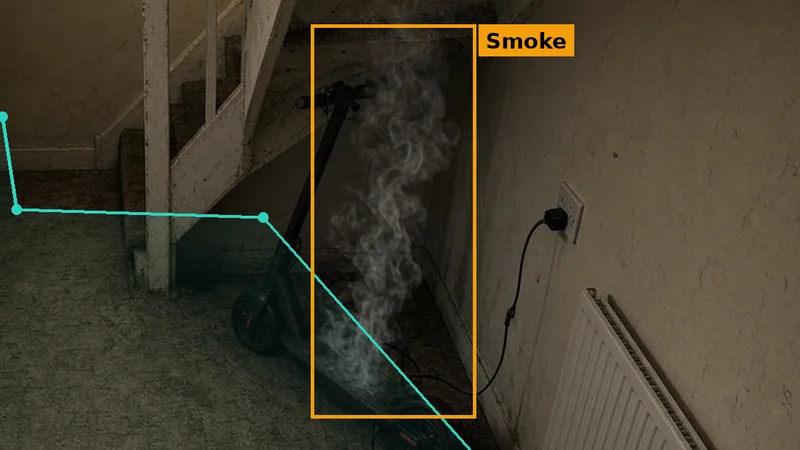
Choose a kind of HMO below to see how a zone might be set up. Each image is a camera view with a zone drawn over the area to watch.
Which kind of HMO?
Many shared houses have no camera inside at all, but a camera on the side passage or the back yard is common. That is where bins, bikes and rubbish collect, and where an arsonist or intruder would go. A zone over the passage can alert the landlord to smoke or flame, or to someone there at night.
Outside, smoke and people
In a house converted into flats, the stairs and landings are usually the only way out and are shared by everyone. Where a camera already covers the common parts, a zone over a landing can alert the managing agent if visible smoke appears in the escape route.
Common parts, overnight
Larger HMOs often have a shared laundry or utility room with dryers and a boiler, used by many tenants and empty overnight. A zone over the appliances can add a visual check for smoke or flame. It does not replace the alarm in that room, which must still be there and working.
Shared utility rooms, overnight
Each area needs its own zone and schedule.
Other places worth considering include bike stores, bin stores and back yards. Our guides to lithium-ion battery storage, arson prevention with CCTV and block of flats security cover related ground.
The limits of camera detection
Every detection method has limits. A camera can only see what is in its view, and most HMO fires start in a tenant's room or a kitchen, where there should be no camera. Smoke from those fires will not be seen until it reaches a hallway in view, by which time the alarm should already be sounding. Cameras need enough light, or infrared, to see at night, and thin smoke in the dark is harder to see. A camera cannot see heat. A camera that has no power sees nothing, so ask your installer what keeps the cameras, recorder and network running in a power cut.
What about false alerts?
Steam from a shower or a kettle, cigarette smoke by the front door, headlights, reflections and insects near the lens can all look like smoke to a camera. Good set-up keeps false alerts down. Tight polygon zones cover the risk, not the whole view. Schedules arm zones when the risk is highest, such as overnight. Clean lenses and steady lighting help, and a self-learning system gets better over time at knowing what is normal for each camera. Looking back at alerts after the first week or two, and adjusting zones, makes a big difference.
A worked example
Here is how this might look for the fictional shared house shown at the top of this page. It is an example, not a real house. Five tenants share a Victorian terrace with a licence, a fire risk assessment, a mains-wired interlinked alarm system, fire doors to every room and an e-scooter rule in the house rules. The managing agent looks after it from an office across town. After talking to their fire risk assessor and insurer, the agent adds smoke and flame detection to the existing camera in the communal hallway, with a zone over the hallway and the space under the stairs armed from 23:00 to 07:00. The tenants are told in writing.
One night, a tenant leaves an e-scooter charging under the stairs, against the rule. At 02:40 thin grey smoke starts to rise from it. The alarms sound and wake the tenants, who get out by the front door as the welcome pack told them, before the smoke reaches the bedrooms. At the same moment the camera zone sees the smoke, and the alert reaches the agent's on-call phone with the clip and an AI description. The agent can see smoke under the stairs, call 999, give the fire service the address and say exactly where it is, then call the tenants to check that everyone is out.
Crews deal with the fire. The next day, the agent records the incident: the time, what was found, what the fire service did, the damage and the actions, including repairs, a review of the fire risk assessment and the e-scooter rule and a check of the alarms and doors. The alarms got the tenants out. The camera meant the person responsible for the house knew within a minute, not at 08:30 when the first tenant called the office.
How Woodcock AI fits
Woodcock AI connects to existing IP cameras, and detection runs on an edge server on site or on a cloud server. It adds smoke and flame detection, and people and vehicle detection, to the cameras you already have. You draw polygon detection areas over the places that matter, choose when they are armed and who gets the alerts. Each alert has a snapshot, a short clip and an AI description of what the camera saw. Our smoke and fire detection page and how it works page show more.
Woodcock AI is self-learning, so it gets better over time at knowing what is normal on each camera. It is the result of years of development and is now in use on real sites in the UK. It works alongside your alarms, fire doors, fire risk assessment, checks and records rather than replacing them. Ask your cameras (Coming soon, early 2027) will let you ask questions about what your cameras have seen in everyday words.
Ways to start
Book a site assessment. We look at what your cameras see by day and after dark, and show where zones would help, such as hallways, landings, side passages and bin areas. Or ask for a live test on your cameras: we connect two or three of your existing cameras for about a fortnight, so you can see the alerts for yourself. We are also happy to arrange an on-site demo.
Sources
- Housing Act 2004, including section 254 (meaning of HMO) and Schedule 4 (mandatory licence conditions); Licensing of Houses in Multiple Occupation (Prescribed Description) (England) Order 2018, article 4; Licensing of Houses in Multiple Occupation (Prescribed Descriptions) (Wales) Order 2006, article 3.
- Management of Houses in Multiple Occupation (England) Regulations 2006, regulations 4, 6 and 10.
- Regulatory Reform (Fire Safety) Order 2005, article 6; Fire Safety Act 2021; Fire Safety (England) Regulations 2022.
- Smoke and Carbon Monoxide Alarm (England) Regulations 2015, regulation 4, and the 2022 amendment regulations; Electrical Safety Standards Regulations 2020, regulation 3; Gas Safety (Installation and Use) Regulations 1998, regulation 36.
- Wales: Renting Homes (Fitness for Human Habitation) (Wales) Regulations 2022, regulations 5 and 6. Scotland: Housing (Scotland) Act 2006, section 125; Fire (Scotland) Act 2005, section 78. Northern Ireland: Houses in Multiple Occupation Act (Northern Ireland) 2016, sections 1 and 7.
- GOV.UK, House in multiple occupation licence, your landlord's safety responsibilities, renting out a property: making repairs, HHSRS landlord and agent guide and fire safety in purpose-built blocks of flats.
- LACORS, Housing: fire safety. Guidance on fire safety provisions for certain types of existing housing (July 2008).
- London Fire Brigade, guidance note GN103: charging and storage for electric-powered personal vehicles, e-bike and e-scooter safety, record number of e-bike and e-scooter fires in 2025 (28 January 2026) and reducing arson risk.
- Incidents: London Fire Brigade, house fire in West Ealing (April 2026) and house fire in Marylebone (October 2026); Southend Echo, fire at an HMO in Westcliff (May 2026).
- Scottish Fire and Rescue Service; Northern Ireland Fire and Rescue Service; ICO, guidance on video surveillance.
We have summarised these sources in our own words and checked them on 3 November 2026. This guide is general information, not legal or fire safety advice for your property. Housing and fire safety law differs between England, Wales, Scotland and Northern Ireland, and councils set their own licensing schemes and conditions. Your council's private housing team, your fire risk assessor, your local fire and rescue service and your insurer can advise on your HMO.
Your alarms wake the tenants. Who tells you?
Book a site assessment and we will look at what your cameras see by day and after dark, and show where smoke and flame zones would help over communal hallways, landings, side passages and bin areas, or ask for a live test on your cameras.
Related pages
Frequently asked questions
What are the fire safety requirements for an HMO?
In England, an HMO landlord or manager must keep the means of escape free from obstruction and in good repair, keep fire fighting equipment and fire alarms in good working order, and take reasonable steps to protect occupiers from injury. Most HMOs also need a fire risk assessment for the common parts under the Fire Safety Order. In practice councils usually expect a mains-wired, interlinked fire alarm system, fire doors to rooms off the escape route, a protected escape route, emergency lighting where needed, and gas and electrical safety checks, following the LACORS guidance.
Does an HMO need a fire risk assessment?
In most cases, yes. The Fire Safety Order applies to the common parts of HMOs and other buildings with more than one home, so the responsible person, usually the landlord or managing agent, must carry out a fire risk assessment of those parts. LACORS recommends a risk assessment approach for every HMO, and councils will often ask to see it, especially when you apply for or renew a licence.
What kind of fire alarm does an HMO need?
It depends on the size, layout and use of the house, and your fire risk assessment and council decide. The LACORS guidance usually expects mains-wired, interlinked smoke alarms with battery back-up in smaller shared houses, and a larger system with a control panel in bigger HMOs and bedsits, with detection in the escape route and in rooms where there is a risk. Battery-only smoke alarms are rarely enough for an HMO.
Do HMOs need fire doors?
Usually, yes. LACORS generally expects doors to bedrooms, kitchens and other rooms that open onto the escape route in most HMOs to be fire resisting, often FD30 with self-closers, and with smoke seals in higher-risk houses. Fire doors must be kept shut, never wedged, and their closers and seals kept in good repair. The exact standard depends on the house and your fire risk assessment.
Can tenants keep e-bikes in the hallway of an HMO?
They should not. London Fire Brigade guidance says e-bikes and e-scooters should not be stored or charged in common areas or escape routes, including under the stairs, and that a dedicated external location is best where possible. Put a clear rule in the tenancy agreement and house rules, give tenants charging advice, and cover it in your fire risk assessment.
Can AI on CCTV replace smoke alarms in an HMO?
No. The alarm system is required by law and is what wakes the tenants. AI video detection on existing cameras covering the communal hallway or the outside of the house can watch for visible smoke and flame and send an alert with a clip to the landlord or managing agent, so someone off site knows quickly. It is an extra layer only, and cameras should cover common parts and outside areas, never tenants’ rooms.
Last reviewed 3 November 2026
Care homes are a different kind of sleeping risk, with residents who need staff to escape. See our care home fire safety guide.