

Care home fire safety: the law, evacuation and night staffing
Care home fire safety means the precautions a care provider must have to protect residents who may not be able to escape on their own: a fire risk assessment that is current and recorded, an evacuation strategy (usually progressive horizontal evacuation) that works with night staffing, personal emergency evacuation plans, a suitable fire alarm, fire doors and compartments, emergency lighting, trained staff and regular drills. In England and Wales the duties come from the Fire Safety Order, enforced by the fire and rescue service, with CQC or Care Inspectorate Wales checking safety as a regulator. AI on existing CCTV can add early warning outside, but never replaces the alarm or the plan.

What is care home fire safety?
Care home fire safety is everything a care provider does to stop a fire starting in the home, to find it quickly if it does, to hold back fire and smoke, and to get every resident to safety. In most buildings, that last part relies on people hearing the alarm and walking out. In a care home, it usually does not. Many residents cannot walk unaided, cannot climb or descend stairs, are living with dementia, or are frail, unwell or asleep after medication. Some will not understand that the alarm means danger. Staff have to move them, often one at a time, often with equipment, and at night there are far fewer staff to do it.
That is why the official guidance for England and Wales says plainly that a care home's plan should not depend on the fire and rescue service to evacuate residents. The home must be able to protect and move its own residents with its own staff. Everything else in this guide follows from that: the type of fire alarm, the fire doors and compartments, the evacuation strategy, the personal plans for each resident, staff numbers at night, the training and drills, and the everyday management of risks such as smoking, oxygen, laundry and mobility scooters.
This guide is for registered managers, care home owners and operators, nominated individuals, estates and maintenance leads, and anyone acting as the responsible person for a residential or nursing care home in the UK. It explains who is responsible in law, how fire and care regulators enforce, how the rules differ in Scotland, Wales and Northern Ireland, what a care home fire risk assessment should cover, evacuation strategies including progressive horizontal evacuation, personal emergency evacuation plans, night staffing, fire alarms, fire doors, training and drills, the common causes of fire in care homes, and where camera-based detection can help outside the building and in the common parts.
A note before we start. Where we say "must", we point to the law. Where we say "should" or "usually", it comes from official guidance, and the right answer for your home depends on its size, layout, residents and staffing. Your fire risk assessor, your local fire and rescue service, your care regulator and your insurer can tell you what your home needs. Nothing on this page is legal or fire safety advice for your premises.
Why care homes carry a higher risk
The Home Office guide for residential care premises, first published in 2006 and still the main official guide for existing care homes in England and Wales, explains that people in care homes are at greater risk because of who they are, not just where they are. Residents may have limited mobility, impaired hearing or sight, or reduced awareness of danger. Some depend completely on staff to move. Some may smoke, some use medical oxygen, and many use creams and dressings that change how fabrics burn. They are often asleep, and they live in the building around the clock.
The building adds to the risk. Many care homes are converted houses or older buildings that have been extended over the years, with long corridors, several staircases, small rooms and a mix of construction. Bedrooms open onto corridors that are also the escape routes. Kitchens and laundries run for long hours with heavy equipment. Lifts are used for residents who cannot use the stairs, and in most buildings lifts should not be used in a fire unless they are designed and managed for evacuation. Night shifts are lean, and staff on them may be agency workers who do not know the building well.
None of this means care homes are unsafe. Most UK care homes have a good fire safety record, with fire alarm systems, fire doors and trained staff. But when things go wrong, the consequences can be grave, because residents cannot simply walk away from smoke. The guidance and regulation in this area have been shaped by real tragedies, and providers who understand why the rules exist are much better placed to apply them sensibly.
Lessons from Rosepark
The case most often cited in the UK is the fire at Rosepark Care Home in Scotland in 2004. The Scottish Government's current guidance for existing care homes describes it as a short, rapidly developing fire that started in a cupboard in a bedroom corridor. Inhalation of smoke and toxic gases claimed the lives of 14 residents. The guidance uses it to show the serious risk that fire poses to people in care homes, and the importance of managing fire safety well, every day.
The lessons from Rosepark run through every modern care home guide. Fire and smoke can spread quickly along corridors if doors are not effective. Cupboards and store rooms full of combustible material can be a hidden source of fire. Fire risk assessments must look at the whole building, including the places staff rarely go. Staff must know the evacuation strategy and be able to carry it out at night. And bedroom doors that hold back smoke for long enough can make the difference between residents who survive and residents who do not.
The rest of this guide starts with the law, because that sets the minimum. Then it moves to how a care home actually plans for a fire, and the everyday risks that cause most of them.
The law in England and Wales
In England and Wales, the main fire safety law for care homes is the Regulatory Reform (Fire Safety) Order 2005, usually called the Fire Safety Order. It applies to almost all non-domestic premises, and a care home is a workplace as well as a home, so it is firmly within scope. The Order puts the duties on the "responsible person". Under article 3, in a workplace that is the employer, if the workplace is to any extent under their control. In most care homes, that is the registered provider: the company, charity, partnership or individual that runs the home and employs the staff.
Other people can share the duties. If the provider leases the building, the landlord may keep control of parts of it, such as the roof, the structure, a shared plant room or a car park, and then has duties for those parts. A facilities company that maintains the fire alarm, or an estates team at group level, may have duties to the extent of their control. The registered manager is not automatically the responsible person in law, but in practice usually runs fire safety day to day, and the provider needs to make sure they have the time, training and budget to do it.
The Order sets out what the responsible person must do. Under article 9, they must make a suitable and sufficient assessment of the fire risks. They must then put in place general fire precautions to protect everyone on the premises, which includes the residents, staff, visitors and contractors. Article 13 covers fire-fighting equipment and fire detection and warning. Article 14 covers emergency routes and exits, which must be kept clear and lead as directly as possible to a place of safety. Article 15 requires procedures for serious and imminent danger, which in a care home means the fire emergency plan and the evacuation strategy. Article 17 requires the premises, equipment and devices to be kept in efficient working order and good repair. And article 21 requires staff to be given adequate safety training, on starting and when risks change, repeated periodically.
The responsible person must also appoint one or more competent persons to help with the preventive and protective measures, give staff clear information about the risks and the procedures, and co-operate with any other responsible persons in the same building. The Home Office guide notes that you can nominate yourself as a competent person if you have enough training, experience or knowledge. In a care home, most providers rely on a mix of trained in-house staff and specialist contractors for alarms, emergency lighting, fire doors and the fire risk assessment itself.
Changes from the Building Safety Act
Section 156 of the Building Safety Act 2022 amended the Fire Safety Order from 1 October 2023. Before that date, the significant findings of a fire risk assessment only had to be written down in certain cases, such as where five or more people were employed. Now every responsible person must record the fire risk assessment in full, along with the fire safety arrangements for the premises. If they appoint someone to help with the assessment, that person must be competent. Responsible persons who share a building must find each other, tell each other their names, contact addresses and the parts they are responsible for, and keep a record of it. And when a care home changes hands, the outgoing responsible person must pass the relevant fire safety information to the new one. For most care homes these changes simply formalised what good providers already did, but they make it much harder to argue that an undocumented assessment was enough.
Who enforces fire safety in a care home?
The local fire and rescue authority enforces the Fire Safety Order. Fire safety inspectors carry out audits, and risk-based inspection programmes commonly give priority to premises where people sleep, such as care homes. They also visit after fires, complaints or concerns raised by other agencies. Where they find serious problems, they can give informal advice, issue an enforcement notice requiring specific work by a set date, or, where the risk to people is serious, issue a prohibition notice that restricts or stops the use of all or part of the building. Under article 32, failing to comply with the Order can be a criminal offence, and fire authorities can and do prosecute where people have been put at risk.
Care regulators have their own powers. In England, the Care Quality Commission registers and inspects care homes under the Health and Social Care Act 2008. The fundamental standards in the Regulated Activities Regulations 2014 include regulation 12, safe care and treatment, which includes "ensuring that the premises used by the service provider are safe to use for their intended purpose and are used in a safe way", and regulation 15, which requires premises and equipment to be clean, secure, suitable, properly used and properly maintained. Poor fire safety is therefore a care quality issue as well as a fire safety issue, and CQC can take its own action.
The two regimes are designed to work together rather than duplicate each other. In 2021, CQC and the National Fire Chiefs Council published a memorandum of understanding that sets out how they share information and coordinate action. It records that the primary regulatory responsibility for fire safety in buildings sits with fire and rescue services, while CQC looks at whether people receive safe care. In practice, a fire officer who finds serious problems in a care home may tell CQC, and a CQC inspector who sees wedged fire doors or blocked exits may tell the fire service. Providers should expect both regulators to know about any serious fire safety concern.
CQC also looks at fire safety before a home opens. When a provider applies to register a care home, CQC asks for a current fire risk assessment as a supporting document. CQC says it should cover matters such as the storage of medical gases, personal emergency evacuation plans, the smoking policy, the alarm system, the exits, staff training and fire drills, together with an action plan, and that any actions should be completed before the application is made.
Scotland, Wales and Northern Ireland
Fire safety and care regulation are devolved, so the details differ across the UK, although the principles are much the same. In Wales, the Fire Safety Order applies, enforced by the three Welsh fire and rescue services, and the Home Office residential care guide is used. Care homes are regulated by Care Inspectorate Wales under the Regulation and Inspection of Social Care (Wales) Act 2016. Wales has gone further than England on sprinklers for new buildings: under regulation 37A of the Building Regulations 2010 as they apply in Wales, new care homes, and buildings converted into care homes, must have an automatic fire suppression system, and this was extended to children's care homes from December 2024.
In Scotland, the duties sit in Part 3 of the Fire (Scotland) Act 2005 and the Fire Safety (Scotland) Regulations 2006, which require the duty holder to assess fire risks and put fire safety measures in place, enforced by the Scottish Fire and Rescue Service. The Scottish Government's practical fire safety guidance for existing care homes, updated in February 2022, is statutory guidance for the fire service as enforcing authority, so it carries real weight. Care services are registered and inspected by the Care Inspectorate. The Scottish guidance covers similar ground to the Home Office guide, including protected areas and horizontal evacuation, with a strong focus on staffing at night.
In Northern Ireland, the Fire and Rescue Services (Northern Ireland) Order 2006 and the Fire Safety Regulations (Northern Ireland) 2010 set the duties, enforced by the Northern Ireland Fire and Rescue Service. Care homes are registered and inspected by the Regulation and Quality Improvement Authority. Again, the duty to assess the risk, provide precautions, plan the evacuation and train staff is at the heart of the law.
| Nation | Main fire safety law | Fire enforcer | Care regulator |
|---|---|---|---|
| England | Regulatory Reform (Fire Safety) Order 2005, as amended | Local fire and rescue authority | Care Quality Commission |
| Wales | Regulatory Reform (Fire Safety) Order 2005, as amended | North Wales, Mid and West Wales, and South Wales fire and rescue services | Care Inspectorate Wales |
| Scotland | Fire (Scotland) Act 2005, Part 3, and Fire Safety (Scotland) Regulations 2006 | Scottish Fire and Rescue Service | Care Inspectorate |
| Northern Ireland | Fire and Rescue Services (NI) Order 2006 and Fire Safety Regulations (NI) 2010 | Northern Ireland Fire and Rescue Service | Regulation and Quality Improvement Authority |
If you run homes in more than one nation, keep one group fire safety policy but check each home against its own law, guidance and regulator. Terms differ: Scotland talks about the "duty holder" rather than the "responsible person", for example, and the expected content of the fire risk assessment, the drill records and the staff training can vary slightly.
The care home fire risk assessment
Everything in care home fire safety starts with the fire risk assessment. It is a legal requirement under article 9 of the Fire Safety Order, and in Scotland and Northern Ireland under their own laws, and it is the document fire inspectors and care inspectors will ask to see first. A good assessment is specific to your building, your residents and your staffing. It explains what could cause a fire, who would be at risk, what is already in place, what still needs doing, and how the home will get everyone to safety. A generic template with boxes ticked is rarely enough.
The Home Office guide for residential care premises sets out the same five steps it uses for every type of building. Identify the fire hazards. Identify the people at risk. Evaluate the risk, then remove or reduce the hazards and protect people from what remains. Record what you found, make an emergency plan, and inform, instruct and train staff. Then review the assessment regularly. The guide warns that the assessment in a care home must be dynamic, because residents' needs can change in a matter of days and the plan must keep up.
Step 1: fire hazards
Fire needs three things: a source of ignition, something to burn, and oxygen. A care home has all three in quantity. Sources of ignition include smoking materials, electrical equipment and chargers, portable heaters brought in by residents or families, kitchen equipment, laundry dryers, candles and seasonal decorations, contractors' hot work, and arson. Fuel includes bedding, mattresses, curtains, upholstered chairs, clothes, paper records, incontinence products, laundry in bulk and stored equipment. And as well as the oxygen in the air, many homes have residents using medical oxygen, which makes materials catch fire more easily and burn much more fiercely.
The assessment should look at every room and space, not just the obvious ones. Rosepark showed how dangerous a cupboard off a corridor can be. Store rooms, linen cupboards, plant rooms, roof spaces, under-stair cupboards, staff rooms, offices and the areas outside the building should all be included. So should the habits of the home: where residents and staff smoke, what gets left in corridors, how laundry is handled at night, and where bins, skips and deliveries end up.
Step 2: people at risk
In most buildings, the people at risk are assessed as groups. In a care home, the guide expects the assessment to consider residents' mobility, awareness and dependency in detail, because this decides how they can be evacuated and how many staff are needed. A resident who can walk with a frame and follow instructions needs far less help than one who is bedbound and attached to a catheter, an oxygen supply or an automatic dosing pump. A resident living with dementia may not understand the alarm, may wander towards the fire, or may resist being moved by staff they do not recognise.
Staff are at risk too, particularly those working alone at night, in the kitchen or laundry, or in isolated parts of the building. Visitors and contractors may not know the escape routes. The assessment should name the groups who are present in your home at different times, including during the night shift, and explain how each will be warned and moved. This is the link between the fire risk assessment and each resident's personal emergency evacuation plan, covered later.
Steps 3 to 5: act, record and review
Step 3 is where the assessment turns into action. For each hazard, can it be removed? If not, can it be reduced or controlled? And for the risk that remains, are the precautions good enough: early warning from the fire alarm, fire doors and compartments that hold back smoke, escape routes that are clear and protected, emergency lighting, fire-fighting equipment, and enough trained staff to move residents? The guide is explicit that the evacuation must be achievable by the home's own staff, at the worst time, which is usually the night shift.
Step 4 is recording. Since October 2023, the whole assessment must be recorded, along with the fire safety arrangements. The record should include the significant hazards, the people at risk, the measures in place, the actions still needed with dates and owners, the emergency plan, and the training given. Step 5 is review: at a set interval, and whenever something important changes. In a care home that might be a new resident with very different needs, a change in night staffing, refurbishment or a new wing, a fire, a near miss, or a drill that showed the plan would not work.
Who should carry out the assessment?
The responsible person can carry out the assessment themselves if they are competent. The Home Office guide suggests that premises with very large numbers of residents, for example more than 60, complicated layouts such as a network of escape routes or split levels, more than four storeys, or homes that form part of a multi-occupied complex, will probably need a competent person with comprehensive training or experience in fire risk assessment. In practice, most care providers use a specialist fire risk assessor, and many groups have a fire safety adviser who reviews each home's assessment.
Since the Building Safety Act changes, the law also says that anyone you appoint to help with the assessment must be competent, meaning they have enough training and experience or knowledge and other qualities to do it properly. Ask any assessor about their experience of care homes specifically, how they approach evacuation strategies and night staffing, and whether they will look at your PEEPs and drill records. Registers kept by professional bodies can help you find an assessor, but the responsibility for choosing a competent one stays with you.
Routine checks and records
The assessment is supported by a routine of checks. The Home Office guide suggests daily checks that fire exits are not obstructed and security devices will not stop people escaping, that doors on escape routes swing freely and close fully, that the fire alarm panel shows the system is working and that signs are legible. It also suggests a routine for closing corridor fire doors at night. Weekly, the fire alarm is tested, following the installer's instructions, and extinguishers are checked. Monthly, emergency lighting is tested and fire doors are checked for closing, frames and seals. Competent persons service the alarm and emergency lighting periodically, and all systems and structural fire protection are inspected each year.
| How often | What to check | Who usually does it |
|---|---|---|
| Daily | Escape routes and exits clear; exit security devices; doors swing freely and close; alarm panel normal; signs legible; corridor fire doors closed at night | Duty manager or nominated staff |
| Weekly | Fire alarm test, following the installer's instructions; extinguishers in place | Maintenance staff or nominated staff |
| Monthly | Emergency lighting function test; fire doors closing correctly with frames and seals intact | Maintenance staff |
| Six-monthly | Fire alarm and emergency lighting tested and maintained | Competent contractor |
| Yearly | All fire-fighting equipment, alarms and installed systems; structural fire protection inspected | Competent contractor |
Record every test, fault, repair and drill in a fire safety log book, paper or digital, and keep it where inspectors can see it. Gaps in the log are one of the most common findings on inspection, and an untested alarm or a fire door that has not closed for weeks is hard to defend after a fire. Our fire safety log book guide covers what to record and how to keep it.
Evacuation strategies for care homes
The single most important decision in a care home fire risk assessment is how residents will be evacuated. In a shop or an office, everyone leaves at once when the alarm sounds. In a care home, that is rarely possible. The Home Office guide describes three strategies, and most homes use a combination, depending on the building and the residents.
Single stage evacuation means everyone leaves the building straight away to a place of total safety. It suits residents who are largely independent and can be expected to leave without help, and small homes where residents can get outside quickly. Progressive horizontal evacuation means moving residents away from the fire to an adjoining protected area on the same floor, and then further if needed. Delayed evacuation means that some residents, for example those who cannot be moved quickly because of medical treatment, stay in their rooms, protected by enhanced fire separation, while the fire is dealt with or while staff prepare to move them. Even where delayed evacuation is used, the guide says a suitable evacuation plan is still required.
Progressive horizontal evacuation
Other than small premises where residents can escape quickly to open air, the Home Office guide says all care homes it covers should develop a strategy of progressive horizontal evacuation, often shortened to PHE. The idea is simple. The parts of the building where residents sleep are divided into smaller sub-compartments, called protected areas, separated from each other on the same floor by walls and doors that give at least 30 minutes of fire resistance. If a fire starts in one protected area, staff close the doors and move residents through into the next protected area. That area gives them a place of reasonable safety while the fire is tackled, or before a further move to another area, down a protected stair or outside.
Each protected area should have at least two alternative exits to adjoining areas, so that a fire in one direction does not trap the residents. It should be big enough to take the residents who will be moved into it as well as those already there. The number of residents in each protected area matters too: the fewer beds in each area, the fewer people staff have to move away from the fire. The guide links this directly to staffing, saying the number of beds allowed in each sub-compartment should depend on the minimum number of staff who are awake and available on the premises, which is normally the night-time staffing level.
PHE only works if the building and the people both work. The walls, ceilings and fire doors between protected areas must hold back fire and smoke for the time needed, which means the doors must close properly, gaps around pipes and cables must be sealed, and nothing must be propped open at the wrong time. The fire alarm must tell staff exactly where the fire is, usually through a zoned or addressable panel. And staff must know the plan well enough to act within seconds, without waiting to be told.
Night staffing and the worst case
The guide is clear that the evacuation plan must be tested against the worst case, and that this is usually when the lowest number of staff are available, at night when residents are asleep. At night, many residents will be sleeping, some with their responses further slowed by medication, and an immediate full evacuation is rarely practicable and may itself harm residents. The guide says that staffing levels should be sufficient at all material times to move residents to safety within the safe evacuation time, and that where the emergency plan relies on staff, staff numbers at all times must be sufficient. You should be able to show the enforcing authority that you always have enough staff to carry out the plan without outside help, for example through a fire drill.
This is often where fire safety and care staffing meet. A home that has reduced its waking night staff, opened extra beds on a floor, admitted residents with higher needs, or relies heavily on agency staff who do not know the building may find that its evacuation plan no longer works. The fire risk assessment should say how many staff are needed at night, for which areas, and why. If the numbers do not add up, the options are to add staff, reduce the number of residents in a protected area, move higher-dependency residents to lower floors or smaller areas, or improve the building's fire protection, not to hope the fire service arrives in time.
Timing the evacuation is the honest test. The guide suggests a simulated evacuation exercise, involving residents where possible or volunteers acting as residents, to measure how long it takes to clear a protected area. Run it with night staffing levels, in the hardest area of the building, with doors closing and equipment being used as it would be. If the time is longer than the protection the building gives, the plan needs to change.
Personal emergency evacuation plans
Because residents' needs vary so much, the general evacuation strategy is supported by an individual plan for each resident who needs help, usually called a personal emergency evacuation plan, or PEEP. The Home Office guide notes that any PEEP developed for a resident may need to be built into that person's care plan, which is where most homes keep it. A PEEP describes how that resident will be warned of a fire, how they will be moved, how many staff and what equipment are needed, any medical needs that affect evacuation, and where they will go.
PEEPs only help if they are current and known. Review them when a resident's mobility, health or behaviour changes, after a fall or a hospital stay, and at regular care plan reviews. Make sure night staff know the PEEPs for the residents they look after, and keep a summary of dependency by room or by protected area in a fire box or grab pack near the fire panel, for staff and for the fire service when they arrive. Respite and short-stay residents need PEEPs as well, often within hours of arrival.
Some residents will need evacuation aids, such as evacuation chairs, sledges or mats, or will be moved in their beds or wheelchairs. The fire risk assessment should say what aids are needed and where they are kept, and staff who will use them must be trained and practised. Lifts should not be used in a fire unless they are specifically designed and managed for evacuation following the fire risk assessment, and the reason for not using lifts should be part of staff training.
Alarms, doors, lighting and sprinklers
The fire risk assessment decides what fire protection a care home needs, but the guidance gives a clear starting point. Care homes depend on early warning, on fire doors and compartments that hold back smoke while staff move residents, on emergency lighting so that routes can be used at night, and in many homes on sprinklers that slow a fire down. Each of these has to be chosen, installed, tested and maintained, and each has to fit the evacuation strategy.
Fire detection and alarms
The Home Office guide says all residential care premises should have an automatic fire detection system. In a very small home, for example one with no more than one floor above ground and only a handful of residents who need no help to leave, mains-powered interlinked smoke alarms may be suitable. Beyond that, a fire detection and alarm system designed to BS 5839-1 is expected. Where all residents can leave without help, a Category L2 system may be enough. Where there are more than ten residents above the ground floor, or a significant proportion of residents rely on staff to evacuate, a Category L1 system, with detection throughout the building, is normally needed.
Detection should give staff the location of the fire quickly. In larger homes this usually means an addressable panel that shows the exact device, with zone charts or plans beside it so night staff can go straight to the right room. Manual call points should be fitted so that no one has to travel more than 45 metres to reach one, at a consistent height on exit routes. Residents who are deaf or hard of hearing may need visual or vibrating alarms in their rooms. The alarm should also release hold-open devices on fire doors, shut down ventilation where needed, and operate dampers in laundry chutes.
False alarms are a serious problem in care homes. They disturb residents, they can lead to unnecessary and risky moves, they tie up fire crews, and above all they wear down staff trust in the alarm, so that the next one is treated as another false one. The guide asks responsible persons to investigate every false alarm, find the cause and fix it. Common causes are cooking, steam from bathrooms and en-suites, aerosols, dust from building work, and poorly maintained detectors. Choosing a heat detector rather than a smoke detector in a room next to an en-suite, isolating zones for contractors under a permit, and agreeing a staff confirmation process with your fire and rescue service can all help. Fire services' policies on automatic fire alarm signals differ, and many treat sleeping risk premises such as care homes differently from offices or shops, so check your local fire service's policy, write it into your plan, and make sure staff always call 999 when there is a real fire.
Fire doors, compartments and hold-open devices
Fire doors are what make progressive horizontal evacuation possible. Doors to residents' rooms, to corridors between protected areas, to stairs, to stores and plant rooms all need to be fire-resisting, fitted with suitable self-closing devices where the assessment requires it, and kept in good repair. Daily checks should confirm that doors swing freely and close fully into their frames, and monthly checks should look at frames, hinges and intumescent seals.
Residents often want their room doors left open, and staff need corridor doors open to move around. Wedging or propping fire doors open is a common and dangerous habit, and it defeats the whole evacuation strategy. The answer is to use approved devices linked to the fire alarm. Hold-open devices keep corridor doors open and release them when the alarm sounds. Free-swing door closers let a resident's door open and close like a normal door, without the strong pull of a standard closer, and then close it automatically on alarm. The guide also suggests a routine to close corridor doors at night, as part of the night shift's checks.
Compartments only work if the walls and ceilings between them are intact. Holes made for new cabling, pipework or data points, gaps above suspended ceilings, and missing fire stopping in roof voids are common weaknesses, especially after refurbishment. Our fire door regulations guide covers inspection in more detail, and building work should always be followed by a check of compartmentation and a review of the fire risk assessment.
Emergency lighting and signs
Night staff move residents in the dark, so emergency lighting matters even more in a care home than in most buildings. It should cover escape routes, stairs, final exits, protected areas where residents will wait, the fire alarm panel and plant areas, and external routes to the assembly point. Escape route signs should be clear and lit. Emergency lighting should be function tested monthly at a time when it will not be needed straight away afterwards, and serviced and fully tested by a competent person. See our emergency lighting guide for the testing routine.
Sprinklers and suppression
Sprinklers do not replace a good evacuation plan, but they can make a huge difference. A residential sprinkler head discharges water only where it has detected heat, controlling the fire, limiting the smoke, and giving staff more time to move residents. Requirements differ across the UK. Scottish guidance says that since May 2005, new or altered residential care buildings are provided with an automatic life safety fire suppression system to comply with building regulations, and suggests retrofitting where other fire safety measures cannot be improved. In Wales, regulation 37A of the Building Regulations 2010 requires automatic fire suppression systems in certain new and converted buildings, including care homes. In England there is no requirement for sprinklers in every care home, though they are often part of the design of new homes and the fire risk assessment may recommend them in existing ones. Our commercial sprinkler systems guide explains how they work.
Kitchens need their own protection. The Home Office guide suggests that larger kitchens should have an automatic suppression system over the cooking range, as well as suitable extinguishers and a fire blanket. Portable extinguishers should be chosen for the risk, checked regularly and serviced each year, and staff should be trained in when to use them and when to walk away and close the door instead.
Training, fire marshals and drills
A care home fire plan depends entirely on staff. The Home Office guide says that all staff, including agency and bank staff, should receive fire safety training, and in practice this starts at induction, before anyone works a shift alone. Training should cover what to do on discovering a fire, how to raise the alarm, the home's evacuation strategy, how to close doors and move residents into the next protected area, how to use evacuation aids, the location of fire equipment, the risks of oxygen and emollients, and why lifts are not used. Staff who will move residents need practical, hands-on training with the equipment they will actually use.
Refresher training should be given at set intervals and repeated when things change, such as new residents with different needs, changes to the layout or a new role. It should happen in working hours, and it should be recorded so you can show who was trained, when and in what. Many homes appoint fire marshals or a senior person in charge on each shift who leads the response, checks the panel, directs staff and briefs the fire service. Night staff, who will often be the ones dealing with a real fire, need the most practice, not the least. Our fire safety training guide and fire warden duties guide go into more detail.
Drills test whether the training works. The guide suggests drills at least once a year, or more often as the fire risk assessment requires, and more often where staff turnover is high. Each member of staff should take part. At least one drill should take place at night or simulate night-time staffing levels, and residents should be included where it is safe and appropriate, with volunteers acting as residents for the moves that would be too distressing. Respite residents should be told about the arrangements. After each drill, record the time taken, what went well and what went wrong, and update the plan, the PEEPs and the training.
Everyday fire risks in care homes
Most fires in care homes do not start with a dramatic event. They start with an ordinary habit that went slightly wrong: a cigarette dropped on a chair, an oxygen user lighting up, a charger left overnight, a dryer full of lint, a fryer left alone for a minute, or a bin set alight next to a wall. The fire risk assessment should look closely at these, because they are the risks the home controls day to day.
Smoking
Many care homes have residents who smoke, and the law allows for it. In England, the Smoke-free Regulations 2007 allow a care home to designate a room where adult residents may smoke, provided it is designated in writing, has a ceiling and is enclosed except for doors and windows, has a ventilation system that does not ventilate into any part of the premises that is smoke-free, is clearly marked as a smoking room, and has mechanically closing doors. Scotland, Wales and Northern Ireland have their own smoke-free laws, with their own provisions for care homes. Many homes instead provide a covered outdoor smoking shelter.
Smoking is a well-known cause of fatal fires, especially among older people and people with reduced mobility, so each resident who smokes should have an individual risk assessment in their care plan. Can they smoke safely without supervision? Do they use oxygen or emollients? Are their mobility or awareness affected? Measures can include smoking only in the designated area, supervision, fire-retardant aprons and blankets, deep safety ashtrays, and holding cigarettes and lighters for residents who cannot use them safely. The guide warns that a cigarette can smoulder for hours: ashtrays should be emptied daily into a metal bin taken outside, never into a plastic sack left in the building. Night staff should check smoking areas at the end of the evening.
Medical oxygen
Residents using oxygen from cylinders or concentrators face a much higher risk if anything nearby ignites. Oxygen soaks into clothing, bedding and hair, and makes them catch fire easily and burn fiercely. The Home Office guide and London Fire Brigade's health care products advice both stress the same basics: no smoking, e-cigarettes or naked flames near oxygen equipment, warning signs on the doors of rooms where it is used and stored, cylinders secured and kept in a ventilated area away from heat, and training for staff, residents and visitors. Residents on oxygen will also need careful PEEPs, because they may be among those for whom delayed evacuation is the safer choice.
Emollients and airflow mattresses
Skin creams are used widely in care homes, and they carry a fire risk that many staff do not know about. The MHRA warns that both paraffin-based and paraffin-free emollients can soak into clothing, bedding and dressings, and that the residue makes fabric catch fire more easily and burn more intensely. Washing fabric at high temperatures may reduce the build-up but may not remove it entirely. The risk is greatest for residents who smoke or who are near a naked flame or heat source, and for those who cannot react quickly. Record emollient use in the fire risk assessment and the resident's care plan, change bedding and clothing regularly, and tell staff, residents and families about the risk.
London Fire Brigade's advice also covers airflow pressure-relief mattresses, which, if punctured in a fire, can release air that makes the fire spread rapidly, while a backup battery may keep the pump running, and other health care equipment with chargers or electric motors. Consider these items when assessing residents' rooms and in the night staff's understanding of what a fire in a room might look like.
Mobility scooters, e-scooters and chargers
Mobility scooters and powered wheelchairs are part of daily life for many residents, and their batteries, especially lithium-ion batteries, are a growing fire risk. The National Fire Chiefs Council's mobility scooter guidance notes that a typical Class 2 mobility scooter fire can produce enough toxic smoke to fully compromise a large corridor in less than three minutes. Scooters are often left in corridors, entrances and lobbies, which are exactly the routes residents need to escape, so storage and charging must be assessed in the fire risk assessment.
Good practice is to store and charge scooters in a dedicated, ventilated room or enclosure separated from the escape routes by fire-resisting construction, with automatic fire detection linked to the alarm. Where that is not possible, a covered external store or shelter with power is often the next best option. Chargers should be the manufacturer's approved type, plugged directly into a wall socket rather than an extension lead, and unplugged when charging is complete, away from exits and escape routes, as London Fire Brigade advises in its guidance note on charging and storage. E-scooters and e-bikes brought in by staff or visitors are usually best kept out of the building altogether, or stored in an external area under the same rules. Our lithium-ion battery storage guide covers lithium-ion risks in more detail.
Laundry
The Home Office guide describes laundries as a high-risk area, often located in basements where a fire can grow out of sight. Washing machines and dryers should not be overloaded, and dryer lint filters and ducts should be cleaned regularly. Cloths, mop heads and towels that have absorbed oils, chemicals or cleaning products can self-heat and spontaneously combust in dryers or when piled warm after a cycle, so they should be washed properly and allowed to cool. Laundry chutes give smoke and fire a route between floors, and should be fitted with dampers that close on fire detection. Do not leave dryers running unattended overnight unless the fire risk assessment allows it and there is detection, and keep the laundry door closed. The laundry entrance and the yard outside are often among the quietest parts of the site at night, which matters for both accidental and deliberate fires.
Kitchens
Care home kitchens cook large volumes every day, often with deep fat fryers and heavy use of extraction. Deep fat fryers should have thermostats and must never be left unattended, extraction ducts and filters should be cleaned on a schedule set by the fire risk assessment and the cleaning contractor, and gas and electrical equipment should be maintained. Larger kitchens should have an automatic suppression system over the cooking range. A fire blanket should be provided, along with the right type of extinguisher. Close the kitchen door when it is not in use and at night, and check that equipment is switched off at the end of service. Our commercial kitchen fire safety guide goes further. Kitchenettes on units, toasters in lounges and residents' own kettles need to be in the assessment too.
Storage, bins and arson
Care homes collect things. Wheelchairs, bath chairs, hoists, pressure mattresses, linen trolleys, continence supplies and archived records all burn, and they tend to drift into corridors, stairwells and under stairs. The guide asks for combustible items to be stored away from escape routes, in fire-resisting rooms where needed, and for stores to be kept locked. Outside, bins, skips, cardboard and garden waste give an arsonist or a dropped cigarette everything they need.
The Home Office guide's advice on arson for residential care is practical. Make sure external areas are well lit. Secure the perimeter where you can. Remove rubbish and combustible waste regularly. Do not place skips next to the building. Keep wheelie bins in a secure compound separated from the building, so they cannot be moved next to it and set alight. Do not allow vehicles to park next to the building. And encourage staff to challenge people who should not be there. Our bin store fire safety guide and arson prevention guide cover the outside of the building in more detail.
Empty and derelict care homes are a particular target. In August 2026 a former care home near Liss in Hampshire, which had stood empty, was destroyed by a late-night fire that needed more than 60 firefighters from 13 stations, and two people were arrested on suspicion of arson, according to BBC reports. No one was hurt because the building was empty. The lesson for occupied homes is that the outside of the building, at night, is where many deliberate fires begin, and where the fewest people are watching.
At night, outside: where AI on existing CCTV fits
A care home at night is a quiet place with a lot going on. A small team of night staff look after residents across the building, often busy in residents' rooms for long stretches. The fire alarm covers the inside of the building, and it is what warns everyone if a fire starts in a room, a corridor or the laundry. But the outside of the building, the entrance porch, the service yard, the bins, the gardens and the car park, is not usually covered by fire detection at all. These are the places where scooters are left, smokers go, bins and skips sit and arsonists come, and the Liss fire shows how fast an unwatched building can be lost. Many care homes already have cameras covering exactly these areas.

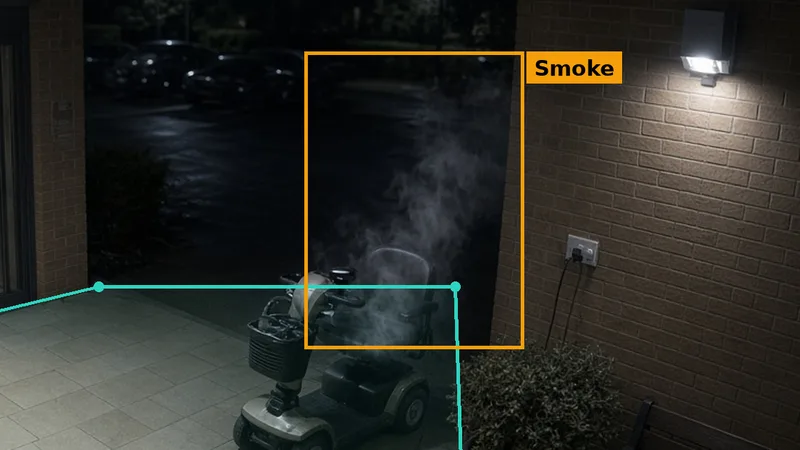
AI video detection watches for visible smoke and flame, and for people, inside areas you choose, at the times you choose, and sends an alert with a snapshot and a short clip to the people you choose, such as the night staff phone and the on-call manager. On a camera covering the porch, it can see smoke from a scooter or a dropped cigarette. On a camera over the service yard, it can see a bin fire against the wall, or flag a person in the yard at 2am.
We want to be clear about what this is and is not. Video smoke and flame detection does not do the job of the fire alarm system in a care home, which the law requires and which warns everyone inside. It does not do the job of the evacuation strategy, the PEEPs, night staffing, fire doors, training, drills or the fire risk assessment, or anything your fire and rescue service, CQC, your assessor or your insurer requires. It does not sound your alarm or call the fire service. It is an extra layer of early visual warning, mostly outside, that tells the people who need to know.
Cameras, residents and privacy
Cameras in a care home need particular care, because it is people's home. CQC's guidance on using surveillance says surveillance can help keep people safe and premises secure, but providers should be clear about the purpose, consult the people who use the service, their families and staff, get legal advice, and protect people's privacy and dignity. Hidden cameras are only appropriate in rare circumstances. CQC treats the use of surveillance as part of how a service is run, and the ICO regulates the recordings under data protection law.
For fire and security purposes, cameras on the outside of the building, in entrances, lobbies and some corridors are usually the right places. Never put cameras in residents' rooms, bathrooms or toilets for this purpose. Tell residents, families, staff and visitors which areas are covered, with clear signs, explain why, and record the decision in a data protection impact assessment. Our guide to AI CCTV and UK GDPR explains more.
Where it can help
Choose an area below to see how a zone might be set up. Each image is a camera view with a zone drawn over the area to watch.
Which area of the home?
The service yard is where bins, cages, deliveries and the laundry door meet, usually out of sight of the night staff. The Home Office guide asks for bins to be kept in a compound away from the building. A zone over the bins and the laundry door can alert the night staff to smoke or flame, or to someone in the yard after dark.
Bins, laundry, stores
Many homes have cameras in entrances, lobbies and some corridors. A zone over a corridor can see smoke drifting into view, which can help night staff on a big floor see where it is. Inside the building the fire alarm comes first, always. Cameras should only cover common areas the home has assessed, never residents' rooms or bathrooms.
Inside, common areas only
Gardens, summer houses, sheds and boundary fences are often dark and empty at night. A zone over the summer house and the fence line can alert the night staff to smoke or flame, or to someone in the grounds who should not be there, before a small fire against a shed or a fence becomes a big one.
Sheds, summer houses, fences
Each area needs its own zone and schedule.
Other places worth considering include scooter stores, smoking shelters, oxygen stores outside, the kitchen yard and the delivery bay. Our guides to outdoor fire detection, out-of-hours security and perimeter intrusion detection cover related ground.
The limits of camera detection
Every detection method has limits. A camera can only see what is in its view, and most care home fires inside start in a resident's room, a kitchen or the laundry, where the fire alarm is the primary warning. Cameras need enough light, or infrared, to see at night, and thin smoke in the dark is harder to see. A camera cannot see heat. A camera that has no power sees nothing, so ask your installer what keeps the cameras, recorder and network running in a power cut. And an alert only helps if someone sees it: decide who carries the phone at night, and what they do.
What about false alerts?
Steam from the laundry vent or kitchen extract, smokers in the shelter, headlights in the car park, reflections, spiders' webs and insects near the lens can all look like smoke or movement to a camera. Night staff have no time for alerts they cannot trust, so good set-up matters. Tight polygon zones cover the risk, not the whole view. Schedules arm zones when the risk is highest, such as overnight. Clean lenses and steady lighting help, and a self-learning system gets better over time at knowing what is normal for each camera. Looking back at alerts after the first week or two, and adjusting zones, makes a big difference.
A worked example
Here is how this might look for the fictional care home shown at the top of this page. It is an example, not a real home. A two-storey home with 40 residents has an L1 fire alarm, protected areas on each floor, PEEPs for every resident and a night team of four. Its fire risk assessment found that residents' mobility scooters were being left in the entrance porch overnight, and the home has since built a scooter store, but the habit has not completely stopped. After talking to their fire risk assessor and insurer, the manager adds smoke and flame detection to the existing cameras over the porch and the service yard, with zones armed from 22:00 to 07:00, and alerts to the night staff phone and the on-call manager. Residents and families are told in the newsletter and by signs.
One night, a scooter has been left charging in the porch. At 03:10 thin grey smoke starts to rise from it. The porch is outside the fire doors, and the detectors inside have not yet seen anything. The camera zone sees the smoke, and the alert reaches the senior carer's phone with the clip and an AI description. She sees smoke in the porch, calls 999, and starts the fire plan: staff shut the main entrance doors, check the ground-floor protected area nearest the porch and prepare to move residents, and she meets the crew with the dependency list.
Crews deal with the fire in the porch before smoke gets into the building. The next day, the manager records the incident and reviews the fire risk assessment, the scooter rules and the charging arrangements, and reports to CQC where its notification rules require it. The alarm and the fire doors protected the residents inside. The camera meant the night staff knew about the fire while it was still outside.
How Woodcock AI fits
Woodcock AI connects to existing IP cameras, and detection runs on an edge server on site or on a cloud server. It adds smoke and flame detection, and people and vehicle detection, to the cameras you already have. You draw polygon detection areas over the places that matter, choose when they are armed and who gets the alerts. Each alert has a snapshot, a short clip and an AI description of what the camera saw. Our smoke and fire detection page and how it works page show more.
Woodcock AI is self-learning, so it gets better over time at knowing what is normal on each camera. It is the result of years of development and is now in use on real sites in the UK. It works alongside your alarm, fire doors, evacuation plan, staff, checks and records rather than replacing any of them.
Ways to start
Book a site assessment. We look at what your cameras see by day and after dark, and show where zones would help, such as the porch, the service yard, the grounds and the car park. Or ask for a live test on your cameras: we connect two or three of your existing cameras for about a fortnight, so you and your night staff can see the alerts for yourselves. We are also happy to arrange an on-site demo.
Common care home fire safety mistakes
Fire inspectors, care inspectors and fire risk assessors find the same problems in care homes again and again. Many of them can be seen on a walk round the building at night.
- An evacuation plan that only works by day. Night staffing, beds per protected area and resident dependency that no longer add up.
- Fire doors wedged open. Doors propped with chairs or wedges instead of hold-open devices or free-swing closers.
- Scooters and equipment on escape routes. Mobility scooters charging in corridors, hoists and wheelchairs parked in stairwells.
- PEEPs out of date. A resident's needs changed after a fall or a hospital stay, and the PEEP did not.
- Staff not trained, or not practised. Agency and night staff who have never taken part in a drill.
- False alarms not investigated. The same detector goes off every week and nobody finds out why.
- Gaps in compartmentation. Holes left by cable and pipe work above ceilings and through walls.
- Oxygen and emollient risks not assessed. Smokers using oxygen or emollients without an individual assessment.
- Bins against the building. Wheelie bins and cages pushed against walls and under windows.
- A fire risk assessment that is out of date. It does not reflect the current residents, layout or staffing.
Care home fire safety checklist
Use this checklist to review your own home. It follows the guidance described above, but your fire risk assessment and your enforcing authority decide what applies to your building.
Assessment and plan
- Fire risk assessment, current, recorded in full and reviewed.
- Evacuation strategy that works with night staffing.
- PEEPs for every resident who needs help, in the care plan.
- Dependency list and plans by the fire panel.
Protection
- The right category of fire alarm, tested weekly and serviced.
- Fire doors that close, with hold-open devices where needed.
- Emergency lighting tested monthly and serviced.
- Compartmentation checked after any building work.
People
- Induction and refresher training for every member of staff.
- Drills, including at least one with night staffing.
- Fire marshal or person in charge on every shift.
- Residents, families and visitors told what to do.
Everyday risks and outside
- Smoking, oxygen and emollient risks assessed for each resident.
- Scooters stored and charged away from escape routes.
- Laundry and kitchen controls in place and checked.
- Bins in a compound, rubbish cleared, outside well lit.
Sources
- Regulatory Reform (Fire Safety) Order 2005, articles 3, 9, 13, 14, 15, 17, 21 and 32; Building Safety Act 2022, section 156.
- Home Office (GOV.UK), Fire safety risk assessment: residential care premises.
- Health and Social Care Act 2008; Health and Social Care Act 2008 (Regulated Activities) Regulations 2014, regulation 12 and regulation 15.
- CQC, memorandum of understanding with the National Fire Chiefs Council, fire risk assessment registration guidance and using surveillance in your care service.
- Scotland: Fire (Scotland) Act 2005, section 53; Fire Safety (Scotland) Regulations 2006; Scottish Government, practical fire safety guidance for existing care homes and means for fighting fire; Care Inspectorate.
- Wales: Regulation and Inspection of Social Care (Wales) Act 2016; Building Regulations 2010, regulation 37A; Care Inspectorate Wales. Northern Ireland: Fire and Rescue Services (Northern Ireland) Order 2006; Fire Safety Regulations (Northern Ireland) 2010; RQIA.
- Smoke-free (Exemptions and Vehicles) Regulations 2007, regulation 5; MHRA, safe use of emollient skin creams.
- NFCC, mobility scooter guidance for residential buildings; London Fire Brigade, fire safety advice for users of health care products and equipment and guidance note GN103.
- Incident: BBC News, fire at a former care home near Liss and arrests after the fire (August 2026). ICO, guidance on video surveillance.
We have summarised these sources in our own words and checked them on 3 November 2026. This guide is general information, not legal or fire safety advice for your home. Fire safety and care regulation differ between England, Wales, Scotland and Northern Ireland. Your fire risk assessor, your local fire and rescue service, your care regulator and your insurer can advise on your care home.
Your alarm covers the inside. Who watches the outside at night?
Book a site assessment and we will look at what your cameras see by day and after dark, and show where smoke, flame and people zones would help over the porch, the service yard, the grounds and the car park, or ask for a live test on your cameras.
Related pages
Frequently asked questions
What are the fire safety regulations for care homes?
In England and Wales, the Regulatory Reform (Fire Safety) Order 2005 requires the responsible person, usually the registered provider, to carry out and record a fire risk assessment, put fire precautions in place, plan for emergencies, train staff and keep everything maintained. It is enforced by the fire and rescue service. CQC in England and Care Inspectorate Wales also check that premises are safe as part of registration and inspection. Scotland and Northern Ireland have their own fire safety laws with similar duties.
What is progressive horizontal evacuation in a care home?
Progressive horizontal evacuation, or PHE, means moving residents away from the fire into an adjoining protected area on the same floor, separated by walls and doors that give at least 30 minutes of fire resistance, and then further if needed. The Home Office guide expects it in most care homes, because many residents cannot leave the building quickly. The number of residents in each protected area should match the number of staff available at night.
How many staff are needed at night for fire evacuation?
There is no single number. The fire risk assessment must show that the staff on duty at the quietest time, usually at night, can move residents to safety in time without help from the fire service. That depends on how many residents need help, how many are in each protected area, the layout and the equipment. Timed drills with night staffing levels, using volunteers acting as residents, are the best way to test it.
Does every care home resident need a PEEP?
Every resident who would need help to evacuate should have a personal emergency evacuation plan, and in most care homes that means nearly every resident. The PEEP sets out how they will be warned and moved, how many staff and what equipment are needed, and any medical needs. The Home Office guide notes that PEEPs may need to be part of the care plan. Review them whenever a resident’s needs change.
How often should care homes do fire drills?
The Home Office guide suggests drills at least once a year, or more often as the fire risk assessment requires, for example where staff turnover is high. Every member of staff should take part, and at least one drill should take place at night or simulate night staffing levels. Record what happened, how long it took and what you will change.
Can AI on CCTV take the place of the fire alarm in a care home?
No. The fire alarm is required by the fire risk assessment and is what warns everyone inside. AI video detection on existing cameras covering the outside and the entrances can watch for visible smoke and flame, and for people at night, and send an alert with a clip to the night staff and the on-call manager. It is an extra layer only, and cameras should never be placed in residents’ rooms or bathrooms.
Last reviewed 3 November 2026
Hotels are a different sleeping risk, where guests do not know the building and night staff are few. See our hotel fire safety guide.