

Catalytic converter theft prevention: a UK guide for fleets, depots, dealers and car parks
Catalytic converter theft prevention means making it slow, noisy and risky for thieves to cut the converter from a vehicle. For a business, the essentials are parking to a plan with converter ends against walls or in tight rows, using a secure compound, fitting guards tested to Sold Secure Gold, marking and registering converters, tilt alarms, good lighting, a locked gate and a fast response plan: call 999, never approach. AI on existing CCTV can warn of people and vehicles after hours, but never replaces these.

Last updated 3 November 2026. A catalytic converter is a small metal box in a vehicle's exhaust. It is easy to forget it is there, until somebody starts a van in the morning and it roars like a tractor. Thieves cut converters out because of the precious metals inside them, and they can do it in less than a minute. For a business that relies on vehicles parked overnight, such as a fleet depot, a patient transport service, a school or charity with minibuses, a car dealer or a garage, or any firm with a staff car park, one night can take several vehicles off the road at once.
This guide explains catalytic converter theft prevention in the UK for the people who look after those vehicles and those sites: fleet and transport managers, owners of small van firms, operations managers at ambulance and patient transport providers, school business managers, charity managers with community minibuses, dealer principals and garage owners, and facilities teams that run car parks. It covers why converters are stolen, the figures and the 2026 thefts, which vehicles and which sites are at most risk, what the police and Secured by Design recommend, advice by type of site, what to do if it happens, a checklist you can print, and where cameras fit.
We make AI detection for existing CCTV cameras: people and vehicles, and smoke and flame. Near the end we explain where that fits on a site with vehicles parked out of hours and where it does not. It does not read number plates and it does not see under a vehicle, so it cannot tell you that a converter is being cut. What it can do is tell you, while it is happening, that a person or a vehicle is somewhere on your site that nobody should be at two in the morning. That is an addition to good parking, guards, marking, alarms and your people, never a replacement for them.
If you want to go deeper on related topics, we have separate guides on vehicle repair garage security, car park security, car dealership security, HGV yard security, fuel theft prevention and metal theft prevention. This page looks at the converter itself, and at the yards and car parks where vehicles stand unwatched at night.
What is catalytic converter theft?
A catalytic converter sits in the exhaust system, usually under the vehicle and close to the engine. It turns some of the harmful gases from the engine into less harmful ones before they leave the exhaust. The BBC notes that since 1993 all petrol cars made in the UK have had to have one to meet European emissions standards. Diesel vehicles have a similar part, the diesel oxidation catalyst, which Secured by Design says is often built into the diesel particulate filter, or DPF, and those are being stolen for their scrap value too.
Inside the converter is a honeycomb coated with precious metals: platinum, palladium and rhodium. Hampshire and Isle of Wight Constabulary told The News in March 2026 that converter theft is closely linked to the prices of rhodium and palladium, and that higher prices in recent years have, in the force's view, helped to drive thefts up again. The BBC notes that some of these metals have at times been worth more per gram than gold.
Police.uk says converters can be removed in less than a minute, that theft most often happens in car parks but can happen anywhere, and that thieves may sell them on through scrapyards, online or by shipping them out of the country. The part is bolted or welded into the exhaust, so the thief does not need to get into the vehicle at all. They only need to get underneath it.
That is what makes this crime so awkward for businesses. Locking a van does nothing to protect its converter. The alarm on many vans will not go off unless it senses the vehicle being lifted, and Secured by Design notes that commercial vans may not have an alarm fitted as standard. A vehicle parked in a yard, a car park or a depot after hours is, from underneath, as open as it would be on the street.
How do thieves steal catalytic converters?
The method is simple. Police.uk lists two signs that a theft is being committed: a vehicle being raised with a car jack in a car park or residential area, and a loud drilling or cutting sound from underneath a vehicle. Secured by Design adds that a small trolley jack is enough to lift almost any car, and that vans, SUVs and hybrid cars are particularly at risk because their ride height makes the exhaust easier to reach. With a tall van, a thief may not need a jack at all.
Most thefts happen when nobody is about. In the 2026 incidents later in this guide, thieves struck late in the evening and overnight, and in several cases the loss was not found until the next morning, when a driver started a vehicle and heard the noise. But Secured by Design also warns that some thieves work in daylight, wearing hi-vis clothing or disguised as motor trade professionals, because a person under a car in a car park can look like a person fixing it.
The police are clear that these are not harmless crimes. Police.uk advises people not to approach suspects, because they have been known to use violence. The National Police Chiefs' Council lead for vehicle crime has said, in a statement published by Secured by Design, that converter thefts are being committed by organised groups. That shapes the right response for a business: detect early, call the police, keep everyone safe, and gather evidence, rather than sending staff out to confront anyone.
Catalytic converter theft in the UK: the figures
For a few years, catalytic converter theft was one of the fastest-growing vehicle crimes in the UK. The BBC reported in February 2026 that almost 100,000 converters were stolen between 2019 and 2022, based on Freedom of Information figures. Then the numbers dropped sharply. Auto Express asked every UK police force for their figures, and of the 30 forces that gave a usable answer, recorded thefts went from 3,008 in 2019 to 6,909 in 2021, and then down to 150 in 2024. That is a fall of 98% on average compared with 2021.
Some forces saw almost total falls. Auto Express reported that South Yorkshire Police went from 850 converter thefts in 2021 to five in 2024, and Humberside Police from 192 to 30. The Police Service of Northern Ireland, in a separate Freedom of Information answer, recorded 11, 9, 16 and 21 thefts from 2019 to 2022, then three in each of 2023 and 2024.
Why the fall? The National Police Chiefs' Council lead, Assistant Chief Constable Sarah Grahame, told Auto Express that forces had worked with partner agencies, set up a database to register and track stolen converters, and used forensic marking to help catch offenders. She also said that preventative policing can be the most effective approach, because investigators can find it hard to identify suspects and obtain evidence. The BBC credited police enforcement, tighter rules on scrap metal dealers and falls in the value of the metals. Auto Express also noted that rhodium prices peaked in 2021, the same year thefts peaked.
So is the problem over? Not for everyone. Hampshire and Isle of Wight Constabulary told The News at the end of March 2026 that the number of reports so far that year was already more than six times higher than in the whole of 2025. Devon and Cornwall Police, answering a Freedom of Information request published in July 2026, recorded 11 converter theft offences in 2024 and 15 in 2025, with 28 converters taken in total, and vans featured heavily among the vehicles hit. The national picture is low, but the risk moves around, and it returns when metal prices rise and when gangs find a new area.
For context, the Office for National Statistics said that police in England and Wales recorded 312,231 vehicle offences in the year ending June 2026, down 7% on the year before. Converter thefts are only a small part of that total, and they are not always recorded as a separate category, which is one reason why figures vary so much between forces. What matters to a business is not the national total but what is happening near your site, which your local neighbourhood policing team can usually tell you.
There is another reason not to relax. The same Auto Express report noted that thieves have moved on to other targets, with the industry reporting a sharp rise in cable thefts from electric vehicle chargers. Our EV charging fire safety guide and metal theft prevention guide cover those risks. The tactics are the same: arrive after hours, cut quickly, leave. A site that watches its vehicles and its charging bays well after dark is protecting both.
Catalytic converter thefts in 2026: what happened where
The thefts below were reported in the UK in 2026. We have named the place but not the business, and we have only used what the police or the operator said publicly. The point is not to single anyone out. It is to show the pattern: where the vehicles were, when the thieves came, and how the loss was found.
Bracknell and Slough, January and February. Thames Valley Police said in February that it had received a number of reports of converters stolen from cars in Bracknell and Slough since January, with the thefts taking place overnight. The force advised parking in view of CCTV cameras and in well-lit areas, reversing up against walls and other objects so thieves have no room to cut, and reporting anyone acting suspiciously.
Bristol, St Philips, 15 February. A patient transport provider said that between about 21:00 and midnight, converters were cut from ten of its ambulances at its base. It said it had given its CCTV footage to the police. Ten vehicles taken off the road in one evening is the kind of loss that stops a service, not just a business.
Oxford, February. The BBC reported on a driver whose car had its converter stolen twice while parked at one of the city's park and ride sites, and used the case to explain why hybrids are targeted and what the police advise.
The New Forest, March. The Advertiser and Times reported on 19 March that four converters had been stolen in the New Forest within a week: in Barton on 1 March, at an enterprise centre in Totton on 2 March, in Fritham on 6 March, and on an industrial estate in Calmore on 7 March, with an attempted theft on Calmore Road on 6 March. Business premises were among the places hit.
Kidderminster, June. The Kidderminster Standard reported in early June that a converter had been stolen from a vehicle parked on Chester Road South, some time between 15:30 on a Monday and 07:30 the next morning, and police appealed for witnesses.
Swindon, 1 September. A charity shared CCTV footage showing a man going underneath its van on a trading estate at about 19:00, in an apparent attempt to steal the converter, and Wiltshire Police confirmed it was investigating. The manager said the security camera notified her that someone was on the premises, but by the time she and the police arrived, the suspect had gone. That case is worth noting: an alert is only as good as the response that follows it.
St Helens, College Street, 19 September. Merseyside Police said that at about 23:20, two men climbed a fence into a site and cut converters from two ambulances. CCTV showed them climbing the fence, and the theft was discovered at about 07:00 the next morning. Two ambulances were taken off the road.
Banff, Aberdeenshire, 16 October. Police Scotland said that at about 01:27, a diesel particulate filter was stolen from underneath a minibus parked at a secondary school, by two males dressed in black. It is a reminder that diesels are at risk too, not only petrol hybrids.
Edinburgh, Gorgie Road, 20 October. Police Scotland said converters had been stolen from four delivery vans belonging to a furniture charity, at its own premises. Civil Society reported that it was the charity's third theft in four years.
Look at those cases together. Most happened after hours. Most were at the operator's own premises, in its own yard, behind its own fence, not on the street. Several were found only when the first driver arrived. And many involved more than one vehicle, because once a thief is in a yard full of vans, they can work along the row. Those are exactly the things a business can change: how the yard is laid out and lit, how the vehicles are parked, what is fitted to them, and how quickly someone knows that a person or a vehicle is where they should not be.
Which vehicles are most at risk?
Any vehicle with a converter can be a target. But some are hit much more often than others, and the police are quite open about which. Hampshire and Isle of Wight Constabulary said in March 2026 that hybrid vehicles are most often targeted. Because a hybrid has two power sources, its converter is used less, so the metals are less likely to corrode. That keeps the converter in better condition and makes it worth more to a thief. Thames Valley Police said the same in February, when it reported that one popular hybrid model had been the most frequent target in Bracknell and Slough since January.
Vans are the second big group, and for a business with a fleet they are probably the biggest worry. Secured by Design says that vans and SUVs are particularly at risk because their ride height makes the exhaust easier to reach, so a thief may not even need a jack. It also points out that commercial vans may not have an alarm fitted as standard. The Devon and Cornwall Freedom of Information answer listed a long run of van models among the vehicles hit in 2024 and 2025, and in 2026 the vehicles taken off the road included patient transport ambulances, which are usually van-based, and charity delivery vans.
Diesels are not safe either. Secured by Design notes that on diesel vehicles the oxidation catalyst is often built into the diesel particulate filter, and that there is evidence those are being stolen for their scrap value too. The theft at a school in Banff in October 2026 was exactly that: a DPF taken from the underside of a minibus. Plenty of fleet operators assume their diesel vans are of no interest to converter thieves. They should not.
Finally, think about how vehicles are parked, not just what they are. A row of high-sided vans parked nose to tail in a dark yard, with nobody overlooking it, is about as easy a target as exists. A single car parked in a busy, lit, overlooked spot, with its exhaust end against a wall, is much harder. A lot of catalytic converter theft prevention comes down to that simple difference.
What does catalytic converter theft cost a business?
We do not quote prices in this guide, and the replacement cost of a converter varies a lot by vehicle. But for a business, the part is rarely the main cost. The BBC notes that it is illegal to drive a car in the UK without a catalytic converter. A vehicle with its converter cut out sounds much louder, may show an engine warning light and may lose power. In practice, a van or minibus that has lost its converter is off the road until it is repaired.
That is where the real damage is done. When ten patient transport ambulances are hit in one evening, as the Bristol operator described in February 2026, patients' journeys have to be rearranged. When four charity delivery vans are hit, as in Edinburgh in October, collections and deliveries stop. A plumbing or electrical firm with three vans off the road loses three days of jobs, or more if parts are slow to arrive. A dealer with a hybrid on the forecourt that has lost its converter cannot sell it until it is fixed.
Then come the knock-on costs. There is the insurance excess on each vehicle, and possibly higher premiums at renewal. There may be hire vehicles to arrange and staff time spent on reports, claims, and calls to customers. Some operators lose contracts or bookings. And there is the effect on staff, who arrive in the morning to find vehicles damaged and sometimes have to work out on the spot how to cover the day's work.
All of that is why prevention is worth planning properly, rather than reacting to the first theft. The good news is that most of the effective measures are not complicated, and several cost very little: where you park, how you light the yard, whether the gate is shut, and who is told when something happens at night.
The law: scrap metal, marking and selling stolen converters
The trade in stolen converters relies on someone buying them. The Scrap Metal Dealers Act 2013 tightened that up in England and Wales. Under section 12, a scrap metal dealer must not pay for scrap metal except by a non-transferable cheque or an electronic transfer of funds. If a dealer pays in cash, the dealer, the site manager and the person who made the payment can all be guilty of an offence. That section has been in force since 1 October 2013.
The BBC credited tighter rules on scrap metal dealers, together with enforcement and lower metal prices, for the fall in thefts after 2021. Hampshire and Isle of Wight Constabulary, in its March 2026 appeal about the New Forest thefts, said it particularly wanted to hear from people who work in scrapyards or for metal recyclers who had seen suspicious attempts to sell converters. The police say thieves also sell converters online or ship them out of the country, which is why making a converter identifiable matters.
Marking is the business owner's part of that. Police.uk advises registering the converter and marking it with a forensic marking solution. Secured by Design explains why: unmarked converters are very hard to match back to the vehicle they came from, so a marked converter is harder to sell and easier to trace. It says marking needs to be done with an approved Secured by Design product that is heat resistant, because the exhaust gets very hot, and that it is best applied by a garage when the vehicle is being serviced. The NPCC lead told Auto Express that forces have created a database to register and track stolen converters, and that forensic marking has helped to catch offenders.
For a fleet, the practical approach is to add marking to the service schedule, so every vehicle is done at its next service without a separate trip. Keep a record of each vehicle's marking reference in the fleet file, along with the registration, the make and model, and photographs of the underside. If a vehicle is hit, you can give the police that record straight away. Some operators also put stickers in the windows saying that the converter is marked. It costs very little and may make a thief think twice, though it is no substitute for the measures below.
How to prevent catalytic converter theft: the layers
There is no single fix. Police.uk, Secured by Design, Thames Valley Police, Hampshire and Isle of Wight Constabulary, the RAC and the AA all give versions of the same advice, and the BBC summarised it in February 2026: park in a locked garage or a well-lit, overlooked area; park close to walls, fences or other vehicles to restrict access underneath; install security measures such as CCTV, motion-activated lighting and alarms; fit locks, guards or cages to the converter; and mark it with a serial number or forensic identifier. Each of those layers makes a theft slower, noisier or riskier for the thief, and slower, noisier and riskier is what puts thieves off.
For a business, the layers look a little different from the advice for a private driver, because you are protecting many vehicles in one place, usually overnight, often with nobody on site. So in this section we take each layer in turn and translate it for yards, depots and car parks. Then, in the next section, we look at particular types of site.
1. Parking: the cheapest layer
Thames Valley Police advised in February 2026 that drivers should try to park in view of CCTV and in well-lit areas, and reverse up against walls and other objects so offenders do not have room to cut the converter off. Hampshire and Isle of Wight Constabulary gave similar advice in March, suggesting parking against a wall. Police.uk says that commercial vehicles should be parked in a secure compound if possible, and if not, in a well-lit and overlooked area, parked so that the converter cannot easily be reached.
For a fleet, that means thinking about the layout of the yard. Find out where the converter sits on each of your vehicle types, which is usually towards the front but varies. Then plan bays so that the converter end of each vehicle faces a wall, a fence with no gap underneath, or another vehicle parked tight. Park the highest-risk vehicles, such as hybrids and the highest vans, in the middle of the yard and furthest from the boundary, with lower vehicles around them. Leave as little space as practical between vehicles. Write the parking plan down and make it part of the last person's closing routine, so it happens every night, not just in the week after a theft.
2. Protecting the converter itself
Police.uk advises asking your dealer about locks or guards approved by the vehicle manufacturer and tested to Sold Secure Gold. Sold Secure is the testing scheme run by the Master Locksmiths Association, and Secured by Design explains that its grades of Bronze, Silver and Gold reflect how much time the testers are allowed and what types of tools they use. Secured by Design's crime prevention site gives the same advice: fit an aftermarket product approved by the vehicle manufacturer and tested to Sold Secure Gold, and ask the dealership which is best for the make and model.
Hampshire and Isle of Wight Constabulary added two more options in March 2026: asking a garage to weld the bolts, to make the converter harder to remove, and fitting a cage clamp, a cage that locks around the converter. The RAC, quoted by the BBC, makes a fair point: guards are meant to slow thieves down and deter them, not to guarantee a converter cannot be stolen. That is true of every layer, which is why they work best together.
Alarms are the other part of protecting the vehicle. Secured by Design explains that most modern vehicles with a converter have a factory alarm that can detect being lifted or tilted with a trolley jack, so make sure every vehicle is locked and its alarm set. But commercial vans may not have an alarm as standard, so it suggests asking the dealer about fitting an alarm approved by Thatcham or Secured by Design. Its crime prevention site also recommends a tilt sensor alarm, which will sound if a thief tries to jack the vehicle up. The catch, for a business, is that an alarm going off in an empty yard at 02:00 may not be heard by anyone. Think about who will know.
3. Lighting, sightlines and the site itself
Police.uk talks about well-lit and overlooked parking for a reason: thieves do not like being seen. Secured by Design recommends LED security lighting operated by a daylight sensor, positioned so it does not bother neighbours or road users. For a yard, light the parking rows and the approaches to them, not just the gate, and make sure trees, skips or stacked materials do not create dark corners where a thief can work unseen.
The 2026 incidents show that the yard itself is where most thefts happen, so the boundary matters. At St Helens in September, CCTV showed two men climbing a fence to reach two ambulances. A fence that is hard to climb, with nothing stacked against it, and a gate that is shut and locked every night, raise the effort a thief needs. Our perimeter intrusion detection guide and out-of-hours site security checklist go into fences, gates and closing routines in detail.
4. Detection and response
The last layer is knowing that something is happening, and doing something about it. Police.uk advises calling 999 if you see a converter theft in progress. That only works if someone sees it. In the Bristol, St Helens and Edinburgh cases, the losses were found after the event, and in St Helens the thefts were discovered around seven and a half hours later. CCTV recorded the thieves in some cases, and that footage is valuable evidence, but recording alone did not bring anyone to the yard while it was happening.

That is the gap that alerting fills, whether through a monitored alarm, a guard, a keyholder service, or AI detection on your existing cameras. The Swindon case in September 2026 is a good example of both the value and the limits. A security camera notified the manager about an attempted theft at 19:00, but by the time she and the police got there, the suspect had gone. The alert worked. What it needed was a faster route to a response, which is a matter of planning, not technology. We come back to that in the section on responding.
Catalytic converter theft prevention by type of site
The layers are the same everywhere, but the way they fit together depends on the site. Here is how we would think about the main types of site where business vehicles, or vehicles a business is responsible for, are parked out of hours.
Fleet depots, van yards and trade operators
If you run vans, whether ten or two hundred, the depot is where they are most exposed. In the evening they all come back to one place, often parked in the order they arrived, with the highest vans along the fence line because that is where there is room. Then everyone goes home. The 2026 cases show what can happen next: thieves get over the fence or through the gate and work along the row, and nobody knows until the first driver arrives in the morning.
The fix starts with a plan. List your vehicle types and find out where the converter or DPF sits on each. Lay out the yard so the converter ends face walls or tight rows. Put the highest-risk vehicles in the middle. Fit guards tested to Sold Secure Gold where the maker approves one, and add marking at each service. Check which vans have no alarm and decide whether to fit an approved one. Then look at the site: the fence, the gate, the lighting, the camera coverage, and, most importantly, who gets told if something happens at night and what they do.
Give the plan an owner, usually the transport or fleet manager, and review it each time vehicles change. New vans mean new converter positions, and a yard that worked for one fleet may not work for the next. If drivers take vans home, the same advice applies to their driveways or streets: park in a garage if there is one, otherwise in a well-lit, overlooked spot, with the converter end against a wall. Our HGV yard security guide and fuel theft prevention guide cover the other things thieves go for in a yard full of vehicles.
Ambulances, patient transport, minibuses and charity vehicles
Five of the 2026 incidents in this guide involved vehicles like these: patient transport ambulances in Bristol and St Helens, charity vans in Swindon and Edinburgh, and a school minibus in Banff. They have a lot in common. They are usually van-based, so they sit high and are easy to get under. They are often parked together at one base. Many of the people who run them are small teams with nobody on site overnight. And when they are off the road, the people who depend on them are let down: patients miss appointments, pupils miss trips, and clients miss deliveries.
For these services, prevention is part of keeping the service running. Use the fleet depot plan above, with extra attention to the vehicles you cannot do without. If you only have one or two minibuses, park them against the building, in the most overlooked spot on site, with the converter end against a wall. Schools can often park a minibus in a locked compound or inside a gated area that is shut overnight. Our school security guide covers school sites more generally.
Ask your local neighbourhood policing team what they are seeing in your area, and whether they can give crime prevention advice for your site. And make sure the insurer and the vehicle supplier know what measures you have in place, as they may have advice or requirements of their own.
Car dealers and vehicle repair garages
Dealers and garages have more vehicles to protect than most businesses, and those vehicles are not always theirs. Used stock on the forecourt often includes the hybrids and 4x4s that thieves prefer. Customers' cars may be left overnight, waiting for work the next day. The back yard and prep area are usually darker and less overlooked than the front. And Secured by Design warns that thieves sometimes work in daylight dressed as motor trade professionals, which is a particular risk on sites where people in overalls under cars are normal.
We cover this in more depth in our vehicle repair garage security guide and our car dealership security guide. In short: park the most at-risk stock and customer vehicles away from the boundary and with the converter end protected, bring keys and vehicles inside where you can, light the yard, and check who is on site during the day. Motor trade businesses are also in a good position to help their customers, because Secured by Design recommends that converter marking is applied by a garage when a vehicle is serviced.
Staff car parks, hotel car parks and park and ride
Police.uk says converter theft most often happens in car parks. For an office, the staff car park empties in the early evening and is quiet until morning, apart from the cars that are left there. For a hotel, guests' cars are parked overnight, often in a car park at the back. For a park and ride site, cars are left all day, which is why the BBC's February 2026 report focused on a driver who was hit twice at an Oxford park and ride. Industrial estates, such as the one in Calmore where a converter was taken in March, have shared roads and car parks that are dark and empty after hours.
The challenge in a car park is that the vehicles usually belong to someone else, so you cannot fit guards or mark converters. What you can control is the car park itself: lighting, sightlines, barriers or gates, signage, and how you respond to suspicious activity. Secured by Design points drivers towards car parks with the Safer Parking award, of which it says there are more than 5,000 around the country. Our car park security guide, hotel security guide and office security guide cover each type in detail, and our industrial estate security guide covers shared estates.
For an employer, it is also worth telling staff about the risk and the advice, especially those who drive hybrids or high vehicles. Small changes, such as parking nose in to a wall, or in the bays nearest the building, cost nothing and reduce the risk.
What to do if a catalytic converter theft is happening, or has happened
Every business with vehicles parked out of hours should decide in advance what happens if someone sees, or is told about, a converter theft in progress. Police.uk is clear: if you see it happening, call 999. Do not approach the suspects, because they have been known to use violence. If it is safe to do so, police.uk suggests taking photos of the suspects or the registration of their vehicle. If the theft has already happened, report it online or at a police station.
For a business, that means two things. First, nobody should go into a yard to confront thieves, whether they are a keyholder, a manager who lives nearby, or a member of staff on a late shift. The cutting tools used for converters are dangerous, and the people using them may be working in a group. Second, the person who gets the alert, from an alarm, a camera or a neighbour, needs to know that their job is to call 999, watch from a safe place if they can, and note what they see, not to go and look.
Think about who that person is. In many small businesses it is the owner, at home, in bed. In larger ones it may be a keyholding company, a monitoring centre or a site manager on a rota. Whoever it is, they need to be able to see what is happening quickly. A clip on their phone is much more useful than a siren they cannot hear or a recording nobody looks at until the morning. They also need the site address, the gate code if the police need it, and a clear idea of what a normal night looks like, so they can tell the difference between a theft and a driver collecting a van late.
Speed matters, as the Swindon case in September 2026 showed. The camera did its job and the manager was notified, but the suspect had gone by the time she and the police arrived. That is not a failure; it may well have stopped the theft. But if your alerting is going to lead to a response, practise it. Who calls whom? How long does it take to get eyes on the camera? Is the alert going to someone who will see it at 01:00?
The morning after
If you find that a converter has been stolen, do not drive the vehicle. The BBC notes that it is illegal to drive in the UK without a catalytic converter, and a vehicle with a cut exhaust may not be safe. Report the theft to the police online or by the police non-emergency number, unless the thieves are still there, in which case call 999. Make a note of the crime reference number, which your insurer will ask for.
Then save your CCTV footage straight away. Many recorders overwrite footage after a set number of days, so export the relevant clips before they are lost. Check every vehicle on site, not just the one that was found, because thieves often work along a row. Tell your insurer, your customers, and your staff. And, once the immediate problem is dealt with, work out how the thieves got in and why nobody knew. That is the gap to fix before they come back, which they sometimes do: the Edinburgh charity hit in October 2026 had been targeted before, according to Civil Society.
CCTV, evidence and data protection
Footage of a theft can be valuable to the police, as the Bristol and St Helens cases showed. But CCTV on a business site is covered by data protection law, so it needs to be run properly. The ICO's guidance on video surveillance explains what that means in practice: have a clear purpose, such as preventing and detecting crime, tell people that cameras are in use, keep footage only as long as you need it, keep it secure, and have a process for sharing it with the police. The ICO notes that its guidance is under review following the Data (Use and Access) Act 2025, so check it for updates.
The ICO also treats some technologies, such as systems that identify vehicles or faces, as needing particular care. Woodcock does not read number plates or recognise faces, so that part of the guidance does not apply to our detection, but your existing system might be different. Our AI CCTV and GDPR guide explains how to run AI detection on CCTV within UK data protection law, including privacy notices and impact assessments.
A nightly vehicle security checklist
Most of what prevents converter theft is routine: doing the same simple things every night, without fail, especially in the months when nothing has happened for a while. Here is a checklist you can print and adapt. Put it by the door the last person uses, and ask them to sign it.
The vehicles
- Every vehicle locked and its alarm set
- Parked to the plan: converter ends to walls or tight rows
- Hybrids and highest vans in the middle, away from the fence
- Keys secured inside, not left in vehicles
- Any vehicle with damage underneath reported before close
Converter protection (monthly)
- Guards and cage clamps in place and undamaged
- Marking recorded for each vehicle in the fleet file
- New vehicles booked in for marking at first service
- Vans without an alarm listed, with a decision on fitting one
- Window stickers in place where you use them
The yard and boundary
- Gate shut and locked; side gaps closed
- Nothing stacked against the fence that helps someone climb
- Security lights working over the parking rows
- No skips, pallets or trailers creating dark corners by the vehicles
- Doors to the building locked; nobody left on site unexpectedly
Cameras and response
- Cameras recording; views over the rows not blocked
- Detection zones armed for the night, if you use them
- Keyholder on duty knows they are on and has their phone
- Everyone knows: do not approach, call 999 if it is happening now
- Last person out signs the sheet
Review the checklist every few months, and after any incident, near miss or change to the fleet or the site. If the checklist and the reality drift apart, the checklist is the thing to fix. If items keep getting missed, ask why. It may be that the last person out has too much to do, or that something on the list is not practical, and both are worth knowing.
Where does ordinary yard CCTV fall short?
Most depots, yards and car parks already have CCTV. Often there is a camera on the gate, one or two on the building looking over the parking, and perhaps one on the fence. But like most business CCTV, it is usually a record, not a warning. The cameras record all night and nobody looks until the morning, when a driver starts a van and hears the roar. That footage can help the police, as it did in Bristol and St Helens in 2026, but it does not bring anyone to the yard while the thieves are there.
Vehicle alarms have the opposite problem. A tilt alarm may sound when a van is jacked up, but if the yard is empty and the nearest house is a field away, nobody hears it. And high vans can be reached without a jack at all. What is missing is a way for a person to know, while it is happening, that someone is among the vehicles who should not be.
How can AI on existing CCTV help prevent catalytic converter theft?
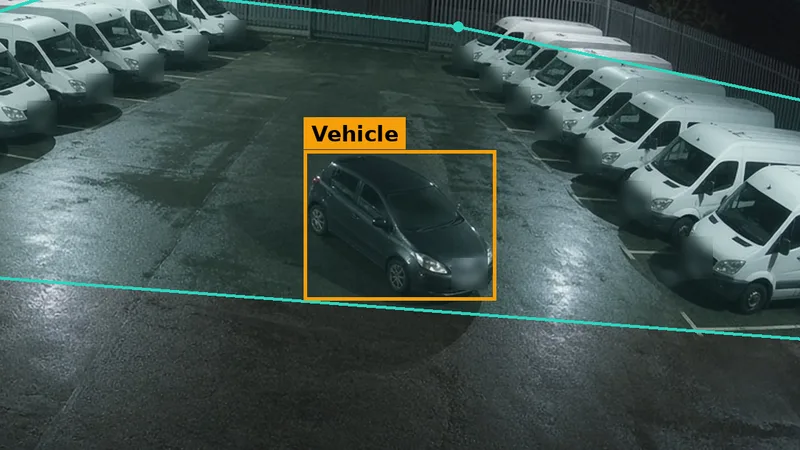
AI video detection changes what existing cameras can do. Software watches the camera views and looks for the things you care about: people and vehicles where nobody should be after hours, and visible smoke and flame. When it sees them in an area that is armed, it sends an alert straight away with a snapshot, a short clip and a description of what the camera saw, so a keyholder or manager can check what is happening and call 999 if a crime is in progress.
With Woodcock AI, you draw polygon detection areas on each camera view around exactly what you want to watch, such as the van bays, the gate or the inside of the fence, and leave out what you do not, such as the public road or a neighbour's yard. You choose when each area is armed and who gets the alerts. For converter theft, the useful detections are people in a zone after hours, vehicles where they should not be, and people crossing a line such as the fence. The alert is about who is there, not about what they are cutting: the camera cannot see under a vehicle. But a person walking into a closed yard at 01:00 is the warning that matters.
Three areas worth watching
Choose an area below to see what a camera view of it might look like and how a detection zone could be set up.
Which area?
The parking rows are where the theft happens, so a camera view along the rows is the most useful one you can have. Draw a zone over the bays and the ground beside them and arm it after the last vehicle is due back. A person or a vehicle among the parked vans at night is not normal, and an alert with a clip lets the keyholder see what is going on while there is still time to call 999.
People and vehicles, after close
In an office, hotel or hospital car park, cars are left overnight and the car park is quiet. A zone over the bays, armed from late evening to early morning, watches for people and vehicles among the parked cars. Think about who is normally there, such as night staff, hotel guests and cleaners, and set the schedule and the zone to suit, so that the alerts are about the unusual.
People and vehicles, overnight
If your vehicles are in a compound, the fence is the first line. A zone along the inside of the fence, or a line on the camera view that people should not cross after hours, watches for anyone climbing over or coming through a gap. It gives the earliest warning of all, before anyone reaches the vehicles, as long as the camera has a clear, well-lit view of the fence.
People crossing in, overnight
Each area needs its own zone and schedule.
Where should cameras watch?
Start from where your vehicles are parked overnight and how someone would reach them. In most yards that means a view along the parking rows; the gate and the entrance, for vehicles coming in after close; the fence line, especially any stretch out of sight of the road; and the approach road, if thieves could stop there. If you have EV chargers on site, a view of the charging bays can watch for people by the cables after hours, and for smoke and flame. Our camera placement guide explains how to choose and check views.
Not every camera is suitable. Detection needs a clear, stable view with enough light or good infrared at night, aimed so that people and vehicles in the zone are a reasonable size in the picture. A camera on the gate that only sees the road outside will not help with a thief already in the bays. Sometimes the answer is to re-aim a camera you already have; sometimes it is to add one with a better view of the rows.
What AI on your cameras cannot do
Be clear about the limits. Woodcock AI detects people and vehicles, and visible smoke and flame, in the zones you choose. It cannot see underneath a vehicle, so it cannot tell you that a converter is being cut; it tells you that someone is there. It does not read number plates and it does not recognise faces. It sees only what the camera sees, so a dark corner or a blocked view is a gap. And it is an addition to good parking, guards, marking, alarms, fences, lighting and your people, never a replacement for any of them. Someone still has to act on the alert.
What about false alerts?
Yards and car parks are busy with things that are normal: drivers returning late, early starts, cleaners, deliveries, foxes and cats, headlights from the road. Good set-up keeps false alerts down. Schedules keep zones off while people are expected, and on once the yard should be empty. Tight polygon areas cover the bays, not the public road or the pavement. Clean lenses and good lighting give the software the clearest view. And because Woodcock AI is self-learning, it gets better over time at knowing what is normal on each camera. Our guide to reducing CCTV false alarms goes into more detail.
A worked example
Here is how this might look for a fictional community transport charity with fourteen minibuses parked overnight in a fenced yard beside its office, and four cameras: one along the minibus bays, one on the gate, one on the far fence and one on the office door. It is an example, not a real business. The gate is locked at 19:00 and zones over the bays, the gate and the fence are armed until 06:00. The last driver parks to the plan, signs the close-down sheet and leaves by the side door at 19:20. At 01:12, a dark car with its lights off rolls in through a gap beside the gate and stops in the lane between the two rows of minibuses. The vehicle zone over the bays sees it, and within a minute the alert reaches the operations manager, who is the keyholder that week, with the clip and a description. She watches the clip at home, sees two people getting out with a bag, and calls 999. Nobody goes to the yard. The police are on their way while the thieves are still there; whether they arrive in time, nobody can promise, but the clip is ready for them either way.
The next morning, the manager looks at what happened. The gap beside the gate was wide enough for a car, and the minibuses at the end of the row were parked with their converter ends towards the open yard. The gap is closed, the parking plan is changed, guards are booked for the highest minibuses, and the marking records are checked. The camera did not stop anyone by itself. What it added was a warning while it was happening, and a clip for the police.
How Woodcock AI fits
Woodcock AI connects to existing IP cameras and runs on an edge server on site or on a cloud server. It adds people and vehicle detection, and smoke and flame detection, to the cameras you already have. You draw polygon detection areas over the places that matter, choose when they are armed and who gets the alerts. Each alert has a snapshot, a short clip and an AI description of what the camera saw. For sites with lots of vehicles, our vehicle yards page shows how this looks in practice.
Woodcock AI is self-learning, so it gets better over time at knowing what is normal on each camera. It is the result of years of development and is now in use on real sites in the UK. It works alongside your parking plan, guards, marking, alarms, fences, lighting and people rather than replacing them. Ask your cameras (Coming soon, early 2027) will let you ask questions about what your cameras have seen in plain words.
Ways to start
Book a site assessment. We look at what your cameras see by day and after dark, and show where zones would help, such as the parking rows, the gate and the fence line. Or ask for a live test on your cameras: we connect two or three of your existing cameras for about a fortnight, so you can see the alerts for yourself. We are also happy to arrange an on-site demo.
Sources
- Police.uk, Catalytic converter theft (crime prevention advice).
- Secured by Design, Catalytic converter theft: how to prevent it, Catalytic converter crime prevention advice and Security standards explained (including Sold Secure grades).
- Auto Express, Britain's catalytic converter theft epidemic nearly over, October 2025, Freedom of Information figures from 30 UK police forces and comments from the National Police Chiefs' Council.
- Office for National Statistics, Crime in England and Wales: year ending June 2026.
- Devon and Cornwall Police, Freedom of Information disclosure: catalytic converter theft, July 2026; Police Service of Northern Ireland, Freedom of Information disclosure: catalytic converter theft.
- Scrap Metal Dealers Act 2013, section 12 (legislation.gov.uk).
- Information Commissioner's Office, Guidance on video surveillance, including CCTV.
- Reports of 2026 incidents and police advice: The News, Hampshire; Advertiser and Times, New Forest; Bracknell News, Bracknell and Slough; BBC News, Oxford; the operator's own social media post, Bristol, February 2026; Kidderminster Standard, Kidderminster; Swindon Advertiser, Swindon; St Helens Star, St Helens; Grampian Online, Banff; Civil Society, Edinburgh.
We have summarised these sources in our own words. Figures for converter theft vary between forces because of how crimes are recorded, so treat them as a guide to the trend, not an exact count. The Scrap Metal Dealers Act 2013 applies in England and Wales; Scotland and Northern Ireland have their own rules. Check the advice of your local police force, your vehicle maker and your insurer. This page is general guidance, not legal or insurance advice. If a crime is in progress, always call 999.
Who is in your yard at 2am?
Book a site assessment and we will look at what your cameras see by day and after dark, and show where zones would help over the parking rows, the gate and the fence line, or ask for a live test on your cameras.
Related pages
Frequently asked questions
How do you stop catalytic converter theft from business vehicles?
Use layers. Park to a plan, with converter ends against walls or in tight rows, and keep vehicles in a secure compound if you can. Fit guards approved by the vehicle maker and tested to Sold Secure Gold, mark and register converters at service, set alarms and fit tilt alarms to vans that lack one. Light the yard, lock the gate, and make sure someone is told fast if anyone is among the vehicles at night.
Which vehicles are most at risk of catalytic converter theft?
The police say hybrids are most often targeted, because their converters are used less and so are worth more. Vans, SUVs and 4x4s are at risk because their ride height makes the exhaust easy to reach. Diesels are at risk too: Secured by Design says diesel particulate filters with a built-in catalyst are being stolen, and a DPF was taken from a school minibus in Banff in October 2026.
Is catalytic converter theft still a problem in the UK?
Nationally it fell sharply: Freedom of Information figures from 30 forces show recorded thefts down from 6,909 in 2021 to 150 in 2024. But it has not gone away. Hampshire and Isle of Wight Constabulary said in March 2026 that reports so far that year were more than six times the 2025 total, and fleets, ambulances, minibuses and charity vans were hit across the UK in 2026.
What should I do if I see someone stealing a catalytic converter?
Call 999 if it is happening now. Do not approach the suspects: police.uk warns they have been known to use violence. If it is safe, watch from a distance and note what you can, such as the time, descriptions and their vehicle. Keep any CCTV footage. If you find the theft afterwards, report it online or by the police non-emergency number and do not drive the vehicle.
Does marking a catalytic converter help?
Yes. Unmarked converters are very hard to match back to a vehicle, so marking makes them harder to sell and easier to trace. Police.uk advises registering and forensically marking the converter. Secured by Design says to use an approved, heat-resistant marking product, best applied by a garage when the vehicle is serviced. For a fleet, add it to the service schedule and record each code.
Can AI on existing CCTV help prevent catalytic converter theft?
Yes, as an addition, never a replacement. Woodcock AI runs on an edge server on site or on a cloud server and watches polygon zones you draw over parking rows, gates and fence lines, armed after hours. It alerts with a clip when a person or vehicle is there. It cannot see under a vehicle, does not read number plates, and someone still has to respond by calling 999.
Last reviewed 3 November 2026