

Fire safety in flats: regulations, doors and evacuation
Fire safety in flats means the precautions that protect people living in a building shared by many households: each flat built as a fire-resisting compartment, fire-resisting flat entrance doors and communal fire doors that close and seal, a protected and lit escape stair kept clear of smoke and clutter, smoke alarms in every flat, an evacuation strategy (usually stay put) explained to residents, a current fire risk assessment recorded in full, and control of risks like e-bikes, bin stores and deliberate fires. In England and Wales, the Fire Safety Order covers the common parts, structure, external walls and flat entrance doors, but not the inside of flats. AI on existing CCTV can add early warning outside, but never replaces any fire precaution.

What fire safety in flats means
Fire safety in flats is about one simple idea: many households share one building, and a fire in one flat, or in the shared parts, must not trap the people in the others. A block of flats is designed so that each flat is a fire-resisting box. If a fire starts inside a flat, the walls, floors and the flat entrance door should hold it there long enough for the people in that flat to get out and for the fire and rescue service to put it out. The corridors, lobbies and stairs that everyone uses to get out must stay clear, protected from smoke and lit. And the outside of the building, the walls, the windows and the balconies, must not let a fire spread from floor to floor.
All of this depends on people. The building owner or management company has to check the fire doors, keep the shared areas clear, look after the fire safety equipment and make sure there is a current fire risk assessment. Residents have to keep their own front door shut and working, not store things in the corridor, charge e-bikes and scooters safely, and know what to do if there is a fire. When any one part fails, such as a front door wedged open, a pushchair and a pile of boxes on the landing, or a smouldering bin under a window, the whole plan for the building can fail with it.
This guide explains how fire safety works in blocks of flats in the UK. It covers the law and who is responsible, the extra duties that apply to taller buildings, the fire risk assessment, the evacuation strategy, fire doors, alarms, lighting and signs, the everyday risks in shared and outside areas, and a checklist you can use. At the end, it explains where AI on existing CCTV can help, by watching outside areas like bin stores, cycle stores and car parks at night, and where it cannot.
Who this guide is for
This guide is written for the people who run blocks of flats: freeholders and landlords, resident management companies, right to manage companies, managing agents, and housing associations and councils with flats to look after. It is also useful for residents and leaseholders who want to understand what should be happening in their building and what they can ask for. It covers purpose-built blocks, which is what most people mean by a block of flats, and also touches on houses that have been converted into flats and flats above shops, where the rules work slightly differently.
Most of the detail is about England, where the newest rules apply. Wales shares much of the same law but not all of it, and Scotland and Northern Ireland have their own laws. Where the rules differ, the guide says so. It is general information, not legal advice for your building. Your fire risk assessor, your local fire and rescue service and your own advisers can tell you exactly what applies to you.
Why blocks of flats are different
Government fire statistics show that most fire deaths in England happen in people's homes, and a fire at night, when people are asleep, is slow to be noticed. In a house, a family can usually get out through the front or back door. In a block of flats, many households share the same corridors and, in many blocks, a single staircase. If that stair fills with smoke, or is blocked by stored things, there may be no other way out except through the windows. That is why the design of the building and the way it is managed matter so much more than in a single house.
Control is also split. Each flat is a private home, and the people who live there decide what goes on inside it: cooking, heating, smoking, what they plug in and charge. The common parts, the shared corridors, stairs, lobbies, bin stores, car parks and plant rooms, are the responsibility of the building owner or management company. The fire safety of the building depends on both doing their part, and on clear information passing between them. A good fire safety plan for a block of flats is as much about people and communication as about doors and alarms.
The law on fire safety in flats
There is no single law called "fire safety in flats". Instead, several laws work together, and which parts apply depends on where the building is, how tall it is and who owns and runs it. In England and Wales, the main one is the Regulatory Reform (Fire Safety) Order 2005, usually called the Fire Safety Order. It applies to the parts of a block of flats that residents share, and it puts the duties on a "responsible person". It does not apply to the inside of individual flats, which are private homes.
Since 2005, the Fire Safety Order has been added to several times. The Fire Safety Act 2021 made clear that, in any building with two or more homes, the order covers the structure, the external walls and the doors into each flat. The Fire Safety (England) Regulations 2022 added practical duties on fire doors, information for residents and extra measures for taller buildings. The Building Safety Act 2022 changed the order again, on records, competence and information, and set up a new regime for the tallest blocks. And the Fire Safety (Residential Evacuation Plans) (England) Regulations 2025 added duties to help residents who would struggle to get out on their own.
Who is the responsible person?
The Fire Safety Order puts its duties on the responsible person. For a block of flats, that is usually the person or organisation that has control of the common parts, which normally means the freeholder, or a management company where the leases give it the job of running the building. That might be a resident management company owned by the leaseholders, a right to manage company, or a council or housing association for social housing. A managing agent may also have duties where its contract gives it control of fire safety in the building.
In many blocks, more than one person has some control. A freeholder might own the building while a management company runs it, and a commercial tenant might run the shop on the ground floor. Where that happens, each of them has duties for the parts they control, and the order requires them to cooperate and share information. The key is to be clear, in writing, who does what: who commissions the fire risk assessment, who checks the doors, who looks after the fire alarm in the shop and who tells residents what to do. Most enforcement problems in flats begin with nobody being sure whose job something was.
The Fire Safety Act 2021
The Fire Safety Act 2021 is short, but it matters a great deal to blocks of flats. It added two paragraphs to article 6 of the Fire Safety Order. Where a building contains two or more sets of domestic premises, the order now clearly applies to the building's structure and external walls, including doors and windows in those walls and anything attached to them, such as balconies, and to all doors between the flats and the common parts, including flat entrance doors. It came into force in England on 16 May 2022, and in Wales on 1 October 2021.
In practice, this means the fire risk assessment for a block must now take account of the external walls and the front doors of the flats, not just the stairs and corridors. For most low-rise brick blocks, the assessor can deal with the external walls on a visual check as part of the normal assessment. Where there is reason to think the walls might help fire spread, such as combustible cladding or insulation, the government's factsheet on the Act points to a more detailed appraisal of the external walls, carried out under the British Standards Institution's PAS 9980 code by someone competent to do it.
What about the inside of each flat?
The inside of each flat is not covered by the Fire Safety Order. But that does not mean nobody is responsible. If the flat is rented, the landlord has duties of its own. In England, the Smoke and Carbon Monoxide Alarm (England) Regulations 2015, as amended in 2022, require private and social landlords to fit at least one smoke alarm on each storey of a home used as living accommodation, to fit a carbon monoxide alarm in any room with a fixed combustion appliance (other than a gas cooker), and to repair or replace alarms once told they are faulty. Under the Housing Act 2004, councils can take action against landlords where fire is a serious hazard in a rented home.
Owner-occupiers decide for themselves what goes on in their own flat, but their lease will usually say they must not do anything that puts the building at risk, such as removing the self-closer from their front door or replacing it with one that is not a fire door. In practice, the most useful thing any resident can do is fit and test smoke alarms, keep the front door closing properly, plan how they would get out and take care with cooking, smoking, heaters and battery charging. Fire and rescue services offer home fire safety visits, and many target older or disabled residents.
Who enforces the rules?
The local fire and rescue service enforces the Fire Safety Order in the common parts of blocks of flats. Inspectors carry out audits, often after a complaint, a fire or as part of a planned programme for higher-risk buildings. Most problems are dealt with by advice and an agreed plan. Where the risk is serious, the fire service can serve an enforcement notice, which sets a deadline for the work, or a prohibition notice, which can stop part of the building being used. Failing to meet the duties is a criminal offence, and serious cases go to court.
For the tallest blocks, the Building Safety Regulator oversees the new higher-risk building regime set up by the Building Safety Act 2022. Councils deal with housing standards in rented flats under the Housing Act 2004, and with houses converted into flats that count as houses in multiple occupation. Responsible persons should keep their records in good order, because the first thing any inspector will ask for is the fire risk assessment and the evidence that its action plan has been followed.
The Fire Safety (England) Regulations 2022
The Fire Safety (England) Regulations 2022 came into force on 23 January 2023. They apply only in England, and they put specific, practical duties on the responsible person for blocks of flats. The duties come in tiers. Some apply to every building with two or more flats that share parts residents would use to escape. More apply where the top storey is over 11 metres high, which is typically a building of more than four storeys. The most apply to high-rise buildings, which the regulations define as at least 18 metres high or with at least seven storeys. The government's guidance page sets out each duty with a separate factsheet.
The height is measured from ground level to the top of the floor surface of the top storey, not to the roof, so a building that looks tall may still fall below a threshold, and the other way round. If you are not sure which tier your building falls into, your fire risk assessor can tell you, and the government guidance explains how to measure.
Duties for every block of flats
In every block with two or more flats and common parts that residents would use to escape, regulation 9 requires the responsible person to give residents fire safety instructions. These must explain, in a way residents can understand, the evacuation strategy for the building, how to report a fire, and anything else residents need to do once a fire has happened. They must be displayed in a conspicuous part of the building and given to each new resident as soon as reasonably practicable after they move in, and again whenever they change.
Regulation 10 adds information about fire doors. Residents must be told that fire doors should be kept shut when not in use, that they and their guests should not tamper with self-closing devices, and that they should report any fault or damage to a door straight away. This must go to new residents as soon as they move in and to all residents at least every 12 months. Many responsible persons combine the two into one short, clear leaflet, with a copy displayed by the main entrance and in each lobby, and translated where residents need it.
Fire door checks in blocks over 11 metres
Where the building is over 11 metres high, regulation 10 also requires checks of the fire doors. The responsible person must check all fire doors in the common parts at least every three months. These include doors to stairs and lobbies, doors that divide corridors, and doors to cupboards, plant rooms and service risers, which should be kept locked shut. They must also use best endeavours to check every flat entrance door at least every 12 months, and keep a record of what they did, including the steps taken when a resident would not give access.
A check means looking at the door and making sure it still works: that it closes fully into its frame from any angle, that the self-closer works, that the intumescent strips and smoke seals are in place and undamaged, that the gaps are not too big and that the hinges, glazing and letterbox have not been damaged or changed. The checks are not a full survey, and anything that looks wrong should be put right by someone competent. Our guide to fire door regulations explains what to look for in more detail.
Extra duties in high-rise blocks
High-rise blocks, at least 18 metres or seven storeys, have more duties under regulations 4 to 8. The responsible person must give the local fire and rescue service electronic copies of the floor plans and a single-page building plan, and information about the design and materials of the external walls, including the level of risk they present and any action taken. They must keep hard copies of the plans in a secure information box, install wayfinding signs that show the floor number and flat numbers on every landing and in every lift lobby, visible in low light or by torch, and check lifts for firefighters and key firefighting equipment every month.
Firefighting equipment here means things like dry and wet rising mains, smoke control systems, evacuation alert systems and fire suppression systems. If a firefighting lift or one of these pieces of equipment is out of order for more than 24 hours, the responsible person must tell the fire and rescue service, and tell them again when it is fixed. The results of the monthly checks must be made available to residents. These rules exist because, in a tall building, firefighters depend on the building itself to help them reach the fire and get people out.
The secure information box
The secure information box gives firefighters the key facts about the building in the first minutes after they arrive. Regulation 4 requires it in high-rise blocks, and building regulations guidance now recommends one in new blocks over 11 metres too. It must be somewhere firefighters can reach easily, usually by the main entrance, large enough for the documents, and reasonably secure from unauthorised access and vandalism. It must hold the name, address and contact number of the responsible person, contact details for anyone else who can give access to the building, and copies of the floor plans and the building plan.
The responsible person must give the fire service whatever it needs to open the box, inspect the box at least once a year and keep the information up to date. It is worth adding a box check to the same visit as the monthly or quarterly checks, so it is never forgotten.
The Building Safety Act and higher-risk buildings
The Building Safety Act 2022 set up a new regime for the tallest residential buildings. Under section 65 and the government's criteria, an occupied building is a higher-risk building if it is at least 18 metres high or has at least seven storeys, and contains at least two residential units. Higher-risk buildings must be registered with the Building Safety Regulator. Each has one or more accountable persons, with a principal accountable person, who must assess and manage the building safety risks of fire spread and structural failure, keep information about the building, and prepare a safety case report.
The accountable person must also give residents information about the building's safety and run a resident engagement strategy, so residents can have their say and raise concerns. The regime sits alongside the Fire Safety Order rather than replacing it. In many buildings, the accountable person and the responsible person are the same organisation, and the fire risk assessment is one of the key documents in the safety case. The Act also changed the Fire Safety Order for every building: since 1 October 2023, all fire risk assessments must be recorded in full, anyone helping the responsible person must be competent, and residents must be given information about the fire risks and precautions in the building.
Wales, Scotland and Northern Ireland
Wales shares the Fire Safety Order and the Fire Safety Act 2021 with England, but the 2022 England Regulations and the 2025 evacuation plan rules do not apply there. The Welsh Government is putting its own building safety regime in place, so check its current guidance. Since 1 January 2016, new homes in Wales, including flats, and buildings converted into homes have needed an automatic fire suppression system, usually sprinklers, under regulation 37A of the Building Regulations 2010 as they apply in Wales. In Scotland, fire safety in common parts is dealt with under Scottish law, and all homes must have interlinked fire and smoke alarms, and a heat alarm in the kitchen, under the tolerable standard in force since 1 February 2022. The Scottish Government publishes practical fire safety guidance for existing high-rise domestic buildings.
Northern Ireland has its own fire safety law and guidance, enforced by the Northern Ireland Fire and Rescue Service. The principles are the same in every nation: protect the escape routes, keep fire inside the flat where it starts, give residents clear information, and keep the building's fire safety measures working. But the detail, the forms and the enforcers differ, so always check the guidance for the nation your building is in.
The fire risk assessment for a block of flats
Every block of flats with common parts covered by the Fire Safety Order needs a suitable and sufficient fire risk assessment. It is the starting point for everything else. The assessment looks at what could start a fire in the common parts, what would burn, who would be at risk and how they would escape, and then checks whether the fire precautions in the building are good enough. It ends with an action plan, listing what needs to be done, by whom and by when, in order of priority.
Since 1 October 2023, under changes made by section 156 of the Building Safety Act 2022, every responsible person must record the whole fire risk assessment, not just the significant findings, and record the fire safety arrangements for the building. They must also record the name of anyone they appoint to help with the assessment. Our guide to fire risk assessments explains the general process. This section covers what is different for blocks of flats.
Type 1 to Type 4 assessments
The government guide, Fire safety in purpose-built blocks of flats, describes four types of fire risk assessment. A Type 1 assessment covers the common parts only and is non-destructive. The assessor looks at the building without opening up walls or ceilings, but does look at a sample of flat entrance doors from both sides, as far as possible. A Type 2 assessment is the same, but includes some destructive inspection, such as opening up a sample of walls or ceilings to check the fire-stopping behind them. A Type 3 assessment covers the common parts and the inside of some flats, without opening anything up, and a Type 4 covers both, with destructive inspection.
The guide says a Type 1 assessment is normally enough for most purpose-built blocks. A more detailed type may be needed where there is reason to doubt the compartmentation, such as poor-quality works in the past, or where the evacuation strategy needs to be checked, for example because the building has been changed or has a history of fire spreading. A Type 3 or Type 4 assessment goes beyond what the Fire Safety Order requires, and needs residents' cooperation to get into their flats, so it is normally done only where the assessor or the fire service has a specific concern.
Choosing a competent assessor
The law requires that anyone who helps the responsible person with the fire risk assessment is competent, meaning they have enough training and experience or knowledge to do it properly. Blocks of flats can be more complex than they look, with hidden voids, service risers, past alterations and external walls to consider, so it is sensible to use an assessor who works on flats regularly. The government has published a guide on choosing a competent fire risk assessor, and many responsible persons look for an assessor who is registered with a professional body or works for a third-party assured company.
A good assessor will be clear about the limits of their competence. For example, a general fire risk assessor may be able to check the external walls of a low-rise brick block visually, but should recommend a specialist appraisal of the external walls under PAS 9980 where there is cladding or other combustible material and the risk is not clear. Ask the assessor before they start what type of assessment they will do, how they will deal with the external walls and flat entrance doors, and when they will deliver the written report.
Keeping the assessment up to date
A fire risk assessment is not a one-off. The law requires it to be reviewed regularly and whenever there is reason to think it is no longer valid, or there has been a significant change. That includes after a fire or a near miss, after building works that change the doors, walls or alarm system, when the evacuation strategy changes, when a shop or other business opens in the building, and when new flats are added. Many responsible persons review the assessment of a typical block every year or two, and more often for taller or more complex blocks, but the right interval depends on the building and should be set by the assessor.
Just as important is working through the action plan. An assessment with a long list of overdue actions is worse than useless in front of an inspector, because it shows the responsible person knew about the problems and did not fix them. Keep a simple log that records each action, when it was done and by whom, alongside the door checks, the alarm and emergency lighting tests and the information given to residents. Our guide to the fire safety log book shows a simple way to do this.
The evacuation strategy for a block of flats
Every block of flats needs an evacuation strategy, which is the plan for what residents should do if there is a fire. It is decided by the fire risk assessment and must match how the building is built. There are two main strategies in blocks of flats. Under "stay put", residents of the flat where the fire is leave, and everyone else stays in their own flat unless the fire or smoke affects them. Under "simultaneous evacuation", everyone leaves the building when the alarm sounds. Some buildings use a temporary change of strategy while defects are fixed, and a few larger or more complex buildings use a phased or partial approach set by their design.
The strategy must be written down, explained to residents in the fire safety instructions and shared with the fire and rescue service. It should be reviewed whenever the building changes. Our guide to fire evacuation plans explains the general principles of planning an escape. This section covers how they apply in blocks of flats.
How stay put works
Most purpose-built blocks of flats in England are designed for stay put. The government guide explains why. Each flat is built as a fire-resisting compartment, so a fire in one flat should not spread to others or into the common parts before the fire service puts it out. The people in the flat where the fire started get out, shut their front door behind them and call 999. Everyone else is safer staying inside their own flat, behind their own fire door, than crowding into a stair that firefighters need to use. If smoke or fire reaches their flat, or they are told to leave by the fire service, they should get out.
Stay put does not mean "never leave". Residents can always choose to get out if they feel unsafe, and the escape routes must be kept clear so they can. Because the strategy depends on the building, blocks designed for stay put usually do not have a communal fire alarm, since sounding an alarm on every floor would send everyone into the stair. Instead, each flat has its own smoke alarms, and the common parts are protected by fire doors, fire-resisting walls and smoke ventilation.
When everyone needs to leave
Stay put only works if the compartmentation is sound. If the fire risk assessment finds serious defects, such as flat entrance doors that are not fire-resisting, gaps in fire-stopping between flats, or external walls that could let fire spread up the building, stay put may no longer be safe. In that case, the responsible person may need to change to a simultaneous evacuation strategy, at least until the defects are fixed. This is a serious decision. It should be made with advice from a competent fire safety professional and in discussion with the fire and rescue service.
A temporary change to simultaneous evacuation normally means fitting a communal fire alarm, designed to the right standard, so everyone hears it, and sometimes, for a short time until the alarm is in, trained people patrolling the building to raise the alarm. The National Fire Chiefs Council publishes guidance on this. Simultaneous evacuation is also normal in some converted houses and small blocks where the layout means stay put cannot be relied on. Our guide to HMO fire safety covers converted buildings in more detail.
Residential evacuation plans for residents who need help
Some residents would struggle to get out of a building on their own, because of a mobility problem, a sight or hearing impairment or a cognitive condition. The Fire Safety (Residential Evacuation Plans) (England) Regulations 2025 came into force on 6 April 2026. They apply in England to high-rise blocks of at least 18 metres or seven storeys, and to blocks over 11 metres that have a simultaneous evacuation strategy, including a temporary one. In these buildings, the responsible person must take reasonable steps to identify residents who would have difficulty evacuating by themselves.
If a resident asks, the responsible person must carry out a person-centred fire risk assessment with them, a conversation to understand their particular risks, and take reasonable and proportionate steps to reduce them. They must use reasonable endeavours to agree an emergency evacuation statement with the resident, setting out what they should do in a fire. With the resident's explicit consent, key information goes to the fire and rescue service, and the assessment and statement must be reviewed at least every 12 months. The buildings covered must also have a building emergency evacuation plan. The government guidance and toolkit explain each step. These are new duties, so check the guidance as it develops.
Evacuation alert systems
Since 1 December 2022, building regulations guidance in England has said that new blocks of flats over 18 metres should have an evacuation alert system designed to BS 8629, as explained in the government's update to Approved Document B. This is not a fire alarm. It does not go off automatically when there is smoke. It is a system the fire and rescue service can use, from a control panel near the entrance, to sound an alert in particular flats or floors and tell residents to leave, if they decide during a fire that a stay put building now needs to be evacuated.
Where a block has an evacuation alert system, it counts as key firefighting equipment for the monthly checks in high-rise blocks, and residents must know what the alert sounds like and what to do when they hear it. Responsible persons with older blocks are not required by these rules to fit one, but the fire risk assessment and the fire service may consider whether it is needed for a particular building.
Telling residents what to do
The best evacuation strategy fails if residents do not know it. The fire safety instructions required in England should be short, clear and practical. Tell residents what the strategy is, what to do if there is a fire in their flat, what to do if they hear or see a fire elsewhere, how to call 999 and give the address of the building, and why they must keep fire doors shut and the common parts clear. Use simple language and pictures, and offer translations and accessible formats where residents need them.
Repeat the key messages often, not just once a year. Notices in lobbies and lifts, a short leaflet with the annual information, messages in residents' newsletters and a talk at the residents' meeting all help. Our guide to fire safety signs covers the signs needed in the common parts, and our fire safety training guide covers training for caretakers, concierge and staff who work in blocks of flats.
Fire protection in a block of flats
A block of flats protects its residents with several layers, each backing up the others. The first is compartmentation: the walls and floors between flats, and between flats and the common parts, are built to resist fire for a set time. The second is the doors, because every door into a flat or a stair is a gap in a fire-resisting wall. The third is smoke control, which keeps the escape stair clear. The fourth is detection, warning and lighting, so people know there is a fire and can see to get out. The fifth is the equipment that helps firefighters do their job.
The fire risk assessment checks each layer. Most problems found in blocks of flats are not dramatic. They are holes drilled through compartment walls for new cables or pipes and never sealed, front doors replaced with ordinary doors, closers removed because they were "too heavy", vents that no longer open, and store cupboards filled with rubbish. Each one weakens a layer, and together they can turn a fire that should have stayed in one flat into one that threatens the whole building.
Flat entrance doors
The front door of each flat is one of the most important fire safety features in the building. In a stay put block, it is what stops smoke and fire from a flat getting into the corridor and stair, and what protects the residents of other flats if the fire is in the common parts. It should be a fire-resisting door, normally to at least a 30-minute standard, with a self-closing device that pulls it shut from any open position, intumescent strips and smoke seals in good condition, and a frame, hinges, glazing and letterbox that do not weaken it.
Because the Fire Safety Act 2021 brought flat entrance doors into the Fire Safety Order, the responsible person must now consider them in the fire risk assessment, even though the door may belong to the leaseholder under the lease. Replacing a front door with one that is not fire-resisting, or removing the closer, is one of the commonest problems in blocks of flats. Residents should ask the managing agent before changing their door, and the responsible person should check a sample of doors and act on what they find. The fire door regulations guide has more detail.
Communal fire doors
The communal fire doors are the doors in the common parts: the doors onto the stair, the doors between corridors and lobbies, the doors to bin stores, plant rooms and meter cupboards, and the doors that divide long corridors into sections. They keep smoke out of the escape route and stop a fire spreading along a corridor. In blocks over 11 metres in England, they must be checked at least every three months. In every block, they should be part of the regular checks.
The commonest fault is simple: a door wedged or propped open, because residents or contractors find it awkward to carry things through. Others are broken or disconnected closers, damaged or missing seals, holes made for new cables or door entry equipment, and doors that have dropped on their hinges and no longer close into the frame. Where a door needs to be held open for good reason, a hold-open device linked to the fire detection system can be fitted, so it closes automatically when smoke is detected.
Protected stairs and smoke control
In most blocks of flats, the stair is the only way out, and in a fire it is also the way firefighters come in. It is a protected route, built with fire-resisting walls and doors. To keep smoke out, most blocks have some form of smoke ventilation. In small older blocks, this may be an openable window or a vent at the top of the stair, opened by the fire service. In newer and taller blocks, it is often an automatic opening vent, which opens when smoke detectors in the common parts sense smoke, sometimes with vents in the lobbies on each floor or a mechanical system.
Smoke ventilation is only useful if it works. Vents should be tested regularly and serviced at least once a year by a competent contractor, following the maker's instructions and the relevant standard, and the results recorded. A vent that is stuck shut, blocked by stored items or switched off because it kept opening in the wind will not keep the stair clear when it is needed. In high-rise blocks, smoke control systems count as firefighting equipment for the monthly checks.
Smoke alarms and fire alarms in flats
Most people expect a block of flats to have a fire alarm that sounds throughout the building. In most purpose-built blocks with a stay put strategy, it does not, and that is deliberate. As the government guide explains, a communal alarm would send everyone into the stair at once, causing the crowding that stay put is designed to avoid, and false alarms would soon teach residents to ignore it. Instead, each flat has its own smoke alarm, or an interlinked set of alarms with a heat alarm in the kitchen in newer flats, so the people in the flat where the fire starts are warned early. Detectors in the common parts are often fitted only to open the smoke vents.
A communal fire alarm is needed where the strategy is simultaneous evacuation, in some converted houses, and where a shop, restaurant or other business on the ground floor has its own alarm system. The business must still have its own fire risk assessment. Our guide to commercial fire alarm systems explains the types and standards. One gap is worth noting: the detectors in a typical block cover the inside of the flats and sometimes the stair, but rarely the outside bin store, cycle store or car park, which is where many deliberate and accidental fires begin.
Emergency lighting, signs and wayfinding
Escape routes in the common parts should have emergency lighting, so residents can see their way out if the power fails during a fire, especially in internal corridors and stairs without daylight. Emergency lights should be tested monthly with a short flick test and given a full-duration test each year, with the results recorded. Our guide to emergency lighting regulations explains the testing in detail. Exit signs are needed where the way out is not obvious, and "fire door keep shut" signs should be on communal fire doors.
In high-rise blocks in England, the 2022 Regulations also require wayfinding signs on every landing and in every lift lobby, showing the floor number and which flats are on that floor, so firefighters can find their way in smoke. They must be visible in low light or by torch. Many responsible persons of lower blocks fit similar signs because they help both firefighters and residents.
Equipment for firefighters
Taller blocks are fitted with equipment to help the fire and rescue service. Dry rising mains are empty pipes running up the building that firefighters connect to at ground level to get water to upper floors. Firefighting lifts let firefighters reach upper floors safely. In England, building regulations guidance has recommended sprinklers in new blocks of flats over 11 metres since 26 November 2020, as set out in the Approved Document B update. Sprinklers may also be fitted in older blocks where the fire risk assessment or the owner's own plans call for them.
All of this equipment must be maintained and tested, and in high-rise blocks it must be checked monthly, with faults lasting over 24 hours reported to the fire service. The responsible person should also keep access for fire engines clear. Residents and visitors parking on access roads or across dry riser inlets, and gates that firefighters cannot open, slow the response. Our guide to fire extinguisher types covers extinguishers, which are not usually provided in the common parts of blocks of flats, because residents are expected to get out rather than fight a fire.
External walls, windows and balconies
The Fire Safety Act 2021 made clear that the external walls of a block of flats, including windows, balconies and anything attached to the walls, are part of the fire risk assessment. For most traditional brick or block buildings, the assessor can deal with the external walls on a visual check. Where there is cladding, insulation, timber or other material that could help fire spread, the assessor should recommend a fire risk appraisal of the external wall under PAS 9980, carried out by a competent specialist, and the action plan should follow its findings.
Balconies need particular care. Combustible decking or balustrades, stored items, gas barbecues and patio heaters, smoking and stored e-bikes can all start or spread a fire on the outside of the building, where internal compartmentation does not help. Many leases and building rules ban barbecues and storage on balconies for this reason. The responsible person should explain any balcony rules clearly to residents and consider them in the fire risk assessment.
Everyday fire risks in and around blocks of flats
Many fires in blocks of flats start inside a flat, often in the kitchen, and the compartmentation is designed to hold them there until the fire service arrives. But the responsible person also has to manage the risks in and around the shared parts of the building. These are where clutter builds up, where e-bikes are left to charge, where bins overflow and rubbish is dumped, and where deliberate fires are set. They are also the places the fire precautions in a typical block are least likely to cover.
Keeping the common parts clear
The government guide describes two ways of managing the common parts. Under "zero tolerance", nothing at all may be stored or left in corridors, lobbies and stairs. Under "managed use", some items, such as doormats, a small plant or framed pictures, may be allowed under clear rules, provided they do not add to the fire risk or block the route. The fire risk assessment should say which approach the building uses. Zero tolerance is simpler to explain and check, and is often recommended where there is only one stair.
Whichever approach is chosen, it has to be checked and enforced. Bikes, pushchairs, shoe racks, boxes and furniture left in corridors can burn, block the route and trip people escaping in smoke. Regular inspections, polite but firm letters, a deadline for removal and, as a last resort, removing items under the lease all play a part. Mobility scooters need special care: they should be stored and charged in a suitable, separate space, not in the stair or the corridor.
E-bikes and e-scooters
Fires involving the lithium batteries in e-bikes and e-scooters have become one of the biggest concerns for blocks of flats. When a damaged, poor-quality or wrongly charged battery fails, it can burst into flames with little warning, burn very fiercely and give off toxic smoke. A fire like that in a corridor, a stair or a bin store can block the only way out. The London Fire Brigade's guidance for responsible persons sets out practical steps for buildings, and it is useful wherever your block is.
The key steps are to make sure e-bikes and e-scooters are never stored or charged in corridors, stairs or other escape routes, to consider a suitable storage area, such as a separate, well-ventilated store away from the building or protected by fire-resisting construction, and to give residents clear advice: buy from reputable sellers, use the right charger, never charge overnight or while out, never tamper with the battery, and stop using a battery that is damaged, swollen or getting hot. Include the advice in the annual fire door and safety information.
Bin stores and refuse chutes
Bin stores are one of the commonest places for fires to start around blocks of flats, both accidental, from hot ashes, cigarette ends, batteries or barbecue coals thrown away, and deliberate. A bin store should be away from the building, or a separate fire-resisting room with its own door, so a fire in it cannot spread into the flats or the escape routes. Doors and gates should be kept shut and locked where possible, the bins emptied often, and overflowing rubbish and fly-tipped items cleared quickly.
Older blocks may have refuse chutes, with a hopper on each floor and a bin chamber at the bottom. The hoppers should close properly, the chute should be kept clean and in good repair, and the bin chamber should be kept clear and secure. Residents should be told what must never go down the chute or into the bins, especially batteries, vapes, hot ashes and barbecue coals. Our bin store fire safety guide goes into more detail.
Deliberate fires
Deliberate fires around blocks of flats usually use whatever is lying around: rubbish in a bin store, a mattress dumped by the back door, a bike in an unlocked store or a pile of post in a lobby. Most can be prevented by good management. Keep doors, gates and bin stores secure. Clear rubbish and dumped items quickly. Light the outside of the building well at night. Keep the door entry system working, and remind residents not to let strangers in behind them. Report damage and dumped items, and work with the police and the fire service where there is a pattern.
Cameras help in two ways. They put off some people, and they help the police after the event. Most cameras at blocks of flats are recorded but not watched, so a fire set at the back of the building at night can grow for some time before anyone notices. Our guide to arson prevention and CCTV covers the options, and our block of flats security guide covers access, cameras and door entry.
Car parks, cycle stores and EV charging
Many blocks have an undercroft or basement car park underneath, a surface car park beside them and a cycle store nearby. An undercroft car park is effectively part of the building, so a car fire or a fire in rubbish dumped there can affect the flats above. It should be separated from the flats by fire-resisting construction, kept clear of dumped items and well lit, and included in the fire risk assessment. Cycle stores are increasingly full of e-bikes and e-scooters, so they need the same care as any other place where batteries are kept.
Electric vehicle chargers are being added to many car parks. They should be installed, tested and maintained by competent electricians to the relevant standards, with clear rules for residents, and their location considered in the fire risk assessment, especially in enclosed car parks. Keep the fire service access roads and gates working, and make sure the fire service can reach the car park entrance.
Contractors and works in the building
Many breaches of compartmentation in blocks of flats are made by contractors: a hole drilled through a wall for a new cable, a ceiling opened for a pipe, or a fire door propped open while materials are carried through, and never put right. Make sure every contractor working in the common parts or the risers knows the fire safety rules for the building. Require a permit for hot work, such as welding, cutting and soldering, with a check of the area after the work is finished, and require that any new hole through a fire-resisting wall or floor is sealed with a suitable fire-stopping product before they leave.
Works inside flats can affect the whole building too. Leaseholders and landlords should be reminded that they need consent before changing the front door, removing walls or adding new openings, and that any fire-stopping they disturb must be put back properly. A short check of the common parts after major works is a simple way to catch problems before they are forgotten.
Converted houses and flats above shops
Not every building with flats is a purpose-built block. Many houses have been converted into flats over the years, and the quality of the conversion varies widely. Some were done well to building regulations of the time; others have thin floors and walls between flats and ordinary front doors. In these buildings, stay put may not be safe, and a communal fire alarm and simultaneous evacuation may be needed. Some converted buildings that do not meet building regulations count as houses in multiple occupation under the Housing Act 2004, and councils have powers over them. Our HMO fire safety guide explains these rules.
Flats above shops, pubs and restaurants raise their own issues. The flats must be properly separated from the business below by fire-resisting construction, the escape route from the flats should not pass through the business, and the two responsible persons, the business and the owner of the flats, must cooperate and share information. A kitchen fire in a takeaway at night, with the flats above full of sleeping people, is exactly the scenario both fire risk assessments need to plan for.
What residents should do
Residents are part of fire safety in their building. Fit smoke alarms in your flat if you own it, test them every month and ask your landlord to fix them if you rent. Keep your front door closing properly, and never remove the closer or wedge it open. Keep corridors and stairs clear, charge e-bikes, scooters and other batteries safely, and never leave cooking unattended. Know the evacuation strategy for your building, and if there is a fire in your flat, get out, close the door behind you and call 999.
If you would find it hard to get out on your own, tell the responsible person or managing agent, especially if you live in a high-rise block or a block with a simultaneous evacuation strategy, where the residential evacuation plan rules apply. Report damaged fire doors, broken lights, blocked routes and dumped rubbish straight away, and ask your local fire and rescue service about a home fire safety visit.
At night, outside: where AI on existing CCTV fits
A block of flats at night is quiet, but it is not free of risk. The residents are asleep, the caretaker or concierge, if there is one, has gone home or is at the front desk, and the managing agent is closed until the morning. Each flat has its own smoke alarms, which warn the people inside if a fire starts in their home. But the outside of the building, the bin store, the cycle store, the car park, the exit paths and gates, is not usually covered by fire detection at all. These are the places where batteries are left, rubbish is dumped and deliberate fires are set. Many blocks already have cameras covering exactly these areas, recording for security, with nobody watching.

AI video detection can turn those existing cameras into an extra pair of eyes. Software watches the camera feeds for visible smoke and flame, and for people and vehicles, inside zones you draw on each view. When something is seen in an armed zone, it sends an alert with a snapshot, a short clip and a plain description of what the camera saw to the on-call contact, the caretaker, the concierge or the managing agent's out-of-hours line. A person then looks and decides what to do, following the building's fire safety arrangements.
This does not change the fire risk assessment or the evacuation strategy, and it does not replace any fire precaution. It adds early sight of things the smoke alarms in the flats cannot see, outside, where a small fire can grow for a long time unnoticed. For a block whose biggest worry is a fire in the bin store or the car park reaching the building before anyone knows, that can be useful.
Where cameras help most at a block of flats
Choose the shared areas where a fire could start or be started at night, where nobody is around, and where a camera already has a clear view. For most blocks, that means the bin store, the cycle store, the car park, and the exit paths and gates at the back of the building. Pick an area below to see what a zone there would watch for.
Which area of the block?
Cycle stores hold bikes, and more and more of them are e-bikes and e-scooters with lithium batteries. A damaged or poor-quality battery can catch fire with no warning and burn fiercely. A zone over the stands can alert the on-call contact to visible smoke or flame in a store nobody visits at night.
Bikes, e-bikes, e-scooters
An undercroft car park sits under the flats, so a car fire or a fire in dumped rubbish can affect the homes above. A zone over the bays and the corners where rubbish gets dumped can see smoke or flame, and people or vehicles that should not be there, at hours when nobody is around.
Undercroft and surface
Final exits, paths and gates must stay clear so residents can get away from the building. A zone over the exit path can see smoke from rubbish dumped or set alight by the door, and people at the back of the block at night. It does not replace checks that the exit is clear; it adds eyes between checks.
Outside the building
Each area needs its own zone and schedule.
Each zone gets its own schedule. A bin store zone might be armed from 22:00 until the caretaker arrives in the morning, so residents taking out rubbish in the evening do not trigger alerts. A cycle store zone might run all night, because e-bike battery fires can start at any time. A car park zone might watch only the far corner where rubbish gets dumped. People detection can run alongside smoke and flame detection in the same zone, so the on-call contact knows if someone is in the bin store at three in the morning.
Privacy: cameras at blocks of flats
Residents are entitled to privacy in their own homes, and the law protects it. Cameras for fire and security at a block of flats should cover shared outside areas, such as bin stores, cycle stores, car parks, entrances and exit paths, and, where the responsible person has assessed the need, shared lobbies. They must never be pointed into flats, through windows, onto balconies or into private gardens. Use clear signs, tell residents about the cameras in a privacy notice, decide how long recordings are kept and who can see them, and follow the ICO guidance on video surveillance. Consult residents before adding new cameras.
AI detection on cameras you already have does not have to change what the cameras see. It looks for smoke, flame, people and vehicles in the zones you draw, and the zones themselves can be drawn to exclude anything the building does not want to watch, such as windows and balconies in the background. Our guide to AI CCTV and UK GDPR explains the data protection points to consider before you start.
What AI on cameras cannot do
Be clear about the limits. Camera-based detection sees only what is in the camera's view and only what is visible: smoke, flame, people and vehicles. It does not measure heat, so it will not find a cable overheating inside a wall or a fire in a closed flat. It does not warn residents, which is the job of the smoke alarms in each flat and, where there is one, the communal alarm. It cannot check that a fire door closes, which needs a person. It needs a working camera, a clear lens and enough light, or a camera with good night vision. It is an extra layer for the outside and shared areas, not a fire alarm, and it is not a replacement for any fire precaution, the fire risk assessment or the evacuation strategy.
Keeping camera false alerts down
Blocks of flats have plenty of things that can look like smoke on a camera: vapour from boiler flues on a cold night, steam from kitchen extracts, mist and rain, headlights in the car park and residents smoking by the door. A good setup keeps false alerts down by drawing tight zones over the real risk only, arming them at the times nobody should be there, keeping lenses clean and lighting steady, and letting the system learn what is normal on each camera. Self-learning means each camera gets better at telling everyday movement from a real event. After the first week, look back at every alert and adjust the zones and schedules.
A worked example: the bin store at night
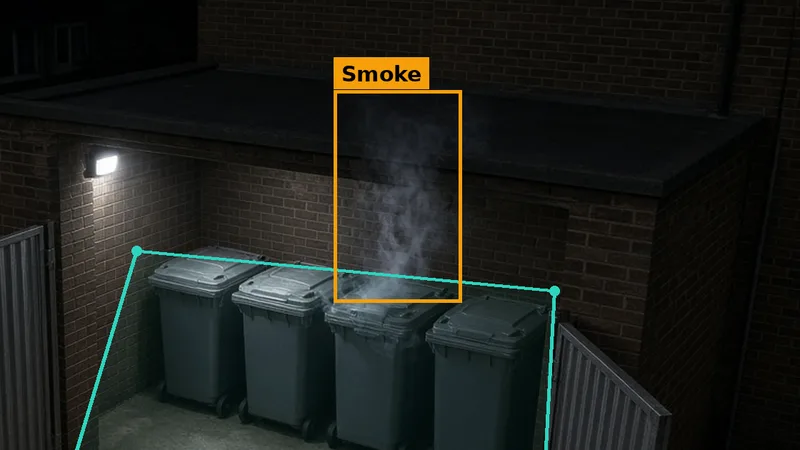
Here is a fictional example. A five-storey block of 30 flats on the edge of a town centre has a brick bin store at the back, a few metres from the building, under the windows of the first-floor flats. A camera on the back wall already looks into the store. A zone over the bins is armed from 22:00 to 07:00. At 02:10, barbecue coals thrown into one of the bins earlier in the evening start to smoulder, and thin grey smoke rises from under the lid.
The camera sees it. The managing agent's out-of-hours contact gets an alert on their phone: smoke in the bin store, with a snapshot and a short clip. They look at the clip, see smoke rising from the bin a few metres from the building, call 999 and give the address, and call the caretaker, who lives nearby, to meet the fire service. Nobody in the flats would have known until the smoke reached their windows. The next day, the agent moves the bins further from the building, adds a notice about hot ashes and coals to the bin store door and to the residents' newsletter, and asks the fire risk assessor to look again at the bin store.
Where Woodcock AI fits
Woodcock AI adds smoke and flame detection, and people and vehicle detection, to the cameras a block of flats already has. You draw polygon zones over exactly the areas to watch, such as the bin store, the cycle store, the car park or the exit path, set when each zone is armed, and choose who gets the alerts. The system is self-learning, getting better on each camera over time. Detection runs on an edge server on site or on a cloud server, so there is no need to replace cameras. It has been developed over years and is in use on real sites today.
Ways to start
The easiest first step is a site assessment: we look at what your existing cameras see, by day and after dark, and show where zones would help. You can also ask for a live test on your cameras, connecting two or three of them for about a fortnight, so your on-call team sees real alerts from your own block. Or book an on-site demo. There is no commitment to look.
Common fire safety mistakes in blocks of flats
Fire inspectors and assessors see the same problems again and again in blocks of flats. Most of them can be found on a walk round and fixed quickly.
- Front doors replaced. Flat entrance doors swapped for ordinary doors, or closers removed.
- Communal doors wedged. Stair and corridor doors propped open, closers broken, seals damaged.
- Corridors used as storage. Bikes, pushchairs, shoe racks and boxes on the escape route.
- Holes in compartment walls. Left by cabling, plumbing or door entry works and never sealed.
- An old assessment. Not reviewed after works, or with actions never done.
- No resident information. No fire safety instructions or annual fire door information.
- E-bikes charged in corridors. Or stored in the stair or by the only exit.
- Bins against the building. Overflowing bin stores under windows or by the entrance.
- Vents that do not work. Smoke vents stuck, switched off or never tested.
- Unclear responsibility. Nobody sure whether the freeholder, the agent or the management company does what.
Fire safety in flats checklist
Use this checklist to review your own block. It follows the guidance described above, but your fire risk assessment and your enforcing authority decide what applies to your building.
Responsibility and assessment
- Responsible person named, and who does what agreed in writing.
- Fire risk assessment current, recorded in full, type agreed, assessor named.
- External walls considered, with a PAS 9980 appraisal where needed.
- Action plan worked through, with dates recorded.
Protection
- Flat entrance and communal fire doors that close and seal, checked as required.
- Compartment walls and floors intact, new holes sealed.
- Smoke vents, emergency lighting and signs tested and serviced.
- High-rise duties done: information box, plans, wayfinding, monthly checks.
People
- Evacuation strategy written down and shared with the fire service.
- Fire safety instructions and fire door information given to residents.
- Residents who need help identified, with plans where the 2025 rules apply.
- Caretakers and contractors briefed on the building's fire rules.
Everyday risks and outside
- Common parts managed: zero tolerance or managed use, checked and enforced.
- E-bike and mobility scooter storage and charging rules in place.
- Bin stores away from the building or fire-resisting, kept shut and emptied.
- Car parks, cycle stores and exit paths clear, lit and secure.
Sources
- Regulatory Reform (Fire Safety) Order 2005, including article 6; Fire Safety Act 2021 and the GOV.UK factsheet on its commencement; Building Safety Act 2022, section 156.
- Fire Safety (England) Regulations 2022 and the GOV.UK guidance and factsheets.
- Fire Safety (Residential Evacuation Plans) (England) Regulations 2025 and the GOV.UK residential PEEPs guidance.
- Building Safety Act 2022, section 65 and the GOV.UK criteria for higher-risk buildings.
- GOV.UK, Fire safety in purpose-built blocks of flats; Approved Document B 2022 update.
- Smoke and Carbon Monoxide Alarm (England) Regulations 2015 and the 2022 amendment; Housing Act 2004.
- Scotland: Scottish Government, fire and smoke alarms in Scottish homes and practical fire safety guidance for existing high-rise domestic buildings.
- London Fire Brigade, e-bike and e-scooter guidance for responsible persons. ICO, guidance on video surveillance.
We have summarised these sources in our own words and checked them on 3 November 2026. This guide is general information, not legal or fire safety advice for your building. Fire safety law differs between England, Wales, Scotland and Northern Ireland. Your fire risk assessor, your local fire and rescue service and your own advisers can advise on your building.
The smoke alarms cover the flats. Who watches the bin store at night?
Book a site assessment and we will look at what your cameras see by day and after dark, and show where smoke, flame and people zones would help over the bin store, the cycle store, the car park and the exit paths, or ask for a live test on your cameras.
Related pages
Frequently asked questions
What are the fire safety regulations for flats in the UK?
In England and Wales, the Regulatory Reform (Fire Safety) Order 2005 applies to the common parts of blocks of flats and, since the Fire Safety Act 2021, to the structure, external walls and flat entrance doors. In England, the Fire Safety (England) Regulations 2022 add duties on resident information, fire door checks and high-rise buildings, and the Building Safety Act 2022 covers higher-risk buildings. Scotland and Northern Ireland have their own laws. The inside of each flat is not covered by the Fire Safety Order, but landlords have smoke and carbon monoxide alarm duties.
Who is responsible for fire safety in a block of flats?
The responsible person, usually the freeholder or the management company that controls the common parts, such as a resident management company, a right to manage company, a council or a housing association. A managing agent may share duties under its contract. Where more than one person has control, each has duties and they must cooperate. Residents are responsible for their own flats and for not putting the building at risk.
What does stay put mean in a block of flats?
Stay put is the usual evacuation strategy in purpose-built blocks. If there is a fire in your flat, you get out, close the door and call 999. If the fire is elsewhere, you are normally safer staying in your own flat unless smoke or fire affects it or the fire service tells you to leave. It only works if the walls, floors and fire doors are sound, so the fire risk assessment must check them.
How often must fire doors in flats be checked?
In England, in blocks over 11 metres high, the Fire Safety (England) Regulations 2022 require communal fire doors to be checked at least every three months and flat entrance doors, on a best endeavours basis, at least every 12 months, with records kept. In every block with shared parts, residents must be told how to use fire doors when they move in and every year after that.
Do blocks of flats need a fire alarm?
Most purpose-built blocks with a stay put strategy do not have a communal fire alarm, because it would send everyone into the stair at once. Each flat has its own smoke alarms instead, and detectors in the common parts often only open smoke vents. A communal alarm is needed where the strategy is simultaneous evacuation and in some converted houses. The fire risk assessment decides.
Can AI on CCTV take the place of fire alarms in flats?
No. Smoke alarms in each flat, and the fire doors and compartments, are what protect residents. AI video detection on existing cameras covering bin stores, cycle stores, car parks and exit paths can watch for visible smoke and flame, and for people at night, and send an alert with a clip to the on-call contact. It is an extra layer only, and cameras should never be pointed into flats, windows or balconies.
Last reviewed 3 November 2026