

Office fire safety: the law, risk assessment and checklist
Office fire safety in the UK rests on a responsible person, a written fire risk assessment, working alarms and clear exits, trained people, and a plan that still works when the building is empty. This guide covers the Fire Safety Order for offices and shops, who is responsible in owner-occupied and multi-let buildings, the five-step assessment, alarms, exits, emergency lighting and extinguishers, everyday risks from electrics, kitchens, smoking and storage, evacuation and fire wardens, and the out-of-hours risks at bins, plant rooms and rear exits. It also explains where AI on existing outside cameras can help watch for smoke and flame after hours, and where it cannot replace the alarm, the assessment or a call to 999.

What office fire safety means
Office fire safety is about stopping a fire from starting in or around an office, finding any fire quickly if one does start, and making sure that everyone inside, whether it is a full floor on a Monday morning or two people working late on a Friday, can get out safely. It also means protecting the building, the records, the kit and the businesses that depend on being able to open the next day.
Fire safety in an office rests on a few things working together. There is the law, which puts the duty on a responsible person, usually the employer, the landlord or anyone else with control of the premises. There is a written fire risk assessment, which looks at what could start a fire, who could be harmed and whether the precautions in place are good enough. There are the physical precautions: a way of raising the alarm, clear exits, emergency lighting where it is needed, signs and fire extinguishers. And there are the people: fire wardens who know what to do, a plan for anyone who needs help to get out, and someone who checks that all of this still works from week to week.
This guide explains how fire safety works for offices, business parks and multi-let office buildings across the UK. It covers the law and who the responsible person is, the fire risk assessment using the government guide for offices and shops, alarms, exits, emergency lighting and extinguishers, the everyday risks of electrics, kitchens, smoking, storage and building works, evacuation, fire wardens and training, and the risks when the office is locked and empty: arson, bins and rubbish against the walls, plant rooms and rear exits. At the end, it explains where AI on existing CCTV can help by watching the outside of the building at night, and where it cannot.
Who this guide is for
This guide is written for the people who look after office buildings: employers and directors in owner-occupied offices; landlords, managing agents and facilities managers in multi-let buildings and business parks; health and safety leads; fire wardens and marshals; and the contractors who maintain alarms, extinguishers and emergency lighting. It is written about offices, but much of it also applies to the office floors above shops, the office suites inside industrial estates, and the shared coworking floors that have become common in many towns.
Most of the detail is about England and Wales, where the same main fire safety law applies. Scotland and Northern Ireland have their own laws, which work in a similar way, and the guide says where they differ. It is general information, not legal advice for your building. Your fire risk assessor, your local fire and rescue service, your insurer and your own advisers can tell you exactly what applies to your premises.
Why offices need their own approach
Offices are unlike many other workplaces in four ways. The first is the pattern of use. Many offices are full for part of the week and almost empty for long stretches, especially with hybrid working, late nights and bank holiday weekends. A fire that starts when nobody is there can grow for a long time before anyone notices. The second is the mix of ignition sources that sit quietly in open-plan floors: chargers, personal heaters, overloaded extension leads, kitchenettes, printers and, increasingly, e-bike and laptop batteries left on charge overnight.
The third is shared control. In a multi-let building the landlord or managing agent usually controls the common parts, while each tenant controls its own demise. The Fire Safety Order requires those responsible persons to co-operate and share information. The fourth is what happens outside. London Fire Brigade advice on office environments warns that clutter, stock or rubbish left in a publicly accessible place can become a target for arson. Bins against the wall, plant cages, loading bays and rear fire exits are where many office fires begin when the building is locked.
Recent office fires
Place-named incidents from 2025 and 2026 show how often the risk sits outside the occupied floors. In August 2025, London Fire Brigade attended a fire at a converted office building on Lomond Grove in Camberwell, Southwark; part of the reception was damaged and the Brigade reported that the fire was believed to have been caused by the failure of a lithium-ion battery pack. In September 2025, a fire that started in a wheelie bin at Vermont House in Washington, near Sunderland, spread into an office building that housed several tenants. In March 2026, a roof fire at a former office building in Greenwich Way, Andover, was treated as suspected arson. In September 2026, Gloucestershire Police opened an arson investigation after a fire that began in a large bin placed against two office units at Kingsditch Trade Park in Cheltenham.
None of those buildings is a Woodcock AI customer, and this guide does not claim to know the full cause of each fire. The pattern is what matters for planning: outside storage, bins against the building, plant and empty floors after hours are the places a responsible person cannot ignore.
Those incidents are a reminder that office fire safety is not only about the open-plan floor. The responsible person has to think about the yard, the plant and the hours when access control shows nobody inside. A written assessment that ignores the outside of the building is not finished. The rest of this guide walks through the law, the assessment, the building precautions, the everyday risks and the out-of-hours watch in that order.
Office fire safety law: who is responsible?
In England and Wales, the main law is the Regulatory Reform (Fire Safety) Order 2005, usually called the Fire Safety Order. It applies to almost every building other than private homes, and that includes offices and shops. The government has published a dedicated fire safety risk assessment guide for offices and shops under Article 50 of the Order to help responsible persons meet their duties. The law does not apply to offices that form part of private domestic accommodation.
The Order puts the duties on a responsible person. Under article 3, in a workplace this is the employer, if the workplace is to any extent under their control. In any other case, it is the person who has control of the premises in connection with carrying on a trade, business or other undertaking, whether for profit or not. If nobody fits that description, it is the owner. For most offices, that means the employer for the floors they occupy, and the landlord or managing agent for the common parts of a multi-let building.
Multi-let offices and shared control
In a multi-let office or business park there is almost always more than one responsible person. The landlord or freeholder usually controls the structure, the common corridors, stairways, plant rooms and the outside of the building. Each tenant controls its own demise. Managing agents often hold day-to-day control on behalf of the landlord. Under article 5 and article 22, everyone with some control must take all reasonable steps to co-operate and co-ordinate, and must share information about significant risks that could affect others in the building.
In practice that means a shared emergency plan for the common parts, clear agreement on who tests the landlord’s alarm and who tests each tenant’s, and a way of telling every occupier when works, hot work or a change of use will affect escape routes. GOV.UK guidance on fire safety in the workplace says the same: if there is more than one responsible person, you have to work together.
Leases, licences and who controls what
Leases and licences often try to allocate fire safety duties between landlord and tenant. Those clauses matter commercially, but they do not remove duties that the Fire Safety Order places on whoever actually has control. If you control a floor, you need an assessment for that floor even if the lease says the landlord is responsible for fire safety. If you control the common parts, you need an assessment for those parts even if every tenant has its own. The practical answer is usually two assessments that talk to each other, plus a shared emergency plan for the stairs, lobbies and outside areas.
Facilities management contracts should spell out who tests the alarm, who books the extinguisher service, who keeps the log book and who calls the fire and rescue service. Ambiguity here is how weekly tests slip. Name the roles, write them into the fire safety arrangements, and make sure deputies exist for holidays and sickness.
What the responsible person must do
The Fire Safety Order sets out what the responsible person must do. They must make a suitable and sufficient assessment of the fire risks (article 9), and put in place general fire precautions to protect people, based on that assessment. They must make sure the premises have suitable means of detecting a fire and giving warning, and fire-fighting equipment where needed (article 13). They must make sure routes to emergency exits and the exits themselves are kept clear, so that everyone can leave quickly and safely, with emergency lighting and signs where needed (article 14). They must have procedures for serious and imminent danger, including evacuation (article 15), and keep the precautions and equipment maintained and in good working order (article 17).
The Order also requires the responsible person to appoint one or more competent persons to help with the preventive and protective measures (article 18). A competent person is someone with enough training, experience or knowledge to do the job, and the article allows the responsible person to take on that role themselves if they are competent. Where an office employs staff, they must be given adequate fire safety training (article 21), during normal working hours, when they start and from time to time afterwards.
Who the law protects
The duties protect relevant persons, which means anyone who is lawfully on the premises or in the immediate area and could be harmed by a fire there. In an office that includes employees on every floor and every shift pattern, hybrid workers who come in only some days, visitors and clients, cleaners and security staff who work when the floors are empty, contractors on maintenance or fit-out, and people in neighbouring units who share escape routes or plant. Your fire risk assessment needs to think about all of them, including anyone who may need help to get out.
The written record since October 2023
In England, section 156 of the Building Safety Act 2022 amended the Fire Safety Order from 1 October 2023. Every responsible person must now record their completed fire risk assessment in full, record who carried it out or reviewed it, and record their fire safety arrangements. GOV.UK has published a plain summary of these responsibilities under section 156. The old rule that only workplaces with five or more employees had to keep a written record no longer applies in England. Wales has its own guidance; check the current Welsh position rather than assuming the England rule. In practice, a written assessment is good practice everywhere.
How offices are inspected and enforced
The local fire and rescue authority enforces the Fire Safety Order in most offices. Crown premises, some defence sites, construction sites and a few other specialised places have different enforcers, but an ordinary office or business-park suite will usually be inspected by the fire service. Inspectors look for evidence that you have carried out a suitable assessment and acted on it. If they are not satisfied they may issue an enforcement notice requiring improvements, or in extreme cases a prohibition notice that restricts use of all or part of the premises until the risk is reduced. An alterations notice can require you to tell them before you make changes that could increase the risk.
Failure to comply with a duty under the Order or with a notice is an offence. You can appeal a notice to the magistrates’ court. Where you agree that improvements are needed but disagree on the technical solution, you and the authority can agree to refer the point for independent determination. Keeping a clear written assessment, a testing log and records of training makes those conversations faster and more factual.
Scotland, Wales and Northern Ireland
Scotland has its own regime under the Fire (Scotland) Act 2005, Part 3 and the Fire Safety (Scotland) Regulations 2006. The Scottish Government publishes practical fire safety guidance for existing non-residential premises, which covers offices. The duty holder must carry out a fire safety risk assessment and keep it under review. Northern Ireland has the Fire Safety Regulations (Northern Ireland) 2010, made under the Fire and Rescue Services (Northern Ireland) Order 2006. Wales shares the Fire Safety Order with England, but some Building Safety Act changes and guidance differ, so check the current Welsh position on recording the assessment rather than copying the England rule blindly.
Enforcement in most offices sits with the local fire and rescue authority. They can inspect, require improvements, and in serious cases issue enforcement or prohibition notices. Failure to comply with a duty or a notice is an offence. If you are unsure how the law applies to your building, ask the fire safety office at your local fire and rescue service, as GOV.UK advises.
What the offices and shops guide covers
The government guide is for employers, managers, occupiers and owners of premises where the main use is an office or a shop. That includes purpose-built and converted office blocks, and individual office units inside larger complexes. It does not cover the overall management of multi-use shopping centres, which have their own large places of assembly guide, and it does not apply to offices in private domestic accommodation. Where you handle and store flammable materials, the guide helps you take those into account. Historic buildings have an appendix of their own.
The guide does not set rigid standards. It gives recommendations you can use when judging whether the precautions in your office are good enough. Other methods can also meet the law. If your building was recently built or altered under current building regulations, the detection, escape routes and firefighting facilities may already be satisfactory provided they are maintained and the risk has not risen. You still need a fire risk assessment, and you still need to keep it up to date.
The office fire risk assessment
A fire risk assessment is an organised look at your premises, the activities carried on there and the chance that a fire could start and harm people in and around the building. The aims, as set out in the accessible offices and shops guide, are to identify the fire hazards, reduce the risk of those hazards causing harm as low as reasonably practicable, and decide what physical fire precautions and management arrangements are needed so that people can escape safely if a fire does start.
GOV.UK summarises the same process in five steps on its fire risk assessments page: identify the fire hazards; identify people at risk; evaluate, remove or reduce the risks; record your findings, prepare an emergency plan and provide training; and review and update the assessment regularly. The offices and shops guide walks through those steps in detail for office and retail premises, including outdoor locations and rooms that are rarely used.
What an office assessment should look at
In an office, Step 1 usually finds ignition sources such as electrical equipment, portable heaters, kitchen appliances, lighting too close to stored materials, hot work by contractors, smoking materials where smoking still happens outside, and arson. Fuel sources include paper and packaging, soft furnishings, cleaning products, plastics and rubber, waste (especially shredded paper) and anything stored in plant rooms or under stairs. Oxygen is normally just the air, plus any oxidising chemicals kept for cleaning or maintenance.
Step 2 identifies who is at risk: staff on every floor and shift, lone workers and cleaners, visitors who do not know the building, people with disabilities or who may be slower to leave, and anyone in neighbouring units who share stairs or lobbies. Step 3 evaluates the chance of a fire starting and the risk to those people, then removes or reduces hazards where it is reasonable to do so, and puts in place detection, warning, escape routes, lighting, signs, extinguishers and maintenance. Steps 4 and 5 record the findings, set the emergency plan and training, and keep the assessment under review when the building, the layout or the way it is used changes.
Who should carry out the assessment?
The responsible person can carry out the assessment themselves if they are competent, or they can appoint someone else. The offices and shops guide is written to help a responsible person assess less complex offices and shops. If you read it and decide you cannot apply the guidance, you should seek expert advice. More complex premises, multi-storey multi-let buildings, and offices with unusual processes or large numbers of people will usually need a person with comprehensive training or experience in fire risk assessment.
London Fire Brigade is clear that it cannot write your fire risk assessment for you: as the enforcing authority that would be a conflict of interest. It does publish advice on how to find a competent assessor. Keep the assessment under review at least when anything significant changes, and it is good practice to look at it every year even if nothing obvious has moved.
When to review the assessment
Keep the assessment under review. Reasons to revise it include a change to work processes or the way you organise them, alterations to the building or the internal layout, substantial changes to furniture and fittings, new or increased storage of hazardous substances, failure of fire precautions such as the alarm or emergency lighting, a significant increase in the number of people present, or the presence of people with a form of disability that the previous plan did not cover. Hybrid working that empties whole floors on some days is itself a significant change for many offices and belongs in the review.
Do not rewrite the assessment for every trivial change, but if a change introduces new hazards, consider them and do whatever you need to keep the risks under control. If a fire or a near miss occurs, treat that as a signal to reassess. Records of testing, maintenance and training are useful when you review, because they show what actually happens in the building rather than what the plan hoped would happen.
Warning and evacuating people
Once a fire has started, been detected and a warning given, everyone in the office should be able to escape to a place of total safety without help from the fire and rescue service. Some people with disabilities and others with special needs may need help from designated staff. Escape routes should be designed so that anyone confronted by fire can turn away from it and reach a protected stair or a final exit.
How the warning is given
In some small, open-plan, single-storey offices, a fire may be obvious to everyone as soon as it starts. In those cases, where exits and travel distances are adequate, a simple shout of “fire” or a manually operated device such as a gong may be enough. The offices and shops guide says that where a shout or manual device is not adequate, an electrical fire warning system is likely to be required. In larger premises, particularly those with more than one floor, an electrical system with sounders and manual call points is the usual answer.
Where there are unoccupied areas, or common corridors in multi-occupied premises, in which a fire could develop before anyone notices, automatic fire detection may be necessary. Large or complex office blocks may need a more sophisticated warning and a phased evacuation. Special arrangements are often needed when people are working alone, when cleaners or contractors are in at the weekend, or when normal occupancy patterns change.
Telling people what to do
Staff need clear information and instruction as soon as they start, and regularly afterwards. That includes people who work outside normal hours. The information should cover the significant findings of the assessment, the measures in place, what to do if there is a fire, who the nominated people are, and any special arrangements. Fire action notices in prominent places support that briefing. Visitors and contractors need a short, clear explanation of the alarm sound, the nearest exits and the assembly point.
In multi-let buildings, a single emergency plan covering the whole building is usually necessary, agreed with every responsible person who has control. Nominate one person to co-ordinate that plan so that tenants are not inventing different assembly points or contradictory messages.
After hours, hybrid days and empty floors
Hybrid working has changed who is in the building and when. A floor that used to be full may now have a handful of people on a Wednesday and nobody on a Friday afternoon. Cleaners and security staff may be the only people present late at night. Contractors may be working on a weekend fit-out when the fire wardens who normally sweep the floor are at home. Your emergency plan and your assessment must cover those patterns, not only the busy midweek peak.
Disabled people and PEEPs
The means of escape must be suitable for everyone likely to be in the building. That may mean personal emergency evacuation plans (PEEPs) for staff who need them, trained buddies, use of refuges where the building provides them, and clear arrangements for visitors who need support. The Equality Act 2010 sits alongside the Fire Safety Order here. The plan should not rely on the fire and rescue service to evacuate individuals; their job on arrival is to fight the fire and rescue people who are trapped, not to run your day-to-day evacuation.
False alarms and unwanted calls
False alarms from electrical fire warning systems are a major problem and lead to many unwanted calls to the fire and rescue service. Malicious activation of manual call points, cooking fumes from a kitchenette, dusty detectors in a store and contractors working near a sensor are all common causes in offices. Review the design and location of call points and detectors against how the building is used now, not how it was designed ten years ago. Protect call points from accidental knocks in busy corridors if that is a pattern, without making them hard to reach in a real fire. Log every false alarm, look for patterns, and fix the cause rather than simply silencing the panel and moving on.
Unwanted calls waste fire service time and can make people slower to react when the next alarm is real. A good office culture treats every alarm as real until it is proven otherwise, then records the unwanted activation and deals with the cause before the next working day.
Fire alarms, doors and escape routes
The physical precautions in an office are what turn a written assessment into a building people can escape from. They include the fire detection and warning system, fire doors and compartmentation, escape routes, emergency lighting, signs, extinguishers and any fixed firefighting systems the building has. All of them must be installed where needed, kept in working order and tested on a sensible timetable.
Fire detection and alarms
Most offices of any size need an electrical fire warning system with manual call points on the escape routes and sounders that can be heard throughout the areas they cover. Automatic detection is particularly important in unoccupied spaces such as store rooms, plant rooms, roof voids and common corridors in multi-let buildings, where a fire could grow before anyone walks past. False alarms from malicious call-point use or poorly placed detectors are a real problem; the offices and shops guide asks you to review the design and location of devices against how the building is actually used.
Keep a log of weekly tests, faults and services. A competent person should service the system on the schedule your assessment and the relevant standards require, commonly every six months for many office systems, with daily checks that the panel is healthy and weekly tests of sounders and call points.
Fire doors and compartments
Fire doors hold fire and smoke back so that people have time to escape and so that a fire on one floor or in one tenancy does not race through the whole building. They only work if they are closed. Wedging fire doors open is one of the most common failures fire crews see in workplaces. If a door needs to be held open for day-to-day access, use a device that releases automatically when the alarm sounds, and make sure it is maintained. Check seals, closers, gaps and signage as part of your routine.
Escape routes, lighting and signs
Escape routes and final exits must stay clear at all times when the premises are occupied. That means no storage in corridors or stairways, no furniture blocking a door, and no padlock or security device that slows people down in an emergency. Final exit doors should open easily in the direction of escape without a hunt for a key. Emergency escape lighting is likely to be needed on internal routes without windows and wherever the building is used in darkness, including early winter evenings. Signs must use the pictogram form required by the Health and Safety (Safety Signs and Signals) Regulations, and fire action notices should be easy to find and read.
Signs and notices
Signs must help people find escape routes, firefighting equipment and any emergency telephones. Under the Health and Safety (Safety Signs and Signals) Regulations they must be in pictogram form; text can support the pictogram but cannot replace it. Notices should explain how to use equipment where needed, what to do if there is a fire, and anything the fire and rescue service needs to know, such as the location of isolation switches or hazardous stores. Keep signs legible and correct when you rearrange a floor. A fire action notice that still shows last year’s assembly point is worse than unhelpful.
Extinguishers, sprinklers and other kit
Portable extinguishers should match the risks on each floor: water or foam for paper and furnishings, carbon dioxide for electrical rooms and kitchenettes, and a fire blanket where food is prepared. People with no training should not be expected to fight a fire; their job is to raise the alarm and leave. Fire wardens who may use an extinguisher need proper training. Where the building has hose reels, sprinklers, dry risers or other fixed systems, those must be maintained too, whether they were required by building regulations or installed for other reasons.
Installation, testing and maintenance
New fire precautions should be installed by a competent person. You must keep existing equipment, devices and facilities provided for safety in effective working order, and maintain fire-separating elements so that smoke does not pour into escape routes through gaps and poorly sealed services. Daily checks typically cover exits clear of bolts and padlocks, doors on escape routes that swing freely and close fully, and a glance at the fire alarm panel. Weekly tests cover the fire warning system and a look at extinguishers. Monthly tests often cover emergency lighting. Six-monthly and annual work is usually done by a competent service engineer. Keep a log book of what was tested, what failed and what was fixed.
In a multi-let building, be clear who owns each system. The landlord may own the common-parts alarm and the dry riser; a tenant may own detectors inside its demise. Shared confusion is how weekly tests get missed. Write the split down and put it in both the landlord’s and the tenant’s fire safety arrangements.
Everyday fire risks in offices
Most office fires start from ordinary things: a heater left on, a toaster full of crumbs, a charger under a desk, a pile of packaging by a heat source, or a bin set alight outside after dark. The offices and shops guide lists the common ignition sources and fuels; London Fire Brigade’s office advice highlights overloaded sockets, daisy-chained extension leads, items left charging unattended, lighting too close to materials, and arson against clutter left in publicly accessible places.
Electrical equipment and heaters
Electrical equipment is a leading cause of accidental fires in offices. Keep ventilation openings clear, do not overload sockets, avoid daisy-chaining extension leads, and treat scorch marks or discoloured plugs as a reason to take the item out of use. Personal heaters brought in on cold days are a frequent problem: prefer fixed convector heating, keep heaters clear of paper and fabrics, and discourage staff from bringing their own. Fixed wiring should be inspected by a competent person on a cycle that matches the risk, and portable appliances should be checked in proportion to how they are used, as the HSE explains in its portable appliance testing FAQs. The Electricity at Work Regulations 1989 sit alongside the Fire Safety Order here.
Kitchenettes and break-out areas
Tea points and break-out kitchens cause a disproportionate share of office fires. Toasters, microwaves, sandwich presses and fridges need cleaning, sensible use and an end-of-day check that nothing is left on. A fire blanket and the right extinguisher nearby are useful, but the first rule is still to raise the alarm and get people out if a fire is growing. Deep fat frying on an office floor is a bad idea; if catering goes beyond a simple kitchenette, treat it as a commercial kitchen risk and assess it properly.
Smoking, terraces and outdoor heat
Where smoking is still allowed outside, put it in a designated place away from bin stores, plant intakes and combustible storage, with proper disposal for smoking materials. Do not let smokers gather by a rear exit that must stay clear. Patio heaters and outdoor events on terraces need the same care as any other heat source next to a building.
Storage, housekeeping and waste
Paper, packaging and stored furniture feed a fire. Keep stores tidy, keep escape routes clear, and move waste out of the building promptly. Finely divided waste such as shredded paper is particularly easy to ignite. Under-stair cupboards and voids should not become dumping grounds. At the end of the day, and before a long weekend or Christmas shutdown, walk the floors and the outside of the building: heaters off, kitchenettes clear, bins emptied or secured, cardboard cages not piled against the wall.
Bins, skips and arson
The offices and shops guide is blunt about arson: look for situations that present an opportunity, and do not leave rubbish where it can be set alight against the building. Secure wheeled bins in a compound, keep skips a sensible distance from the premises, and empty cardboard cages before lock-up. Recent place-named fires in Washington, Cheltenham and elsewhere show how quickly a bin fire against an office wall can enter the building when nobody is there to see it.
Plant rooms, loading bays and rear exits
External plant cages, condenser compounds, loading bays and rear fire exits are part of the premises for fire safety purposes. Hot surfaces, fuel stores, delivery packaging and doors that must open freely in an emergency all belong in the assessment. Keep plant enclosures clear of stored cardboard. Make sure rear exits are not blocked by parked vehicles or stacked pallets. If contractors are doing hot work on the roof or at the plant, use a permit, control ignition sources and check afterwards for smouldering.
Lithium-ion batteries and e-bikes
Laptop power banks, tool batteries and e-bike or e-scooter batteries bring a modern office risk. Charging is when many battery fires start. Keep damaged batteries off the premises, do not charge in escape routes, and only allow e-bike charging where your fire risk assessment says it is acceptable, ideally in a purpose-designed arrangement outside or in a separated store with detection. This sits alongside the wider advice in our guide to lithium-ion battery storage fire safety.
Long weekends and Christmas shutdown
The days before a long weekend or the Christmas shutdown are when offices leave heaters on, dishwashers running, cardboard piled for a collection that will not come until January, and bins overflowing against the wall. Walk the floors and the outside of the building before lock-up. Switch off what should be off. Empty or secure the bins. Check that plant room doors are locked and that rear exits are not blocked by last-minute deliveries. If a skeleton staff or a security patrol will be the only people on site, make sure they know the alarm panel, the assembly point and who to call. Our Christmas shutdown checklist guide covers the wider shut-down routine; the fire parts of it belong in this assessment too.
Building works and hot work
Fit-outs, roof repairs and plant replacements bring ignition sources into places that are usually quiet. Welding, cutting, grinding and the use of hot-air guns need a hot-work permit, a clear area, a watcher while the work goes on, and a check for smouldering afterwards. Tell other responsible persons in the building when works will affect escape routes or the alarm. Temporary plastic sheeting, stored materials and blocked corridors are common during office refurbishments; the assessment and the daily checks need to keep up with the changing layout, not wait until the job is finished.
Shared kitchens, shared stores, shared blame
In a multi-let building a shared kitchenette or a shared basement store can become nobody’s problem until something burns. Agree who cleans, who empties the shared bins, who locks the store and who is allowed to leave goods there overnight. Put those rules in the house regulations and in each tenant’s induction. If one tenant’s cardboard is routinely left in a landlord corridor, that is both a housekeeping failure and a co-operation failure under articles 5 and 22.
The same logic applies to shared cycle stores and e-bike charging. If charging is allowed, the fire risk assessment for the common parts should say so, with detection, separation and clear rules. If it is not allowed, say so clearly and enforce it. Ambiguous “use at your own risk” signs do not satisfy the Order.
Training, fire wardens and drills
Article 21 requires adequate fire safety training for employees. Induction should show the exits, the alarm sound, the assembly point and what to do on discovering a fire. Fire wardens and deputies need extra training on sweeping floors, helping people who need support, and using extinguishers if that is part of their role. Drills should test the real plan, including quiet hybrid days, not only the busiest midweek morning. Keep records of who was trained and when, and fix anything the drill showed was unclear.
In a multi-let building, joint drills and shared training with neighbouring tenants make the shared emergency plan real. Cleaners, security staff and regular contractors need a briefing too, because they are often in the building when the day staff are not.
At night, outside: where AI on existing CCTV fits
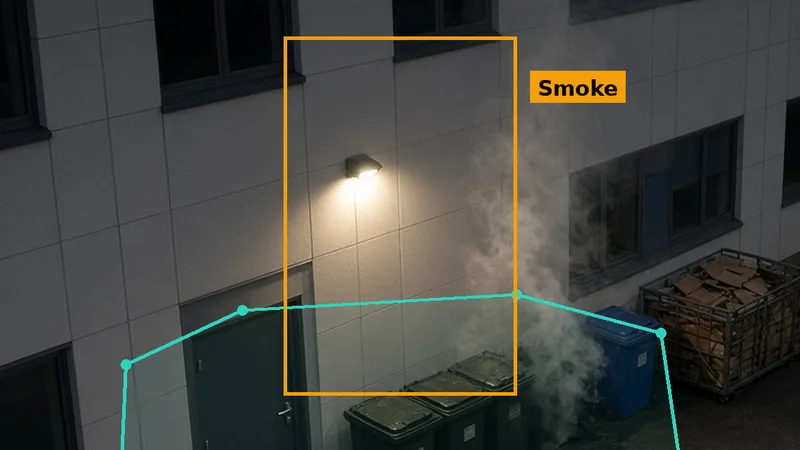
The fire alarm, the detectors, the fire doors and the emergency plan protect people inside the office. They do not watch the bin yard, the plant cage or the rear exit when the building is locked and the floors are dark. That is the gap where AI on existing outside cameras can help: polygon zones over the places smoke, flame or people would appear after hours, with an alert, a clip and a short AI description sent to a facilities manager or key holder.
Detection runs on an edge server on site or on a cloud server. It is an extra layer only. It never replaces the fire alarm, the fire risk assessment, the evacuation plan, the fire wardens or a call to 999. It is not a reason to point cameras at desks, meeting rooms or other office interiors for this product; the pitch is the outside of the building.
Which outside area?
Wheelie bins and cardboard cages against or near the building are a common arson and accidental fire risk when the office is empty.
Armed overnight
External plant cages and condenser compounds sit against the wall and are rarely visited after dark.
Armed overnight
Rear fire exits and service doors are how people leave in an emergency and how arsonists or late contractors often approach.
Armed after hours
Each area needs its own zone and schedule.
Where cameras help most
The highest-value views for smoke and flame after hours are the bin store and waste yard, external plant cages and condenser compounds, rear fire exits and service yards, loading bays and the strip of wall where cardboard or pallets get left. People zones on the same cameras can flag someone at a rear door or climbing into a bin compound when the building should be empty. Schedule the zones for the hours the office is locked; leave them idle while the yard is busy with deliveries if that would create noise.
Privacy: cameras around offices
If cameras capture identifiable people, UK data protection law applies. The ICO guidance on video surveillance expects a clear purpose, a lawful basis, signs, secure retention, and care when staff are monitored at work. Outside yard cameras used for safety and security still need that paperwork. Do not use this product as a reason to film inside office interiors; keep interior privacy decisions separate and conservative.
What AI on cameras cannot do
Cameras do not smell smoke inside a sealed riser. They do not open a fire door, silence an alarm or decide that a building is safe. They do not remove the need for weekly alarm tests, extinguisher services or a written assessment. If smoke is visible on a clip, someone still has to call 999 and send a key holder. Treat every alert as a reason to look, not as proof that the fire service has been told.
A worked example: the bin yard at 23:40
Take a fictional three-storey office on a business park. The last person leaves at 18:00, the intruder alarm is set, and the Woodcock zones over the bin yard, the plant cage and the rear exit arm for the night. At 23:40, thin grey smoke rises from the bin area against the cladding. The bin-yard zone flags it, and the facilities manager gets a clip and a short description on their phone. They watch the clip, call 999, and send the key holder. The fire alarm inside the building remains the system that protects anyone who might still be on a floor.

Keeping camera false alerts down
Outside cameras see headlights, moving trees, foxes and cleaners on a late round. Tight polygon zones, armed only when the building is locked, and a short human look at each clip keep the noise down. Self-learning helps the system ignore repeated harmless motion over time. If an alert is wrong, mark it so the next night is quieter. The aim is a clip you will actually watch at midnight, not a stream you learn to ignore.
Where Woodcock AI fits
Woodcock AI connects to the outside cameras you already have. You draw polygon zones over the bin yard, plant cage, rear exit or loading bay, set the hours they are armed, and receive alerts with a snapshot, a clip and an AI description when visible smoke, flame or people appear. Self-learning helps cut repeated false motion from trees and headlights over time. It runs on an edge server on site or on a cloud server. Book a site assessment, or ask for a live test on your cameras, if you want to see what your existing views would cover.
Ways to start
Most offices begin with two or three outside cameras that already see the bin store, the plant and a rear exit. We look at those views by day and after dark, agree the zones and the armed hours, and run a live test so you can see the alerts on your own phone before you decide anything further. There is no need to rip out the fire alarm or change the written assessment; this sits beside them.
Common office fire safety mistakes
- Fire doors wedged open on busy floors.
- No thought for cleaners, late workers or empty hybrid days in the emergency plan.
- Bins, skips and cardboard left against the cladding overnight.
- Fire wardens named on a poster but never drilled.
- A fire risk assessment that still describes last year’s layout.
- Assuming the landlord’s assessment covers a tenant’s own demise, or the other way round.
- Treating outside CCTV as a substitute for 999 or for the fire alarm.
Office fire safety checklist
Law and assessment
- Responsible person identified for every part of the building you control.
- Written fire risk assessment in place and reviewed when anything significant changes.
- In England, the whole assessment recorded, with the assessor named.
- Co-operation agreed with landlord, tenants or managing agent where control is shared.
Building precautions
- Fire alarm tested weekly; faults logged and fixed.
- Automatic detection where unoccupied areas need it.
- Escape routes and final exits clear; fire doors close and latch.
- Emergency lighting and signs checked on schedule.
- Extinguishers the right type, visible, and serviced.
People
- Staff inducted on the plan; wardens trained and covered on every occupied day.
- PEEPs where needed; visitor and contractor briefings in place.
- Drills carried out and recorded, including quiet days.
Everyday and outside
- Heaters, chargers and kitchenettes controlled; end-of-day checks done.
- Bins and skips secured and kept away from the wall.
- Plant cages and rear exits clear; hot work permitted and checked.
- Out-of-hours watch on outside cameras where they help, without replacing the alarm.
Use this as a prompt beside your own fire risk assessment, not as a substitute for it.
Sources
- Regulatory Reform (Fire Safety) Order 2005, including articles 3, 5, 9, 13, 14, 15, 17, 18, 21 and 22.
- HM Government, Fire safety risk assessment: offices and shops (accessible version). GOV.UK, fire safety in the workplace and fire risk assessments.
- GOV.UK, fire safety responsibilities under section 156 of the Building Safety Act 2022.
- London Fire Brigade, office environments; office building fire, Southwark, August 2025.
- Gas Safety (Installation and Use) Regulations 1998; Electricity at Work Regulations 1989; HSE, portable appliance testing FAQs; Equality Act 2010.
- Scotland: Fire (Scotland) Act 2005, Part 3; Fire Safety (Scotland) Regulations 2006; Scottish Government, practical fire safety guidance for existing non-residential premises.
- Northern Ireland: Fire Safety Regulations (Northern Ireland) 2010; Fire and Rescue Services (Northern Ireland) Order 2006. ICO, guidance on video surveillance.
- Place-named incident reports: BBC, Washington Vermont House bin fire, September 2025; BBC, Andover former office roof fire, March 2026.
We have summarised these sources in our own words and checked them on 6 November 2026. This guide is general information, not legal or fire safety advice for your office. Fire safety law differs between England, Wales, Scotland and Northern Ireland. Your fire risk assessor, your local fire and rescue service, your insurer and your own advisers can advise on your building.
The fire alarm covers the floors. Who watches the bins and the plant at night?
Book a site assessment and we will look at what your cameras see by day and after dark, and show where smoke, flame and people zones would help over the bin yard, the plant cage, the rear exit and the loading bay, or ask for a live test on your cameras.
Related pages
- Office security
- Fire risk assessment
- Fire evacuation plan
- Fire safety training
- Fire warden duties
- Fire safety log book
- Electrical fire safety
- Bin store fire safety
- Emergency lighting regulations
- Commercial fire alarm systems
- Arson prevention
- Lithium-ion battery storage fire safety
- Christmas shutdown checklist
- Book a site assessment
Frequently asked questions
Do offices need a fire risk assessment?
Yes. In England and Wales, the Regulatory Reform (Fire Safety) Order 2005 applies to offices. The responsible person must carry out a suitable and sufficient fire risk assessment and keep it under review. In England, since 1 October 2023, the whole assessment must be recorded in writing. Scotland and Northern Ireland have similar duties under their own laws. The government publishes a dedicated guide for offices and shops.
Who is responsible for fire safety in a multi-let office?
Usually more than one person. The employer or tenant is responsible for the workplace they control; the landlord or managing agent is usually responsible for the common parts and the shell. Everyone with some control must co-operate, co-ordinate and share information on significant risks. Check your lease and who actually controls each area.
Do small offices need a fire alarm?
Not always a full automatic system. In a small, open-plan, single-storey office where a fire would be obvious to everyone, a shout or a manual device may be enough if exits and travel distances are adequate. Where there are unoccupied areas in which a fire could grow unseen, or more than one floor, an electrical system and often automatic detection are needed. Your fire risk assessment decides.
How often should office fire drills happen?
Often enough that staff know the plan, including on quiet hybrid days. Many offices drill at least once a year and after significant changes, and the assessment may ask for more. Record what happened and fix anything that did not work.
Can AI on CCTV replace an office fire alarm?
No. The fire alarm, clear exits, the emergency plan and trained fire wardens protect people inside the building. AI video detection on existing cameras covering the outside walls, bins, plant and rear exits can watch for visible smoke and flame, and for people, when the office is locked, and send an alert with a clip to a facilities manager or key holder. It is an extra layer only.
What is the biggest out-of-hours fire risk for offices?
Bins, skips and combustible waste left against the building, together with plant areas and rear exits that nobody watches after lock-up. Arson and accidental ignition both show up in those places. Keep waste secured and away from the walls, and consider outside camera zones as an extra watch, not as a substitute for the alarm or for calling 999.
Last reviewed 6 November 2026