

Hotel fire safety: the law, night evacuation and guests
Hotel fire safety means the precautions a hotel, guest house or B&B must have to protect guests who are asleep in a building they do not know: a fire risk assessment that is current and recorded in full, a suitable fire alarm (often Category L2, loud enough to wake guests), fire doors on bedrooms and corridors, protected and lit escape routes, an emergency plan that works at night with the staff on duty, arrangements for disabled and deaf guests, trained staff and drills, and control of risks such as kitchens, laundry, bins and smoking. In England and Wales the duties come from the Fire Safety Order, enforced by the fire and rescue service. AI on existing CCTV can add early warning outside, but never replaces the alarm or the plan.

What is hotel fire safety?
Hotel fire safety is everything a hotel, inn, guest house or bed and breakfast does to stop a fire starting, to find it quickly if it does, to hold back fire and smoke, and to get every guest and member of staff out safely. In an office or a shop, people are awake, they know the building and they leave when the alarm sounds. In a hotel, most guests are asleep for much of the time the building is busiest with risk. They arrived a few hours ago, they came in by the front door and the lift, and many have never looked at the escape route from their room. Some will have had a drink. Some are deaf, or use a wheelchair, or are travelling with young children.
That is why official guidance treats hotels and other sleeping accommodation as a special case. The guests depend on the building and the staff to warn them early, to keep smoke out of the corridors long enough for them to get out, and to guide them to a safe place. At night, the staff may be a single night porter, a duty manager on call and perhaps a security officer. Everything in this guide follows from that: the type of fire alarm, the fire doors on every bedroom, the escape routes and emergency lighting, the evacuation plan, the training of night staff, and the everyday management of kitchens, laundries, bins, terraces and plant rooms.
This guide is for hotel owners, general managers, operations and maintenance managers, owners of inns and pubs with rooms, guest house and B&B owners, serviced apartment operators and anyone acting as the responsible person for premises where paying guests sleep in the UK. It explains who is responsible in law, how fire and rescue services enforce, how the rules differ in Scotland and Northern Ireland, what a hotel fire risk assessment should cover, how to warn and evacuate guests, including disabled guests, what to expect of night staff, fire alarms, fire doors, emergency lighting, training and drills, the everyday causes of hotel fires, the rules for small B&Bs and holiday lets, and where camera-based detection can help outside the building and in back-of-house areas.
A note before we start. Where we say "must", we point to the law. Where we say "should" or "usually", it comes from official guidance, and the right answer for your hotel depends on its size, layout, guests and staffing. Your fire risk assessor, your local fire and rescue service and your insurer can tell you what your premises need. Nothing on this page is legal or fire safety advice for your hotel.
Why hotels carry a particular risk
The Home Office guide for sleeping accommodation, first published in 2006 and still the main official guide for existing hotels, guest houses and similar premises in England and Wales, explains why people who sleep on the premises are at greater risk. A fire that starts at night can grow for some time before anybody notices. Guests are spread across many separate rooms, each behind its own door. They may be on several floors, at the far end of long corridors, and they will usually try to leave the way they came in, even when that is the route the fire is on.
The guide also points out that the number of people in a hotel changes. A quiet midweek night in winter is very different from a wedding party in June, a conference in the function rooms or a sell-out weekend when a big event is in town. Some guests stay one night, others for weeks. Staff work shifts, and many hotels have high staff turnover and agency workers who may not know the building well. The fire risk assessment has to work for the busiest night with the fewest staff on duty, not just the average.
Hotels also have more places for a fire to start than most buildings. A large kitchen may run from early breakfast to late room service. Laundries run tumble dryers for hours. Plant rooms hold boilers, electrical switchgear and air handling units. There are bars, function rooms with decorations and stage lighting, spas and saunas, outside terraces where guests smoke, bin stores full of packaging and food waste, and sometimes car parks under the building. Most of these places are behind the scenes, where guests never go and staff only visit from time to time.
Why guests are slow to respond
The official guide is direct about how guests react to a fire alarm. They may not recognise the sound, or may think it is a test or a false alarm, especially if they have heard false alarms before. If they are asleep, they need to wake, work out where they are and find their way in a building they do not know, perhaps in the dark and in smoke. Many will stop to get dressed, gather their family or pick up belongings. Some may be slower because of alcohol, drugs or medication. Guests with a hearing impairment may not hear a standard sounder at all.
So a good hotel plan does not assume that guests will hear the alarm and walk out on their own in a few seconds. It gives them as much warning as possible, as early as possible, and it gives them protected routes that stay clear of smoke for long enough. It tells them what to do before anything goes wrong, with a clear notice in every bedroom. And it makes sure that staff on duty, even at three in the morning, know how to check the panel, call the fire and rescue service, guide guests out, help those who need it and account for everyone at the assembly point.
A hotel fire in 2026
A hotel fire this year shows how quickly an ordinary day can change. In August, London Fire Brigade was called to a fire in a plant room on the first floor of a twelve-storey hotel in Fulham. Around 450 people left the building, and three were treated for smoke inhalation. The brigade said the cause was under investigation.
We are not drawing conclusions about the cause, which is for the investigators. But the fire carries a lesson for anyone who runs a hotel. It did not start in a guest bedroom. It began in a part of the building that guests do not use and that staff visit only from time to time. And it meant moving hundreds of people out of a busy building in a hurry. Plant rooms, bin stores, laundries, car parks and other back-of-house areas are the places a hotel fire risk assessment needs to think hardest about, especially at night, when fewer staff are on duty and most guests are asleep.
The rest of this guide starts with the law, because that sets the minimum. Then it moves to how a hotel actually plans for a fire, from warning guests to the everyday risks behind the scenes that cause many of them.
The law on hotel fire safety
In England and Wales, fire safety in hotels, guest houses, B&Bs, inns with rooms, hostels, holiday parks and most other non-domestic premises is governed by the Regulatory Reform (Fire Safety) Order 2005, usually called the Fire Safety Order or the FSO. It replaced the old system of fire certificates, which many older hotel owners will remember. Since 2006 there has been no certificate to apply for. Instead, the law places duties on a "responsible person" to assess the fire risk and to take the precautions that the assessment shows are needed. A hotel that once held a fire certificate cannot rely on it today.
The Order applies to the parts of the premises used for the business, which in a hotel means almost all of the building: the bedrooms, corridors and stairs, the restaurant, bars, kitchens, function rooms, laundry, plant rooms and staff areas, and the outside areas within the hotel's control. It also applies to rooms where staff sleep in. It does not usually apply to a private home, so a guest house owner's own private flat may sit outside it, but the shared escape routes the owner's family uses with guests will not.
Who is the responsible person?
Article 3 of the Order defines the responsible person. In a workplace, it is the employer, if the workplace is under their control. Where that is not the case, it is the person who has control of the premises in connection with a business, or the owner. In an independent hotel this is usually the company that owns and runs it, with the general manager or owner acting for it day to day. In a group, a management company may run hotels owned by an investor, or a hotel may operate under a franchise or a lease.
In practice, more than one person often has some control. A hotel may lease its restaurant to a separate operator, share a building with offices or flats, or have a spa run by another company. Contractors carry out refurbishment while the hotel stays open. The Order expects everyone with control to meet the duties for the parts they control, and article 22 requires responsible persons who share premises to co-operate and co-ordinate, and to tell each other about risks. Get the split of duties written down, especially for shared escape routes and the fire alarm.
The duties cannot be passed on simply by appointing a consultant or a facilities company. You can, and often should, use competent people to help, but the responsible person stays accountable. Make sure that whoever runs the hotel at night has the authority and the information to act on fire safety without waiting for head office.
The main duties
The Order sets out a series of duties, which together make up a hotel's fire safety management. The responsible person must carry out a suitable and sufficient fire risk assessment under article 9, and review it regularly. They must take general fire precautions to protect everyone on the premises, including guests and visitors, not just staff. They must make sure, where necessary, that the premises have suitable fire-fighting equipment and fire detection and warning, under article 13, and that escape routes and exits can be used safely and quickly, under article 14, with emergency lighting and signs where needed.
They must have procedures for serious and imminent danger, under article 15, including enough competent people to carry out the evacuation. They must make sure the fire precautions are kept in good working order and repair, under article 17, and give staff adequate safety training when they start and when risks change, under article 21. Staff must also be told about the risks and the precautions. And under the separate duties on information, guests need clear information too, which in a hotel usually means a fire action notice in each bedroom.
What the Building Safety Act changed
The Building Safety Act 2022, section 156, amended the Fire Safety Order in England from 1 October 2023. Before then, only businesses with five or more employees, or those with a licence or an alterations notice, had to record the significant findings of their fire risk assessment. Now every responsible person must record the whole fire risk assessment, not just the significant findings, however small the business. That includes the smallest B&B.
The record must also include the name of the person, and their organisation if they have one, who carried out or helped with the assessment, and the fire safety arrangements, meaning how the hotel plans, organises, controls, monitors and reviews its fire precautions. The responsible person must not appoint someone to help with the assessment unless that person is competent. There are also stronger duties to share information with other responsible persons in the same building, and some of the penalties under article 32 were tightened. Wales has its own arrangements for some of these changes, so check the current position with your fire and rescue service.
How hotels are inspected and enforced
The Fire Safety Order is enforced by the local fire and rescue authority. Fire safety inspecting officers carry out audits of premises, and hotels and other sleeping risks are a common focus because of the potential for loss of life at night. An audit usually looks at the fire risk assessment, the fire alarm and its records, emergency lighting, fire doors, escape routes, staff training and the evacuation plan. Many hotels also see fire officers after a fire or a complaint from a guest, and licensing authorities may involve the fire service when a hotel applies for or varies a premises licence for its bar or events.
Most problems are dealt with by advice and an action plan. Where things are more serious, the fire and rescue authority can issue an alteration notice, an enforcement notice requiring specific work within a set time, or a prohibition notice that stops or restricts the use of all or part of the building straight away, for example closing upper floors that lack a protected route. Failing to meet the duties where people are put at risk of death or serious injury is a criminal offence, and hotel operators and managers have been prosecuted, with large fines and, in the most serious cases, prison sentences.
Insurers take a close interest too. Most hotel insurance policies require a current fire risk assessment, a maintained fire alarm and regular inspections of electrical installations and kitchen extract ductwork. After a fire, the insurer will ask for the records. A gap in the paperwork can make a difficult time worse, so keep the fire log book, test records and certificates in good order and easy to find.
Scotland, Wales and Northern Ireland
Wales uses the same Fire Safety Order as England, enforced by the three Welsh fire and rescue services, though some of the 2022 amendments and guidance apply differently there. In Scotland, the law is Part 3 of the Fire (Scotland) Act 2005 and the Fire Safety (Scotland) Regulations 2006, enforced by the Scottish Fire and Rescue Service. The Scottish Government publishes its own practical fire safety guidance for existing premises with sleeping accommodation, updated in February 2022. It covers hotels, tourism hostels, B&Bs and self-catering holiday lets, and it says the duties apply however the accommodation is marketed, including through online booking platforms.
In Northern Ireland, the law is the Fire and Rescue Services (Northern Ireland) Order 2006 and the Fire Safety Regulations (Northern Ireland) 2010, enforced by the Northern Ireland Fire and Rescue Service. The principles are much the same in all four nations: someone must assess the risk, put precautions in place and keep them working. The terms, the guidance documents and some details differ, so a hotel group with properties across the UK should check each one against its own nation's rules.
| Nation | Main law | Enforced by | Main guidance for existing hotels |
|---|---|---|---|
| England | Regulatory Reform (Fire Safety) Order 2005, amended by the Fire Safety Act 2021 and the Building Safety Act 2022 | Local fire and rescue authority | Home Office: fire safety risk assessment, sleeping accommodation; small paying guest accommodation guide |
| Wales | Regulatory Reform (Fire Safety) Order 2005 | Welsh fire and rescue authorities | The same Home Office guides; check for Welsh Government updates |
| Scotland | Fire (Scotland) Act 2005, Part 3; Fire Safety (Scotland) Regulations 2006 | Scottish Fire and Rescue Service | Scottish Government: existing premises with sleeping accommodation (2022) |
| Northern Ireland | Fire and Rescue Services (NI) Order 2006; Fire Safety Regulations (NI) 2010 | Northern Ireland Fire and Rescue Service | Fire safety guidance for Northern Ireland premises; ask NIFRS which applies |
The hotel fire risk assessment
The fire risk assessment is the foundation of hotel fire safety. Everything else, from the type of alarm to the number of night staff, should come out of it. The official guide sets out five steps. First, identify the fire hazards: sources of ignition such as cooking, electrical equipment, heaters, smoking and arson, sources of fuel such as furniture, linen, packaging and waste, and sources of oxygen. Second, identify the people at risk, which in a hotel means sleeping guests, guests who may need help, staff, contractors and visitors to the bar, restaurant and events.
Third, evaluate the risk and act: remove or reduce the hazards, then decide what protection is needed, from detection and warning to fire doors, escape routes, lighting and signs. Fourth, record what you found and did, prepare an emergency plan, inform and instruct the people who need to know, and train staff. Fifth, review the assessment regularly and whenever something significant changes. For a hotel, the guide stresses that the assessment must reflect the times when the most people are asleep and the fewest staff are on duty.
What a hotel assessment should look at
A good hotel assessment covers every part of the building, not only the guest areas. In the bedrooms and corridors, it looks at whether the doors from rooms to corridors are fire doors that close on their own, whether the alarm can be heard at the bed head with the door closed, whether escape routes are protected, kept clear and lit, and whether guests can find their way in smoke. It looks at travel distances, dead-end corridors, inner rooms and family suites with connecting doors, and rooms in roof spaces or extensions reached by older stairs.
Behind the scenes, it looks at the kitchen, the extract ductwork and the fryers, the laundry and its tumble dryers, linen stores, plant rooms, electrical intake rooms, workshops, chemical stores and the places where waste and packaging build up. It looks at function rooms and bars, which may hold far more people than the bedrooms on a busy night, and at spas, saunas and pools. And it looks outside: the bin store, skips, terraces and smoking areas, the car park, any marquee or outbuilding, and how easy the site is for an arsonist to reach.
The assessment should also consider the people the hotel employs. Night staff need to know what to do, and the plan must be realistic for the number on duty. Staff who sleep on the premises, such as live-in managers or seasonal workers, are sleeping occupants too and need the same protection as guests. Where guests may include large groups, such as school trips, wedding parties or coach tours, the assessment should think about how they will be warned and how group leaders will be involved.
Who should carry out the assessment?
In a small guest house, the owner may be able to carry out the assessment using the official guide, provided they have the knowledge to do it properly. For most hotels, and especially larger, older or more complex buildings, the guidance recommends using a competent fire risk assessor. Since the Building Safety Act changes, you must only appoint a competent person to help, and you must record who they are. Ask about their experience with sleeping accommodation, their professional registration and their insurance, and whether they will look at the outside areas and back of house as carefully as the bedrooms.
A fire risk assessment is not a one-off document. Most hotels should review it at least once a year, and straight away after a change: building work, a new restaurant operator, more bedrooms, a change in night staffing, a change to the fire alarm, a fire or a near miss, or a pattern of false alarms. Keep each version, so you can show what changed and why. The full assessment, the emergency plan and the training records together tell a fire inspector, an insurer and, if the worst happens, an investigator how the hotel managed fire safety.
For more on the assessment process in general, see our guide to the fire risk assessment, and for keeping records, our guide to the fire safety log book.
Warning and evacuating guests
A hotel's emergency plan explains what happens when the fire alarm sounds: who does what, how guests are warned and guided out, how people who need help are assisted, how the fire and rescue service is called and met, and how everyone is accounted for. The official guide expects the plan to be simple and realistic, and to work at the time of greatest risk, which in a hotel is usually the middle of the night, with the building full and the fewest staff on duty. For general advice on writing a plan, see our guide to the fire evacuation plan.
Most small and medium-sized hotels use simultaneous evacuation: when the alarm sounds, everyone leaves straight away by the nearest available route and goes to the assembly point. It is simple and it works well where the building is not too large and the routes are short. Larger and taller hotels may use a different strategy. The guide describes phased evacuation, where the floors nearest the fire leave first and others follow, and staged alarms, where a first-stage alert goes to staff, who check and then trigger a full evacuation if needed.
Staged and phased systems need careful design, a well-trained team on every shift and, usually, a voice alarm that gives clear spoken messages rather than a bell or a tone. The guide notes that messages may need to be given in the languages your guests speak, and that disabled people who need extra time should be alerted at the first stage, not the last. Any delay in warning guests must be justified by the fire risk assessment and agreed with competent advisers. A staged system that relies on one night porter to investigate before anyone else is warned is unlikely to be suitable.
Telling guests what to do
Guests cannot follow a plan they have never seen. Most hotels put a fire action notice in every bedroom, usually on the back of the door, showing the room's position, the escape routes and what to do on hearing the alarm. The government guide for small paying guest accommodation suggests the same, together with a short note in the welcome pack or at check-in. Keep the notice simple, with a plan that is the right way round for the room, and think about guests who do not read English. Pictures and arrows help.
Check-in is a good moment to mention fire safety in a sentence, especially for guests in rooms with an unusual route, and to ask whether anyone in the party would need help to leave in an emergency. Some hotels add the escape route to their digital guest information or room key wallet. In function rooms, the event organiser or a member of staff should point out the exits before the event starts, as theatres and conference centres do. Group leaders on coach tours and school trips should know the plan for their group.
Night staff and the night porter
In many hotels, the night shift is one night porter or night manager, sometimes with a security officer or a second member of staff in a larger building, and a duty manager on call at home. The official guide expects the fire risk assessment to show that the staff on duty at night can carry out the emergency plan. That means they must be trained on the fire alarm panel, know the building, know the plan and be able to call the fire and rescue service quickly. Where there are not enough staff to guide and help everyone, the plan and the building's protection need to make up for it.
When the alarm sounds at night, the porter's first job is usually to read the panel to see which zone or device has gone off, and then follow the plan: call 999 in line with the plan rather than waiting to confirm, sound or confirm the evacuation, check for guests who need help, open or unlock any final exits, meet the fire and rescue service and give them the key information. An addressable panel near the main entrance, showing exactly where the alarm started, makes that much easier, and the guide expects complex premises to have one.
Accounting for guests is harder in a hotel than in an office, because guests may be out, may have left without checking out, or may have gone back to their rooms. A current room list, printed or on a tablet that works without the hotel network, should go with the porter to the assembly point. Many hotels keep a fire pack by the panel with the room list, master keys, a high-visibility tabard, a torch, a plan of the building and details of plant, gas and electrical isolation points for the fire and rescue service.
The night shift is also when a fire outside the building is most likely to go unnoticed. The porter is at the front desk, the duty manager is asleep at home and nobody is looking at the bin store, the terrace or the roof plant. The fire alarm inside will only react when smoke or heat reaches a detector, which for a fire that starts outside may be when it has already spread to the building. We return to this in the section on cameras.
Disabled guests
The Fire Safety Order requires the responsible person to plan for everyone on the premises, including disabled guests. The official guide on means of escape for disabled people explains that the plan should not rely on the fire and rescue service to get disabled people out. Hotels cannot know in advance who will stay, so they usually prepare a standard approach for common needs, such as wheelchair users, people with limited mobility and people who are deaf or blind, and offer a personal plan to any guest who asks or who tells the hotel they may need help.
Ask, but do not assume, and do not make guests feel singled out. A simple question at booking or check-in, asking whether anyone would need help in an emergency, allows the hotel to allocate an accessible room on a lower floor where possible, explain the arrangements and add the guest to the night list. Where disabled guests may be on upper floors, the plan may use refuges, protected areas where people can wait safely for a short time before staff help them down, and evacuation lifts, but only if the lift is designed and managed for evacuation. Ordinary lifts should not be used in a fire.
Whatever the arrangements, the staff on duty must be trained to carry them out, including any evacuation chairs or other equipment, and the refuges must have a way to call for help, such as an emergency voice communication system. Practise the plan with the staff who would actually be there at night, not only the day team.
Guests who are deaf or hard of hearing
A standard fire alarm sounder may not wake a guest who is deaf or hard of hearing, especially if they have removed hearing aids for the night. The official guide suggests that hotels provide equipment such as visual beacons, which flash in the room, and vibrating pads or pagers, which go under the pillow or on the bedside table and are linked to the fire alarm. Some systems use portable kits that can be moved to whichever room the guest is in. Others use permanently fitted beacons in accessible rooms.
The equipment only helps if it works and the guest has it. Test it as part of the alarm testing routine, keep the batteries charged, and make sure the night porter knows which rooms have a guest who has asked for it, so they can check those rooms during an evacuation. For a wider view of fire alarm design, including sound levels and alarm categories, see our guide to commercial fire alarm systems.
Fire alarms, doors and escape routes
The physical fire precautions in a hotel do three jobs: they warn people early, they hold back fire and smoke long enough for people to escape, and they make sure the routes out can be found and used. The fire risk assessment decides what is needed for your building. The official guide gives benchmarks, which a fire inspector will usually expect to see unless there is a good reason for something different.
Fire detection and alarms
Almost every hotel needs an automatic fire detection and alarm system to the British Standard for non-domestic premises, BS 5839-1. The standard sets categories of system. Table 1 of the Home Office guide suggests a Category L2 system for hotels, which means detection in the escape routes and in rooms opening onto them, including bedrooms, plus areas of higher risk. Some hotels need more, such as Category L1 throughout, depending on the building and the fire risk assessment. Smaller guest houses may be able to use a domestic-type system, which we cover in the section on small premises.
The alarm must be loud enough to wake guests. The guide gives a level of 75 dBA at the bed head with the bedroom door closed, which usually means a sounder in each bedroom or a sounder base on the bedroom detector. In complex premises, the guide expects an addressable panel, which shows exactly which device has operated, placed near the main entrance where the night porter and the fire and rescue service can read it. Manual call points should be by every exit and on every floor.
The system must be tested and maintained. The usual routine is a weekly test from a different call point each time, recorded in the log, and a service by a competent engineer at least every six months. Any fault should be fixed promptly, and the fire risk assessment should say what happens while it is out of action, such as extra patrols. For more detail, see our guide to commercial fire alarm systems.
False alarms in hotels
Hotels have more false alarms than most buildings. Steam from showers, burnt toast, kettles, hairspray, deodorant and dust from building work all set off detectors. Each false alarm wakes guests, costs the hotel goodwill and, worst of all, teaches guests and staff that the alarm is not real. Many fire and rescue services no longer attend automatic alarms from some types of premises without a call confirming a fire, although most still respond to sleeping risks such as hotels, especially at night. Check your local fire and rescue service's policy, and make sure the plan reflects it.
Reduce false alarms at the source. Choose detector types that suit each room, such as multi-sensor detectors in bedrooms near en-suite bathrooms, keep extract fans working, tell guests not to cook or use steam appliances in rooms, manage contractors and hot works with a permit, and investigate every false alarm, recording the cause and what was done. A pattern of false alarms from one area is a reason to review the system with your alarm engineer.
Fire doors and compartments
Fire doors are what protect sleeping guests while they wake up and find their way out. In most hotels, every bedroom door opening onto a corridor should be a fire-resisting door, typically giving 30 minutes of protection, fitted with a self-closing device that shuts it fully from any angle. Corridors are usually divided by cross-corridor fire doors so that smoke cannot spread along the whole length, and stairways are protected so they stay clear of smoke. Kitchens, laundries, plant rooms and other high-risk areas should be separated from the rest of the building by fire-resisting construction.
Hotels are hard on doors. Trolleys bang them, guests prop them, closers are disconnected because they are heavy, and refurbishments add new holes and fittings. Check fire doors regularly for gaps, damaged seals, loose hinges and closers that do not shut the door into its frame. Where doors need to stay open during the day, for example on busy corridors, fit hold-open devices that release when the alarm sounds, not wedges or fire extinguishers. Our guide to fire door regulations explains the checks.
Escape routes, lighting and signs
Escape routes must lead to a place of safety outside the building, be kept clear, and be easy to open from the inside without a key. Final exit doors should open with a simple push bar or handle, and any security locking must release automatically on the fire alarm or be easy to open in an emergency. In a hotel, the routes that matter most are often the ones guests do not know: secondary stairs, back corridors, external escape stairs and side gates. Housekeeping trolleys, linen bags, furniture from a refurbishment and deliveries on an escape route are a common finding at audits.
External escape stairs need extra care. They must be kept clear of stored items, ice and leaves, and must lead to a safe route away from the building, not into a locked yard or a car park gate that only opens with a fob. Protect openings near the stair, such as windows and vents, so a fire inside cannot block it. Walk the route from top to bottom regularly, including at night, to make sure it is lit and the gate at the bottom opens.
Emergency lighting is needed so people can find their way out if the power fails. The official guide says hotel corridors, stairs and function rooms will usually need it, and that a three-hour duration is the most popular design for premises where people sleep, because it allows them to stay or return when power is not restored quickly. Fire exit signs are needed where the route is not obvious. The guide notes that signs may not be needed in an area such as a hotel foyer where the way out is clear. Our guide to emergency lighting regulations covers the testing routine.
Extinguishers, sprinklers and smoke control
Most hotels need portable fire extinguishers on each floor and in higher risk areas, with fire blankets and wet chemical extinguishers in kitchens. Staff should be trained to use them, but the plan should never depend on tackling a fire. Getting guests out comes first. Sprinklers and other automatic suppression systems are not generally required in existing hotels in England, though newer and taller buildings may have them as part of their design, and some hotels add them for property protection or to support a particular strategy. Any decision about sprinklers should be made with your fire engineer and insurer.
The guide also mentions smoke control. Modern hotels, particularly those with atriums or long corridors, may have smoke ventilation systems that open vents or run fans when the alarm sounds, to keep stairs and corridors clear. These need regular testing and servicing by a specialist, just like the alarm.
Everyday fire risks in hotels
Most hotel fires do not start in a guest bedroom. They start in the kitchen, the laundry, a plant room, the bin store, an electrical cupboard, a smoking area or the roof, often in places where guests never go and staff visit only now and then. The official guide spends much of its length on these everyday risks, because removing or reducing them is the cheapest and most effective fire precaution of all.
Kitchens
Hotel kitchens cook at volume for long hours, from early breakfast to late room service and banquets. The official guide says that premises with extensive catering, such as a hotel, should have an automatic fire suppression system over the cooking range, thermostatic controls on deep fat fryers, and regular cleaning of extract ducts, grease traps and filters. Grease that builds up in the ductwork is one of the most common ways a small kitchen fire spreads through a building, sometimes to the roof, where the extract fan sits. High-risk areas like a hotel kitchen should be separated from the rest of the building by fire-resisting construction, usually 30 minutes.
Keep the kitchen's gas isolation valve easy to find and staff trained to use it, keep fire blankets and wet chemical extinguishers by the range, and make sure the last person out at night checks that the fryers and ovens are off. Room service kitchens and bar food areas need the same care on a smaller scale. Our guide to commercial kitchen fire safety covers ductwork cleaning and suppression in more detail.
Laundry and linen
Hotel laundries run tumble dryers for hours, and lint is highly flammable. Clean filters at least daily and ducts on a schedule, and do not leave dryers running unattended overnight. Towels and robes from a spa or massage room can hold oils that do not wash out fully. Warm, oily linen piled in a basket or cage after drying can heat up on its own and catch fire hours later, sometimes in the middle of the night. Let loads finish the cool-down cycle, spread hot linen out, and keep linen stores tidy and away from heat sources. For more on this hazard, see our guide to spontaneous combustion.
Bins, skips and arson
Hotels produce a lot of waste: food, cardboard, packaging, bottles and furniture from refurbishments. The official guide says waste should be kept to a minimum, with wheeled bins secured in a compound, away from the building where possible, and any skips at least 6 m from the building. Bins pushed against a wall, under a window or beside the kitchen door can carry a fire straight into the building, and a fire in a bin store at night may not be noticed until it has spread.
Arson is one of the most common causes of fires in commercial buildings, and hotels are no exception. The guide suggests keeping the outside of the premises well lit, securing the perimeter and the bin store, not parking vehicles or storing materials against the building, making sure staff report anyone who should not be there, and having security alarms or detection that are acted on. A hotel with a car park, a service yard and a garden has a lot of perimeter to watch at night. Our guides to bin store fire safety and arson prevention go further.
Smoking, terraces and outdoor heat
Smoking is not allowed in enclosed or substantially enclosed public places and workplaces in the UK, and that includes the public areas of hotels. In England, the Smoke-free (Exemptions and Vehicles) Regulations 2007 allow a small number of designated rooms in certain premises, and hotel bedrooms are not among them, so most hotels are smoke-free inside. The rules differ slightly in Scotland, Wales and Northern Ireland, so check those that apply to you. The result is that guests and staff who smoke go outside, often to a terrace, a doorway, a car park or a corner of the service yard.
The official guide points out that a discarded cigarette can smoulder for hours before it bursts into flame. Provide a proper smoking area away from doors, windows, air intakes, bins and anything combustible, with metal ashtrays or sand buckets that are emptied safely into a metal container, not a plastic bin. Timber decking, bark mulch in planters, dry hedges and stacked furniture cushions are all easy fuel for a dropped cigarette end. Check the smoking area and the terrace at the end of service, and again at night.
Patio heaters, fire pits and barbecues on hotel terraces add more heat. The small paying guest guide asks that they are sited away from the building and anything that can burn, and the same applies to larger hotels. Make sure fire pits are out before the terrace closes, gas cylinders are stored safely outside, and parasols and awnings are folded away from heaters.
Marquees, plant rooms, car parks and charging
Many hotels host weddings and events in marquees on the lawn. A marquee brings temporary electrics, generators, festoon lighting, decorations, candles and many people in a fabric structure. The event needs its own fire risk assessment, with a supplier who meets the right standards, exits kept clear and lit, generators fenced and placed away from the marquee, and the site checked when the party ends and overnight while equipment is left in place.
Plant rooms hold boilers, switchgear, air handling units and water heaters, often on the roof or in the basement. They should be kept locked, clear of storage, covered by the fire alarm and inspected and serviced. Rooftop plant and kitchen extract fans are out of sight of everyone and a fire there can go unnoticed. Car parks, especially under or beside the building, bring vehicles, electric vehicle charging points and sometimes stored items. Guests increasingly arrive with e-bikes and e-scooters, and staff may commute on them. Decide where they can be stored and charged, away from escape routes and bedrooms.
Small B&Bs, guest houses and holiday lets
The Fire Safety Order applies to any premises where paying guests stay, however small. The Home Office guide Making your small paying guest accommodation safe from fire, published in 2023 and updated in 2025, is written for small premises such as B&Bs, guest houses and self-catering holiday homes. It covers buildings with a ground floor, or a ground and first floor, no more than 10 guests and no more than four bedrooms on the first floor. The owner must still carry out and record a fire risk assessment, but the guide sets out a simpler approach.
For these small premises, the guide suggests interlinked smoke alarms to the domestic standard BS 5839-6, usually Grade D1 mains-powered alarms with a sealed battery back-up, with heat alarms in kitchens. It says an existing Grade F1 system of battery alarms may be acceptable for a short time while the upgrade is planned. Doors should close properly at night, exit doors should open from the inside without a key, and guests should be told the plan, with a simple fire action notice on the back of the bedroom door and in the welcome pack. Smoking should not be allowed in communal areas.
In Scotland, the Scottish Government's guidance for sleeping accommodation covers self-catering holiday lets and short-term lets, and holiday let owners there also need a short-term let licence with its own safety conditions. Wherever you are, larger premises or buildings with more floors fall outside the small premises guide and should use the full sleeping accommodation guide with a competent assessor.
Training and fire drills
Hotels have high staff turnover, shift patterns and agency workers, which makes training hard and essential. The official guide expects induction training on the first day, before a new starter works alone, covering the fire alarm, the escape routes, what to do on finding a fire and on hearing the alarm, and their role in the emergency plan. Night staff need more: how to read and operate the panel, how to call the fire and rescue service, how to carry out the evacuation with the staff available, and how to help disabled guests.
Refresher training should happen at least once a year, and more often for key roles. Fire drills test the plan and show where it fails. Hotels often cannot run a full drill with sleeping guests, so many run drills for staff at shift changes, desktop exercises and walk-throughs at night with the night team, and full drills when the hotel is quiet. Record every session and every drill: who took part, what happened, how long it took and what will change. Our guides to fire safety training and fire warden duties cover the content in more depth.
At night, outside: where AI on existing CCTV fits
A hotel at night is quiet, but it is not empty of risk. The guests are asleep, the night porter is at the front desk and the duty manager is at home. The fire alarm covers the inside of the building, and it is what warns everyone if a fire starts in a bedroom, a corridor or the kitchen. But the outside of the building, the terraces and smoking areas, the service yard and bin store, the roof plant, the grounds and the car park, is not usually covered by fire detection at all. These are the places where cigarette ends are dropped, bins and skips sit, kitchen extract fans run and arsonists come. Many hotels already have cameras covering exactly these areas, recording for security, with nobody watching.

AI video detection can turn those existing cameras into an extra pair of eyes. Software watches the camera feeds for visible smoke and flame, and for people and vehicles, inside zones you draw on each view. When something is seen in an armed zone, it sends an alert with a snapshot, a short clip and a plain description of what the camera saw to the night porter's phone, the duty manager and anyone else on the list. A person then looks and decides what to do, following the hotel's fire plan.
This does not change the fire risk assessment or the emergency plan, and it does not replace any fire precaution. It adds early sight of things the alarm cannot see, outside, where a small fire can grow for a long time unnoticed. For a hotel whose biggest fear is a fire that starts behind the scenes at night and reaches the building before anyone knows, that can be useful.
Where cameras help most in a hotel
Choose the areas where a fire could start or be started at night, where nobody is around, and where a camera already has a clear view. For most hotels, that means the terrace and smoking area, the service yard and bin store, the roof and plant, the external escape stairs and final exits, the car park and the grounds, including marquees after events. Pick an area below to see what a zone there would watch for.
Which area of the hotel?
Kitchen extract fans, condensers and rooftop plant are out of sight of everyone. Grease in the ductwork can carry a kitchen fire to the roof, and electrical faults in plant can smoulder for a long time. A zone over the extract fan and the plant can alert the night porter to visible smoke or flame on a roof nobody looks at.
Extract fans, condensers, plant
External escape stairs, side gates and final exits must stay clear and usable. A zone over the foot of the stair and the gate can see smoke from a fire nearby, such as bins left by the stair, and people at the gate at night. The fire alarm still does the warning; the camera helps the porter see what is happening outside.
Outside the building
After a wedding or event, a marquee, a generator and decorations may be left on the lawn overnight, with nobody nearby. A zone over the marquee and the generator pen can alert the night porter to smoke or flame, or to someone in the grounds who should not be there, before a small fire becomes a big one.
Marquees, generators, lawns
Each area needs its own zone and schedule.
Each zone gets its own schedule. A terrace zone might be armed from the time the bar closes until the breakfast team arrives, so the evening crowd does not trigger alerts. A roof zone might run all day, because nobody should be there except contractors with a permit. A grounds zone might be armed only after events. People detection can run alongside smoke and flame detection in the same zone, so the porter knows if someone is in the bin store or by the marquee at three in the morning.
Privacy: cameras in hotels
Hotel guests expect privacy, and the law expects it too. Cameras for fire and security should cover outside areas, entrances, back-of-house areas and, where the hotel has assessed the need, public corridors and lobbies. They must never be in guest bedrooms, bathrooms, spa treatment rooms, changing areas or any place where people expect privacy. Use clear signs, include the cameras in your privacy notice, decide how long recordings are kept and who can see them, and follow the ICO guidance on video surveillance. Staff should be told about cameras in back-of-house areas, and the purpose should be clear and proportionate.
AI detection on cameras you already have does not have to change what the cameras see. It looks for smoke, flame, people and vehicles in the zones you draw, outside or in back-of-house areas, and the zones themselves can be drawn to exclude anything the hotel does not want to watch, such as neighbouring windows. Our guide to AI CCTV and UK GDPR explains the data protection points to consider before you start.
What AI on cameras cannot do
Be clear about the limits. Camera-based detection sees only what is in the camera's view and only what is visible: smoke, flame, people and vehicles. It does not measure heat, so it will not find a cable overheating inside a wall or a fire in a closed room. It does not warn guests, which is the fire alarm's job, and it does not move anyone, which is the job of the night porter and the plan. It needs a working camera, a clear lens and enough light, or a camera with good night vision. It is an extra layer for the outside and back-of-house areas, not a fire alarm, and it is not a replacement for any fire precaution, the fire risk assessment or the emergency plan.
Keeping camera false alerts down
Hotels are full of things that can look like smoke on a camera: steam from the kitchen extract on a cold night, vapour from a laundry vent, mist and rain, headlights in the car park and smokers on the terrace. A good setup keeps false alerts down by drawing tight zones over the real risk only, arming them at the times nobody should be there, keeping lenses clean and lighting steady, and letting the system learn what is normal on each camera. Self-learning means each camera gets better at telling everyday movement from a real event. After the first week, look back at every alert and adjust the zones and schedules.
A worked example: the terrace at night
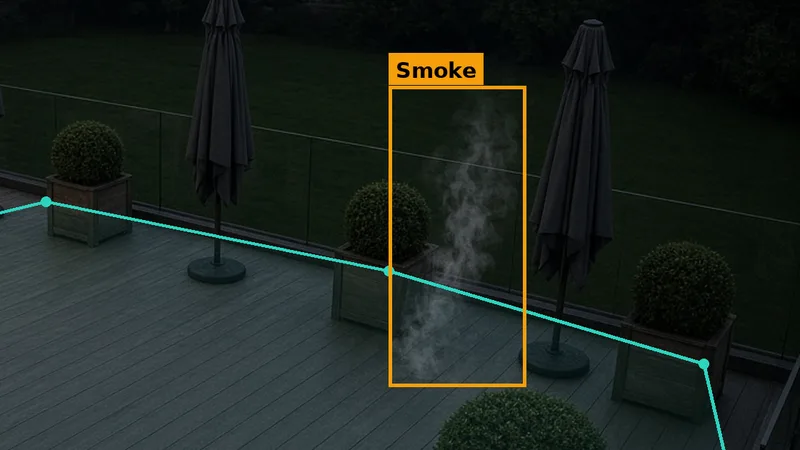
Here is a fictional example. A 60-bedroom hotel on the edge of a market town has a garden terrace with grey decking outside its restaurant, where guests smoke in the evening. The bar closes at 23:00, and a zone over the terrace is armed from then until 07:00. At 01:20, a cigarette end that fell through a gap in the decking hours earlier starts to smoulder against the dry leaves underneath, and thin grey smoke rises beside a planter.
The camera sees it. The night porter's phone shows an alert: smoke on the terrace, with a snapshot and a short clip. The porter looks at the clip, sees smoke rising from the decking a few metres from the restaurant doors, and follows the fire plan: calls 999, takes an extinguisher and checks from a safe distance, and lets the duty manager know. Nobody inside the hotel would have known until the fire reached the building. The next day, the manager moves the smoking area off the decking to a paved spot with a metal ash bin, adds an end-of-night check of the terrace to the closing routine and updates the fire risk assessment.
Where Woodcock AI fits
Woodcock AI adds smoke and flame detection, and people and vehicle detection, to the cameras a hotel already has. You draw polygon zones over exactly the areas to watch, such as the terrace, the bin store, the roof plant or the marquee, set when each zone is armed, and choose who gets the alerts. The system is self-learning, getting better on each camera over time. Detection runs on an edge server on site or on a cloud server, so there is no need to replace cameras. It has been developed over years and is in use on real sites today.
Ways to start
The easiest first step is a site assessment: we look at what your existing cameras see, by day and after dark, and show where zones would help. You can also ask for a live test on your cameras, connecting two or three of them for about a fortnight, so your night team sees real alerts from your own hotel. Or book an on-site demo. There is no commitment to look.
Common hotel fire safety mistakes
Fire inspectors and assessors see the same problems again and again in hotels. Most of them can be found on a walk round, especially at night, and fixed quickly.
- A plan that only works by day. One night porter cannot read the panel, call 999, guide guests and help disabled guests at once.
- Fire doors wedged or damaged. Bedroom and corridor doors propped open, closers disconnected, seals painted over.
- Escape routes used as storage. Housekeeping trolleys, linen bags and furniture from a refurbishment on stairs and corridors.
- Final exits locked at night. Side gates and fire exits secured with keys or fobs that nobody has to hand.
- An assessment older than the building. Written before the refurbishment, the new spa or the extra rooms.
- Kitchen ductwork not cleaned. No record of the last duct clean, or filters thick with grease.
- Bins against the building. Wheeled bins under windows or beside the kitchen door.
- Smoking areas in the wrong place. By a doorway, on timber decking or next to the bin store.
- No plan for deaf or disabled guests. Equipment missing, or the night porter does not know who needs help.
- Too many false alarms. Guests and staff stop taking the alarm seriously.
Hotel fire safety checklist
Use this checklist to review your own hotel. It follows the guidance described above, but your fire risk assessment and your enforcing authority decide what applies to your building.
Assessment and plan
- Fire risk assessment, current, recorded in full, with the assessor named.
- Emergency plan that works at night with the staff on duty.
- Arrangements for disabled and deaf guests, offered at check-in.
- Fire pack and room list by the panel.
Protection
- The right category of fire alarm, loud enough at the bed head, tested weekly and serviced.
- Fire doors on bedrooms and corridors that close and seal.
- Emergency lighting tested monthly and serviced.
- Escape routes and external stairs clear, lit and unlocked from inside.
People
- Induction on the first shift for every member of staff.
- Night staff trained on the panel, the plan and 999.
- Drills and walk-throughs, including night routines.
- Fire action notice in every bedroom.
Everyday risks and outside
- Kitchen suppression, fryer controls and duct cleaning in place.
- Laundry filters cleaned, warm linen spread out.
- Bins in a compound, skips 6 m away, outside well lit.
- Smoking area, heaters and fire pits away from the building.
Sources
- Regulatory Reform (Fire Safety) Order 2005, articles 3, 9, 13, 14, 15, 17, 21, 22 and 32; Building Safety Act 2022, section 156.
- Home Office (GOV.UK), Fire safety risk assessment: sleeping accommodation, Making your small paying guest accommodation safe from fire and means of escape for disabled people.
- Scotland: Fire (Scotland) Act 2005, section 53; Fire Safety (Scotland) Regulations 2006; Scottish Government, practical fire safety guidance for existing premises with sleeping accommodation.
- Northern Ireland: Fire and Rescue Services (Northern Ireland) Order 2006; Fire Safety Regulations (Northern Ireland) 2010.
- Smoke-free (Exemptions and Vehicles) Regulations 2007.
- Incidents: London Fire Brigade, hotel fire in Fulham (August 2026). ICO, guidance on video surveillance.
We have summarised these sources in our own words and checked them on 3 November 2026. This guide is general information, not legal or fire safety advice for your hotel. Fire safety law differs between England, Wales, Scotland and Northern Ireland. Your fire risk assessor, your local fire and rescue service and your insurer can advise on your premises.
Your alarm covers the inside. Who watches the terrace at night?
Book a site assessment and we will look at what your cameras see by day and after dark, and show where smoke, flame and people zones would help over the terrace, the service yard, the roof plant and the grounds, or ask for a live test on your cameras.
Related pages
Frequently asked questions
What are the fire safety regulations for hotels in the UK?
In England and Wales, the Regulatory Reform (Fire Safety) Order 2005 requires the responsible person, usually the hotel operator, to carry out and record a fire risk assessment, put fire precautions in place, plan for emergencies, train staff and keep everything maintained. It is enforced by the local fire and rescue service. The Home Office guide for sleeping accommodation explains what this usually means for hotels. Scotland and Northern Ireland have their own fire safety laws with similar duties.
Who is responsible for fire safety in a hotel?
The responsible person is the employer, or the person in control of the premises, which for most hotels is the operating company. Where a building is owned by one company and run by another, or shares parts with other businesses, each person with control of part of it has duties and must cooperate. Day-to-day tasks can be given to managers and staff, but the legal responsibility stays with the responsible person.
What fire alarm does a hotel need?
The fire risk assessment decides, but the Home Office guide says most hotels need an automatic fire detection and alarm system to BS 5839-1, usually at least Category L2, with detectors in bedrooms, corridors and high-risk rooms. It must be loud enough to wake guests, typically 75 dB(A) at the bed head, and larger hotels often use addressable panels and staged or voice alarms. Small B&Bs may use interlinked domestic alarms instead.
How should a hotel plan fire evacuation at night?
Plan for the quietest time, when guests are asleep and only one or two staff may be on duty. The plan should say who reads the panel, who calls 999, how guests are warned and guided out, how disabled and deaf guests are helped, and how everyone is counted using the room list. Test it with night staff through drills and walk-throughs, and record what you learn.
Do B&Bs and holiday lets need a fire risk assessment?
Yes. Anyone who lets paying guests stay must carry out and record a fire risk assessment. For small premises with up to 10 guests on no more than two floors, the Home Office guide on small paying guest accommodation sets out a simpler approach, including interlinked smoke alarms, doors that close at night, exits that open without a key and a fire plan for guests.
Can AI on CCTV take the place of a hotel fire alarm?
No. The fire alarm is required by the fire risk assessment and is what warns everyone inside. AI video detection on existing cameras covering terraces, service yards, roofs and grounds can watch for visible smoke and flame, and for people at night, and send an alert with a clip to the night porter and duty manager. It is an extra layer only, and cameras should never be placed in guest rooms or bathrooms.
Last reviewed 3 November 2026